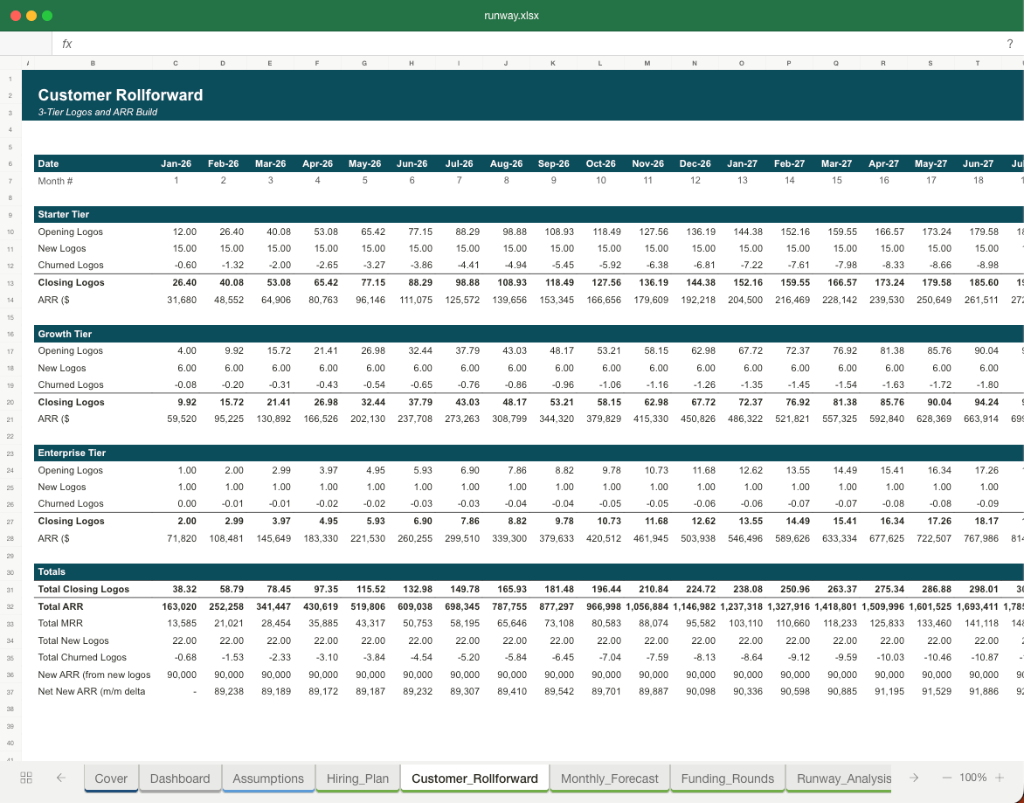
 Squire Financial Model
Fintech Startup Financials (Free Excel Download)
Vertical SaaS + payment processing platform built exclusively for barbershops and men's salons.



professionals from Deloitte
Used by professionals from






About this model
Squire is a vertical SaaS and payment-processing platform built for barbershops and men’s salons. Its operating system supports appointments, point of sale, customer management, and the financial workflows of a service business.
The company earns recurring subscription revenue from shops and a take rate on payments processed through its Commander POS. As a shop matures on the platform, both software ARPU and payment volume can expand, creating strong cohort dynamics.
The model should forecast active shops, subscription ARPU, retention, appointments or transactions per shop, average ticket, and gross payment volume. Apply a net payment take rate, then separately model hardware, payment processing, support, and sales costs to show blended SaaS and payments margin.
A turnkey financial model
Live formulas, no hardcoded values
Outputs are driven by live formulas, so the workbook updates from its assumptions instead of relying on hardcoded results.
All assumptions in one tab
Inputs are clearly marked in the Assumptions tab and separated from calculations, making it clear what to change and what to leave intact.
Statements always balancing
For integrated-statement models, the balance sheet, cash flow, and supporting schedules tie through properly.
Distinct schedules for clarity
Debt, working capital, taxes, and cash flow can get messy quickly. We group calculations in clear schedules, not across disconnected tabs.
No hidden macros or external links
There are no unexplained external workbook links or macros to undermine auditability or portability.
Changes flow through the model
Update a key driver and see the impact carry through the forecast, financing, and return outputs. We never use hardcoded numbers in formulas.
About Squire
getsquire.com
How to build a detailed financial model for Squire
A complete walkthrough of the business, drivers, and assumptions behind the downloadable Squire model - distilled from its pitch deck and publicly available information.
Product & value proposition
"First one-stop-shop for barbers and men's salons" (slide 3). Core modules:
- CRM, POS, Analytics, Booking, Payment, Discovery (slide 3).
- Commander Management System: tablet POS hardware + card reader + web/mobile dashboard (slide 5).
- Consumer White Label App: end-client booking, payment, tipping (slide 6).
- Key pitch: replaces 9+ fragmented apps (Instagram, Yelp, Mailchimp, StyleSeat, Boulevard, Clover, ADP Mobile, Self Employed, QuickBooks) with a single Squire app (slide 4).
Revenue model
Two explicit revenue streams identified:
- SaaS subscription ("Vertical SAAS", slide 5) - recurring monthly fee per shop (ARR metric used throughout; specific subscription price not disclosed in deck).
- Payment processing ("+ Payment Processing", slide 5) - take-rate on transactions processed through the Commander POS and consumer app. Consumer-side transaction sample visible in app mockup (slide 6): service $20 ("Buzz"), tip 20% = $4, taxes & fees $1, total $25. Suggests low-ATV per haircut service. Subscription pricing likely tiered by barber seat count or feature tier, typical of vertical SaaS for SMB salons; exact pricing not disclosed. Payment take-rate likely in the 2–3% range, consistent with SMB vertical SaaS payment processing peers (Toast, Mindbody, etc.).
Traction & metrics
Slide 8 ("Last 12 Months", Aug 2019 – Jul 2020):
- Two bar charts: New Shops added per month and New ARR Bookings ($K) per month.
- Both charts show strong sequential growth from May–Jul 2020 after a sharp dip in Apr 2020 (COVID lockdown).
- "June and July%+ YoY Growth!" - specific % blacked out.
- Apr 2020 New Shops bar is near-zero (lockdown). May–Jul 2020 shows recovery spike above prior year levels.
- Specific bar values are redacted (black boxes); direction is unambiguously up-and-to-the-right with COVID dip. Slide 11 ("Shop Growth" - longer-term view, 4 bars each):
- New Shops: 4 periods shown, growing from a small base to a materially larger bar. Exact values redacted.
- New ARR Bookings ($M) - note unit is $M not $K as in slide 8, implying meaningful scale by latest period. Values redacted. Slide 9 (COVID-19 Response):
- Waived all subscription fees until December 2020.
- Launched Online Gift Cards for revenue during closure.
- Released COVID Waiver Forms and Virtual Waiting Room features.
Unit economics
Slide 10 ("Shops Grow Over Time"):
- Net Retention line chart by cohort tenure (3 Mo, 6 Mo, 9 Mo, 12 Mo, 15 Mo+): upward-sloping - shops expand revenue over time (net retention > 100% implied by slope). Specific % values redacted.
- Monthly ARPU line chart by cohort tenure (3 Mo, 6 Mo, 9 Mo, 12 Mo, 15 Mo+): upward-sloping - ARPU grows as shops mature on platform. Specific $ values redacted.
No CAC, LTV, or gross margin figures disclosed.
Competition / moat
Slide 4: competitive moat framed as consolidation - barbershops without Squire need 9+ apps; with Squire, they need 1. Named competitors visible in "without" screenshot: Instagram, Yelp, Mailchimp, StyleSeat, Boulevard, Clover, ADP Mobile, Self Employed, QuickBooks. Moat levers implied: data network (CRM + booking + payments in one system), switching cost (all data locked in), consumer discovery marketplace (demand-side stickiness).
Team & funding ask / use of funds
Slide 7:
- Songe LaRon - CEO; Yale Law School, Skadden (YC alumni marker shown).
- Dave Salvant - President; Wisconsin School of Business, J.P. Morgan (YC alumni).
- YC batch indicated (Y logo).
- Advisors / press mentions: BarberEvo, The Rise of Squire, Richie the Barber, Grey Matter LA, Brittany Fitapelli, Robert Braid, Zach Ramsey, Josh O'Meara-Patel.
Recommended financial model
- Archetype + why: Vertical SaaS ARR model with embedded payments revenue layer. Squire has two distinct revenue streams (subscription + payment take-rate) that compound together as shops mature. The cohort expansion dynamic (rising Net Retention + rising ARPU over tenure) makes a cohort-based ARR model the right spine, with a separate payments GMV → revenue line.
- Forecast horizon & granularity: 3 years (2020–2022), monthly for Year 1, quarterly for Years 2–3. Monthly granularity needed to capture COVID recovery shape and new shop onboarding cadence visible in slide 8.
- Key drivers & assumptions:
- New shops added per month - direction and shape visible from slide 8 bar chart (strong May–Jul 2020 recovery); specific unit counts redacted → starting from ~30–50 new shops/month at peak based on bar chart relative sizing; refine with real data.
- Churn rate (gross) ~5% monthly at cohort month 1, declining; net retention chart implies gross churn is more than offset by expansion.
- Net Revenue Retention % shown as upward-sloping by cohort on slide 10; specific values redacted → exits 15 Mo+ cohort at ~110–120% NRR, consistent with vertical SaaS expansionary dynamics.
- Monthly ARPU by cohort age upward-sloping; starting $ redacted → ~$200–$350/month at month 3, growing to ~$400–$600/month at 15 Mo+, based on industry comps and payment processing supplement.
- Payment GMV per shop per month ~$8,000–$15,000 based on haircut ATV ~$25 × ~400–600 appointments/month for a small shop.
- Payment take-rate 2.5%, consistent with vertical SaaS SMB payment peers.
- SaaS subscription fee ~$150–$200/month per shop base fee; not disclosed in deck.
- COVID subscription fee waiver all fees waived through Dec 2020 → model should zero-out subscription revenue Apr–Dec 2020 for existing shops; payment revenue partially recovers as shops reopen May–Jul 2020.
- COGS / gross margin SaaS gross margin ~70–75%; blended gross margin lower (~50–60%) once payment processing COGS included.
- S&M / onboarding cost per shop (CAC) ~$500–$1,500; not in deck.
- Scenarios (Base / Bull / Bear - which variables flex):
- Base: New shops follow observed Aug-19–Jul-20 trajectory; ARPU expansion per slide 10 shape; NRR ~115%.
- Bull: Post-COVID acceleration sustains; NRR reaches 125%; payment GMV per shop higher end of range.
- Bear: COVID second wave / re-lockdowns suppress new shop adds through H1 2021; subscription fee waivers extend; NRR ~100%.
- Required sheets / outputs:
- Assumptions - all drivers with / tags and toggle for scenarios.
- Shop Cohort Model - monthly cohort waterfall: new shops added, churned, surviving; ARPU by cohort age → MRR/ARR per cohort.
- Payments Revenue - GMV per active shop × take-rate → payments revenue.
- Revenue Bridge - SaaS subscription + payments = total revenue; COVID fee-waiver adjustment line.
- P&L Summary - Revenue, COGS (split SaaS / payments), Gross Profit, S&M, R&D, G&A, EBITDA.
- KPI Dashboard - Total Active Shops, MRR, ARR, Blended ARPU, NRR, Gross Margin, Payment GMV.
Frequently asked
Is the Squire financial model free?+
Yes. The Squire model is a free Excel (.xlsx) download with live formulas. Sign up with your email and the workbook is yours to keep, review, and edit.
What's included in the model?+
A 5-year monthly forecast with P&L, cash flow and runway, valuation (exit multiple plus a DCF cross-check), MOIC/IRR returns, and unit economics, with live formulas throughout.
How was this model built?+
It was built from Squire's pitch deck and publicly available information, then structured to investment-banking standards as a fully editable Excel model.
Can I change the assumptions?+
Yes. You can change assumptions and the live formulas will recalculate in the downloadable Excel model.
Have more financial modelling questions? Contact us

Created by ex-finance professionals
Hey, I’m Alex and I created Finamodel.
Over my years in the finance industry I kept building the same models over and over again. Same structure, same assumptions, different logo. So I started building frameworks to turn them into clean, reusable templates.
Every model here is one I’d actually use for a client, and I personally vet each one before it goes up.
I’m not an expert in every industry, but I’ve built enough models to know what belongs in one. And when something is completely foreign to me, I reach out to my network for experts to work on our models with us.
Having a template library on hand cuts a first build from hours to minutes.
Need help finding your model? You’ll find me in the Finamodel app!
Other Fintech Startup Financial Models
Browse another startup in the same category.
Acin
SaaS and data subscription network for operational risk management at Tier 1 financial institutions

Ageras Group
B2B SME ecosystem - marketplace connecting SMEs with accountants + cloud accounting/payroll software + embedded financial services (lending, factoring, banking)

Airbase
Unified non-payroll spend management platform (corporate cards, AP/bill pay, expense reimbursement, approval workflows) for mid-market companies.

Altruist
Vertically integrated all-in-one platform for registered investment advisors (RIAs) - combining custodial, portfolio management, practice management, and client acquisition tools.
Amenitiz
All-in-one hotel management SaaS platform ("Shopify for hotels") for independent hoteliers - PMS, booking engine, channel manager, website builder, payments, and AI-driven revenue management.

Anrok
SaaS sales tax compliance platform - nexus monitoring, calculation, registration, filing, and remittance - built specifically for SaaS companies.
Arrival
Arrival is an EV manufacturer of commercial vans and buses using proprietary Microfactories and vertically integrated components, going public via SPAC merger with CIIG Merger Corp.

AtoB
AtoB is building financial infrastructure for commercial fleets, starting with a no-fee Visa fleet card for fuel and expanding into payroll, BNPL, and international.