STStan.store Financial Model
Marketplace Startup Financials (Free Excel Download)
All-in-one monetization platform for knowledge creators - replaces 10+ point solutions (Calendly, Stripe, Kajabi, Venmo, etc.) with a single storefront.



professionals from Deloitte
Used by professionals from






About this model
Stan is an all-in-one storefront for knowledge creators to sell coaching, downloads, courses, memberships, community access, and messaging services. It consolidates fragmented tools into a single creator link that can be launched quickly and used as a creator's commercial home.
In its first three months, 25 beta creators generated $30,000 of GMV, rising from $3,100 in month one to $18,100 in month three, with more than 500 organic waitlist signups. The core model is a take rate on payments processed through creator stores rather than a conventional SaaS subscription.
The model builds GMV from active creators, products per creator, buyer conversion, average order value, and recurring memberships, then applies Stan's take rate. Creator activation, audience-led acquisition, payment costs, creator retention, and product mix determine net revenue and the pace of platform growth.
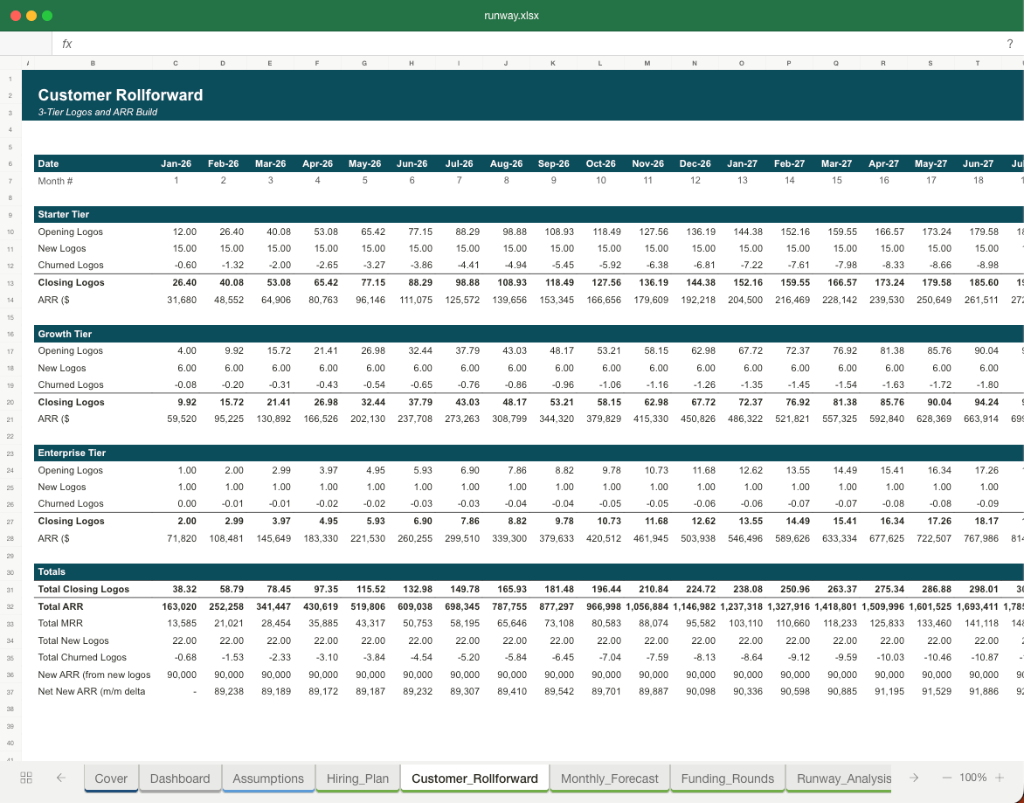
A turnkey financial model
Live formulas, no hardcoded values
Outputs are driven by live formulas, so the workbook updates from its assumptions instead of relying on hardcoded results.
All assumptions in one tab
Inputs are clearly marked in the Assumptions tab and separated from calculations, making it clear what to change and what to leave intact.
Statements always balancing
For integrated-statement models, the balance sheet, cash flow, and supporting schedules tie through properly.
Distinct schedules for clarity
Debt, working capital, taxes, and cash flow can get messy quickly. We group calculations in clear schedules, not across disconnected tabs.
No hidden macros or external links
There are no unexplained external workbook links or macros to undermine auditability or portability.
Changes flow through the model
Update a key driver and see the impact carry through the forecast, financing, and return outputs. We never use hardcoded numbers in formulas.
About Stan.store
How to build a detailed financial model for Stan.store
A complete walkthrough of the business, drivers, and assumptions behind the downloadable Stan.store model - distilled from its pitch deck and publicly available information.
Product & value proposition
- Creator gets a personal "Stan store" link (e.g., stanwith.me/username) in 5 minutes.
- Storefront sections: 1-on-1 coaching bookings, digital downloads, e-courses, memberships/subscriptions, community, text-with-me.
- Replaces fragmented stack (Calendly + Stripe + Kajabi + PayPal + Discord etc.).
- Case study: Tat Londono went from $1K–$1.5K/mo + $300 subscription costs → $4K/mo ($2K recurring) + $0 subscription costs after Stan.
- Prospect funnel 2x'd, 20% increase in conversion, all coaching bookings automated.
- Vision: "Shopify for Creators" - future modules include Tax & Back Office, BI & Analytics, CRM, Brand Network, NFTs.
Revenue model
- Primary: Transaction fee / take rate on GMV processed through Stan storefronts. Implied by the removal of third-party fees (Stripe 3%, PayPal 3%, Kajabi $199/mo) as a selling point; exact Stan take rate not stated in deck.
- Secondary (implied): SaaS subscription fee - slide 3 shows creator paying $6/mo eCourse and $199/mo Kajabi; Stan replaces these at $0 subscription cost, suggesting Stan's model is fee-on-GMV rather than subscription, at least at this stage.
- Channels: Word-of-mouth / organic (500+ waitlist via WoM); community-driven distribution cited as a use-of-funds priority.
Traction & metrics
All figures are 12 weeks post-launch, no paid marketing:
- Month 1 GMV: $3,100
- Month 2 GMV: $7,000
- Month 3 GMV: $18,100 (of which $2.2K is recurring/subscription revenue)
- Total GMV across 25 beta testers: $30K
- Organic waitlist signups: 500+
- PMF signal: 54% "Very Disappointed" (Superhuman benchmark)
- Average GMV per beta tester: ~$1,200 over 3 months ($30K / 25)
Unit economics
- CAC: $0 during beta (100% organic / WoM); no paid CAC disclosed.
Competition / moat
- Competitive positioning: Stan claims top-right quadrant on "Making Money" (y-axis) vs. "Owning Your Brand & Audience" (x-axis) - uniquely combining both.
- Named competitors: Cameo, Patreon, Kajabi, Teachable (high money / low brand ownership), Squarespace, Linktree, Discord (high brand / low money).
- Moat articulated as: "for creators, by creators" brand; founder is own customer (John Hu, @jayhoovy, 41.7K followers, ex-Goldman Sachs / Norwest VP / Stanford GSB); community-driven distribution flywheel.
Team & funding ask / use of funds
- Founder: John Hu (@jayhoovy) - Goldman Sachs, Norwest Venture Partners, Stanford Business. Self-described as his own customer (creator with 41.7K TikTok followers).
- Raising: $5M.
- Use of proceeds: (1) Build a diverse founding team; (2) Establish "for creators, by creators" brand; (3) Invest in community-driven distribution.
- No valuation, no existing investors, no co-founders disclosed.
Recommended financial model
- Archetype + why: Marketplace GMV model with take-rate revenue layer. Stan processes transactions on behalf of creators; revenue = GMV × take rate. This is the Shopify / Gumroad model: creator count drives GMV, platform clips a % on each transaction. A SaaS subscription tier may be layered in later but is not the current monetization. Model should be a 3-year monthly P&L with GMV as the primary top-line driver.
- Forecast horizon & granularity: 36 months (monthly), splitting into beta → launch → growth phases. Monthly cohort tracking of creator additions.
- Key drivers & assumptions:
- Creators on platform (monthly new adds): Month 3 beta = 25; launch ramp: +50/mo in month 4, scaling to +500/mo by month 12 as WoM flywheel and $5M spend kicks in.
- Average GMV per creator per month: ~$600/mo (implied: $30K GMV / 25 creators / ~2-month average tenure); stabilizes around $800–$1,200/mo at scale as creators mature.
- Take rate: 5% of GMV - consistent with Gumroad (8.5%), Teachable (5–10%), Shopify Payments (~2.9% + apps); to be confirmed; model this as a sensitivity variable.
- Churn (creator monthly): 3–5% monthly (creator tools category sees moderate churn; better retention if recurring revenue share is high).
- Recurring GMV mix: 12% of Month 3 GMV was recurring ($2.2K of $18.1K); grows to 30–40% at steady state as more creators sell subscriptions/memberships.
- COGS: payment processing (2.9% of GMV passed through), hosting, and support - ~40–50% gross margin on net revenue.
- Headcount: starting ~5 FTEs post-raise, scaling to ~20 by month 24 ($5M runway allows ~18–24 months at $250K–$280K fully-loaded cost per head).
- CAC: $0 during WoM phase; $50–$200 per creator once paid channels open (community-driven model keeps this low).
- Marketing spend: Budgeted from $5M raise; ~30% of raise ($1.5M) toward brand/distribution over 18 months.
- Scenarios (Base / Bull / Bear - which variables flex):
- Bear: Take rate pressure (3%), slow creator ramp (+30/mo), high churn (7%/mo), low GMV/creator ($500/mo).
- Base: 5% take rate, +100/mo creator adds by month 8, 4% churn, $800 GMV/creator/mo.
- Bull: 6% take rate, +250/mo creator adds by month 8, 2.5% churn, $1,200 GMV/creator/mo (aided by viral WoM and influencer founders).
- Required sheets / outputs:
- Assumptions - all drivers in one place with scenario toggle (Base/Bull/Bear).
- Creator Cohort Model - monthly creator adds, churn, active creators, cumulative GMV per cohort.
- Revenue Build - active creators × avg GMV/creator × take rate = net revenue; separate recurring vs. one-time GMV.
- P&L - revenue, COGS (payment processing + hosting), gross profit, operating expenses (headcount, marketing, G&A), EBITDA.
- Headcount Plan - by function (engineering, sales/community, G&A).
- Cash & Runway - starting from $5M raise, monthly burn, months of runway.
- Dashboard - KPI summary: active creators, GMV, take rate revenue, gross margin %, monthly burn, runway.
Frequently asked
Is the Stan.store financial model free?+
Yes. The Stan.store model is a free Excel (.xlsx) download with live formulas. Sign up with your email and the workbook is yours to keep, review, and edit.
What's included in the model?+
A 5-year monthly forecast with P&L, cash flow and runway, valuation (exit multiple plus a DCF cross-check), MOIC/IRR returns, and unit economics, with live formulas throughout.
How was this model built?+
It was built from Stan.store's pitch deck and publicly available information, then structured to investment-banking standards as a fully editable Excel model.
Can I change the assumptions?+
Yes. You can change assumptions and the live formulas will recalculate in the downloadable Excel model.
Have more financial modelling questions? Contact us

Created by ex-finance professionals
Hey, I’m Alex and I created Finamodel.
Over my years in the finance industry I kept building the same models over and over again. Same structure, same assumptions, different logo. So I started building frameworks to turn them into clean, reusable templates.
Every model here is one I’d actually use for a client, and I personally vet each one before it goes up.
I’m not an expert in every industry, but I’ve built enough models to know what belongs in one. And when something is completely foreign to me, I reach out to my network for experts to work on our models with us.
Having a template library on hand cuts a first build from hours to minutes.
Need help finding your model? You’ll find me in the Finamodel app!
Other Marketplace Startup Financial Models
Browse another startup in the same category.

Acquco
Amazon brand aggregator - acquires third-party Amazon seller businesses at attractive multiples, then scales them via proprietary growth playbooks and technology.
Arive
Premium q-commerce app delivering lifestyle and branded products in under 30 minutes across German cities.

Audience Town
Vertical data and advertising platform targeting home movers across the entire home journey - pre-move through post-move.

AudioMob
Non-intrusive in-game audio ad platform bridging music/brand advertisers to mobile game publishers.

Authoritive
Two-way messaging platform that turns creator expertise into scalable, push-delivered learning experiences via SMS/WhatsApp.

Avo
Building amenity and office perk platform delivering same-day grocery/pantry/goods to residential and commercial tenants via a white-label marketplace.
beehiiv
Newsletter platform for creators to build, grow, and monetize email audiences - SaaS subscription + native ad network revenue.
Borzo
Global same-day logistics marketplace connecting B2B merchants with crowdsourced couriers for last-mile delivery