 Supercast Financial Model
Marketplace Startup Financials (Free Excel Download)
SaaS platform that enables podcasters to monetize via paid subscription tiers, replacing or supplementing ad revenue with recurring listener subscriptions.



professionals from Deloitte
Used by professionals from






About this model
Supercast gives podcasters the tools to sell paid subscriptions through private RSS feeds. It handles payments, subscriber access, podcast hosting, landing pages, and analytics, allowing creators to offer exclusive or ad-free content across the podcast apps listeners already use.
The platform reported $4,000 of MRR, $84,000 of cumulative or period revenue, and subscriber counts trending toward 2,000 in the cited dashboard. Podcasters set their own prices, while Supercast's commercial model is a platform fee or revenue share on subscription GMV.
The model builds subscriber GMV from podcaster accounts, listeners per show, conversion, monthly price, and churn, then applies a take rate to derive net revenue. Podcaster acquisition, show retention, subscriber retention, payment processing, and creator concentration determine the economics of the platform.
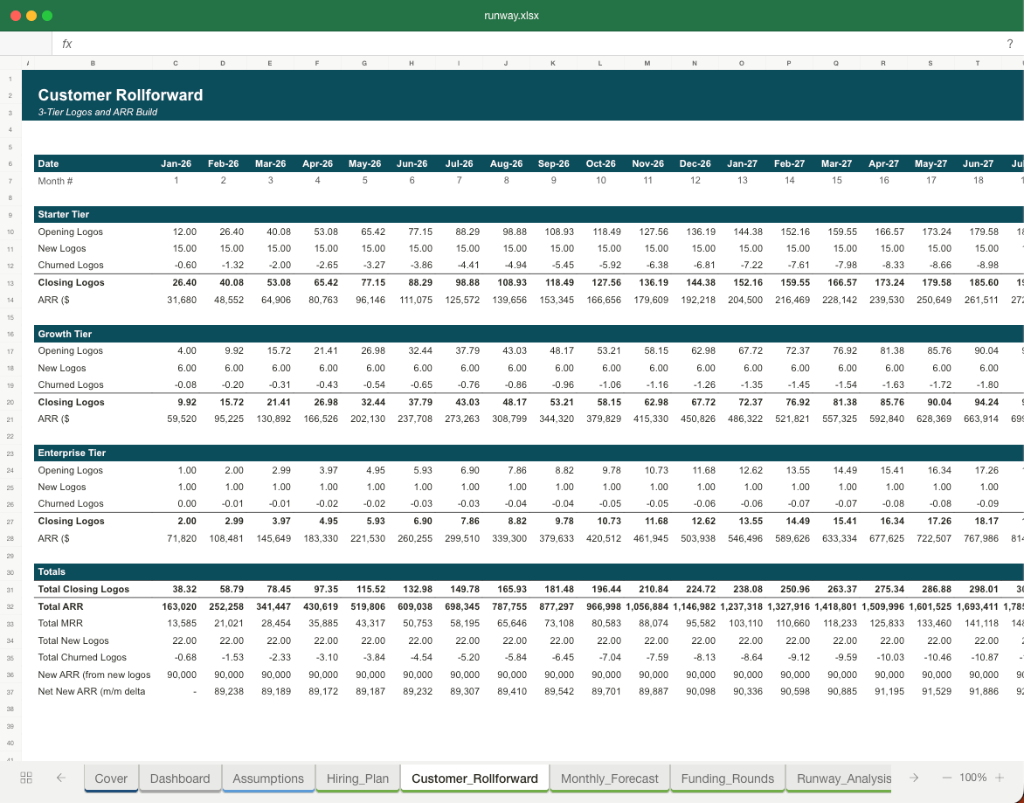
A turnkey financial model
Live formulas, no hardcoded values
Outputs are driven by live formulas, so the workbook updates from its assumptions instead of relying on hardcoded results.
All assumptions in one tab
Inputs are clearly marked in the Assumptions tab and separated from calculations, making it clear what to change and what to leave intact.
Statements always balancing
For integrated-statement models, the balance sheet, cash flow, and supporting schedules tie through properly.
Distinct schedules for clarity
Debt, working capital, taxes, and cash flow can get messy quickly. We group calculations in clear schedules, not across disconnected tabs.
No hidden macros or external links
There are no unexplained external workbook links or macros to undermine auditability or portability.
Changes flow through the model
Update a key driver and see the impact carry through the forecast, financing, and return outputs. We never use hardcoded numbers in formulas.
About Supercast
supercast.com
How to build a detailed financial model for Supercast
A complete walkthrough of the business, drivers, and assumptions behind the downloadable Supercast model - distilled from its pitch deck and publicly available information.
Product & value proposition
- Platform for podcasters to offer premium, ad-free or exclusive content via private RSS feeds to paying subscribers.
- Handles payment processing, subscriber management, unique per-user RSS feeds (prevents feed-sharing), custom landing pages, podcast hosting, and rich analytics.
- Value prop to podcasters: 2x revenue vs. ad-only model. - e.g. a 100K-listener show earns est. $50K/month via subscriptions vs. $25K/month from ads.
- Value prop to listeners: two-tap onboarding, Apple Pay / Google Pay, works with all major podcast apps.
- Analytics product tracks MRR, ARPU, LTV, churn, per-episode engagement - positioning as "SaaS metrics for podcasters."
- Roadmap: email marketing integrations, multi-show/network support, AMA Dashboard.
Market
- 90 million Americans listen to podcasts (30% of population).
- 51% growth in podcast listeners in 2019; 37% annual listener growth since 2013.
- Podcast advertising revenue: $479M (2018) → $679M (2019) → $1.4B (2021E).
- Supercast's thesis: subscription revenue opportunity is larger than advertising - no explicit TAM/SAM/SOM figures given for the subscription side.
- Competitive comparison: Patreon (creator subscriptions, not podcast-native), Glow.fm. Supercast differentiates on RSS-native delivery, per-user analytics, and platform lock-in features.
Revenue model
- Not explicitly stated in the deck. Standard inference: Supercast takes a platform fee or revenue share on subscriber payments collected through the platform.
- Podcasters set their own subscriber price (deck uses $10/month as illustrative example).
- Revenue model = percentage take-rate on GMV (Gross Subscriber Revenue). Typical creator-platform take-rates range 5–15%; for model purposes assume ~10% until confirmed.
- Possibly a SaaS flat fee + lower take-rate, but no pricing page shown in deck.
Traction & metrics
- MRR: $4K
- Cumulative/period Revenue: $84K
- Signup revenue (new subscriber revenue in period): $30K
- Churn revenue: $1.5K
- Subscription count trending toward ~2K subscribers (chart Y-axis labels show 1K and 2K; line approaching 2K)
- Additional dashboard (slide 9) shows: Revenue $45K, Signup $13K, Churn $1K - these appear to be an earlier or different snapshot from the same platform dashboard.
- Named customers: Peter Attia (The Drive), Shane Parrish (Knowledge Project / Farnam Street), Rhonda Patrick (FoundMyFitness).
- Testimonial: Peter Attia "dramatically scaled subscription revenue." - no specific revenue number given.
- Deck dated September 2019; traction data appears to cover May–June 2019 window based on chart axis labels.
Unit economics
- Illustrative model (not Supercast's own actuals): 100K audience × 5% conversion = 5,000 subscribers × $10/month = $50,000/month gross subscriber revenue.
- Industry average conversion rate cited: 5%.
- Typical CPM ranges cited: $18–$50 CPM.
- Supercast's gross margin likely high (SaaS + payment processing pass-through); payment processor fees ~2.9% + $0.30 are a cost of revenue.
Competition / moat
- Direct competitors named: Patreon, Glow.fm.
- Supercast differentiators:
- Private RSS feeds (native podcast app delivery - no separate app required)
- Automated RSS feed security (prevents unlicensed sharing)
- Per-user engagement analytics (unique because of unique feeds)
- Podcast-native business analytics (LTV, churn, ARPU)
- Upcoming: email marketing integrations, multi-show/network support, AMA Dashboard
- Moat strategy: platform lock-in via features podcasters currently do manually; increasing switching costs.
- Backers / partners: Andrew Wilkinson (Metalab, Tiny - investor in Dribbble, Buffer, Superhuman).
Team & funding ask / use of funds
- Jason Sew Hoy - Co-founder & CEO; 12 years creator economy; ex-COO 99designs (acq'd), grew to $65M revenue.
- Aidan Hornsby - Co-founder; founder of DoubleUp; prev Flow, MediaCore (acq'd), SublimeVideo (acq'd).
- Andrew Wilkinson - Chairman; founder Metalab, Tiny, Pixel Union.
- Partners: z1.digital, doubleup.agency, tiny.website.
- Raise: $2MM on a SAFE, $10MM valuation cap, 10% discount.
- Use of proceeds: Product Development (largest slice ~50%), Sales, Marketing.
- Runway: 12–18 months stated.
Recommended financial model
- Archetype + why: SaaS / marketplace GMV model with a take-rate layer. Supercast is a B2B SaaS platform whose economics are driven by (a) number of podcaster accounts, (b) subscribers per podcaster (GMV), and (c) Supercast's platform take-rate on that GMV. The model should track both the podcaster cohort and the end-subscriber GMV, then apply the take-rate to derive Supercast's net revenue. This is analogous to a marketplace ARR model.
- Forecast horizon & granularity: Monthly for Year 1–2 (given early stage and $4K MRR starting point); quarterly thereafter to Year 3–4. Pre-money SAFE implies seed-stage, so 3-year forecast is appropriate. Runway check against $2MM raise is critical output.
- Key drivers & assumptions:
| Driver | Seed value |
|---|---|
| Starting MRR (Supercast platform revenue) | ~$400/month (implied: $4K podcaster GMV × ~10% take-rate) |
| Starting podcaster GMV MRR | $4K |
| Subscriber count | ~1,500–2,000 (approaching 2K on chart) |
| Average subscriber price (podcaster-set) | $10/month |
| Industry conversion rate (audience → subscriber) | 5% |
| Supercast take-rate on GMV | 10% |
| New podcaster accounts added per month (Y1) | 3–5 |
| Average subscribers per podcaster | 300–500 |
| Monthly subscriber churn (end-subscriber level) | ~2–3% |
| Podcaster (account) churn | 5% annually |
| Headcount at close | ~5–8 FTE |
| Monthly burn rate | $100K–$140K |
| Gross margin (Supercast platform) | 70–80% |
- Scenarios (Base / Bull / Bear - which variables flex):
- Base: 3–5 new podcasters/month, 5% audience conversion, 10% take-rate, 2.5% end-subscriber churn
- Bull: faster podcaster growth (8–10/month by Y2), higher average subscriber price ($12–15), lower churn (1.5%)
- Bear: slow podcaster acquisition (1–2/month), higher subscriber churn (4–5%), take-rate compression if competitive pressure forces lower fees
- Required sheets / outputs:
- Assumptions - all drivers above, SAFE terms, headcount plan
- Podcaster Cohort Model - monthly new podcasters added, retention, cumulative active accounts
- GMV Build - active podcasters × avg subscribers × avg price = gross subscriber revenue (GMV)
- Supercast Revenue - GMV × take-rate = net platform revenue; MRR → ARR bridge
- P&L - Revenue, COGS (payment processing ~3%), Gross Profit, OpEx (payroll, product, S&M, G&A), EBITDA, Net Income
- Cash Flow & Runway - starting cash ($2MM raise), monthly burn, months of runway, break-even MRR
- KPI Dashboard - MRR, ARR, podcaster count, total subscriber count, GMV, net revenue, churn %, gross margin
Frequently asked
Is the Supercast financial model free?+
Yes. The Supercast model is a free Excel (.xlsx) download with live formulas. Sign up with your email and the workbook is yours to keep, review, and edit.
What's included in the model?+
A 5-year monthly forecast with P&L, cash flow and runway, valuation (exit multiple plus a DCF cross-check), MOIC/IRR returns, and unit economics, with live formulas throughout.
How was this model built?+
It was built from Supercast's pitch deck and publicly available information, then structured to investment-banking standards as a fully editable Excel model.
Can I change the assumptions?+
Yes. You can change assumptions and the live formulas will recalculate in the downloadable Excel model.
Have more financial modelling questions? Contact us

Created by ex-finance professionals
Hey, I’m Alex and I created Finamodel.
Over my years in the finance industry I kept building the same models over and over again. Same structure, same assumptions, different logo. So I started building frameworks to turn them into clean, reusable templates.
Every model here is one I’d actually use for a client, and I personally vet each one before it goes up.
I’m not an expert in every industry, but I’ve built enough models to know what belongs in one. And when something is completely foreign to me, I reach out to my network for experts to work on our models with us.
Having a template library on hand cuts a first build from hours to minutes.
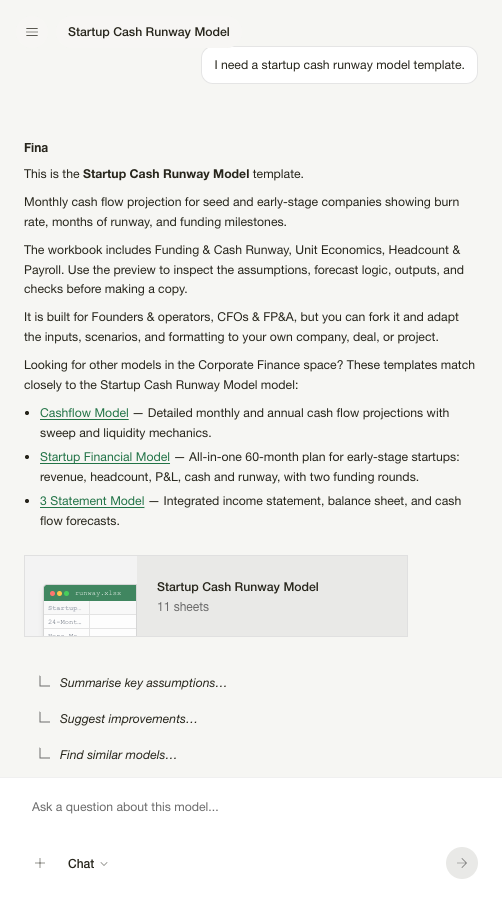
Need help finding your model? You’ll find me in the Finamodel app!
Other Marketplace Startup Financial Models
Browse another startup in the same category.

Acquco
Amazon brand aggregator - acquires third-party Amazon seller businesses at attractive multiples, then scales them via proprietary growth playbooks and technology.
Arive
Premium q-commerce app delivering lifestyle and branded products in under 30 minutes across German cities.

Audience Town
Vertical data and advertising platform targeting home movers across the entire home journey - pre-move through post-move.

AudioMob
Non-intrusive in-game audio ad platform bridging music/brand advertisers to mobile game publishers.

Authoritive
Two-way messaging platform that turns creator expertise into scalable, push-delivered learning experiences via SMS/WhatsApp.

Avo
Building amenity and office perk platform delivering same-day grocery/pantry/goods to residential and commercial tenants via a white-label marketplace.
beehiiv
Newsletter platform for creators to build, grow, and monetize email audiences - SaaS subscription + native ad network revenue.
Borzo
Global same-day logistics marketplace connecting B2B merchants with crowdsourced couriers for last-mile delivery