SUSuperScale Financial Model
AI/ML Startup Financials (Free Excel Download)
AI/ML-powered game optimization platform helping gaming companies unlock unrealized profit from their game portfolios



professionals from Deloitte
Used by professionals from






About this model
SuperScale uses AI and data to optimise mobile-game portfolios. Its SaaS platform supports active game teams, while Legacy Game Management acquires or licenses underperforming titles and takes responsibility for their growth, financing, and operations.
For actively developed games, revenue combines subscription fees with a 25% to 50% share of incremental profit; average contract value is €360,000 ARR and the largest contracts exceed €1 million. Legacy titles can provide 80% to 100% revenue share, but require working capital and separate operating economics.
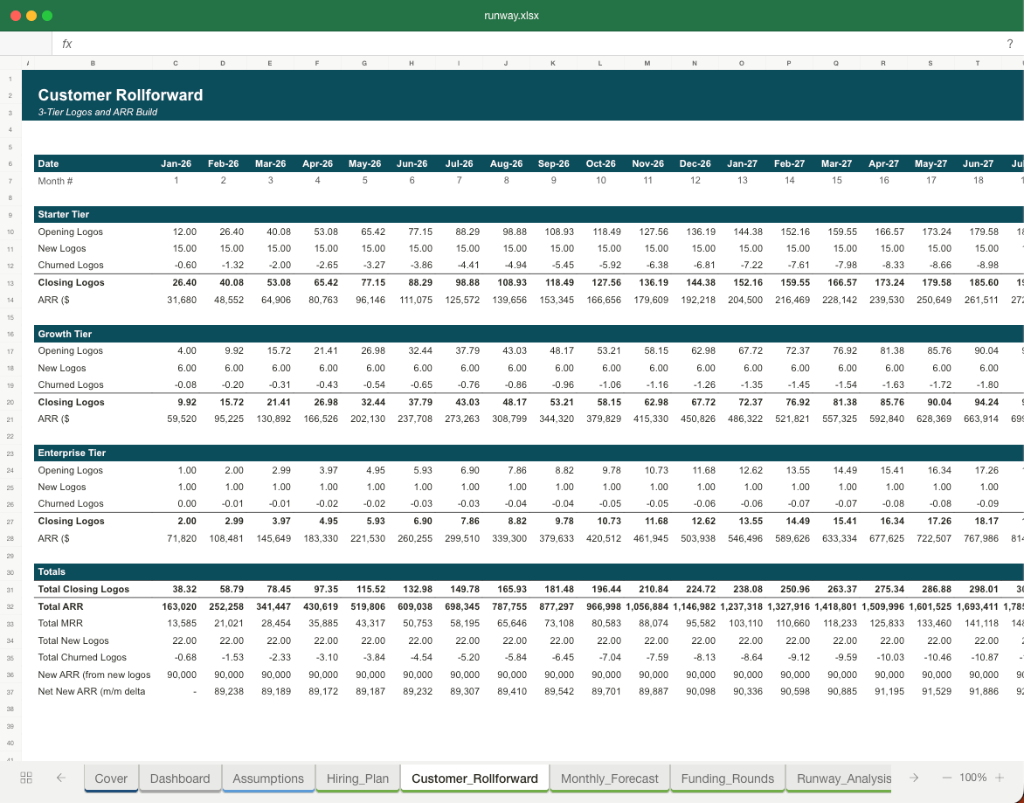
The model runs separate SaaS and legacy-game schedules: contracts, uplift, profit share, acquired-title revenue, and operating investment. It tracks enterprise sales, title pipeline, delivery costs, working capital, R&D and game-operations headcount, gross margin, cash flow, and runway against the €87.7 million 2027 revenue target.
A turnkey financial model
Live formulas, no hardcoded values
Outputs are driven by live formulas, so the workbook updates from its assumptions instead of relying on hardcoded results.
All assumptions in one tab
Inputs are clearly marked in the Assumptions tab and separated from calculations, making it clear what to change and what to leave intact.
Statements always balancing
For integrated-statement models, the balance sheet, cash flow, and supporting schedules tie through properly.
Distinct schedules for clarity
Debt, working capital, taxes, and cash flow can get messy quickly. We group calculations in clear schedules, not across disconnected tabs.
No hidden macros or external links
There are no unexplained external workbook links or macros to undermine auditability or portability.
Changes flow through the model
Update a key driver and see the impact carry through the forecast, financing, and return outputs. We never use hardcoded numbers in formulas.
About SuperScale
superscale.com
How to build a detailed financial model for SuperScale
A complete walkthrough of the business, drivers, and assumptions behind the downloadable SuperScale model - distilled from its pitch deck and publicly available information.
Product & value proposition
- Proprietary data platform that assesses optimization potential of individual games
- AI/ML modules delivering game optimization insights and incremental profit uplift
- Two delivery modes:
- SaaS: enables client in-house growth teams to scale performance with confidence (for actively developed games)
- Legacy Game Management (LGM): SuperScale acquires undervalued legacy titles and takes full operational responsibility for growth, including financing
- Competitive benchmarking and full portfolio optimization are stated differentiators vs. the problem of clients lacking resources and core competence
Market
- Global gaming market 2027: $280bn (Mobile $163bn + PC/Console $117bn)
- Current market (2024): $218.7bn, +8.7% CAGR
- Gaming optimization opportunity: additional $28bn by optimizing existing games
- TAM (optimization): $14bn - defined as 50% success fee of the $28bn market
- SAM: $5.6bn - 40% of TAM representing Americas + EMEA
- SOM: ~$100M (~€88M) - SuperScale's 5-year revenue target
- Mobile target universe (Jan 2023): 5,456 actively developed games (2,729 companies) + 1,994 legacy games (1,525 companies)
Revenue model
SaaS (actively developed games)
- Subscription fee + 25–50% profit share on incremental uplift
- Average contract value: €360k ARR; largest contracts above €1M ARR
- Enterprise sales motion; clients include EA, Zynga, Fingersoft, LEGO, Google Play
Legacy Game Management (LGM)
- Long-term contracts or exclusive IP licenses with 80–100% revenue share to SuperScale
- Average upside per title: €1M/year; pipeline targets: €2M–€4M/year per title
- SuperScale acquires titles and self-finances operations from working capital
5-year revenue split target (2027)
- SaaS: €31.7M (36% of total)
- LGM: €56.1M (64% of total)
- Total: €87.7M
- EBIT target 2027: €43.9M (~50% EBIT margin implied)
Traction & metrics
- First $1M ARR deals closed in 2022
- Enterprise clients: EA, Zynga, Fingersoft, LEGO, Google Play, BoomBit, Nimblebit
- Case Study - SaaS (EA / Zynga / Fingersoft): +$21.3M increase in profitable marketing spend; +$10.2M uplift delivered; +$6M SuperScale revenue share
- Case Study - LGM (Nimblebit): +$2.2M uplift delivered; +$1.5M SuperScale revenue share; +262% overall revenue growth (Nov 2018 to Dec 2022)
- Team: 70 people across UK and Central Europe
- Headcount split: Platform/R&D 17, Professional Services 15, LGM 10, Sales & Marketing 16, Finance & People Ops 12
- SaaS platform and Full Growth Management (FGM) deployed Q4 2021
- VC round and secondary completed 2020
Unit economics
- SaaS average ACV: €360k ARR
- SaaS profit share take-rate: 25–50% of client's incremental profit
- LGM revenue share: 80–100% of acquired title revenue; avg €1M/title/year
- Implied EBIT margin 2027: ~50% (€43.9M EBIT on €87.7M revenue)
- No unit cost data for LGM acquisition cost or marketing spend per client
Competition / moat
- Competitive landscape positions SuperScale as a "Platform + Business impact" player
- Named competitors/comparables: Firebase, Amplitude, Singular, Bango, AppsFlyer, ironSource, AppLovin (tech enablers); N3TWORK, DECA, TiltingPoint (publisher-type)
- SuperScale positions itself above pure tech enablers (more business impact) and above publishers (more platform/tech depth)
- Moat claims: proprietary data platform, benchmarking capability, AI/ML optimization modules, dual-mode delivery
Team & funding ask / use of funds
- CEO & Founder: unnamed in deck (SuperScale founded 2016)
- Veteran investors/advisors: Ivan Trancik (CEO & Founder, Exponea), Paraag Amin CFA (CFO, ex-dotdigital, Goldman Sachs), Guillaume Lautour (Level-Up), Ignacio Monereo (Google, Meta), Brian Chadwick (Spil Games, Devolver)
- Raise: €5M Series A, closing Q2 2023
- Use of funds:
- Platform: €5M over 5 years (including organic) - further platform investment + enterprise sales growth
- M&A + Working Capital (LGM): €2–3M over 2 years for initial legacy game acquisitions
- Follow-on organic: €10M+ over 3–5 years via reinvested profit
- Company states no further external funding required beyond this €5M to achieve targets
Recommended financial model
- Archetype + why: Dual-stream revenue model - SaaS ARR (subscription + profit-share) layered with a Legacy Game Management P&L (IP acquisition + revenue share). Neither pure SaaS nor pure buy-and-build; the model must track both streams separately with different margin and working-capital profiles. Closest to a SaaS + holding company hybrid with an internal M&A portfolio.
- Forecast horizon & granularity: 5 years (2023–2027) annual, consistent with the deck's stated plan. Monthly granularity for Year 1 to track the Series A deployment and initial LGM acquisitions.
- Key drivers & assumptions:
*SaaS stream:*
- Number of active SaaS clients
- Average ACV per client: €360k
- Largest contracts: >€1M ARR
- Profit share take-rate: 25–50% of client incremental profit; model at 35%
- SaaS churn rate
- SaaS gross margin
*LGM stream:*
- Number of legacy titles acquired per year
- Average revenue per acquired title: €1M/year base, pipeline targets €2M–€4M
- Revenue share retained: 80–100%; model at 90%
- Acquisition cost per title
- Working capital required per title before revenue ramp
- LGM gross margin
*Cost base:*
- Headcount: 70 current;
- Capex/platform R&D: €5M over 5 years
- EBIT target 2027: €43.9M
*Market:*
- Gaming market CAGR: +8.7%
- No assumption on mobile vs. PC/console revenue mix needed; SuperScale is platform-agnostic
- Scenarios (Base / Bull / Bear - which variables flex):
- Base: SaaS reaches €31.7M, LGM €56.1M by 2027 per deck targets; ~35% SaaS churn, 3 LGM titles/year
- Bull: Faster LGM acquisition pace (5+ titles/year at higher ACV), higher SaaS ACV mix toward €1M+ deals; EBIT margin 55%+
- Bear: LGM acquisition slower (1–2 titles/year), higher churn in SaaS; revenue ~€40M by 2027; EBIT margin compressed to 30% by cost base
- Required sheets / outputs:
- Assumptions - all drivers toggled for scenario switching
- SaaS Revenue - client cohort build, ACV × clients, profit-share overlay
- LGM Revenue - title-by-title acquisition tracker, revenue ramp per title, rev share
- P&L - consolidated IS with SaaS and LGM segments; EBIT bridge
- Working Capital / Cash - LGM acquisition capex, Platform R&D spend, net cash position
- Headcount Plan - by team (5 teams in deck)
- Summary / Dashboard - KPIs: ARR, LGM titles, EBIT, cash runway
Frequently asked
Is the SuperScale financial model free?+
Yes. The SuperScale model is a free Excel (.xlsx) download with live formulas. Sign up with your email and the workbook is yours to keep, review, and edit.
What's included in the model?+
A 5-year monthly forecast with P&L, cash flow and runway, valuation (exit multiple plus a DCF cross-check), MOIC/IRR returns, and unit economics, with live formulas throughout.
How was this model built?+
It was built from SuperScale's pitch deck and publicly available information, then structured to investment-banking standards as a fully editable Excel model.
Can I change the assumptions?+
Yes. You can change assumptions and the live formulas will recalculate in the downloadable Excel model.
Have more financial modelling questions? Contact us

Created by ex-finance professionals
Hey, I’m Alex and I created Finamodel.
Over my years in the finance industry I kept building the same models over and over again. Same structure, same assumptions, different logo. So I started building frameworks to turn them into clean, reusable templates.
Every model here is one I’d actually use for a client, and I personally vet each one before it goes up.
I’m not an expert in every industry, but I’ve built enough models to know what belongs in one. And when something is completely foreign to me, I reach out to my network for experts to work on our models with us.
Having a template library on hand cuts a first build from hours to minutes.
Need help finding your model? You’ll find me in the Finamodel app!
Other AI/ML Startup Financial Models
Browse another startup in the same category.

AI Rudder
AI Rudder provides multi-lingual conversational AI for B2C customer engagement - automating outbound and inbound voice/chat interactions at scale.

Aisera
AI Service Experience platform that automates IT, HR, and customer service workflows via conversational AI and automation.

Amberscript
AI + human hybrid transcription and subtitling platform targeting B2B customers in Europe

Apheris
Privacy-preserving federated ML platform enabling enterprises to train AI on distributed data without sharing raw data.

Arcane
AI copilot for marketing teams that automates data analysis, reporting, and repeatable tasks via a chat interface and scheduled workflows.

Artisan
AI-powered "digital workers" (branded Artisans) that autonomously perform role-specific tasks - starting with outbound sales - and are delivered as SaaS subscriptions.

Artisan Series A
AI-native B2B SaaS platform consolidating the enterprise software stack with human-like "Artisan" AI employees that automate role-specific workflows

Bigblue
Tech-enabled e-commerce fulfillment platform for European D2C brands - "Amazon-standard" delivery without Amazon.