 Sylvera Financial Model
Fintech Startup Financials (Free Excel Download)
Independent data and ratings infrastructure for voluntary carbon markets



professionals from Deloitte
Used by professionals from






About this model
Sylvera provides independent data and ratings infrastructure for voluntary carbon markets. Its WebApp and API help institutional buyers and market participants evaluate carbon-credit quality without acting as a broker or seller of credits.
The company is a data provider, with commercial relationships based on recurring subscriptions and API licences across the carbon value chain. That independence is central to its positioning: it can rate projects without relying on transaction commissions from the credits themselves.
The model should forecast institutional customers, licence tiers, annual contract value, API usage, expansion, and churn. Bespoke ratings or research can be a separate services line, while data acquisition, analyst capacity, and platform costs determine the operating leverage of the subscription business.
A turnkey financial model
Live formulas, no hardcoded values
Outputs are driven by live formulas, so the workbook updates from its assumptions instead of relying on hardcoded results.
All assumptions in one tab
Inputs are clearly marked in the Assumptions tab and separated from calculations, making it clear what to change and what to leave intact.
Statements always balancing
For integrated-statement models, the balance sheet, cash flow, and supporting schedules tie through properly.
Distinct schedules for clarity
Debt, working capital, taxes, and cash flow can get messy quickly. We group calculations in clear schedules, not across disconnected tabs.
No hidden macros or external links
There are no unexplained external workbook links or macros to undermine auditability or portability.
Changes flow through the model
Update a key driver and see the impact carry through the forecast, financing, and return outputs. We never use hardcoded numbers in formulas.
About Sylvera
sylvera.io
How to build a detailed financial model for Sylvera
A complete walkthrough of the business, drivers, and assumptions behind the downloadable Sylvera model - distilled from its pitch deck and publicly available information.
Product & value proposition
- Sylvera provides independent ratings and data for voluntary carbon credits - analogous to a credit-rating agency (Fitch/Moody's) for carbon offsets
- Core rating output: Sylvera Rating comprising a Carbon Score (e.g. 80%), plus sub-scores for Additionality (4/5), Permanence (3/5), and Co-benefits (5/5)
- Delivery via two channels: WebApp (dashboard interface) and API
- No conflict of interest: Sylvera explicitly does not sell carbon credits itself
- Technology differentiator: satellite-based volumetric tree modelling that claims 4x accuracy improvement over legacy in-field measures and 13x reduction in biomass uncertainty
Market
- TAM: Voluntary carbon market stated as worth $50B by 2030
- Customer segments identified: Project developers, traders & exchanges, offset buyers, asset managers
Revenue model
- Inferred B2B SaaS + API model: WebApp subscriptions and API data licences sold to institutional participants across the carbon value chain
- No transaction / brokerage fee model (explicitly no credit sales)
Competition / moat
- Positioning: conflict-of-interest-free independent data provider; comparable to credit rating agencies in debt markets
- Technology moat: satellite + volumetric tree modelling (4x / 13x claims); partnerships with NASA JPL / Caltech, UCL, World Bank embedded in global carbon accounting standards
- Relationships / people moat: advisory/commercial relationships with IHS Markit, Bain & Co, Princeton, Fitch Ratings, Goldman Sachs, Oxford, Imperial College, Bloomberg, BlackRock, Five AI, Google, NASA JPL
- Named competitors: Not explicitly named; incumbent players implied to have conflicts of interest (they sell credits as well as rating/pricing)
- Chart on slide 7 shows a stacked bar comparing "Baseline in absence of project" vs. "Reported by the project" vs. "Sylvera analysis" for emissions reductions (tCO2), illustrating Sylvera's analysis reduces claimed credits materially - demonstrating methodological rigor but no revenue-relevant numbers readable from image
Team & funding ask / use of funds
- Team: world-class backgrounds in geospatial engineering, data science, finance, ratings, commercial operations, product development
Recommended financial model
- Archetype + why: B2B SaaS / data subscription model (ARR build-up). Sylvera sells recurring data licences and API access to institutional buyers - subscription cohort model is the right frame. Secondary revenue line for bespoke ratings/research can be modelled as professional services. Analogous to Bloomberg / Fitch in carbon.
- Forecast horizon & granularity: 5 years (Year 1–5), monthly for Year 1, annual for Years 2–5. Series A stage warrants monthly burn/runway visibility in Year 1.
- Key drivers & assumptions:
| Driver | Value / Range | Source |
|---|---|---|
| Carbon market TAM by 2030 | $50B | - |
| Revenue model | SaaS subscriptions + API licences | - |
| Customer segments | 4: project developers, traders/exchanges, offset buyers, asset managers | - |
| Average contract value (ACV) per segment | $50K–$200K/yr for institutional buyers (IHS Markit, Goldman, BlackRock tier); rationale: comparable data/ratings SaaS for institutional finance | |
| New logos per year (Year 1) | 10–20; rationale: early institutional sales cycle is long, warm pipeline from named partners | |
| Net revenue retention (NRR) | 110–120%; rationale: data subscription businesses with API usage expand as customers cover more projects | |
| Gross margin | 70–80%; rationale: heavy upfront satellite/model R&D, marginal cost per additional rating is low | |
| Headcount growth | 30–50% YoY from Series A base; engineering + commercial | |
| CAC | $50K–$150K per institutional logo; rationale: enterprise sales cycle | |
| LTV | 5–7x CAC at steady-state NRR | |
| Churn | <10% annual gross churn; institutional data contracts sticky |
- Scenarios (Base / Bull / Bear - which variables flex):
- Base: 15 new logos/yr, $100K ACV, 115% NRR, 75% gross margin
- Bull: Faster market adoption post-2024 regulatory push, 30 logos/yr, $150K ACV, API usage upsells, NRR 125%
- Bear: Slow institutional procurement, voluntary market liquidity crunch, 8 logos/yr, $70K ACV, 105% NRR
- Required sheets / outputs:
- Assumptions (all drivers, toggleable scenarios)
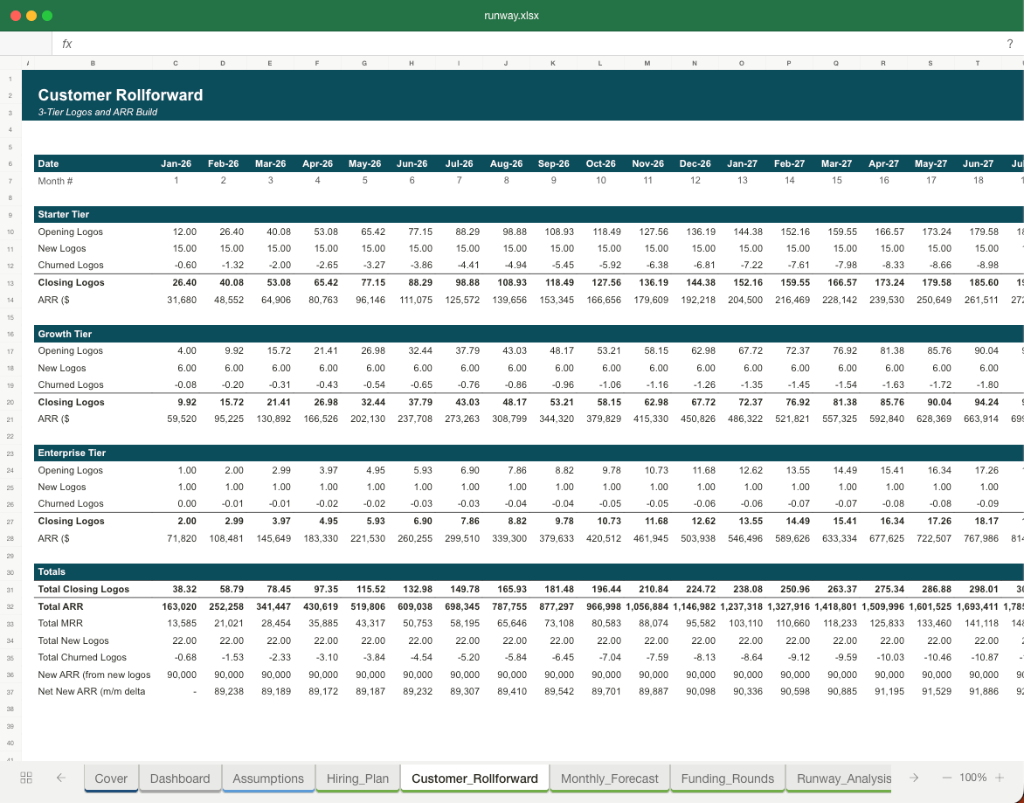
- ARR Waterfall (New ARR, Expansion, Churn, Net New ARR, ending ARR by month/year)
- P&L (Revenue, COGS, Gross Profit, OpEx by function: R&D, S&M, G&A, EBITDA)
- Headcount Plan (by department, tied to S&M and R&D cost)
- Cash & Runway (cash burn, months of runway, Series A proceeds input)
- Unit Economics (CAC, LTV, LTV:CAC, payback period, cohort contribution margin)
- Dashboard (KPI summary: ARR, logo count, NRR, gross margin, runway)
Frequently asked
Is the Sylvera financial model free?+
Yes. The Sylvera model is a free Excel (.xlsx) download with live formulas. Sign up with your email and the workbook is yours to keep, review, and edit.
What's included in the model?+
A 5-year monthly forecast with P&L, cash flow and runway, valuation (exit multiple plus a DCF cross-check), MOIC/IRR returns, and unit economics, with live formulas throughout.
How was this model built?+
It was built from Sylvera's pitch deck and publicly available information, then structured to investment-banking standards as a fully editable Excel model.
Can I change the assumptions?+
Yes. You can change assumptions and the live formulas will recalculate in the downloadable Excel model.
Have more financial modelling questions? Contact us

Created by ex-finance professionals
Hey, I’m Alex and I created Finamodel.
Over my years in the finance industry I kept building the same models over and over again. Same structure, same assumptions, different logo. So I started building frameworks to turn them into clean, reusable templates.
Every model here is one I’d actually use for a client, and I personally vet each one before it goes up.
I’m not an expert in every industry, but I’ve built enough models to know what belongs in one. And when something is completely foreign to me, I reach out to my network for experts to work on our models with us.
Having a template library on hand cuts a first build from hours to minutes.
Need help finding your model? You’ll find me in the Finamodel app!
Other Fintech Startup Financial Models
Browse another startup in the same category.
Acin
SaaS and data subscription network for operational risk management at Tier 1 financial institutions

Ageras Group
B2B SME ecosystem - marketplace connecting SMEs with accountants + cloud accounting/payroll software + embedded financial services (lending, factoring, banking)

Airbase
Unified non-payroll spend management platform (corporate cards, AP/bill pay, expense reimbursement, approval workflows) for mid-market companies.

Altruist
Vertically integrated all-in-one platform for registered investment advisors (RIAs) - combining custodial, portfolio management, practice management, and client acquisition tools.
Amenitiz
All-in-one hotel management SaaS platform ("Shopify for hotels") for independent hoteliers - PMS, booking engine, channel manager, website builder, payments, and AI-driven revenue management.

Anrok
SaaS sales tax compliance platform - nexus monitoring, calculation, registration, filing, and remittance - built specifically for SaaS companies.
Arrival
Arrival is an EV manufacturer of commercial vans and buses using proprietary Microfactories and vertically integrated components, going public via SPAC merger with CIIG Merger Corp.

AtoB
AtoB is building financial infrastructure for commercial fleets, starting with a no-fee Visa fleet card for fuel and expanding into payroll, BNPL, and international.