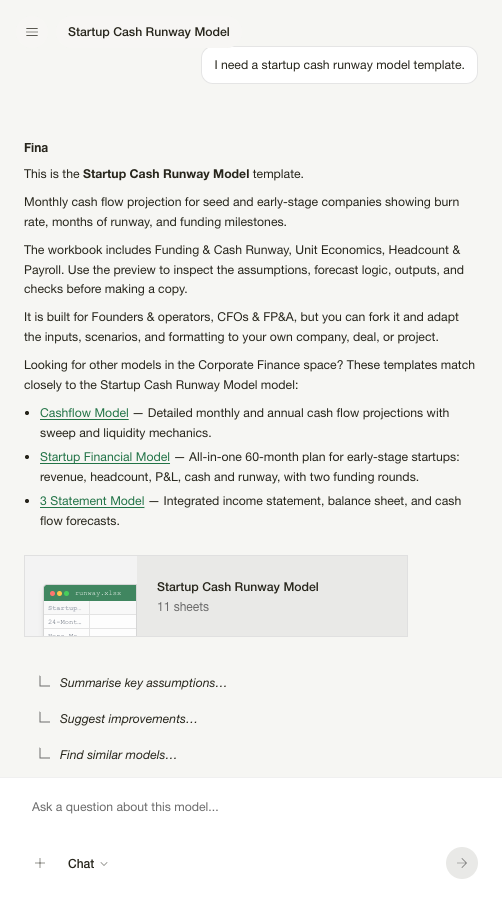
 Symend Financial Model
AI/ML Startup Financials (Free Excel Download)
Digital engagement platform using behavioral science and AI to help enterprise clients recover past-due bills before accounts reach third-party collections



professionals from Deloitte
Used by professionals from






About this model
Symend helps financial institutions engage customers experiencing financial hardship through behavioural science, data, and AI. Its platform supports collections and care workflows designed to improve repayment outcomes while treating customers with more empathy and personalisation.
Enterprise clients can deploy the product across large account populations, then expand into additional customer segments, communications channels, and financial-assistance programmes. Its value depends on accounts served, engagement, resolution outcomes, and the operational cost of delivering those interventions.
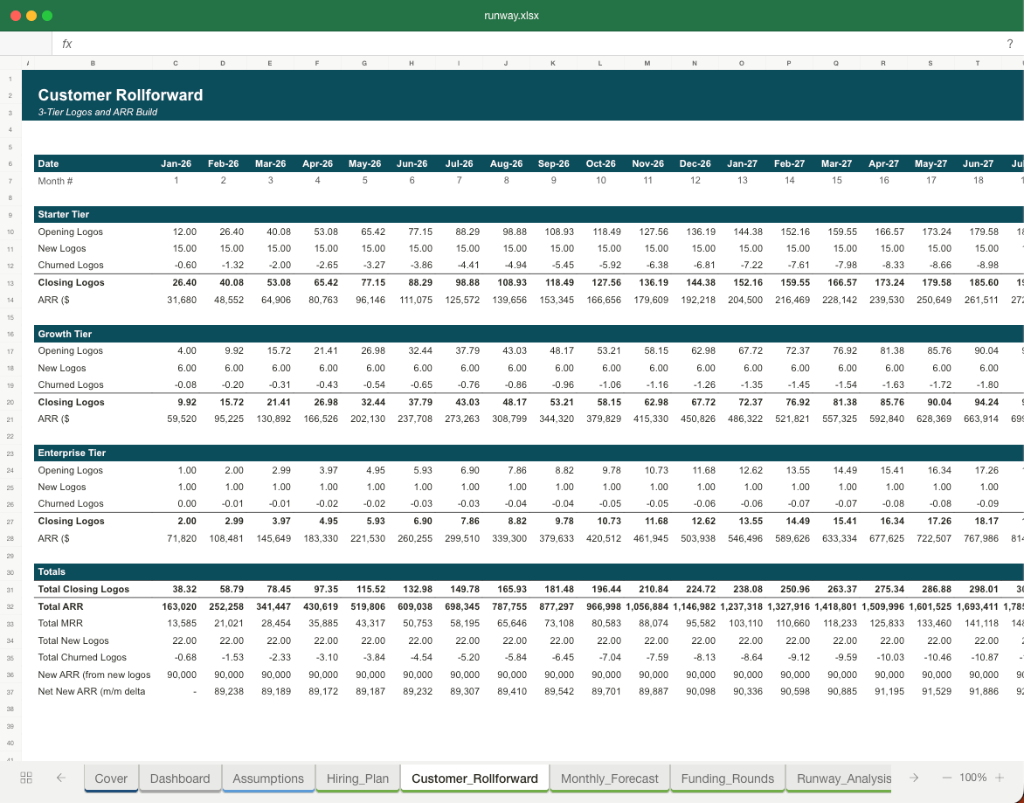
The model uses contract cohorts and accounts served to build recurring and usage-linked revenue. It tests rollout timing, expansion, retention, communication and delivery costs, gross margin, enterprise sales capacity, product and customer-success headcount, cash burn, and runway under outcome-driven adoption scenarios.
A turnkey financial model
Live formulas, no hardcoded values
Outputs are driven by live formulas, so the workbook updates from its assumptions instead of relying on hardcoded results.
All assumptions in one tab
Inputs are clearly marked in the Assumptions tab and separated from calculations, making it clear what to change and what to leave intact.
Statements always balancing
For integrated-statement models, the balance sheet, cash flow, and supporting schedules tie through properly.
Distinct schedules for clarity
Debt, working capital, taxes, and cash flow can get messy quickly. We group calculations in clear schedules, not across disconnected tabs.
No hidden macros or external links
There are no unexplained external workbook links or macros to undermine auditability or portability.
Changes flow through the model
Update a key driver and see the impact carry through the forecast, financing, and return outputs. We never use hardcoded numbers in formulas.
About Symend
symend.com
How to build a detailed financial model for Symend
A complete walkthrough of the business, drivers, and assumptions behind the downloadable Symend model - distilled from its pitch deck and publicly available information.
Product & value proposition
- Digital engagement platform combining behavioral science, predictive analytics, AI/ML, and iterative customer segmentation
- Three pillars: Data Science (predictive analytics, diagnostic AI, data augmentation), Platform (real-time experiments, campaign execution, business logic control), Engagement Science (psychologically-grounded outreach strategies)
- Replaces legacy "one-size-fits-all" collections (voicemails + form letters) with personalized digital outreach calibrated to individual debtor psychology
- Value to client: reduces write-offs, lowers OPEX, improves customer retention, strengthens recession response
- Client ROI claim: 5x to 15x in-year ROI
Revenue model
Not explicitly stated in deck. Inferred from context:
- Likely SaaS platform fee (per-seat or per-account-in-treatment) + success/outcome-based fee component given the ROI framing
- Sold direct to large enterprise (telecom, banks, fintech)
- Multi-year enterprise contracts implied by reference to "in-year ROI" and retention improvement
Traction & metrics
- Over $100MM USD raised to-date
- Serving "the majority of North America's top tier telecom providers"
- Serving multinational financial institutions and "innovative fintech leaders"
- "Engaged millions of customers with past due bills"
- No ARR, MRR, growth rate, customer count, or churn figures disclosed
Unit economics
- Implied strong unit economics: "5x to 15x in-year ROI for its large enterprise clients", but this is client-side ROI not Symend's own margin data
Competition / moat
- Proprietary behavioral science + engagement science methodology
- Data flywheel: platform continuously iterates and optimizes treatment strategies as more data is gathered
- Deep integration with client systems and brand standards
- Strong social proof: serves majority of top North American telcos, TELUS Vendor of the Year 2019
Team & funding ask / use of funds
Team:
- Hanif Joshaghani - Co-Founder & CEO; serial entrepreneur, raised $193M across 4 companies
- Tiffany Kaminsky - Co-Founder & CMO; 10+ years marketing, strategy, client success
- Corey Scobie - CTO; 25+ years global enterprise tech, Fortune 500
- Pehkeong Teh - CPO; 15+ years cloud platforms at Salesforce, Oracle, Microsoft
- Vivian Farris - CPO (People); 20+ years high-growth team building
- Jay McMullan - CRO; 25+ years global high-growth sales
- Aly Khan Musani - CFO; 20+ years international finance & accounting
- Johnny Park - CSO; 10+ years credit originations and collections software
- Matt Lahood - SVP Science & Analytics; 20 years at FICO, advanced analytics
- Dean Skelton - SVP Client Services Engineering; 19+ years software (Canada + Silicon Valley)
Recommended financial model
- Archetype + why: Enterprise SaaS ARR model with outcomes-based revenue overlay. Symend sells to a small number of very large enterprise clients (telcos, banks) under multi-year contracts. The correct model is an ARR/TCV (total contract value) build driven by logo count × ACV, layered with a variable outcomes component (% of recovered balances) if confirmed. Pure ARR mechanics apply; no transactional GMV or DTC dynamics.
- Forecast horizon & granularity: 5-year annual (Years 1–5), with monthly granularity for Year 1–2. Enterprise sales cycles are long; monthly detail matters for cash and headcount planning in early years.
- Key drivers & assumptions:
- Number of enterprise logos (clients) at period start:
- New logo additions per year:
- Average Contract Value (ACV) per logo:
- Contract duration:
- Net Revenue Retention (NRR):
- Logo churn rate:
- Client ROI multiplier (for model validation only): 5x–15x in-year
- Gross margin:
- R&D, S&M, G&A as % of revenue:
- Headcount: 10 named C-suite; total headcount not disclosed
- Total capital raised: >$100MM; runway dependent on burn rate not shown
- Scenarios (Base / Bull / Bear - which variables flex):
- Base: 2–3 new logos/year, NRR 115%, ACV $2M, gross margin 70%
- Bull: 4–5 new logos/year, NRR 125%, ACV $3M, faster expansion into financial institutions
- Bear: 1–2 new logos/year, NRR 105%, ACV $1.5M (pricing pressure or slower telco procurement)
- Required sheets / outputs:
- Assumptions - all drivers with / tags
- ARR Bridge - Beginning ARR + New + Expansion − Churn = Ending ARR
- Revenue Schedule - ACV × logos, broken out by cohort year
- P&L (Income Statement) - Revenue → Gross Profit → EBITDA
- Headcount Plan - by department, driving S&M and G&A
- Cash & Runway - given >$100MM raised, model burn vs. cash balance
- Dashboard - ARR waterfall, NRR trend, logo count, gross margin %, EBITDA margin
Frequently asked
Is the Symend financial model free?+
Yes. The Symend model is a free Excel (.xlsx) download with live formulas. Sign up with your email and the workbook is yours to keep, review, and edit.
What's included in the model?+
A 5-year monthly forecast with P&L, cash flow and runway, valuation (exit multiple plus a DCF cross-check), MOIC/IRR returns, and unit economics, with live formulas throughout.
How was this model built?+
It was built from Symend's pitch deck and publicly available information, then structured to investment-banking standards as a fully editable Excel model.
Can I change the assumptions?+
Yes. You can change assumptions and the live formulas will recalculate in the downloadable Excel model.
Have more financial modelling questions? Contact us

Created by ex-finance professionals
Hey, I’m Alex and I created Finamodel.
Over my years in the finance industry I kept building the same models over and over again. Same structure, same assumptions, different logo. So I started building frameworks to turn them into clean, reusable templates.
Every model here is one I’d actually use for a client, and I personally vet each one before it goes up.
I’m not an expert in every industry, but I’ve built enough models to know what belongs in one. And when something is completely foreign to me, I reach out to my network for experts to work on our models with us.
Having a template library on hand cuts a first build from hours to minutes.
Need help finding your model? You’ll find me in the Finamodel app!
Other AI/ML Startup Financial Models
Browse another startup in the same category.

AI Rudder
AI Rudder provides multi-lingual conversational AI for B2C customer engagement - automating outbound and inbound voice/chat interactions at scale.

Aisera
AI Service Experience platform that automates IT, HR, and customer service workflows via conversational AI and automation.

Amberscript
AI + human hybrid transcription and subtitling platform targeting B2B customers in Europe

Apheris
Privacy-preserving federated ML platform enabling enterprises to train AI on distributed data without sharing raw data.

Arcane
AI copilot for marketing teams that automates data analysis, reporting, and repeatable tasks via a chat interface and scheduled workflows.

Artisan
AI-powered "digital workers" (branded Artisans) that autonomously perform role-specific tasks - starting with outbound sales - and are delivered as SaaS subscriptions.

Artisan Series A
AI-native B2B SaaS platform consolidating the enterprise software stack with human-like "Artisan" AI employees that automate role-specific workflows

Bigblue
Tech-enabled e-commerce fulfillment platform for European D2C brands - "Amazon-standard" delivery without Amazon.