 TBD Financial Model
Crypto/Web3 Startup Financials (Free Excel Download)
TBD is building Web5 - an open decentralized web platform (DWP) that enables developers to write Decentralized Web Apps (DWAs) using DIDs, Verifiable Credentials, and Decentralized Web Nodes (DWNs). [DECK slide 1, 3]



professionals from Deloitte
Used by professionals from






About this model
TBD, a Block subsidiary, is building Web5: an open decentralised web platform based on decentralised identifiers, verifiable credentials, and decentralised web nodes. Its aim is to let developers build decentralised web applications without depending on conventional centralised identity and data infrastructure.
The deck does not disclose direct monetisation. Instead, it presents Web5 as an open protocol layer and points to tbDEX, a decentralised-web-node-based exchange protocol, as a potential downstream platform. This means ecosystem adoption and standards implementation matter more than early assertions of SaaS revenue.
Model developer adoption, decentralised web nodes, credential activity, enterprise services, grants, and protocol usage as separate drivers. Keep any transaction or service monetisation assumption explicit, then include ecosystem investment, developer tooling, infrastructure, and security costs. Adoption speed, partner integrations, grant intensity, node utilisation, and future service pricing should determine scenarios.
A turnkey financial model
Live formulas, no hardcoded values
Outputs are driven by live formulas, so the workbook updates from its assumptions instead of relying on hardcoded results.
All assumptions in one tab
Inputs are clearly marked in the Assumptions tab and separated from calculations, making it clear what to change and what to leave intact.
Statements always balancing
For integrated-statement models, the balance sheet, cash flow, and supporting schedules tie through properly.
Distinct schedules for clarity
Debt, working capital, taxes, and cash flow can get messy quickly. We group calculations in clear schedules, not across disconnected tabs.
No hidden macros or external links
There are no unexplained external workbook links or macros to undermine auditability or portability.
Changes flow through the model
Update a key driver and see the impact carry through the forecast, financing, and return outputs. We never use hardcoded numbers in formulas.
About TBD
tbd.website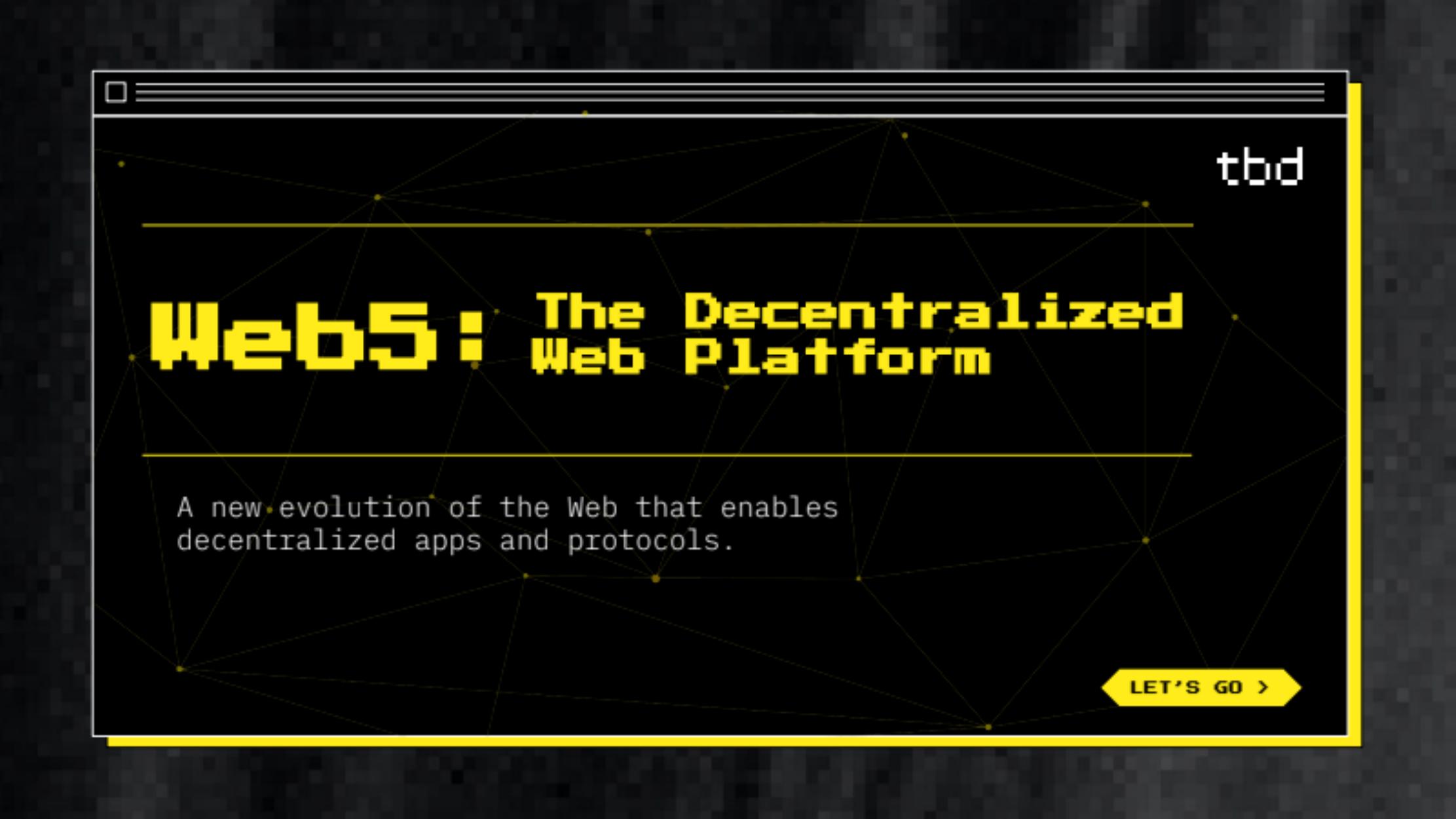
How to build a detailed financial model for TBD
A complete walkthrough of the business, drivers, and assumptions behind the downloadable TBD model - distilled from its pitch deck and publicly available information.
Product & value proposition
Web5 is a technology stack built on three primitives:
- Decentralized Identifiers (DIDs) - self-generated, self-owned identifiers anchored in ION (Bitcoin Layer 2); no centralized authority; resistant to interdiction; universally discoverable.
- Verifiable Credentials (VCs) - cryptographically signed data claims issued to a DID, stored in an identity wallet, and selectively presented to verifying parties (PFIs, banks, apps).
- Decentralized Web Nodes (DWNs) - personal data storage + async messaging nodes; eventually-consistent, optionally encrypted, semantically typed, universally addressable; replicated across devices and clouds.
Together these components form the Decentralized Web Platform (DWP) on top of which Decentralized Web Apps (DWAs) are built - analogous to Progressive Web Apps (PWAs) but with a local DWN SDK replacing centralized app servers.
Key use-cases shown: decentralized finance (tbDEX exchange protocol), music playlist portability across apps, unified travel reservation data, bank credential verification.
Competition / moat
Not explicitly named. Implied competitive framing:
- vs. Web2: current model traps users in company-controlled data silos
- vs. Web3 / crypto: Web5 is positioned as the alternative (Web2 + Web3 = Web5 formula) - avoids "special utility tokens or subjective consensus"; uses Bitcoin ION for DID anchoring, not a proprietary token
Moat: open standard (DID, DWN are W3C emerging standards); Bitcoin-anchored identity (ION); being built by Block / TBD with existing developer ecosystem credibility.
Team & funding ask / use of funds
Recommended financial model
- Archetype + why: This deck does not present an operating company with disclosed revenue, customers, or financials. TBD is a Block subsidiary building open-source infrastructure. The appropriate model is a developer-ecosystem / platform adoption forecast paired with a downstream protocol revenue model (transaction fee / spread on tbDEX exchange volume). If the purpose is an internal business case or investment memo for Block, a 3-statement operating model for TBD as a cost center → revenue center transition is most appropriate.
- Forecast horizon & granularity: 5 years (Year 1–5), annual; quarterly for Year 1–2 once operational metrics are defined.
- Key drivers & assumptions:
- Developer adoption (DWA builders): start at ~500 active developers in Year 1, grow at 150% YoY as platform matures; rationale: early open-source protocol plays (Stripe, Twilio) saw similar curves
- DWN node deployments (proxy for end-user adoption): 10 DWNs per active developer on average in Year 1
- tbDEX monthly transaction volume ($): launch in Year 2; pilot PFIs = 3–5; ramp to $50M GMV/month by end of Year 3; rationale: stablecoin/remittance adjacent, conservative vs. Stellar/Ripple comps
- Protocol take rate on tbDEX: 5–10 bps (0.05–0.10%); rationale: thin spread to compete with SWIFT alternatives
- R&D / headcount spend: primary cost driver; assume 50 engineers at average $200K fully-loaded in Year 1, scaling to 150 by Year 3
- No deck data exists for any of the above; all are model assumptions
- Scenarios (Base / Bull / Bear - which variables flex):
- Bull: tbDEX gains 10+ PFI partners by Year 2; GMV ramps to $200M/month by Year 3; developer ecosystem hits 5,000 active builders
- Base: 3–5 PFI partners by Year 3; $50M GMV/month; 1,500 active builders
- Bear: Protocol adoption stalls; no meaningful PFI uptake by Year 3; TBD remains a pure cost center for Block
- Required sheets / outputs:
- Assumptions - all drivers in one place with vs tags
- Developer Adoption Model - cohort-based growth of DWA builders and DWN deployments
- tbDEX Revenue Model - GMV bridge, take rate, protocol revenue
- P&L - operating expenses (headcount, infrastructure, developer relations), EBITDA
- Cash Flow - burn rate and path to breakeven (relevant if modeling as standalone unit)
- Dashboard - KPIs: active developers, DWN nodes, tbDEX GMV, protocol revenue, burn
Frequently asked
Is the TBD financial model free?+
Yes. The TBD model is a free Excel (.xlsx) download with live formulas. Sign up with your email and the workbook is yours to keep, review, and edit.
What's included in the model?+
A 5-year monthly forecast with P&L, cash flow and runway, valuation (exit multiple plus a DCF cross-check), MOIC/IRR returns, and unit economics, with live formulas throughout.
How was this model built?+
It was built from TBD's pitch deck and publicly available information, then structured to investment-banking standards as a fully editable Excel model.
Can I change the assumptions?+
Yes. You can change assumptions and the live formulas will recalculate in the downloadable Excel model.
Have more financial modelling questions? Contact us

Created by ex-finance professionals
Hey, I’m Alex and I created Finamodel.
Over my years in the finance industry I kept building the same models over and over again. Same structure, same assumptions, different logo. So I started building frameworks to turn them into clean, reusable templates.
Every model here is one I’d actually use for a client, and I personally vet each one before it goes up.
I’m not an expert in every industry, but I’ve built enough models to know what belongs in one. And when something is completely foreign to me, I reach out to my network for experts to work on our models with us.
Having a template library on hand cuts a first build from hours to minutes.
Need help finding your model? You’ll find me in the Finamodel app!
Other Crypto/Web3 Startup Financial Models
Browse another startup in the same category.

0x Labs
0x Labs builds open exchange infrastructure (protocol, API, consumer app) for on-chain token trading across multiple blockchains.

1inch Network
DeFi aggregation protocol that routes crypto swaps across 100+ liquidity sources to deliver best rates and lowest gas fees.

Aether
Synthetic biology platform that builds searchable protein indexes to engineer novel molecular assemblers for high-value industrial products.
Alto
Self-directed IRA platform enabling retail investors to invest in alternative assets (private equity, debt, real estate, crypto) via tax-advantaged retirement savings.
Auki Labs
Decentralized peer-to-peer spatial positioning SDK for social AR - building the infrastructure layer to replace GPS and enable a persistent AR metaverse.
Awesome People Ventures Fund 2
Awesome People Ventures is a community-driven, decentralized early-stage Web3 VC fund raising Fund II.

Axelar
Cross-chain blockchain overlay network enabling universal transfer of assets, transactions, and state across all blockchain ecosystems.
BRD
BRD is a non-custodial crypto wallet app (consumer) and blockchain infrastructure API platform (enterprise) targeting mass-market crypto adoption.