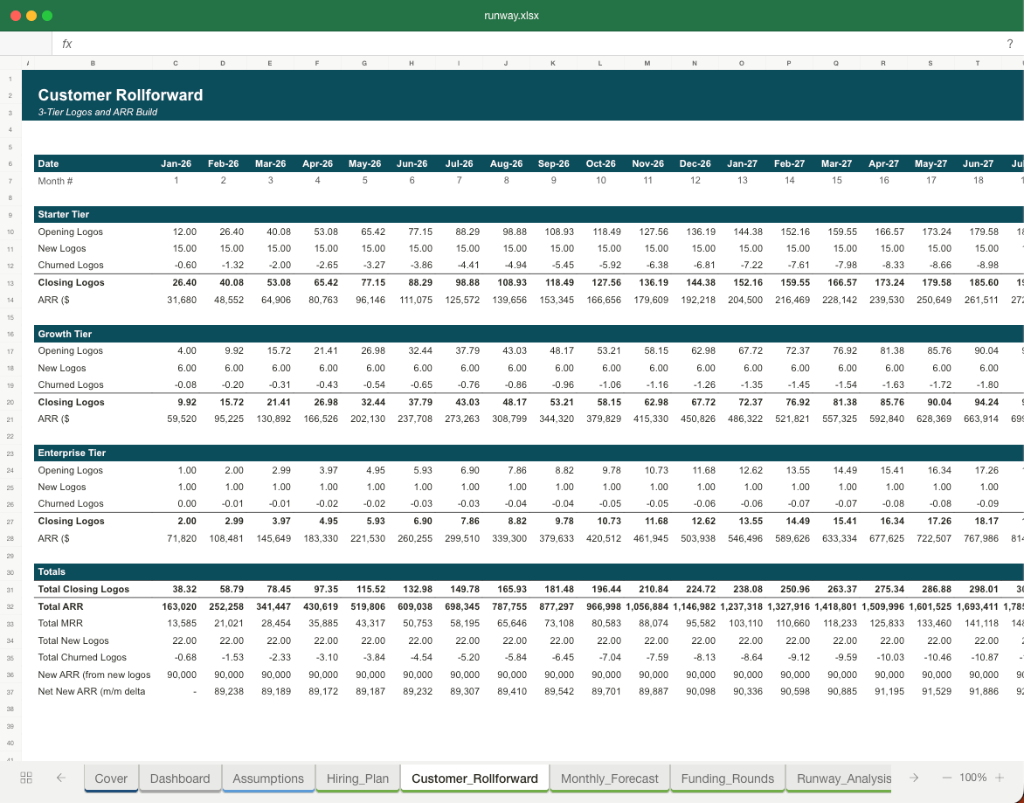
 Terra One Financial Model
Fintech Startup Financials (Free Excel Download)
Full-stack grid-scale battery energy storage platform - develops, finances, builds, and operates BESS assets aggregated into a virtual power plant for grid services and energy trading.



professionals from Deloitte
Used by professionals from






About this model
Terra One develops, finances, builds, and operates grid-scale battery energy-storage assets aggregated into a virtual power plant. It uses the portfolio to sell grid services and trade electricity, applying AI to help optimise dispatch.
This is a capital-intensive infrastructure business, not a conventional software company. Each battery site has a development and construction period followed by recurring revenue from contracted ancillary services and intraday power-market activity.
The model should forecast an asset pipeline by site, MW and MWh capacity, capex, commissioning date, contracted grid-services revenue, and trading margin. Debt, equity, depreciation, operating cost, battery degradation, and merchant-price scenarios must be modelled at asset level before consolidation.
A turnkey financial model
Live formulas, no hardcoded values
Outputs are driven by live formulas, so the workbook updates from its assumptions instead of relying on hardcoded results.
All assumptions in one tab
Inputs are clearly marked in the Assumptions tab and separated from calculations, making it clear what to change and what to leave intact.
Statements always balancing
For integrated-statement models, the balance sheet, cash flow, and supporting schedules tie through properly.
Distinct schedules for clarity
Debt, working capital, taxes, and cash flow can get messy quickly. We group calculations in clear schedules, not across disconnected tabs.
No hidden macros or external links
There are no unexplained external workbook links or macros to undermine auditability or portability.
Changes flow through the model
Update a key driver and see the impact carry through the forecast, financing, and return outputs. We never use hardcoded numbers in formulas.
About Terra One
terra.one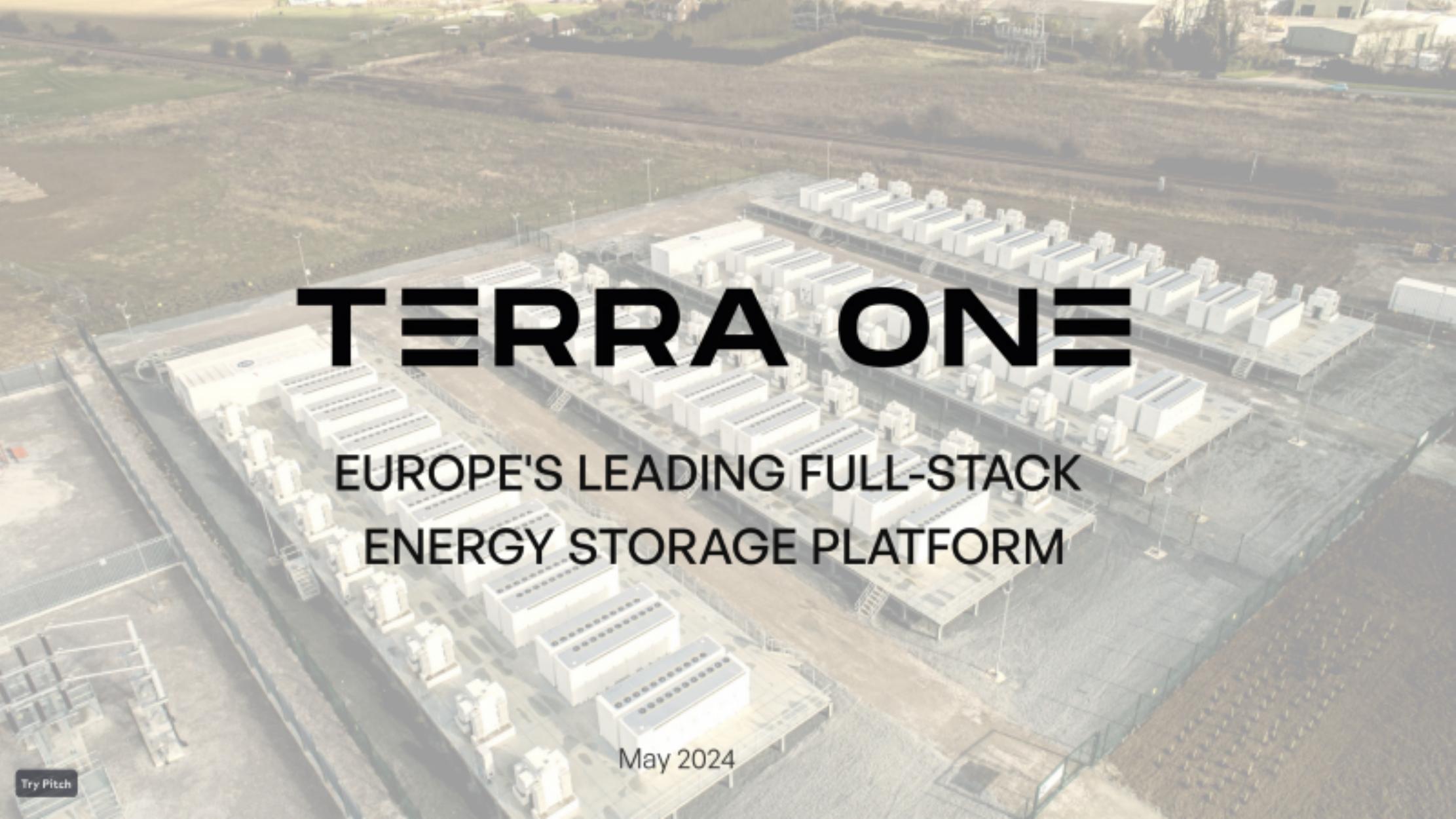
How to build a detailed financial model for Terra One
A complete walkthrough of the business, drivers, and assumptions behind the downloadable Terra One model - distilled from its pitch deck and publicly available information.
Product & value proposition
- Grid-scale BESS: develops sites from property acquisition through permitting, constructs with Samsung SDI batteries + Sungrow inverters, and operates the assets.
- Platform aggregates all battery sites into a single virtual power plant (VPP).
- AI/GPT-based price prediction software (Deep Neural Net V1.4) forecasts day-ahead and intraday electricity prices to optimise dispatch and trading decisions.
- Trading manager module places bids on energy exchanges (Erex) and provides grid frequency-regulation services to grid operators.
- Value claim: profitable without subsidies; lowers cost of power for consumers and industry.
Market
- Problem framing: 19 TWh of renewable energy wasted in Germany alone in 2023 - enough to power 6 million households for a year.
- VRE installed capacity (Germany reference scenario, Fraunhofer ISE 2021): 152 GW in 2020 → 606 GW by 2044.
- Storage capacity required (Germany reference scenario, Fraunhofer ISE 2021): ~1 GWh in 2020 → ~178 GWh by 2044; headline claim "100x by 2040."
- No explicit TAM/SAM/SOM figures in €/$ terms provided in deck.
Revenue model
Two revenue streams, both flowing through the VPP platform:
- Grid services - sell ancillary services (frequency containment reserve, FCR; likely also aFRR) to grid operators (TSOs). Paid per MW of capacity contracted.
- Intraday energy trading - buy/sell power on exchanges (ERIX/intraday spot) using AI price predictions to arbitrage spread between negative-price periods and peak demand. Revenue is spread × MWh cycled.
No explicit pricing per MWh or per MW/year stated in deck. No revenue figures disclosed.
Traction & metrics
- 6 operational or under-construction BESS sites visible in dashboard (May 2024):
- Warstein: 15 MWh / 10 MW
- Eisenach: 15 MWh / 10 MW (label says "15.00 MWh" / "10.33 MW" in image)
- Bad Düben: 15 MWh / 10 MW (labeled "in construction")
- Datensee: 15 MWh / 10 MW (labeled "in construction")
- Iphofen: 24 MWh / 20 MW
- Husum: 15 MWh / 10 MW (labeled "in construction")
- Total visible pipeline: ~99 MWh / ~70 MW across 6 sites.
- No revenue, ARR, or profitability figures disclosed in deck.
Competition / moat
Not explicitly addressed in deck. Implied moats:
- Proprietary AI trading software (Deep Neural Net V1.4) for price forecasting - claimed "best-in-class revenues."
- Full-stack integration (develop → finance → build → operate) compresses development timeline and increases ROI vs. fragmented competitors.
- Team experience: prior roles at OpenAI, NextEra Energy, Next Kraftwerke, BayWa r.e., Macquarie, E.ON, Statkraft, RWE.
Team & funding ask / use of funds
- Team: Tony Schumacher (CEO), Thomas Antonioli (CFO), Charles Gilmour (VP EPC).
- Investors: 468 Capital, neosfer, a16z, Hedosophia, Bit Capital.
Recommended financial model
- Archetype + why: Infrastructure project-roll-up P&L + asset pipeline model. Terra One is an asset developer-operator: each BESS site is a discrete capital project with a fixed capex, then generates recurring revenue via grid services and trading. The right model tracks a pipeline of sites (MWh/MW), each with its own construction schedule and operating ramp, rolled up to consolidated revenue, EBITDA, and debt service. This is closer to a renewable energy IPP (independent power producer) model than SaaS or DTC.
- Forecast horizon & granularity: 5 years (2024–2028), monthly for Year 1–2 (construction draws, commissioning dates matter), annual for Years 3–5. Site-level build-up rolling into consolidated P&L.
- Key drivers & assumptions:
*Pipeline & capacity*
- Sites commissioned per year
- Average site size: 15 MWh / 10 MW
- Capex per MWh installed
*Revenue*
- Grid services revenue (FCR/aFRR): €/MW/year
- Trading spread: €/MWh arbitraged, × cycles/day × operating days
- Revenue mix split between grid services vs. trading
*Costs*
- O&M per MWh/year
- Battery degradation / augmentation capex
- Software/platform OpEx (headcount, cloud, data feeds)
- Corporate overhead (CEO/CFO/VP + hires)
*Financing*
- Project debt per site (non-recourse or corporate)
- Interest rate
- Equity injection per site = residual capex after debt
- Scenarios (Base / Bull / Bear - which variables flex):
- Base: 6 sites/year, FCR price €60k/MW/year, trading spread €40/MWh, 1.5 cycles/day
- Bull: 10 sites/year, FCR €80k, trading spread €55/MWh - AI edge proves out, faster permitting
- Bear: 3 sites/year, FCR €40k (market oversupply of storage), trading spread €25/MWh - regulatory delays + price compression as storage capacity scales
- Required sheets / outputs:
- Assumptions - all drivers above, centrally controlled
- Site Pipeline - site-by-site schedule (start construction, commissioning date, MWh, MW, capex, debt draw, equity)
- Revenue Build - per site: FCR revenue + trading revenue, then consolidated
- P&L - Revenue → Gross Profit → EBITDA → EBIT → Net Income (consolidated)
- Capex & Debt Schedule - draw schedule, amortisation, interest
- Cash Flow - operating CF + investing CF (capex) + financing CF (debt/equity raises)
- KPI Summary - total MWh installed, MW operating, revenue/MWh, EBITDA margin, equity IRR per cohort
- Scenarios toggle (Base / Bull / Bear)
Frequently asked
Is the Terra One financial model free?+
Yes. The Terra One model is a free Excel (.xlsx) download with live formulas. Sign up with your email and the workbook is yours to keep, review, and edit.
What's included in the model?+
A 5-year monthly forecast with P&L, cash flow and runway, valuation (exit multiple plus a DCF cross-check), MOIC/IRR returns, and unit economics, with live formulas throughout.
How was this model built?+
It was built from Terra One's pitch deck and publicly available information, then structured to investment-banking standards as a fully editable Excel model.
Can I change the assumptions?+
Yes. You can change assumptions and the live formulas will recalculate in the downloadable Excel model.
Have more financial modelling questions? Contact us

Created by ex-finance professionals
Hey, I’m Alex and I created Finamodel.
Over my years in the finance industry I kept building the same models over and over again. Same structure, same assumptions, different logo. So I started building frameworks to turn them into clean, reusable templates.
Every model here is one I’d actually use for a client, and I personally vet each one before it goes up.
I’m not an expert in every industry, but I’ve built enough models to know what belongs in one. And when something is completely foreign to me, I reach out to my network for experts to work on our models with us.
Having a template library on hand cuts a first build from hours to minutes.
Need help finding your model? You’ll find me in the Finamodel app!
Other Fintech Startup Financial Models
Browse another startup in the same category.
Acin
SaaS and data subscription network for operational risk management at Tier 1 financial institutions

Ageras Group
B2B SME ecosystem - marketplace connecting SMEs with accountants + cloud accounting/payroll software + embedded financial services (lending, factoring, banking)

Airbase
Unified non-payroll spend management platform (corporate cards, AP/bill pay, expense reimbursement, approval workflows) for mid-market companies.

Altruist
Vertically integrated all-in-one platform for registered investment advisors (RIAs) - combining custodial, portfolio management, practice management, and client acquisition tools.
Amenitiz
All-in-one hotel management SaaS platform ("Shopify for hotels") for independent hoteliers - PMS, booking engine, channel manager, website builder, payments, and AI-driven revenue management.

Anrok
SaaS sales tax compliance platform - nexus monitoring, calculation, registration, filing, and remittance - built specifically for SaaS companies.
Arrival
Arrival is an EV manufacturer of commercial vans and buses using proprietary Microfactories and vertically integrated components, going public via SPAC merger with CIIG Merger Corp.

AtoB
AtoB is building financial infrastructure for commercial fleets, starting with a no-fee Visa fleet card for fuel and expanding into payroll, BNPL, and international.