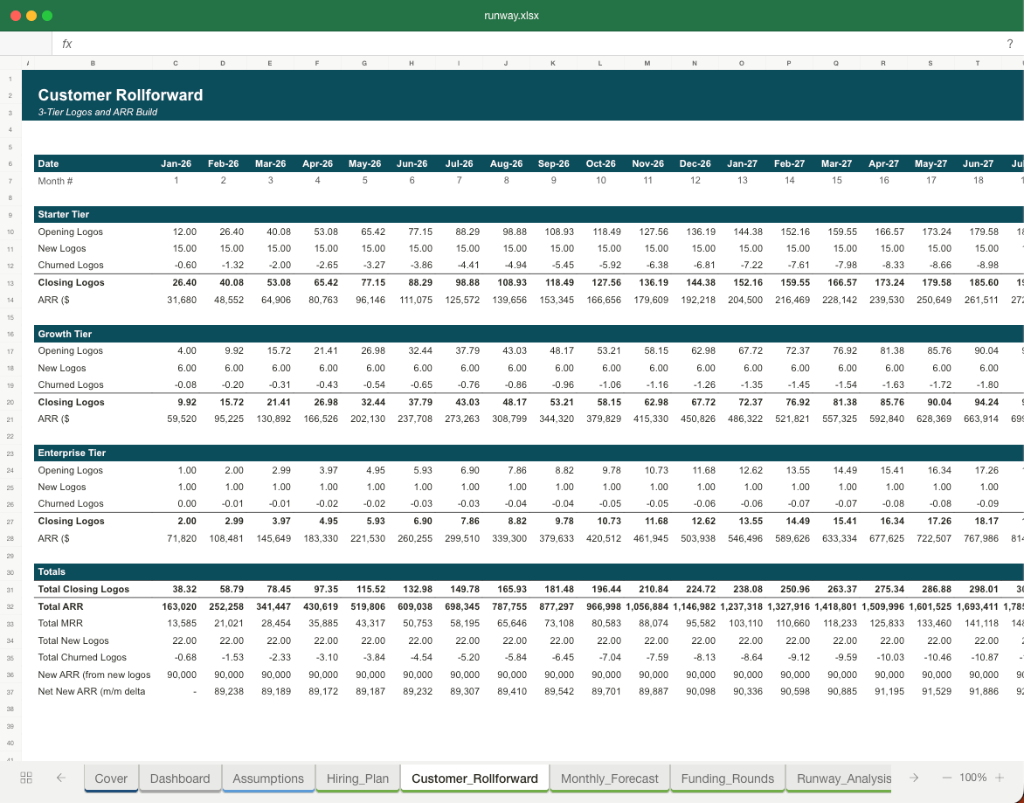
 Terraformation Financial Model
Climate/Energy Startup Financials (Free Excel Download)
Hyperscaling forest restoration using solar-powered desalination to solve climate change at scale [DECK slide 1]



professionals from Deloitte
Used by professionals from






About this model
Terraformation builds reforestation infrastructure around solar-powered desalination, native seed banks, and open-source forestry tools and training. The aim is to remove land and freshwater constraints so local teams can establish and maintain large-scale native forests.
Its market thesis is the scale of atmospheric CO2 and the need for durable, low-emissions removal, rather than a disclosed software or product TAM. The deck cites an operational North Kohala, Hawaii site but gives no revenue, planting, sequestration, customer, or funding metrics.
The model should be project-finance led: each site needs land, solar, desalination, seed-bank, workforce, and maintenance capex and opex before carbon credits become measurable. Forecast hectares, survival, sequestration, verification, and credit price by cohort, roll projects into a consolidated cash flow, and treat grants and credit timing as material sensitivities.
A turnkey financial model
Live formulas, no hardcoded values
Outputs are driven by live formulas, so the workbook updates from its assumptions instead of relying on hardcoded results.
All assumptions in one tab
Inputs are clearly marked in the Assumptions tab and separated from calculations, making it clear what to change and what to leave intact.
Statements always balancing
For integrated-statement models, the balance sheet, cash flow, and supporting schedules tie through properly.
Distinct schedules for clarity
Debt, working capital, taxes, and cash flow can get messy quickly. We group calculations in clear schedules, not across disconnected tabs.
No hidden macros or external links
There are no unexplained external workbook links or macros to undermine auditability or portability.
Changes flow through the model
Update a key driver and see the impact carry through the forecast, financing, and return outputs. We never use hardcoded numbers in formulas.
About Terraformation
terraformation.com
How to build a detailed financial model for Terraformation
A complete walkthrough of the business, drivers, and assumptions behind the downloadable Terraformation model - distilled from its pitch deck and publicly available information.
Product & value proposition
- Core offering: A reforestation infrastructure stack that solves two key scalability bottlenecks - land and freshwater - by pairing solar-powered desalination with native seed banks and open-source forestry apps/training
- Desalination insight: Solar prices have fallen enough to make low-emissions desalination economically viable at scale; desalination can tolerate solar intermittency, allowing leapfrog of the grid transition
- Open-source tooling: Apps and training programmes that convert non-foresters into productive reforestation technicians, massively parallelising the workforce
- Decentralised seed bank infrastructure
- Value proposition framing: Trees are described as a "self-replicating carbon sequestration machine that runs on water and sunlight, produces no pollution, can be operated by people around the world, and has already localised into 1,000+ variants, some producing organic food"
- Positioning: Lowest-cost, safest, fastest, most effective, and most politically feasible CO2 removal method
Market
- Problem scale cited: 45 billion tons of CO2 emitted per year; ~800 billion tons of extant CO2 in atmosphere; 1 trillion trees as the implied target
- No TAM/SAM/SOM framing or dollar market-size figures provided in deck
- CO2 atmospheric chart (1750–2019): atmospheric CO2 rose from ~280 ppm (1750) to ~415 ppm (2019); annual emissions rose from near 0 to ~35 billion tons
Traction & metrics
- One operational site referenced: North Kohala, HI (before/after photo shown)
- No revenue, customer count, trees planted, tonnes sequestered, or other operational KPIs disclosed
- No funding history or round metrics disclosed
Competition / moat
- Implicit competitive framing: deck argues against new/unproven technology as a solution (DAC, BECCS implied but not named); positions proven-tech scalability as the moat
- Moat sources implied: decentralised seed bank IP, open-source network effect, solar-desal cost curve advantage, and first-mover on land + water bottleneck solution
- No named competitors
Team & funding ask / use of funds
Recommended financial model
- Archetype + why: Carbon removal / reforestation project finance model with a 3-statement overlay.
This is not a standard SaaS or DTC business - it is a capital-intensive environmental infrastructure play. The right model is a project-level P&L + balance sheet that tracks: (a) capex deployment into sites (desal + solar + seed banks + land), (b) operating costs of site maintenance and workforce, (c) carbon credit revenue (tonnes sequestered × credit price) as the primary revenue driver, with a rollup across multiple sites as the core scaling mechanic.
- Forecast horizon & granularity:
- 10-year model (Y1–Y10), annual granularity
- Early years (Y1–Y3): site buildout and pre-revenue / grant-funded phase
- Mid years (Y4–Y7): first carbon credit revenue as trees reach measurable sequestration thresholds
- Later years (Y8–Y10): portfolio scaling and potential land/forestry asset monetisation
- Key drivers & assumptions:
| Driver | Value | Source |
|---|---|---|
| Cost of desalination per m³ of water | ~$0.50–$1.00/m³ at solar scale; rationale: current utility-scale solar desal benchmarks | |
| Solar LCOE enabling desal | <$0.03/kWh utility scale; rationale: consistent with global solar cost curves ca. 2020–2024 | |
| Hectares per site | 100–1,000 ha pilot, scaling to 10,000+ ha sites; rationale: standard large reforestation project scale | |
| Trees per hectare | 1,000–2,500 depending on native species mix; rationale: tropical/subtropical forestry norms | |
| CO2 sequestered per hectare per year (mature) | 5–15 tonnes CO2/ha/year; rationale: peer-reviewed range for tropical forest | |
| Years to measurable sequestration (for credit issuance) | 5–7 years; rationale: standard Verra/Gold Standard project timelines | |
| Carbon credit price (voluntary market) | $10–$50/tonne base case; rationale: voluntary carbon market range; bull case $100+/tonne with policy tailwinds | |
| Capex per site (desal + solar + seed bank + nursery) | $2M–$10M depending on site size; rationale: proxy from desal plant costs + solar capex | |
| Opex per site per year | $500K–$2M; rationale: labour, maintenance, monitoring | |
| Number of sites in Year 5 / Year 10 | 5 / 50; rationale: venture-funded scaling trajectory | |
| Grant / philanthropic funding proportion (early) | 60–80% in Y1–Y3; rationale: carbon markets immature at project inception | |
| Open-source tool licensing revenue | $0 in base case (decentralised, free); upside scenario only |
- Scenarios (Base / Bull / Bear - which variables flex):
- Bear: Carbon credit price stays low ($10/tonne); project permitting delays; desal capex overruns; 20 sites by Y10
- Base: Carbon credit price $25–$40/tonne; 50 sites by Y10; grant bridge covers early losses
- Bull: Carbon credit price $80–$100/tonne (regulatory / Article 6 tailwinds); 100+ sites by Y10; open-source platform generates SaaS licensing revenue; land asset value appreciated
- Required sheets / outputs:
- Assumptions - all drivers above with toggle for scenario
- Site Build Schedule - site count, capex timing, cumulative ha planted
- Carbon Sequestration Model - ha × trees/ha × CO2/ha/yr ramp curve → annual tonnes sequestered
- Revenue - tonnes sequestered × credit price; optional: grant income, tool licensing
- Opex - site-level labour, desal + solar opex, HQ overhead
- Capex & Depreciation - desal plant, solar array, nursery, seed bank infrastructure
- P&L - revenue minus opex, EBITDA, D&A, EBIT
- Balance Sheet - project assets, debt (project finance), equity raised
- Cash Flow - FCF, funding gap, cumulative cash burn, runway
- Returns / Impact Summary - IRR, CO2 removed (cumulative tonnes), cost per tonne, implied % of annual global emissions addressed
Frequently asked
Is the Terraformation financial model free?+
Yes. The Terraformation model is a free Excel (.xlsx) download with live formulas. Sign up with your email and the workbook is yours to keep, review, and edit.
What's included in the model?+
A 5-year monthly forecast with P&L, cash flow and runway, valuation (exit multiple plus a DCF cross-check), MOIC/IRR returns, and unit economics, with live formulas throughout.
How was this model built?+
It was built from Terraformation's pitch deck and publicly available information, then structured to investment-banking standards as a fully editable Excel model.
Can I change the assumptions?+
Yes. You can change assumptions and the live formulas will recalculate in the downloadable Excel model.
Have more financial modelling questions? Contact us

Created by ex-finance professionals
Hey, I’m Alex and I created Finamodel.
Over my years in the finance industry I kept building the same models over and over again. Same structure, same assumptions, different logo. So I started building frameworks to turn them into clean, reusable templates.
Every model here is one I’d actually use for a client, and I personally vet each one before it goes up.
I’m not an expert in every industry, but I’ve built enough models to know what belongs in one. And when something is completely foreign to me, I reach out to my network for experts to work on our models with us.
Having a template library on hand cuts a first build from hours to minutes.
Need help finding your model? You’ll find me in the Finamodel app!
Other Climate/Energy Startup Financial Models
Browse another startup in the same category.

Abatable
Robo-advisor platform for sourcing and managing high-quality carbon removal offsets, targeting asset managers.
Bower
Mobile app that rewards consumers for scanning and recycling consumer packaging at existing bins, monetised by CPG brand subscriptions and consumer data.
Bramble Energy
UK deep-tech company commercialising a PCB-based hydrogen fuel cell stack (PCBFC™) for portable power and mobility applications.

Cervest
AI-powered Climate Intelligence platform that quantifies physical climate risk at the asset level, delivered as a freemium SaaS product.

Clockworks Analytics
B2B SaaS platform providing automated fault-detection and diagnostics (FDD) analytics for commercial and institutional building portfolios.

Dandelion Energy
Dandelion Energy installs residential geothermal heat pump systems (ground-source HVAC) with in-house financing, targeting US homeowners on fossil-fuel heating.

Emitwise
B2B SaaS platform automating corporate carbon footprint tracking, reporting, and reduction using machine learning.
Fisker
Fisker is an asset-light, design-led EV company merging with Spartan Energy Acquisition Corp. in a SPAC transaction to fund the launch of the Fisker Ocean SUV.