 Cervest Financial Model
Climate/Energy Startup Financials (Free Excel Download)
AI-powered Climate Intelligence platform that quantifies physical climate risk at the asset level, delivered as a freemium SaaS product.



professionals from Deloitte
Used by professionals from






About this model
Cervest's EarthScan platform uses AI and climate science to score physical climate risk for individual buildings, infrastructure, and portfolios. It covers hazards including flood, heat, drought, water scarcity, and sea-level rise across historical data and long-range scenarios.
EarthScan uses a freemium, self-serve entry point aimed at businesses, financial institutions, and regulators with exposed assets. The deck cites a $40 billion market and a target of 500 million queryable assets, but discloses neither pricing nor current revenue.
Model it as a freemium B2B SaaS funnel: free users or assets convert into paid enterprise accounts with annual contract value, churn, and expansion. An ARR waterfall should feed a P&L and runway plan, with cloud/data costs, the 50-person team, and potential API or data-licensing revenue treated separately.
A turnkey financial model
Live formulas, no hardcoded values
Outputs are driven by live formulas, so the workbook updates from its assumptions instead of relying on hardcoded results.
All assumptions in one tab
Inputs are clearly marked in the Assumptions tab and separated from calculations, making it clear what to change and what to leave intact.
Statements always balancing
For integrated-statement models, the balance sheet, cash flow, and supporting schedules tie through properly.
Distinct schedules for clarity
Debt, working capital, taxes, and cash flow can get messy quickly. We group calculations in clear schedules, not across disconnected tabs.
No hidden macros or external links
There are no unexplained external workbook links or macros to undermine auditability or portability.
Changes flow through the model
Update a key driver and see the impact carry through the forecast, financing, and return outputs. We never use hardcoded numbers in formulas.
About Cervest
cervest.earth
How to build a detailed financial model for Cervest
A complete walkthrough of the business, drivers, and assumptions behind the downloadable Cervest model - distilled from its pitch deck and publicly available information.
Product & value proposition
- Core product: EarthScan™ - a self-serve, AI/ML-driven platform that scores physical climate risk on individual assets (buildings, infrastructure, portfolios) across multiple risk categories (flooding, extreme temperatures, droughts, sea level rise, heat, water scarcity, air pollution).
- Temporal range: −50 years historical to +80 years forecast climate risk
- Scenarios: 3 climate scenarios - BAU, 2040 emissions peak, Paris-aligned
- Coverage target: 500 million queryable built assets by year end
- Freemium/open access model - free tier plus premium (pricing not disclosed)
- Key differentiators: single source of truth, standardised, asset-centric (not policy/academic), shareable across networks, "always on" continuous learning
- Proprietary "multi-signal" spatio-temporal science framework
Market
- TAM: $40 billion (described as "untapped")
- No SAM or SOM breakdown provided.
- No growth rate or source citation for the $40B figure given in the deck.
- Context reference: "$trillions in physical assets at risk" (CDP 2019)
Revenue model
- Freemium model: open/free access tier as acquisition funnel; premium paid tier implied but not named or priced in the deck
- Target customers: businesses, financial services, regulators with physical asset exposure
- Use cases stated: risk discovery, disclosure, strategic growth (visible in product UI)
- No pricing tiers, seat counts, ACV, or contract structure disclosed in deck.
- Channel: self-serve platform (product-led growth implied); partner/customer development function mentioned (Kate Rodger, Head of Customer & Partner Development)
Traction & metrics
- 500m queryable built assets - target by year end (forward-looking, not current)
- 50 team members
- 40% women
- >200 peer-reviewed papers
- EarthScan™ Early Access Program: Q2 2021
- EarthScan™ full launch: Q3 2021
- No revenue, ARR, customer count, MRR, or growth metrics disclosed.
Competition / moat
- Slide 9 frames a market evolution: Climate Science (academic/policy) → Climate Data & Analysis (consulting-led, point solutions) → Climate Intelligence (self-serve, automated, networked). Cervest positions itself as the emerging leader of the third era.
- Competitive moat claimed: proprietary spatio-temporal ML framework, open/freemium distribution (first mover), asset-level granularity, network effects from shared standardised data
- No named competitors.
- Market sentiment: "The market is crying out for a category leader" - two external quotes (names/orgs not readable in text extraction)
Team & funding ask / use of funds
- Funding ask: $30 million Series A
- Key executives:
- Iggy Bassi - Founder & CEO
- Dr. Maxime Rischard - Lead Scientist
- Dr. Benjamin Laken - Head of Innovation
- Dr. Laura Zamboni - Climate Scientist
- Sachin Kapila - Chief Climate Risk Officer
- Partha Bose - Head of Data Strategy
- Mark Hodgson - Chief Commercial Officer
- Melissa Ayres - Chief Marketing Officer
- Kate Rodger - Head of Customer & Partner Development
- Anna Moses - Head of Operations
- Team composition: 50 people, Silicon Valley + EU, earth sciences / climate / ML / platforms focus
Recommended financial model
- Archetype + why: SaaS ARR / freemium B2B SaaS model. Cervest is a platform with a freemium acquisition motion converting to paid enterprise/institutional accounts. Revenue is recurring (annual subscriptions or seat-based), making ARR the right unit. Secondary revenue stream (API/data licensing) is plausible but not confirmed.
- Forecast horizon & granularity: 5 years (2021–2025), monthly for Year 1 (pre-launch ramp), quarterly thereafter. Series A context warrants visibility through to potential Series B / breakeven.
- Key drivers & assumptions:
| Driver | Value |
|---|---|
| Launch date | Q3 2021 |
| Addressable built assets at launch | 500m (target) |
| TAM | $40B |
| Free → paid conversion rate | 2–5% |
| Average ACV (paid tier) | $25,000–$100,000 |
| Paid customer target Y1 | 20–50 |
| Gross margin | 70–80% |
| Headcount at raise | 50 |
| Opex burn rate Y1 | ~$10–12M |
| CAC | - |
| LTV:CAC | Target >3x |
| Net revenue retention | 110–120% |
| Churn | <10% annually |
| R&D as % of revenue | 30–40% Y1, declining |
- Scenarios (Base / Bull / Bear - which variables flex):
- Bear: Free-to-paid conversion 1%; ACV at low end ($25K); slower enterprise sales cycle; regulatory tailwinds delayed.
- Base: Conversion 3%; ACV $50K; organic PLG + modest enterprise sales team.
- Bull: Conversion 5%; ACV $75K+; regulatory mandates (TCFD, EU SFDR) accelerate demand; data licensing revenue layer added by Year 3.
- Primary flex variables: conversion rate, ACV, sales cycle length, regulatory pace, cloud infra COGS scaling.
- Required sheets / outputs:
- Assumptions & toggles (scenario selector)
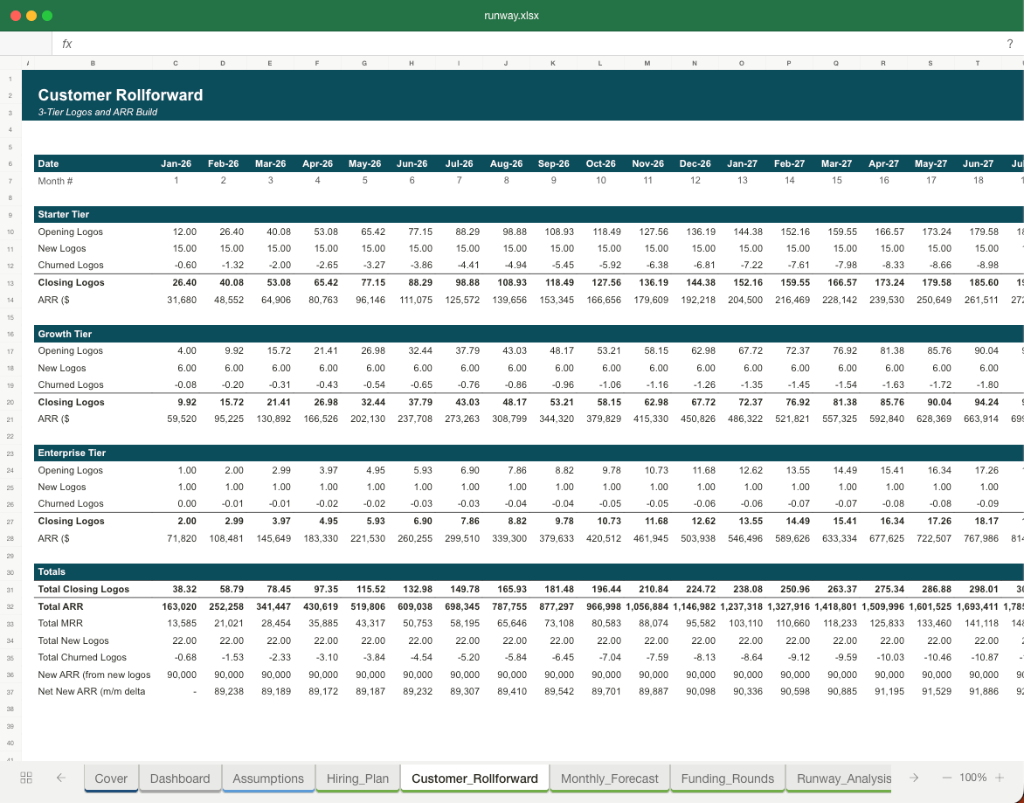
- Monthly cohort model - free signups, conversion to paid, churn, expansion
- ARR build (new ARR, churned ARR, expansion ARR, net new ARR)
- P&L - Revenue, COGS, Gross Profit, R&D, S&M, G&A, EBITDA, Net Income
- Headcount plan (by department)
- Cash flow & runway (Series A proceeds vs. burn to Series B)
- Unit economics summary (CAC, LTV, payback, LTV:CAC)
- Sensitivity table (ACV × conversion rate → ARR at Year 3)
- Dashboard / KPI summary
Frequently asked
Is the Cervest financial model free?+
Yes. The Cervest model is a free Excel (.xlsx) download with live formulas. Sign up with your email and the workbook is yours to keep, review, and edit.
What's included in the model?+
A 5-year monthly forecast with P&L, cash flow and runway, valuation (exit multiple plus a DCF cross-check), MOIC/IRR returns, and unit economics, with live formulas throughout.
How was this model built?+
It was built from Cervest's pitch deck and publicly available information, then structured to investment-banking standards as a fully editable Excel model.
Can I change the assumptions?+
Yes. You can change assumptions and the live formulas will recalculate in the downloadable Excel model.
Have more financial modelling questions? Contact us

Created by ex-finance professionals
Hey, I’m Alex and I created Finamodel.
Over my years in the finance industry I kept building the same models over and over again. Same structure, same assumptions, different logo. So I started building frameworks to turn them into clean, reusable templates.
Every model here is one I’d actually use for a client, and I personally vet each one before it goes up.
I’m not an expert in every industry, but I’ve built enough models to know what belongs in one. And when something is completely foreign to me, I reach out to my network for experts to work on our models with us.
Having a template library on hand cuts a first build from hours to minutes.
Need help finding your model? You’ll find me in the Finamodel app!
Other Climate/Energy Startup Financial Models
Browse another startup in the same category.

Abatable
Robo-advisor platform for sourcing and managing high-quality carbon removal offsets, targeting asset managers.
Bower
Mobile app that rewards consumers for scanning and recycling consumer packaging at existing bins, monetised by CPG brand subscriptions and consumer data.
Bramble Energy
UK deep-tech company commercialising a PCB-based hydrogen fuel cell stack (PCBFC™) for portable power and mobility applications.

Clockworks Analytics
B2B SaaS platform providing automated fault-detection and diagnostics (FDD) analytics for commercial and institutional building portfolios.

Dandelion Energy
Dandelion Energy installs residential geothermal heat pump systems (ground-source HVAC) with in-house financing, targeting US homeowners on fossil-fuel heating.

Emitwise
B2B SaaS platform automating corporate carbon footprint tracking, reporting, and reduction using machine learning.
Fisker
Fisker is an asset-light, design-led EV company merging with Spartan Energy Acquisition Corp. in a SPAC transaction to fund the launch of the Fisker Ocean SUV.
Good Loop
Purpose-driven adtech platform that donates a share of ad spend to charities in exchange for user attention, while offering brands impact reporting and carbon-offset tools.