 Ubiquitous Energy Financial Model
Climate/Energy Startup Financials (Free Excel Download)
Ubiquitous Energy makes fully transparent solar glass (UE Power™) that converts UV and infrared light into electricity, turning building windows into power-generating surfaces with no visible aesthetic change.



professionals from Deloitte
Used by professionals from






About this model
Ubiquitous Energy develops UE Power, transparent solar glass that generates electricity from ultraviolet and infrared light while transmitting visible light. The MIT-originated technology uses standard glass-coating processes and targets commercial and residential windows, with smart-building functionality as a possible extension.
The proposition is a drop-in replacement for window glass, claiming up to 30% building-electricity offset, sub-three-year payback, and potential LCOE below $0.05 per kWh. The deck frames a 20 billion-square-foot annual window-glass market but provides no pricing, production volume, or commercial traction.
The model should be capacity constrained: square feet sold times ASP drives revenue, while coating and glass costs determine the manufacturing learning curve. Forecast pilot conversion, penetration, plant capex, yield, inventory, and gross-margin ramp, then separately flag smart-building services only as optional upside until a commercial pricing model is disclosed.
A turnkey financial model
Live formulas, no hardcoded values
Outputs are driven by live formulas, so the workbook updates from its assumptions instead of relying on hardcoded results.
All assumptions in one tab
Inputs are clearly marked in the Assumptions tab and separated from calculations, making it clear what to change and what to leave intact.
Statements always balancing
For integrated-statement models, the balance sheet, cash flow, and supporting schedules tie through properly.
Distinct schedules for clarity
Debt, working capital, taxes, and cash flow can get messy quickly. We group calculations in clear schedules, not across disconnected tabs.
No hidden macros or external links
There are no unexplained external workbook links or macros to undermine auditability or portability.
Changes flow through the model
Update a key driver and see the impact carry through the forecast, financing, and return outputs. We never use hardcoded numbers in formulas.
About Ubiquitous Energy
ubiquitous.energy
How to build a detailed financial model for Ubiquitous Energy
A complete walkthrough of the business, drivers, and assumptions behind the downloadable Ubiquitous Energy model - distilled from its pitch deck and publicly available information.
Product & value proposition
- Product: UE Power™ - the only fully transparent solar technology generating electricity from non-visible light (UV + infrared), while passing visible light.
- Technology: Patented, invented at MIT; uses standard glass coating processes and abundant raw materials.
- Transparency: 40–80% with neutral color - matches standard commercial window glass.
- Drop-in supply chain: Designed for commercial and residential use with minimal change to existing glass manufacturing/distribution supply chain.
- Key performance claims:
- Offsets up to 30% of building electricity
- <3-year payback and <$0.05/kWh LCOE possible
- Vertical surface area up to 50x more than rooftop solar
- Qualifies for solar investment tax credits (ITC)
- Smart building integration: enables sensors, analytics, communications; tunable thermal (low-E) performance.
Market
- TAM: 20B ft²/yr window glass market; $500B potential stated.
- Market driver: New building regulations requiring on-site renewables are cited as a tailwind.
Revenue model
- Revenue stream: Sale of transparent solar glass panels (replacement for standard commercial window glass).
- Pricing: Not explicitly stated. Implied cost competitiveness via <$0.05/kWh LCOE and <3-year payback metrics.
- Channels: Designed to integrate into existing glass supply chain (fabricators, glaziers, distributors).
- Volume unit: ft² of glass sold; glass industry standard pricing metric is $/ft².
- Secondary / future revenue: Smart building services (sensors, analytics, comms) implied but not modelled in deck.
Unit economics
- Customer payback (end-user): <3-year payback on building energy savings
- LCOE: <$0.05/kWh possible
Competition / moat
- Moat: Patented technology, invented at MIT by co-founders (Richard Lunt / Vladimir Bulović).
- Competitive differentiation: Only fully transparent solar (vs. tinted/colored competing solar glass products); standard glass coating process lowers manufacturing barrier.
Team & funding ask / use of funds
- CEO: Susan Stone - 20yr+ new tech investor (Sierra Wasatch, JP Morgan)
- CTO / Co-Founder: Miles Barr, PhD - MIT PhD, UE inventor, Forbes 30u30, MIT TR35
- VP Finance: Boris Vilidnitsky, CFA - 10yr+ investor, Carbon 3D, Barclays
- Board / Strategic Advisor: Ted Hathaway - 30yr+ building materials exec, prev CEO of Oldcastle
- Dir. Channel Dev.: David Maikowski - 20yr+ glass industry exec, prev Guardian Glass
- VP Strategy: Veeral Hardev - 10yr+ BD exec, launched first QD display at Nanosys
- VP Tech Dev.: Richa Pandey, PhD - UMN PhD, 10yr+ OPV, Top Woman in Solar Award
- VP Manufacturing: Rachel Molaro, PhD - MIT PhD, 10yr+ OPV and equipment design
- VP Project Dev.: Ian Millard, PhD - Cambridge PhD, 25yr+ organic electronics industry
- Co-Founder: Richard Lunt, PhD - MSU Prof, UE inventor, MIT TR35, CAREER Award
- Co-Founder: Vladimir Bulović, PhD - MIT Prof, UE inventor, Director of MIT.nano
Recommended financial model
- Archetype + why: Hardware manufacturer / project revenue model - volume-based (ft² sold) with $/ft² ASP, COGS ramp, and gross margin expansion as manufacturing scales. This is a pre-revenue or early-revenue deeptech hardware company selling into the commercial glass supply chain; the correct model is a capacity-constrained manufacturing P&L with a capital intensity schedule, not a SaaS or marketplace model. If the company has signed offtake agreements or project-based pilots, a project revenue waterfall should supplement.
- Forecast horizon & granularity: 5 years; Year 1–2 monthly (manufacturing ramp, pilot conversions), Year 3–5 annual. Switch to annual once production at scale.
- Key drivers & assumptions:
- Addressable window glass market: 20B ft²/yr
- Market penetration rate Year 1–5: 0.001% → 0.05% ramp; deeptech hardware commercialization is slow
- ASP ($/ft²): $8–$15/ft² based on premium-to-standard window glass; standard low-E glass is ~$5–$8/ft², UE commands a premium for power generation
- COGS / manufacturing cost ($/ft²): high initially ($20–$30/ft²), declining toward $6–$10/ft² at scale via learning curve; standard glass coating costs are the reference floor
- Gross margin: negative in Year 1–2, turning positive ~Year 3 as volume ramps; target 30–40% at maturity
- CapEx / equipment investment: significant; glass coating lines require capital - placeholder $5–$20M per line depending on throughput
- Revenue recognition: Recognized on glass delivery (product sale), not subscription
- ITC benefit pass-through: ITC claimed by building owner, not UE - UE captures value via pricing premium; may change if UE pursues a leasing/PPA model
- Smart building / IoT services revenue: excluded from base case; modelled as upside in Bull scenario
- Payback to end customer: <3 years implied at <$0.05/kWh; validates pricing ceiling
- R&D / SG&A: heavy pre-revenue; estimated 60–80% of revenue in early years
- Headcount: driven by manufacturing scale-up, not sales headcount
- Scenarios (Base / Bull / Bear - which variables flex):
- Bear: Slower manufacturing ramp, ASP pressure from competing solar glass entrants, regulatory ITC changes, higher COGS
- Base: Steady commercialization via glass supply chain partners, 0.01–0.02% market penetration by Year 5
- Bull: Regulatory mandates accelerate adoption, additional revenue from smart building services, international expansion, faster cost-down curve
- Required sheets / outputs:
- Assumptions - all drivers listed above, clearly separated vs
- Revenue - ft² sold × ASP, segmented by commercial vs residential (if data emerges)
- COGS & Gross Margin - manufacturing cost per ft², yields, scrap, ramp curve
- CapEx & Depreciation - equipment lines, manufacturing capacity, depreciation schedule
- OpEx (R&D, SG&A) - headcount-driven
- P&L (Income Statement)
- Cash Flow - operating CF + CapEx; key output is cash burn and runway to profitability
- Balance Sheet (simplified)
- Unit Economics summary - LCOE, end-customer payback, UE gross margin per ft²
- Scenario toggle (Base / Bull / Bear)
Frequently asked
Is the Ubiquitous Energy financial model free?+
Yes. The Ubiquitous Energy model is a free Excel (.xlsx) download with live formulas. Sign up with your email and the workbook is yours to keep, review, and edit.
What's included in the model?+
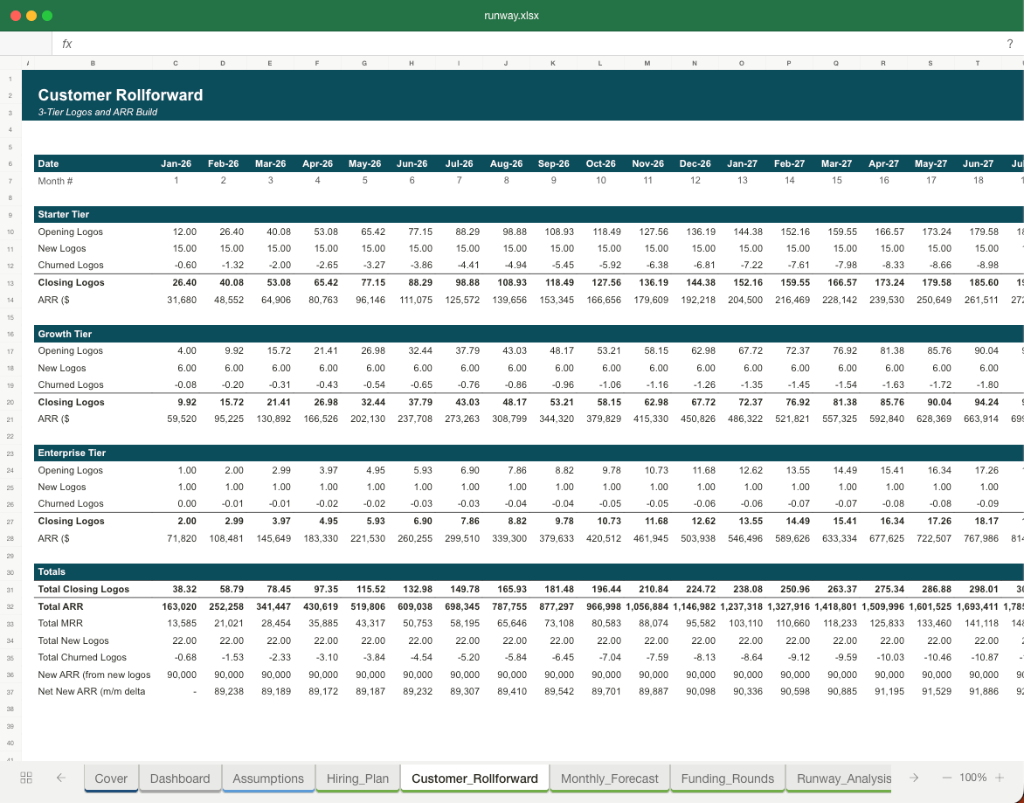
A 5-year monthly forecast with P&L, cash flow and runway, valuation (exit multiple plus a DCF cross-check), MOIC/IRR returns, and unit economics, with live formulas throughout.
How was this model built?+
It was built from Ubiquitous Energy's pitch deck and publicly available information, then structured to investment-banking standards as a fully editable Excel model.
Can I change the assumptions?+
Yes. You can change assumptions and the live formulas will recalculate in the downloadable Excel model.
Have more financial modelling questions? Contact us

Created by ex-finance professionals
Hey, I’m Alex and I created Finamodel.
Over my years in the finance industry I kept building the same models over and over again. Same structure, same assumptions, different logo. So I started building frameworks to turn them into clean, reusable templates.
Every model here is one I’d actually use for a client, and I personally vet each one before it goes up.
I’m not an expert in every industry, but I’ve built enough models to know what belongs in one. And when something is completely foreign to me, I reach out to my network for experts to work on our models with us.
Having a template library on hand cuts a first build from hours to minutes.
Need help finding your model? You’ll find me in the Finamodel app!
Other Climate/Energy Startup Financial Models
Browse another startup in the same category.

Abatable
Robo-advisor platform for sourcing and managing high-quality carbon removal offsets, targeting asset managers.
Bower
Mobile app that rewards consumers for scanning and recycling consumer packaging at existing bins, monetised by CPG brand subscriptions and consumer data.
Bramble Energy
UK deep-tech company commercialising a PCB-based hydrogen fuel cell stack (PCBFC™) for portable power and mobility applications.

Cervest
AI-powered Climate Intelligence platform that quantifies physical climate risk at the asset level, delivered as a freemium SaaS product.

Clockworks Analytics
B2B SaaS platform providing automated fault-detection and diagnostics (FDD) analytics for commercial and institutional building portfolios.

Dandelion Energy
Dandelion Energy installs residential geothermal heat pump systems (ground-source HVAC) with in-house financing, targeting US homeowners on fossil-fuel heating.

Emitwise
B2B SaaS platform automating corporate carbon footprint tracking, reporting, and reduction using machine learning.
Fisker
Fisker is an asset-light, design-led EV company merging with Spartan Energy Acquisition Corp. in a SPAC transaction to fund the launch of the Fisker Ocean SUV.