UTUtilizeCore Financial Model
Fintech Startup Financials (Free Excel Download)
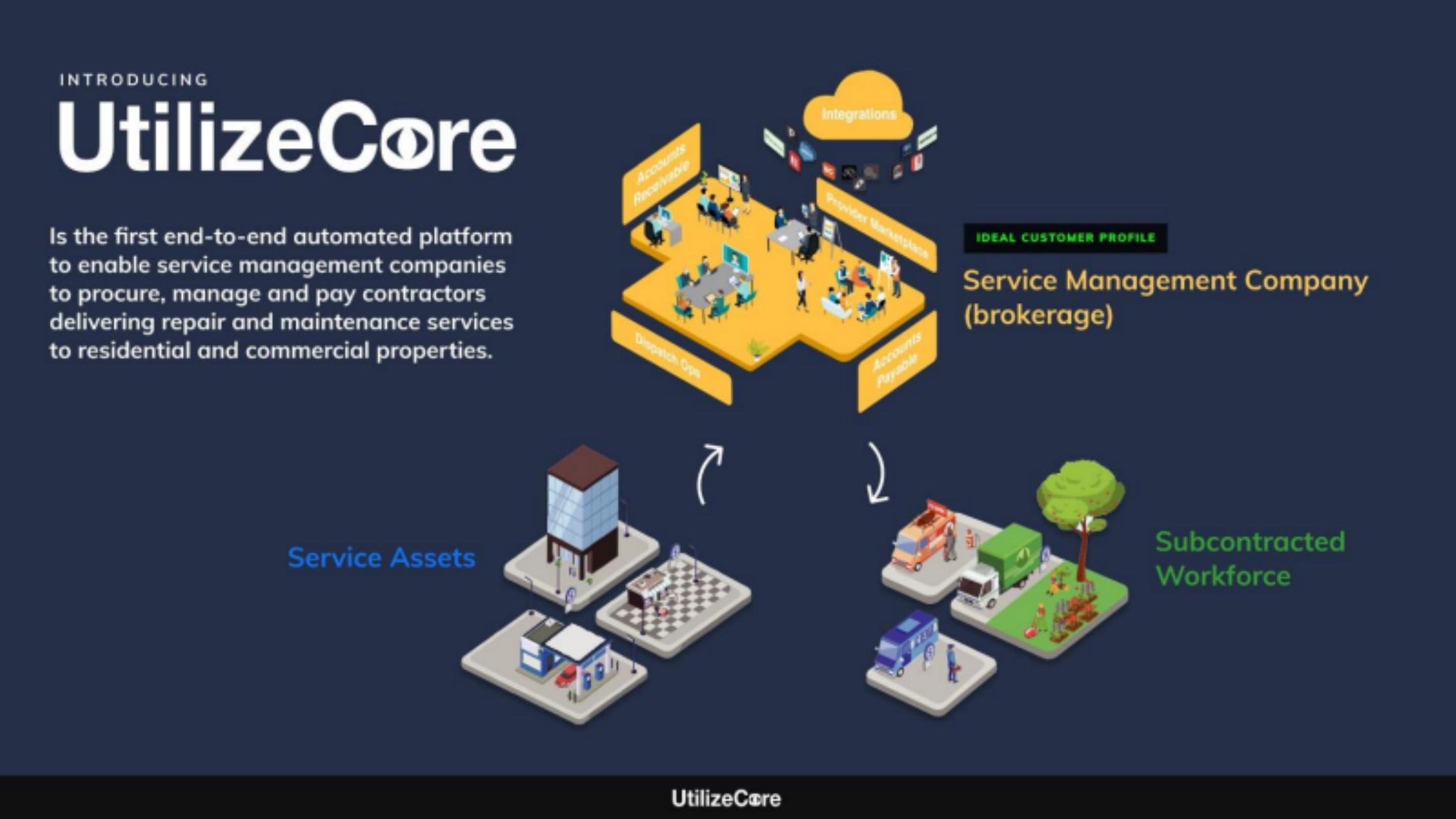
End-to-end automated platform for service management companies (brokerages) to procure, manage, and pay subcontractors delivering repair and maintenance to residential and commercial properties.



professionals from Deloitte
Used by professionals from






About this model
UtilizeCore automates how service-management companies procure, manage, and pay subcontractors for residential and commercial repair work. It connects brokerages, requesters, and subcontractors in a workflow that spans sourcing, work orders, invoicing, and payment.
Requesters and subcontractors use the product for free, while brokerages are the paying customers. The platform has a recurring subscription engine and an alternative-billing opportunity linked to the substantial invoice volume managed through it.
The model should forecast paid brokerages, subscription ACV, subcontractors and work orders per brokerage, invoiced volume, and any transaction take rate. Free-side adoption, brokerage retention, implementation, and payment or support costs show whether the network creates efficient expansion.
A turnkey financial model
Live formulas, no hardcoded values
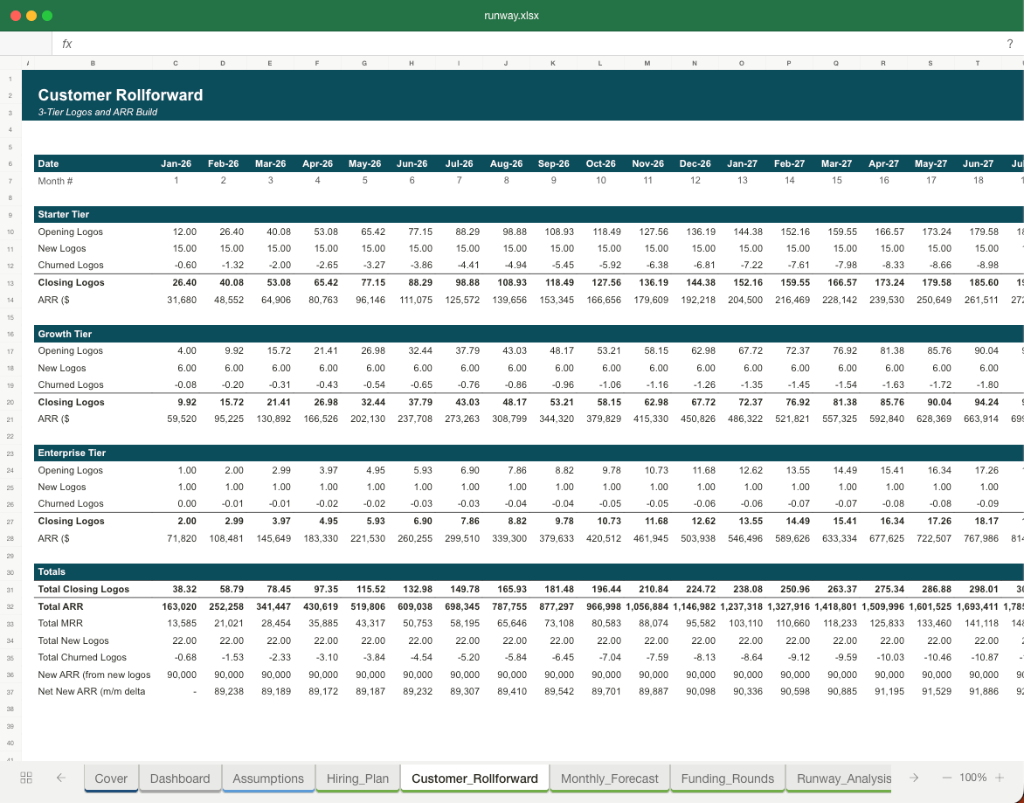
Outputs are driven by live formulas, so the workbook updates from its assumptions instead of relying on hardcoded results.
All assumptions in one tab
Inputs are clearly marked in the Assumptions tab and separated from calculations, making it clear what to change and what to leave intact.
Statements always balancing
For integrated-statement models, the balance sheet, cash flow, and supporting schedules tie through properly.
Distinct schedules for clarity
Debt, working capital, taxes, and cash flow can get messy quickly. We group calculations in clear schedules, not across disconnected tabs.
No hidden macros or external links
There are no unexplained external workbook links or macros to undermine auditability or portability.
Changes flow through the model
Update a key driver and see the impact carry through the forecast, financing, and return outputs. We never use hardcoded numbers in formulas.
About UtilizeCore
How to build a detailed financial model for UtilizeCore
A complete walkthrough of the business, drivers, and assumptions behind the downloadable UtilizeCore model - distilled from its pitch deck and publicly available information.
Product & value proposition
Three-sided platform connecting:
- Service Management Companies (brokerages) - paid subscribers; get full automation: AR, dispatch ops, provider marketplace, AP, integrations.
- Requesters (property owners / clients of the brokerage) - free login to submit work orders.
- Subcontractors (providers) - free login to receive, manage, and get paid for work.
Core workflow automated: Receive Work → Find Contractor → Manage Work → Pay Contractor → Get Paid. Replaces dual-entry, manual processes, and siloed data. Supports trades including electrical, power wash, sweep, snow, pavement. 24 third-party integrations.
Market
- TAM: Global Outsourced Facility Management Market - $680 Billion.
- SAM: Global Integrated Facility Management (IFM) Market - $124 Billion.
- SOM / monetisation framing: 0.5% of subscriber revenue taken as the UtilizeCore fee; no explicit SOM dollar figure or market growth rate stated.
Revenue model
- Primary: Recurring subscription charged to the Service Management Company (brokerage) - the "Paid Subscriber" centre card.
- Secondary: "Alternative Billing" also mentioned alongside subscription - likely transaction/payment take-rate or usage-based billing; no pricing detail disclosed.
- Requesters and subcontractors access the platform free - classic freemium flywheel; monetisation is entirely on the brokerage side.
Traction & metrics
All from slide 5:
- 2,337,839 work orders processed (cumulative)
- 125,312 highest monthly check-ins
- $1.3B+ managed services (total amount invoiced through platform, per slide 6 label)
- 50,000+ companies on UtilizeCore
- 24 third-party integrations
No revenue, ARR, growth rate, churn, or retention figures disclosed.
Competition / moat
Not explicitly shown as a competition slide. Implied differentiation:
- End-to-end automation vs. manual / dual-entry status quo.
- Network effects: free subcontractor and requester logins create a two-sided supply of labour and demand - makes switching costly for paying brokerages.
- 24 integrations deepen platform stickiness.
- Advisory bench includes ServiceChannel veterans (Steven Gottfried built ServiceChannel ARR ~$0→$100M); Tom Edwards was CFO of ServiceChannel.
Team & funding ask / use of funds
Founders:
- Ryan Gottfried (CEO/Co-Founder) - 10 yrs product at VMS/FMS platforms; co-founded Vetty (ERA & 3Lines backed); product at ServiceChannel, WorkMarket (ADP).
- Jason Kwait (President/Co-Founder) - 7 yrs BD; co-founded Vetty, GuideU.
- Johnny Zhu (COO/Co-Founder) - 7 yrs operations; founded Alto Arts; VP Shunyi Real Estate.
- Tom Edwards (CFO) - CFO ServiceChannel 2009–2015; SVP First Advantage; Senior Manager Ernst & Young.
- Steven Gottfried (Chairman) - CEO/Founder ServiceChannel (built $0→$100M ARR); CEO EquipID.
Notable advisors: Bill Macaitis (ex-CMO/CRO Slack, Zendesk, Salesforce), Grant McGrail (SVP Sales TripActions/WeWork/Oracle), Justin Effron (Founder Alice, exit to Expedia), FM-industry advisors with facility management and PE-backed service business backgrounds.
Recommended financial model
- Archetype + why: B2B SaaS ARR model with a transaction/take-rate layer. The brokerage-facing recurring subscription is the primary revenue engine; "alternative billing" suggests a payment/take-rate stream tied to work-order volume ($1.3B+ invoiced through platform implies meaningful transaction flow). This is a vertical SaaS + embedded fintech hybrid - model both.
- Forecast horizon & granularity: 5-year annual model (Years 1–5) with monthly detail for Years 1–2. Paying customer (brokerage) count is the north-star driver.
- Key drivers & assumptions:
- New paid subscriber adds per month: driven by a sales-capacity model (reps × quota); start with 50 net adds/month.
- Annual churn rate (paid brokerages): 10% p.a. - typical early-stage vertical SaaS.
- Take-rate / alternative billing: ~0.5% of managed services invoiced; applied to work-order dollar volume per paying brokerage.
- Work orders per paying brokerage per month: derived from 2,337,839 cumulative WOs ÷ 50,000 companies; ~47 WOs/company historically - skewed by free users; paid brokerages likely higher volume, assume 200 WOs/month.
- Average work-order value: $130 (implied: $1.3B+ ÷ ~10M WO equivalents at scale); confirm with company.
- Free-to-paid conversion of the 50,000+ companies on platform: 1–3%; this is the near-term upsell lever.
- Gross margin: 70–80% - typical B2B SaaS; payment processing costs reduce margin on take-rate stream.
- Scenarios (Base / Bull / Bear - which variables flex):
- Base: 1% free-to-paid conversion; $800 ARPU; 10% churn; 0.5% take-rate on WO volume.
- Bull: 3% conversion; $1,200 ARPU; 7% churn; take-rate expands to 0.75%; faster WO volume growth.
- Bear: <1% conversion; $500 ARPU; 15% churn; take-rate revenue stalls (brokerages resist payment product).
- Required sheets / outputs:
- Assumptions - all drivers, toggleable by scenario.
- Subscriber model - paying brokerage cohort waterfall (new adds, churn, net adds, ending count).
- Revenue build - subscription ARR + transaction/take-rate revenue.
- P&L - gross profit, S&M, R&D, G&A, EBITDA.
- Cash & runway - burn, cash balance, months to breakeven.
- KPI dashboard - ARR, net revenue retention, LTV/CAC (once CAC data available), GMV (managed services invoiced).
Frequently asked
Is the UtilizeCore financial model free?+
Yes. The UtilizeCore model is a free Excel (.xlsx) download with live formulas. Sign up with your email and the workbook is yours to keep, review, and edit.
What's included in the model?+
A 5-year monthly forecast with P&L, cash flow and runway, valuation (exit multiple plus a DCF cross-check), MOIC/IRR returns, and unit economics, with live formulas throughout.
How was this model built?+
It was built from UtilizeCore's pitch deck and publicly available information, then structured to investment-banking standards as a fully editable Excel model.
Can I change the assumptions?+
Yes. You can change assumptions and the live formulas will recalculate in the downloadable Excel model.
Have more financial modelling questions? Contact us

Created by ex-finance professionals
Hey, I’m Alex and I created Finamodel.
Over my years in the finance industry I kept building the same models over and over again. Same structure, same assumptions, different logo. So I started building frameworks to turn them into clean, reusable templates.
Every model here is one I’d actually use for a client, and I personally vet each one before it goes up.
I’m not an expert in every industry, but I’ve built enough models to know what belongs in one. And when something is completely foreign to me, I reach out to my network for experts to work on our models with us.
Having a template library on hand cuts a first build from hours to minutes.
Need help finding your model? You’ll find me in the Finamodel app!
Other Fintech Startup Financial Models
Browse another startup in the same category.
Acin
SaaS and data subscription network for operational risk management at Tier 1 financial institutions

Ageras Group
B2B SME ecosystem - marketplace connecting SMEs with accountants + cloud accounting/payroll software + embedded financial services (lending, factoring, banking)

Airbase
Unified non-payroll spend management platform (corporate cards, AP/bill pay, expense reimbursement, approval workflows) for mid-market companies.

Altruist
Vertically integrated all-in-one platform for registered investment advisors (RIAs) - combining custodial, portfolio management, practice management, and client acquisition tools.
Amenitiz
All-in-one hotel management SaaS platform ("Shopify for hotels") for independent hoteliers - PMS, booking engine, channel manager, website builder, payments, and AI-driven revenue management.

Anrok
SaaS sales tax compliance platform - nexus monitoring, calculation, registration, filing, and remittance - built specifically for SaaS companies.
Arrival
Arrival is an EV manufacturer of commercial vans and buses using proprietary Microfactories and vertically integrated components, going public via SPAC merger with CIIG Merger Corp.

AtoB
AtoB is building financial infrastructure for commercial fleets, starting with a no-fee Visa fleet card for fuel and expanding into payroll, BNPL, and international.