 Verkor Financial Model
Climate/Energy Startup Financials (Free Excel Download)
Digital, smart & low-carbon battery cell Gigafactory targeting Southern Europe, with a pilot line (VIC) as first step before full-scale production.



professionals from Deloitte
Used by professionals from






About this model
Verkor plans to manufacture low-carbon battery cells for EV OEMs and pack integrators, using a digitally optimised production system and in-line recycling of production scrap. Its Battery Intelligent Manufacturing System is intended to improve yield and reduce cost and emissions.
Commercialisation starts with a 50–150 MWh annual pilot line before a planned 16 GWh gigafactory, scaling to 50 GWh by 2030. Renault is identified as an application partner, but the deck discloses no contracted cell volumes, pricing, or revenue; its central challenge is industrial scale-up.
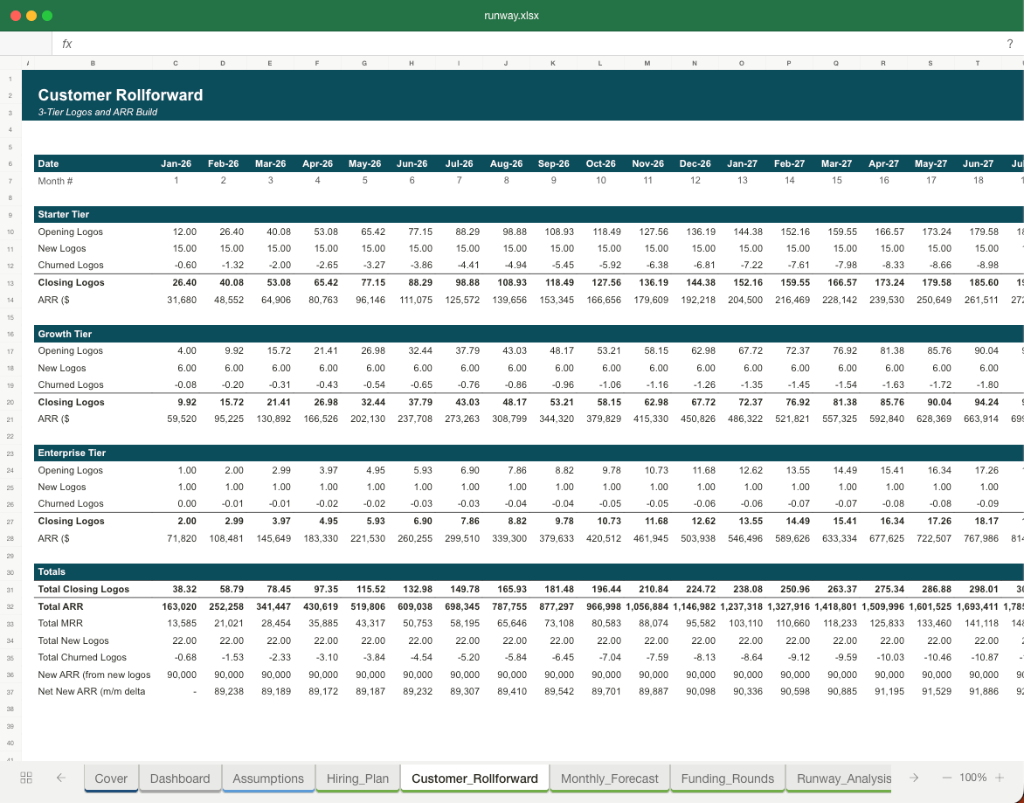
The model should stage pilot and gigafactory capex, commissioning, utilisation ramp, cell ASP per kWh, material and manufacturing COGS, scrap, and labour. Forecast revenue as GWh produced times price, with project financing and cash requirements layered underneath; construction timing, yield improvement, and price pressure are the decisive sensitivities.
A turnkey financial model
Live formulas, no hardcoded values
Outputs are driven by live formulas, so the workbook updates from its assumptions instead of relying on hardcoded results.
All assumptions in one tab
Inputs are clearly marked in the Assumptions tab and separated from calculations, making it clear what to change and what to leave intact.
Statements always balancing
For integrated-statement models, the balance sheet, cash flow, and supporting schedules tie through properly.
Distinct schedules for clarity
Debt, working capital, taxes, and cash flow can get messy quickly. We group calculations in clear schedules, not across disconnected tabs.
No hidden macros or external links
There are no unexplained external workbook links or macros to undermine auditability or portability.
Changes flow through the model
Update a key driver and see the impact carry through the forecast, financing, and return outputs. We never use hardcoded numbers in formulas.
About Verkor
verkor.com
How to build a detailed financial model for Verkor
A complete walkthrough of the business, drivers, and assumptions behind the downloadable Verkor model - distilled from its pitch deck and publicly available information.
Product & value proposition
- Battery cells manufactured at industrial scale with a digitally-optimised production process.
- Two differentiators claimed: (1) BIMS (Battery Intelligent Manufacturing System) - unified cloud/data architecture across the production line to reduce scrap and boost yield; (2) DROPS (Direct Recycling of Production Scraps) - in-line recycling of production waste.
- Value proposition: best production yield on market → lower cell cost per kWh and lower CO₂ footprint vs. incumbents.
- First milestone: Verkor Innovation Centre (VIC) - 50–150 MWh/y pilot line in a 12,000 m² building; R&D lab + training centre for 100–150 direct jobs.
- Gigafactory: 16 GWh initial capacity (target start 2024), scaling to 50 GWh by 2030.
Market
- Competitive framing: European gigafactories concentrated in Northern Europe and cannot meet demand - Verkor positions in Southern Europe as an underserved region.
- Competitors/peers mapped on slide: Northvolt, CATL, LG, Samsung, Tesla, PSA/ACC, SVOLT, MORROW, AMTE, AV, ItalVolt, InoBat.
- No TAM/SAM/SOM figures, no market-size numbers, no EV market growth figures in deck.
Revenue model
- Revenue model: B2B battery cell sales to EV OEMs and pack integrators (Renault Group confirmed as application partner).
- Pricing basis: per-kWh cell pricing (industry standard); no $/kWh figure stated in deck.
- Channels: direct supply agreements with OEMs (Renault Group MoU); pack integrators (MoUs to be announced).
- At 16 GWh capacity: powers ~300,000 cars/year (implied ~54 kWh average pack).
- No revenue figures, no pricing, no contracted volume in deck.
Traction & metrics
- VIC: 50–150 MWh/y pilot line capacity; 12,000 m² building; 100–150 direct jobs at VIC.
- Gigafactory Phase 1: 16 GWh initial production capacity, start 2024.
- Gigafactory Phase 2: 50 GWh target by 2030.
- Jobs: 2,000+ direct jobs; 10,000 indirect jobs (at full 16 GWh scale).
- Cars powered: 300,000 per year at 16 GWh.
- Team: 40+ experts; 200+ years cumulative battery experience.
- No revenue, no contracts signed with volumes, no financial traction data in deck.
Competition / moat
- Geographic moat: only gigafactory planned in Southern Europe; all major incumbents cluster in Northern/Central Europe.
- Technology moat: BIMS digital manufacturing platform + DROPS in-line recycling system claimed to deliver best production yield → lowest cell cost + lowest CO₂.
- Talent moat: team with prior roles at Tesla, BMW, Panasonic, Samsung, A123 Systems, Northvolt, SVOLT.
- Ecosystem moat: consortium covering full value chain - Arkema + Tokai Cobex (active materials), Schneider Electric + Capgemini (manufacturing), Renault Group (application), EQT Ventures + InnoEnergy + IDEC + Demeter FMET (investors/backers).
Team & funding ask / use of funds
- CEO: Benoit Lemaignan (Airbus, Carbone 4, InnoEnergy, Waga Energy).
- CSO: Sylvain Paineau (Thales, Schneider Electric, InnoEnergy).
- CTO: Christophe Mille (BMW, Apple, Tesla).
- CIO: Gilles Moreau (Lancey, CEA).
- CCO: Philippe Chain (Tesla, Renault, Audi).
- CMO: Anna Teyssot (Renault, Alliance Ventures).
- Operations: Sam Kim (SVOLT, A123 Systems).
- Finance: Charline Baechele (Deloitte, InnoEnergy).
- Backers shown: EQT Ventures, EIT InnoEnergy, IDEC Groupe, Demeter FMET.
Recommended financial model
- Archetype + why: Industrial project finance / capacity-build P&L model - this is a pre-revenue hard-asset manufacturing startup. The correct archetype is a phased capex + production ramp model: (1) VIC pilot phase capex and opex, (2) Gigafactory Phase 1 (16 GWh, 2024 start) with ramp curve, (3) Phase 2 expansion to 50 GWh by 2030. Revenue is GWh produced × $/kWh ASP. NOT a SaaS or marketplace model.
- Forecast horizon & granularity: 2021–2030 annual (10 years). Monthly granularity for VIC phase (2021–2023); annual from 2024 onward.
- Key drivers & assumptions:
- VIC capacity: 50–150 MWh/y; use 100 MWh/y midpoint for base case
- VIC capex: €30–50M, typical for 12,000 m² pilot battery line; not in deck
- Phase 1 Gigafactory capacity: 16 GWh
- Phase 1 start date: 2024
- Phase 1 capex: ~€1.2–1.5B (industry benchmark ~€75–100M/GWh for greenfield); not in deck
- Phase 2 capacity: 50 GWh; target year 2030
- Phase 2 capex: incremental ~€2.5–3B for additional 34 GWh
- Ramp curve: 30% / 60% / 85% / 95% utilisation in years 1–4 post start-up (standard gigafactory ramp)
- Battery cell ASP: €80/kWh in 2024 declining to €60/kWh by 2030 (industry consensus trajectory)
- Cell COGS: €65/kWh at start, improving to €45/kWh by 2030 via yield gains and scale (moat claim)
- Gross margin: ~18–25% at scale (range consistent with tier-1 cell manufacturers)
- Headcount: 2,000+ direct at 16 GWh; €60–80K avg loaded salary → ~€130–160M annual labour cost at Phase 1 scale
- Scrap/yield rate: 5–8% scrap (better than market due to BIMS/DROPS); drives COGS improvement
- Revenue per car: 300,000 cars at 16 GWh → implied ~53 kWh average pack size
- Scenarios (Base / Bull / Bear - which variables flex):
- Bull: Phase 1 ramp faster (full utilisation by year 2); ASP decline slower (€85→€70); higher yield from BIMS
- Base: standard ramp; ASP €80→€60; industry-average yield improvement
- Bear: 12-month construction delay to Phase 1; ASP compressed by CATL/Northvolt competition (€75→€50); yield improvement slower
- Required sheets / outputs:
- Assumptions - all drivers with scenario toggles
- VIC P&L - pilot line 2021–2023 (capex, opex, headcount, grant income if any)
- Gigafactory Build - capex schedule Phase 1 and Phase 2, debt/equity split, depreciation
- Production Model - GWh capacity, utilisation ramp, MWh output, scrap loss
- Revenue & COGS - GWh sold × ASP, raw material costs, labour, energy, overhead
- P&L - gross margin, EBITDA, EBIT, D&A, net income
- Balance Sheet - PP&E build, debt drawdown and repayment, equity raises
- Cash Flow - operating CF, capex, financing; liquidity and covenant headroom
- Funding Waterfall - equity rounds, debt (likely project finance), grants/subsidies (EU/French state likely given InnoEnergy backing)
- Dashboard - KPIs: GWh produced, $/kWh ASP, gross margin %, EBITDA %, cumulative capex, cash runway
Frequently asked
Is the Verkor financial model free?+
Yes. The Verkor model is a free Excel (.xlsx) download with live formulas. Sign up with your email and the workbook is yours to keep, review, and edit.
What's included in the model?+
A 5-year monthly forecast with P&L, cash flow and runway, valuation (exit multiple plus a DCF cross-check), MOIC/IRR returns, and unit economics, with live formulas throughout.
How was this model built?+
It was built from Verkor's pitch deck and publicly available information, then structured to investment-banking standards as a fully editable Excel model.
Can I change the assumptions?+
Yes. You can change assumptions and the live formulas will recalculate in the downloadable Excel model.
Have more financial modelling questions? Contact us

Created by ex-finance professionals
Hey, I’m Alex and I created Finamodel.
Over my years in the finance industry I kept building the same models over and over again. Same structure, same assumptions, different logo. So I started building frameworks to turn them into clean, reusable templates.
Every model here is one I’d actually use for a client, and I personally vet each one before it goes up.
I’m not an expert in every industry, but I’ve built enough models to know what belongs in one. And when something is completely foreign to me, I reach out to my network for experts to work on our models with us.
Having a template library on hand cuts a first build from hours to minutes.
Need help finding your model? You’ll find me in the Finamodel app!
Other Climate/Energy Startup Financial Models
Browse another startup in the same category.

Abatable
Robo-advisor platform for sourcing and managing high-quality carbon removal offsets, targeting asset managers.
Bower
Mobile app that rewards consumers for scanning and recycling consumer packaging at existing bins, monetised by CPG brand subscriptions and consumer data.
Bramble Energy
UK deep-tech company commercialising a PCB-based hydrogen fuel cell stack (PCBFC™) for portable power and mobility applications.

Cervest
AI-powered Climate Intelligence platform that quantifies physical climate risk at the asset level, delivered as a freemium SaaS product.

Clockworks Analytics
B2B SaaS platform providing automated fault-detection and diagnostics (FDD) analytics for commercial and institutional building portfolios.

Dandelion Energy
Dandelion Energy installs residential geothermal heat pump systems (ground-source HVAC) with in-house financing, targeting US homeowners on fossil-fuel heating.

Emitwise
B2B SaaS platform automating corporate carbon footprint tracking, reporting, and reduction using machine learning.
Fisker
Fisker is an asset-light, design-led EV company merging with Spartan Energy Acquisition Corp. in a SPAC transaction to fund the launch of the Fisker Ocean SUV.