 Wagestream Financial Model
Fintech Startup Financials (Free Excel Download)
B2B2C financial wellbeing super-app for frontline workers, built around Earned Wage Access (EWA)



professionals from Deloitte
Used by professionals from






About this model
Wagestream is a B2B2C financial-wellbeing app for frontline workers, built around earned wage access. Employers deploy the service to their workforce, and employees can access a portion of pay already earned before their normal payday.
The business earns a £1.75 fee per earned-wage-access transaction and an employer-paid monthly SaaS fee. Savings, insurance, credit, and open-banking products broaden the long-term proposition, while a debt warehouse supports the EWA funding float.
The model should forecast employer contracts, eligible employees, activation, EWA transactions per active user, and employer subscription revenue. Advance balances, funding cost, repayment timing, loss exposure, and partner-service adoption must be separate schedules in the three-statement forecast.
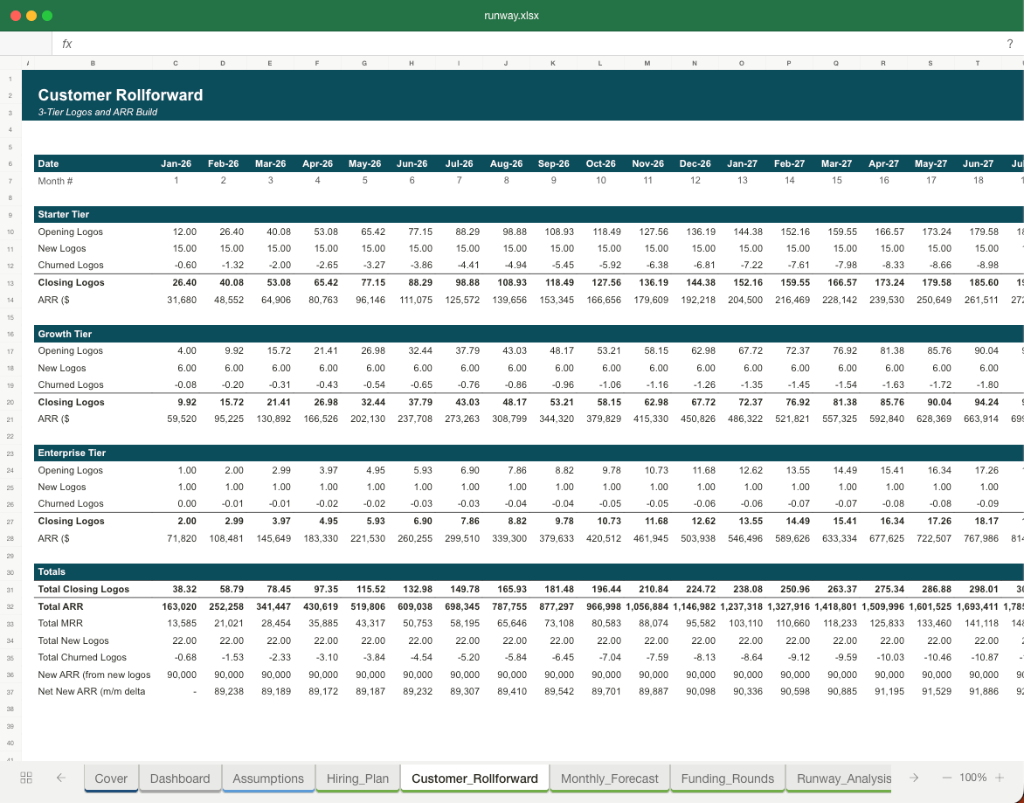
A turnkey financial model
Live formulas, no hardcoded values
Outputs are driven by live formulas, so the workbook updates from its assumptions instead of relying on hardcoded results.
All assumptions in one tab
Inputs are clearly marked in the Assumptions tab and separated from calculations, making it clear what to change and what to leave intact.
Statements always balancing
For integrated-statement models, the balance sheet, cash flow, and supporting schedules tie through properly.
Distinct schedules for clarity
Debt, working capital, taxes, and cash flow can get messy quickly. We group calculations in clear schedules, not across disconnected tabs.
No hidden macros or external links
There are no unexplained external workbook links or macros to undermine auditability or portability.
Changes flow through the model
Update a key driver and see the impact carry through the forecast, financing, and return outputs. We never use hardcoded numbers in formulas.
About Wagestream
wagestream.com
How to build a detailed financial model for Wagestream
A complete walkthrough of the business, drivers, and assumptions behind the downloadable Wagestream model - distilled from its pitch deck and publicly available information.
Product & value proposition
- Core product: Earned Wage Access (EWA) - employees access pay on-demand before payday; launched 2018
- Super-app roadmap with 5 pillars: Assets (track + open banking + human coach), Payments (flexible pay / EWA), Deposits (savings from salary), Credit, Insurance
- Employer-side: portal with anonymised, aggregated employee financial health data; connects ERP, WFM, Payroll, HRIS
- Social impact framing: "eradicate the poverty premium" - frontline workers pay £468/person/year extra for same financial services vs. office workers
- Achieved impact claims: nudged 50,000 workers to save for first time; prevented 100,000 predatory payday loans
Market
- UK frontline workforce: 12 million workers = 43% of workforce
- Median frontline worker earnings: £24,000/year vs. £52,000 for office workers
- "Poverty premium" market inefficiency: £5.6 billion per year in extra financial service costs paid by frontline workers
- Per-worker poverty premium: £468/person/year
- Stated 2025 target: serve 20 million frontline workers (implies international expansion beyond UK)
Revenue model
- Stream 1 - Transaction fee: employees pay £1.75 per EWA transaction
- Stream 2 - SaaS fee: employers pay a monthly SaaS fee (amount not specified)
- Channel: B2B sales to large enterprises → employer deploys to workforce → employees opt in
- Additional pillar revenue (savings, insurance, credit, open banking) implied by product roadmap but no pricing shown
- Debt warehouse (£25M, Shawbrook Bank, Apr 2019) suggests balance sheet funding for EWA float
Traction & metrics
- Employee Adoption rate: 60% (vs. nearest competitor 33%)
- MAU:Download ratio: 54% (vs. nearest competitor 40%)
- DAU:MAU ratio: 38% (vs. competitors ranging 10%–50%; Wagestream ranks 3rd)
- Workers nudged to save for first time: 50,000
- Predatory payday loans prevented: 100,000
- Client NPS proxy: >60% of Wagestream clients actively promote on LinkedIn
- Named employer clients: Toolstation, Bupa, NHS Royal Surrey, Stonegate, NHS Frimley Health, REKM United Kingdom
Unit economics
- EWA transaction fee: £1.75/transaction
- Employer SaaS fee: undisclosed amount
- CAC (employer or employee), LTV, gross margin, contribution margin, payback period: Not in deck
- Implied float cost: debt warehouse carries interest cost (Shawbrook Bank facility) - rate not disclosed
Competition / moat
- Deck positions Wagestream as creator of the Earned Wage Access category in the UK
- Moat claims: enterprise data integrations (ERP/WFM/Payroll/HRIS), proprietary dataset connecting payroll + work schedule data enabling new product types, high employee adoption (60% vs. 33% next best)
- Competitive benchmarking: bar charts on slide 9 compare adoption and engagement vs. unnamed competitors - Wagestream leads on Employee Adoption and MAU:Download; ranks 3rd on DAU:MAU
Team & funding ask / use of funds
- Total equity raised to date: £40M
- Funding history:
- Apr 2018: £1.5M Seed (Fair by Design, QED Investors, Village Global)
- Aug 2018: £3.5M Seed (LeadEdge Capital)
- May 2019: £15M Series A (Northzone, Balderton Capital)
- Apr 2019: £25M Debt Warehouse (Shawbrook Bank)
- Jun 2020: £20M Series B (LocalGlobe)
Recommended financial model
- Archetype + why: B2B2C Embedded Fintech - dual revenue 3-statement model with EWA volume driver. Two distinct revenue lines (employer SaaS + employee transaction fees) driven by enterprise headcount and activation rates. The EWA float/debt facility makes a balance sheet and cash flow statement essential. Closest archetype is a marketplace/usage-based model layered on a SaaS subscription base.
- Forecast horizon & granularity: 5 years (2022–2026) monthly for Year 1, quarterly thereafter. Series C investors will want to see the path to the 20M worker target by 2025.
- Key drivers & assumptions:
| Driver | Value | Source |
|---|---|---|
| EWA transaction fee | £1.75 / transaction | - |
| Employee adoption rate | 60% of enrolled workforce | - |
| MAU:Download ratio | 54% | - |
| DAU:MAU ratio | 38% | - |
| Frontline worker addressable pool (UK) | 12M | - |
| Target workers served by 2025 | 20M (implies international) | - |
| Poverty premium per worker | £468/year | - |
| Employer SaaS fee (monthly) | £2–5/employee/month - typical EWA SaaS range; no deck figure | |
| EWA transactions per active user per month | 2–3 - consistent with bi-weekly pay cycle access patterns | |
| EWA draw size per transaction | £150–300 - based on median £24K salary and partial advance norms | |
| Float utilisation rate | 40–60% of warehouse facility at any time | |
| Debt facility cost (warehouse) | 4–6% p.a. - Shawbrook Bank 2019 rate range | |
| Gross margin on SaaS line | 70–80% - software delivery, minimal variable cost | |
| Gross margin on transaction line | 50–65% - net of float funding cost and payment processing | |
| Customer churn (employer) | 5–10% annual - enterprise stickiness given deep HR integrations | |
| Employee churn | tracks employer workforce turnover (~25% for frontline sector) | |
| New employer logo adds per quarter | ramp from current base; apply S-curve to 20M worker target | |
| Average employer size (employees) | 2,000–5,000 - enterprise focus suggested by named clients (NHS, Bupa, Stonegate) | |
| Sales cycle (employer) | 3–6 months - enterprise HR/payroll procurement | |
| CAC (employer) | £15–30K per employer logo - enterprise B2B SaaS benchmark | |
| International revenue share by 2025 | ~40% - required to reach 20M workers from 12M UK total |
- Scenarios (Base / Bull / Bear - which variables flex):
- Flex: employer logo adds per quarter, employee adoption rate, transactions per active user/month, employer SaaS fee, international penetration speed
- Bear: adoption stays at 30–35% (competitor level), SaaS fee compression, slower international rollout
- Base: 60% adoption holds, 20M workers by 2026 (1 year slip), SaaS + transaction mix balanced
- Bull: super-app pillars (savings, insurance, credit) add meaningful ARPU lift by 2024; adoption reaches 70%+
- Required sheets / outputs:
- Assumptions - all drivers with scenario toggle (Base/Bull/Bear)
- Employer Cohorts - logo adds, headcount enrolled, churn
- Employee Activation - adoption rate, MAU, DAU, transaction volume
- Revenue - SaaS line + transaction fee line + future pillar placeholders (savings, insurance, credit)
- EWA Float Model - warehouse draw, utilisation, interest cost
- P&L (Income Statement) - revenue, gross profit by stream, OpEx, EBITDA
- Balance Sheet - float receivables, warehouse debt, equity
- Cash Flow Statement - operating, investing, financing; runway
- Dashboard / KPIs - workers served, employer count, GMV advanced, ARPU, LTV:CAC
Frequently asked
Is the Wagestream financial model free?+
Yes. The Wagestream model is a free Excel (.xlsx) download with live formulas. Sign up with your email and the workbook is yours to keep, review, and edit.
What's included in the model?+
A 5-year monthly forecast with P&L, cash flow and runway, valuation (exit multiple plus a DCF cross-check), MOIC/IRR returns, and unit economics, with live formulas throughout.
How was this model built?+
It was built from Wagestream's pitch deck and publicly available information, then structured to investment-banking standards as a fully editable Excel model.
Can I change the assumptions?+
Yes. You can change assumptions and the live formulas will recalculate in the downloadable Excel model.
Have more financial modelling questions? Contact us

Created by ex-finance professionals
Hey, I’m Alex and I created Finamodel.
Over my years in the finance industry I kept building the same models over and over again. Same structure, same assumptions, different logo. So I started building frameworks to turn them into clean, reusable templates.
Every model here is one I’d actually use for a client, and I personally vet each one before it goes up.
I’m not an expert in every industry, but I’ve built enough models to know what belongs in one. And when something is completely foreign to me, I reach out to my network for experts to work on our models with us.
Having a template library on hand cuts a first build from hours to minutes.
Need help finding your model? You’ll find me in the Finamodel app!
Other Fintech Startup Financial Models
Browse another startup in the same category.
Acin
SaaS and data subscription network for operational risk management at Tier 1 financial institutions

Ageras Group
B2B SME ecosystem - marketplace connecting SMEs with accountants + cloud accounting/payroll software + embedded financial services (lending, factoring, banking)

Airbase
Unified non-payroll spend management platform (corporate cards, AP/bill pay, expense reimbursement, approval workflows) for mid-market companies.

Altruist
Vertically integrated all-in-one platform for registered investment advisors (RIAs) - combining custodial, portfolio management, practice management, and client acquisition tools.
Amenitiz
All-in-one hotel management SaaS platform ("Shopify for hotels") for independent hoteliers - PMS, booking engine, channel manager, website builder, payments, and AI-driven revenue management.

Anrok
SaaS sales tax compliance platform - nexus monitoring, calculation, registration, filing, and remittance - built specifically for SaaS companies.
Arrival
Arrival is an EV manufacturer of commercial vans and buses using proprietary Microfactories and vertically integrated components, going public via SPAC merger with CIIG Merger Corp.

AtoB
AtoB is building financial infrastructure for commercial fleets, starting with a no-fee Visa fleet card for fuel and expanding into payroll, BNPL, and international.