 World Fund Financial Model
Climate/Energy Startup Financials (Free Excel Download)
European climate tech VC fund targeting startups with Carbon Performance Potential (CPP) of at least 100 MtCO2e/year



professionals from Deloitte
Used by professionals from






About this model
World Fund is a European climate-tech venture fund investing from seed to Series B in companies with at least 100 MtCO2e of annual Carbon Performance Potential. It targets 10–20% ownership, reserves more than 65% of capital for follow-ons, and combines investing with policy and ecosystem access.
The LP pitch points to a large decarbonisation opportunity, a team history of more than 70 investments at 8.9x MOIC, and six Fund I deals at 1.4x MOIC. More than 1,650 inbound opportunities and a network of over 150 individuals and families support sourcing and fundraising.
The financial model should be a ten-year fund waterfall. Forecast commitments, calls, management fees, portfolio construction, initial and follow-on deployment, ownership, losses, exit proceeds, and distribution timing; then calculate carry and LP DPI, RVPI, TVPI, and net IRR. A corporate operating model would misrepresent the economics.
A turnkey financial model
Live formulas, no hardcoded values
Outputs are driven by live formulas, so the workbook updates from its assumptions instead of relying on hardcoded results.
All assumptions in one tab
Inputs are clearly marked in the Assumptions tab and separated from calculations, making it clear what to change and what to leave intact.
Statements always balancing
For integrated-statement models, the balance sheet, cash flow, and supporting schedules tie through properly.
Distinct schedules for clarity
Debt, working capital, taxes, and cash flow can get messy quickly. We group calculations in clear schedules, not across disconnected tabs.
No hidden macros or external links
There are no unexplained external workbook links or macros to undermine auditability or portability.
Changes flow through the model
Update a key driver and see the impact carry through the forecast, financing, and return outputs. We never use hardcoded numbers in formulas.
About World Fund
worldfund.vc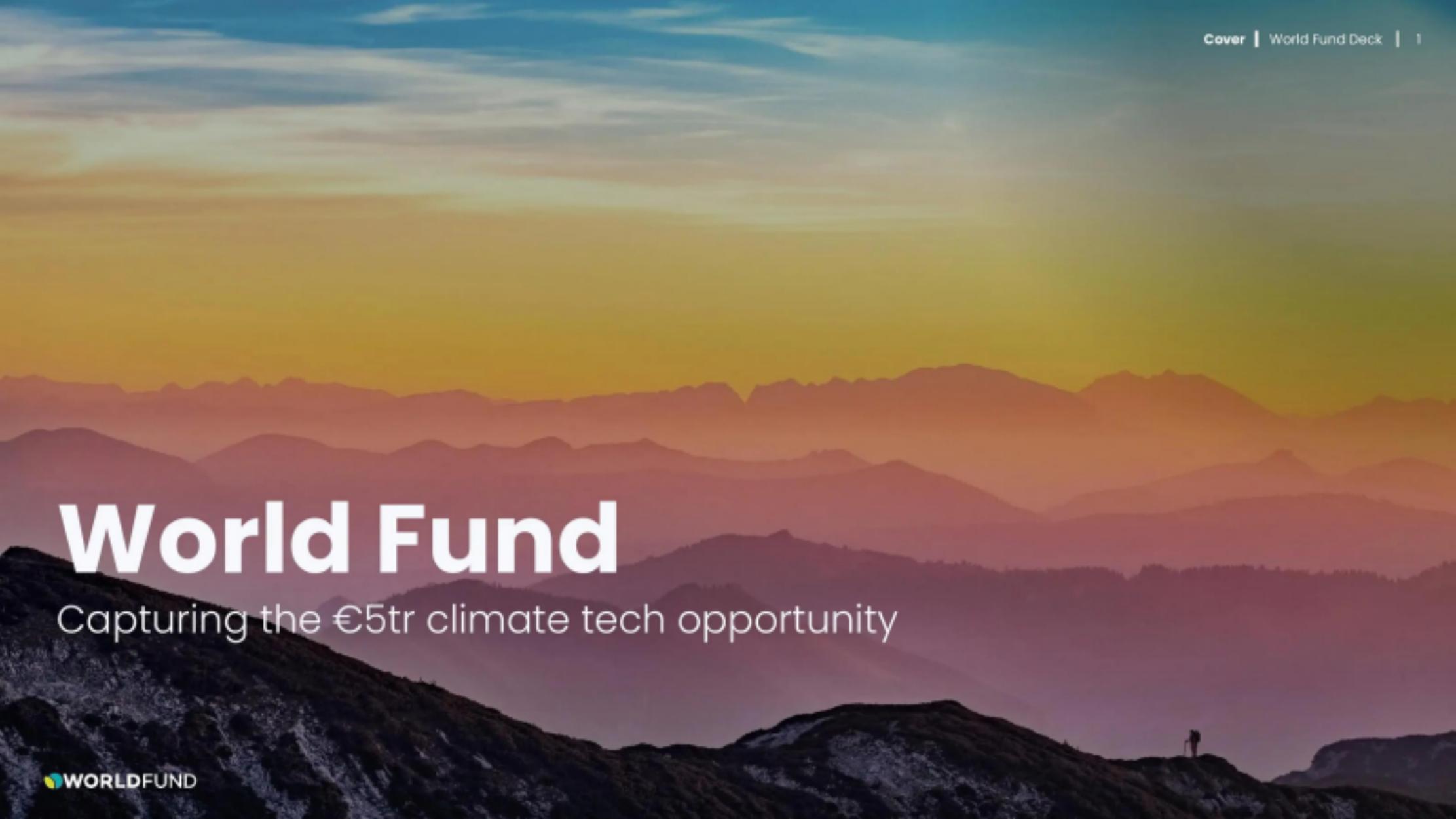
How to build a detailed financial model for World Fund
A complete walkthrough of the business, drivers, and assumptions behind the downloadable World Fund model - distilled from its pitch deck and publicly available information.
Product & value proposition
- Fund invests in climate tech startups from Seed to Series B
- Proprietary Climate Performance Potential (CPP) framework: minimum threshold of 100 MtCO2e annual reduction potential per portfolio company
- CPP methodology developed with CRANE, Project Drawdown, and TU Berlin
- Target ownership: 10–20% equity with active board roles
- Follow-on reserves: >65% of fund reserved for follow-on
- Competitive edge: thought leadership (highest-visibility climate tech VC per deck), >1,650 inbound deals since launch, policy influence via Cleantech for Europe, CRANE, European Parliament, German Ministry of Economy
- LP platform: >150 HNWIs, >120 interested in active involvement, LPs built >10 unicorns
Market
- €5tr market opportunity from decarbonization transformation
- €5.9tr in corporate revenue committed to Net-Zero that needs to be served
- Stacked-column chart (slide 4) shows mismatch: Mobility represents 16% of global emissions (2016) but received 61% of climate tech VC (2013–H1 2021); Energy 29% emissions vs. ~9% VC; Food & Agriculture 20% emissions vs. 12% VC; Built Environment 14% emissions vs. ~15% VC; Industry 21% emissions vs. ~4% VC
- "The next 1,000 unicorns will be in climate tech" - Larry Fink, Blackrock
- Europe: first continent to become net-zero by law
Revenue model
This is a fund, not an operating company. Economics follow standard VC fund structure:
- LP capital deployment: Multi-stage Seed to Series B; follow-on reserves >65%
- Target ownership per deal: 10–20%
Traction & metrics
- >70 investments by the team historically, 8.9x MOIC
- Fund I portfolio: 6 deals executed since 2021, performing at 1.4x MOIC
- Portfolio companies: Space Forge, Q_OA, Juicy Marbles, FreshFlow, Treecard, RECUP (exited)
- RECUP marked "Exited"
- >1,650 inbound deals since launch
- LinkedIn monthly reach >1,000,000; Twitter monthly reach >5,000,000; articles published >2,000
- LP base: >150 individuals & influential families; >120 interested in monthly active involvement
- LPs built >10 unicorns across focus sectors
- LP mix by capital invested: Tech entrepreneurs 41.3%, Climate tech pioneers 23.2%, Mittelstand & DAX 19.5%, Seasoned VCs/PEs 16.0%
- Ranked #1 European ESG fund (Preqin and other platforms)
Unit economics
Key observable data points for fund-level modelling:
- Current portfolio MOIC: 1.4x on 6 deals
- Team historical MOIC: 8.9x on >70 deals
- Target ownership: 10–20%
- Follow-on reserve ratio: >65%
Competition / moat
- Thesis: highest-visibility climate tech VC in Europe
- CPP framework as proprietary deal selection tool (quantified, science-backed)
- Co-VC network across all five sectors (Energy, Food/Agtech, Buildings, Industry, Transport)
- Team: Best Male + Best Female Investor 2020 (Bundesverband Deutsche Startups)
- Policy influence: seats at Cleantech for Europe, European Parliament, German federal ministry, CRANE, GIIN
- Comparable funds referenced as past co-investors: BP Ventures, Octopus Ventures, SET Ventures, Sofinnova, S2G Ventures, Astanor, Demeter, 2150, Picus Capital, BMW i Ventures, MANIV
Team & funding ask / use of funds
Team (slide 9):
- Tim Schumacher - Co-founder/CEO, IPOed Sedo, co-founder/chairman Eyeo (>400m users), >40 personal investments; Best Male Investor 2020
- Daria Saharova - Managing Partner Vito ONE, ex-Seven Ventures & HV Ventures, Jefferies GER; >20 early-stage investments; Best Female Investor 2020
- Danijel Visevic - Director Comms at Project A (>€500m AUM), comms office for Angela Merkel, 60k LinkedIn reach, >5m Twitter reach
- Craig Douglas - Principal at SET Ventures, ESG/climate reporting for 50+ funds, physicist & chemist
Funding ask: Not explicitly stated in deck. No fund size target, close date, or minimum ticket disclosed.
Use of funds: Multi-stage Seed to Series B climate tech investments across Energy, Food & Agriculture, Buildings, Industry & Manufacturing, Transportation
Recommended financial model
- Archetype + why: VC Fund Economics model. This is an LP pitch for a climate tech VC fund - the entity raising money is the GP/fund vehicle, not an operating startup. The correct model tracks capital deployment, management fees, portfolio construction, exit proceeds, carry, and LP return metrics (DPI, TVPI, IRR). An operating 3-statement or SaaS model would be wrong here.
- Forecast horizon & granularity:
- 10-year fund life (standard for European early-stage VC), annual granularity
- Investment period: years 1–4 (typical Seed–Series B deployment window)
- Harvest period: years 5–10
- Key drivers & assumptions:
- Management fee rate:
- Carried interest rate:
- Preferred return (hurdle):
- Number of portfolio companies:
- Average initial check size:
- Follow-on reserve ratio: >65%
- Target ownership: 10–20%
- Portfolio MOIC distribution: Base 3.0x gross / Bull 5.0x / Bear 1.5x is top-quartile; current fund at 1.4x early-stage]
- Loss ratio (write-offs):
- Average hold period to exit:
- Recycling of management fees / early exits:
- LP close / capital calls:
- Scenarios (Base / Bull / Bear - which variables flex):
- Bear: Gross fund MOIC 1.5x, higher loss ratio (50%), longer hold periods - tests whether carry is earned and LPs get capital back
- Base: Gross fund MOIC 3.0x, 35% loss ratio, 6-year average hold
- Bull: Gross fund MOIC 5.0x, 25% loss ratio, 5-year hold, 1–2 breakout unicorn outcomes (consistent with team's 8.9x track record)
- Required sheets / outputs:
- Assumptions - fund size, fee rates, carry, hurdle, deployment schedule, MOIC distribution
- Portfolio Construction - number of companies, check sizes, ownership %, follow-on schedule
- Capital Deployment - annual capital calls, cumulative deployed vs. committed
- P&L / Management Company - management fees by year, fund expenses, GP economics
- Exit Waterfall - gross proceeds by company, return of capital, preferred return, carry split (GP/LP)
- LP Returns - DPI, RVPI, TVPI, net IRR by scenario
- Sensitivity Table - net IRR vs. gross MOIC and fund size (or management fee rate)
Frequently asked
Is the World Fund financial model free?+
Yes. The World Fund model is a free Excel (.xlsx) download with live formulas. Sign up with your email and the workbook is yours to keep, review, and edit.
What's included in the model?+
A 5-year monthly forecast with P&L, cash flow and runway, valuation (exit multiple plus a DCF cross-check), MOIC/IRR returns, and unit economics, with live formulas throughout.
How was this model built?+
It was built from World Fund's pitch deck and publicly available information, then structured to investment-banking standards as a fully editable Excel model.
Can I change the assumptions?+
Yes. You can change assumptions and the live formulas will recalculate in the downloadable Excel model.
Have more financial modelling questions? Contact us

Created by ex-finance professionals
Hey, I’m Alex and I created Finamodel.
Over my years in the finance industry I kept building the same models over and over again. Same structure, same assumptions, different logo. So I started building frameworks to turn them into clean, reusable templates.
Every model here is one I’d actually use for a client, and I personally vet each one before it goes up.
I’m not an expert in every industry, but I’ve built enough models to know what belongs in one. And when something is completely foreign to me, I reach out to my network for experts to work on our models with us.
Having a template library on hand cuts a first build from hours to minutes.
Need help finding your model? You’ll find me in the Finamodel app!
Other Climate/Energy Startup Financial Models
Browse another startup in the same category.

Abatable
Robo-advisor platform for sourcing and managing high-quality carbon removal offsets, targeting asset managers.
Bower
Mobile app that rewards consumers for scanning and recycling consumer packaging at existing bins, monetised by CPG brand subscriptions and consumer data.
Bramble Energy
UK deep-tech company commercialising a PCB-based hydrogen fuel cell stack (PCBFC™) for portable power and mobility applications.

Cervest
AI-powered Climate Intelligence platform that quantifies physical climate risk at the asset level, delivered as a freemium SaaS product.

Clockworks Analytics
B2B SaaS platform providing automated fault-detection and diagnostics (FDD) analytics for commercial and institutional building portfolios.

Dandelion Energy
Dandelion Energy installs residential geothermal heat pump systems (ground-source HVAC) with in-house financing, targeting US homeowners on fossil-fuel heating.

Emitwise
B2B SaaS platform automating corporate carbon footprint tracking, reporting, and reduction using machine learning.
Fisker
Fisker is an asset-light, design-led EV company merging with Spartan Energy Acquisition Corp. in a SPAC transaction to fund the launch of the Fisker Ocean SUV.