 XPANCEO Financial Model
Fintech Startup Financials (Free Excel Download)
Deep tech startup developing a smart contact lens that delivers augmented/extended reality directly on the eye, replacing all screens.



professionals from Deloitte
Used by professionals from






About this model
XPANCEO is developing a smart contact lens intended to deliver augmented and extended reality directly on the eye. Its long-term vision is a computing platform that replaces conventional screens with a wearable device and associated ecosystem.
The company identifies device sales, advertising, app commissions, maintenance and warranty services, and financial products as potential revenue streams. The concept includes a recurring consumable-lens element alongside hardware, which can make lifetime revenue more important than the first device sale.
The model should forecast unit shipments, device price, replacement-lens subscriptions, hardware and consumable cost, active users, app spend, advertising impressions, and service attachment. Manufacturing capex, R&D, warranty reserves, and platform take rates should be kept separate in a hardware-plus-ecosystem P&L.
A turnkey financial model
Live formulas, no hardcoded values
Outputs are driven by live formulas, so the workbook updates from its assumptions instead of relying on hardcoded results.
All assumptions in one tab
Inputs are clearly marked in the Assumptions tab and separated from calculations, making it clear what to change and what to leave intact.
Statements always balancing
For integrated-statement models, the balance sheet, cash flow, and supporting schedules tie through properly.
Distinct schedules for clarity
Debt, working capital, taxes, and cash flow can get messy quickly. We group calculations in clear schedules, not across disconnected tabs.
No hidden macros or external links
There are no unexplained external workbook links or macros to undermine auditability or portability.
Changes flow through the model
Update a key driver and see the impact carry through the forecast, financing, and return outputs. We never use hardcoded numbers in formulas.
About XPANCEO
xpanceo.com
How to build a detailed financial model for XPANCEO
A complete walkthrough of the business, drivers, and assumptions behind the downloadable XPANCEO model - distilled from its pitch deck and publicly available information.
Product & value proposition
XPANCEO's smart contact lens embeds an AR display, solar cells, biosensors, camera, neural interface, adaptive prescription lens, data/power antenna, and batteries into a single contact lens form factor.
Key value props:
- Invisible and weightless - no head-mounted device
- 100% field of view (unlimited FOV for AR content)
- Replaces smartphone, laptop, tablet, TV in one interface
- "SuperVision" features: night vision, zoom, infrared
- Advanced biosensor platform: IOP, dry eye, cortisol, glucose, heart rate, temperature
- Health monitoring and well-being centre
- 20+ patent-pending technologies
- Top-5 optics laboratory (per BCG ranking)
Market
- AR market (TAM proxy): USD 10B in 2022 → USD 225B in 2030; CAGR 41%
- Combined TAM (medical, well-being, super vision, holographic): $750B
- Worldwide contact lens users by 2033: >250M
- Annual contact lens segment volume: >10B units/year
- Regional contact lens user base by 2033: USA 49M, South Korea 12M, UK 4.4M, Germany 3.5M
Revenue model
Five stated revenue streams:
- Selling devices (hardware)
- Advertising (AR on surfaces)
- Commissions from third-party apps and content
- Infrastructure, warranty, maintenance, repairs
- Financial products, services and payment systems
Per-user annual revenue breakdown implied (at scale):
- Device MSRP: $1,500 (annual replacement lens $50/month × 12 = $600 + $300 hardware = $900 cost, implying consumable model)
- App commission revenue: +$100/year per user
- Ad revenue: +$1,800/year per user (AR on surfaces)
Traction & metrics
- No revenue traction in deck - company is pre-commercial / R&D stage.
- User projection chart:
- 2026: 15K users (early adopters)
- 2027: 30K
- 2028: 500K
- 2029: 1M
- 2030: 2M
- 2031: 5M (cross-over point to non-CL users)
- 2032: 10M
- Team: 80% scientists/engineers; 50% PhD; 200+ published articles; co-founder Valentyn Volkov 7,000+ citations
- Founder Roman Axelrod: 3 exits, deals >$5B total
- Competitor Mojo Vision raised $204M, tested complete prototype on a human, then pivoted to microLED
Unit economics
- COGS (at tens-of-millions units/year scale): $900 per user/year ($50/month × 12 lenses + $300 device component)
- MSRP: $1,500
- Revenue on cost: ×3.4 (implying ~$3,060 total revenue per user including recurring streams)
- Gross / profit margin: 74%
- Additional per-user revenue streams: $100/year (app commissions) + $1,800/year (ads)
Note: the ×3.4 revenue-on-cost metric and 74% margin appear to be blended across all revenue streams at assumed scale, not year-1 economics.
Competition / moat
Competitors:
- Mojo Vision - raised $204M, pivoted to microLED; validated the category
- Innovega Inc. - iOptik smart contact lens + glasses hybrid
- InWith Corp. - electronic soft contact lens for Metaverse
- SmartLens / Sensimed - medical-only (glaucoma)
vs. AR glasses (implicit competition):
- Bulky, uncool, restrict peripheral vision, need cleaning, distract others
Moat claims:
- 20+ patent-pending technologies
- Top-5 global optics lab (BCG)
- Novel 2D materials (transition metal dichalcogenides), perovskite solar cells, femtosecond laser-based nanoparticles - published in Nature Communications, Nano Letters, PNAS
- Full-stack: optics, AI, novel materials, neural interfacing
Team & funding ask / use of funds
Team:
- Founder: Roman Axelrod - serial entrepreneur (computer vision, esports, fintech); 3 exits; $5B+ deal experience
- Co-founder: Valentyn Volkov, PhD - nanophotonics expert; 20+ years; 200+ papers; 7,000+ citations
Recommended financial model
- Archetype + why: Hardware + platform subscription/ad model. XPANCEO is a device company with layered recurring software/advertising revenue - closest archetype is a consumer hardware + ecosystem model (think iPhone + App Store economics, but with AR ads). Best modelled as a unit-economics-driven revenue build combining device sales (one-time or annual consumable), app-commission SaaS-like revenue, and advertising CPM/DAU revenue. A light 3-statement P&L (IS + BS + CF) wraps the top.
- Forecast horizon & granularity: 2026–2032 (7 years), annual. Mirrors the deck's own user curve. Pre-launch years (2024–2025) shown as R&D burn only.
- Key drivers & assumptions:
| Driver | Value | Source |
|---|---|---|
| Launch year | 2026 | - |
| Users 2026 | 15,000 | - |
| Users 2027 | 30,000 | - |
| Users 2028 | 500,000 | - |
| Users 2029 | 1,000,000 | - |
| Users 2030 | 2,000,000 | - |
| Users 2031 | 5,000,000 | - |
| Users 2032 | 10,000,000 | - |
| Device MSRP | $1,500/user/year | - |
| COGS per user/year (at scale) | $900 | - |
| App commission revenue/user/year | $100 | - |
| Ad revenue/user/year | $1,800 | - |
| Blended profit margin (at scale) | 74% | - |
| Revenue/cost multiple | ×3.4 | - |
| COGS ramp (early years, pre-scale) | Higher, ~$2,000–$3,000/unit | early production runs are more expensive before volume discounts; deck's $900 is stated at "tens of millions of lenses/year" |
| Ad revenue ramp-in | 0% at launch → 100% by 2029 | ad inventory requires scale; unlikely from day 1 |
| App commission ramp-in | 25% in 2026 → 100% by 2028 | app ecosystem needs time to build |
| R&D opex (pre-launch) | $20–50M/year burn; no data in deck | |
| G&A + Sales & Marketing as % of revenue | ~20–30% in early years, declining to ~15% at scale; benchmarked against hardware/platform cos | |
| Annual churn / replacement rate | ~10–15%/year; contact lenses are consumables with natural cadence but smart lens may have longer commitment | |
| TAM penetration ceiling | ~4% of 250M CL users by 2032 (=10M) | - |
- Scenarios (Base / Bull / Bear - which variables flex):
- Base: Deck's stated user curve; full MSRP; ad revenue starts 2028
- Bull: User adoption 1.5× base; ad ARPU $2,500/year; faster crossover to non-CL users
- Bear: 2-year delay to product-market fit; users 50% of base; no ad revenue until 2030; COGS 20% higher than stated
- Required sheets / outputs:
- Assumptions (all drivers above, toggleable)
- User Growth Model (annual cohorts, new users, cumulative active users)
- Revenue Build (device revenue + app commissions + ad revenue + services; by stream)
- COGS & Gross Margin (scale curve on unit cost)
- Opex (R&D, S&M, G&A - pre-launch heavy)
- Income Statement (P&L through EBITDA)
- Simplified Balance Sheet + Cash Flow (to show funding need and runway)
- Scenario Toggle (Base / Bull / Bear)
- Dashboard (KPI summary: users, revenue, EBITDA, cash runway)
Frequently asked
Is the XPANCEO financial model free?+
Yes. The XPANCEO model is a free Excel (.xlsx) download with live formulas. Sign up with your email and the workbook is yours to keep, review, and edit.
What's included in the model?+
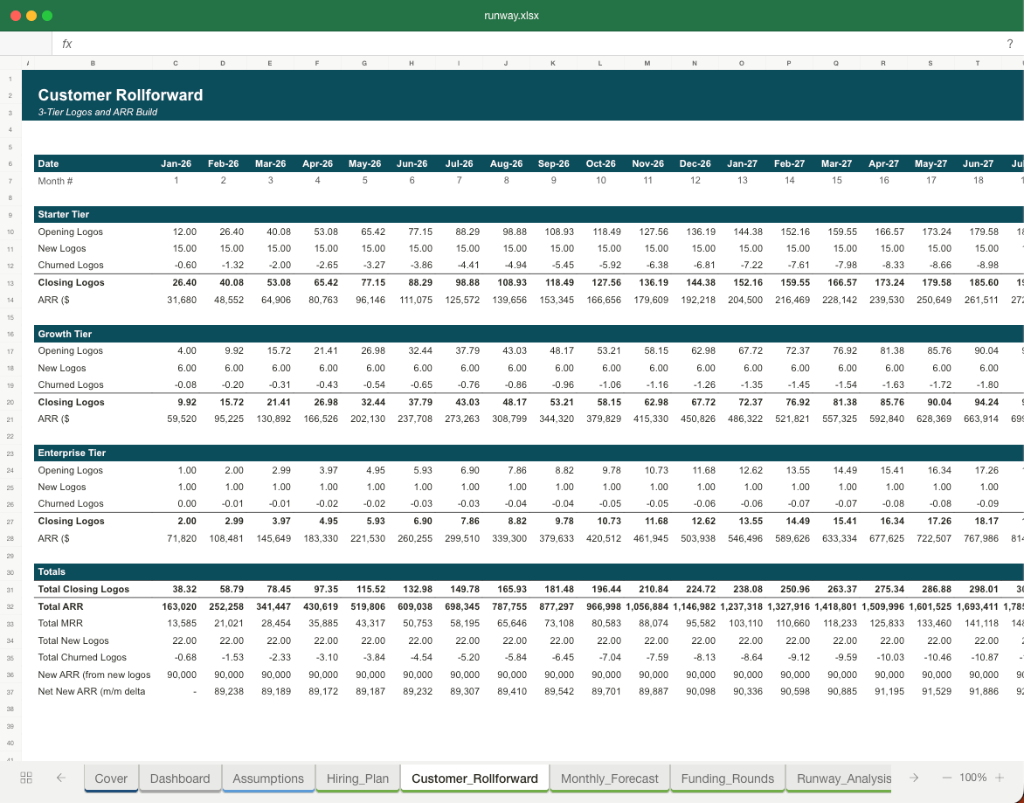
A 5-year monthly forecast with P&L, cash flow and runway, valuation (exit multiple plus a DCF cross-check), MOIC/IRR returns, and unit economics, with live formulas throughout.
How was this model built?+
It was built from XPANCEO's pitch deck and publicly available information, then structured to investment-banking standards as a fully editable Excel model.
Can I change the assumptions?+
Yes. You can change assumptions and the live formulas will recalculate in the downloadable Excel model.
Have more financial modelling questions? Contact us

Created by ex-finance professionals
Hey, I’m Alex and I created Finamodel.
Over my years in the finance industry I kept building the same models over and over again. Same structure, same assumptions, different logo. So I started building frameworks to turn them into clean, reusable templates.
Every model here is one I’d actually use for a client, and I personally vet each one before it goes up.
I’m not an expert in every industry, but I’ve built enough models to know what belongs in one. And when something is completely foreign to me, I reach out to my network for experts to work on our models with us.
Having a template library on hand cuts a first build from hours to minutes.
Need help finding your model? You’ll find me in the Finamodel app!
Other Fintech Startup Financial Models
Browse another startup in the same category.
Acin
SaaS and data subscription network for operational risk management at Tier 1 financial institutions

Ageras Group
B2B SME ecosystem - marketplace connecting SMEs with accountants + cloud accounting/payroll software + embedded financial services (lending, factoring, banking)

Airbase
Unified non-payroll spend management platform (corporate cards, AP/bill pay, expense reimbursement, approval workflows) for mid-market companies.

Altruist
Vertically integrated all-in-one platform for registered investment advisors (RIAs) - combining custodial, portfolio management, practice management, and client acquisition tools.
Amenitiz
All-in-one hotel management SaaS platform ("Shopify for hotels") for independent hoteliers - PMS, booking engine, channel manager, website builder, payments, and AI-driven revenue management.

Anrok
SaaS sales tax compliance platform - nexus monitoring, calculation, registration, filing, and remittance - built specifically for SaaS companies.
Arrival
Arrival is an EV manufacturer of commercial vans and buses using proprietary Microfactories and vertically integrated components, going public via SPAC merger with CIIG Merger Corp.

AtoB
AtoB is building financial infrastructure for commercial fleets, starting with a no-fee Visa fleet card for fuel and expanding into payroll, BNPL, and international.