Debt Service Coverage Ratio (DSCR): Formula and How Lenders Use It

Key Takeaways
- DSCR = NOI / Annual Debt Service, and it tests whether a property's actual cash flow - not its appraised value - can service the loan.
- DSCR and LTV are different tests that protect the lender differently. DSCR checks cash flow coverage; LTV checks collateral value. Lenders take the lower loan amount implied by either test.
- Typical minimums run 1.15x–1.30x depending on loan type and property risk, with multifamily and conventional commercial mortgages usually landing at 1.20x–1.25x.
- Always stress-test DSCR against a higher rate and lower NOI - the base-case ratio only tells you the deal works today, not that it survives a bad year.
- Reverse the formula to size the loan, not just to check a ratio after the fact:
Max Loan = PV(Rate, Term, -NOI / Minimum DSCR / 12)is exactly what a lender's underwriter is running. - Debt yield and interest coverage are close cousins, not substitutes - know which ratio a specific lender or loan document is actually using before you compare deals.
Ready to size your own deal? Run your numbers through the DSCR calculator above, explore a live preview of the real estate fund model below, or go deeper on the full underwriting build in our guide to building a real estate pro forma.
The debt service coverage ratio (DSCR) measures how many times over a property's net operating income covers its annual mortgage payment - it is the single number that decides whether a lender will fund a commercial or investment real estate loan, and at what size. This guide covers the formula, what counts as "debt service," a fully worked 24-unit multifamily example, minimum DSCR requirements by loan type, how lenders stress-test it, and why DSCR (not LTV) is often the constraint that actually caps your loan.
Every income-property lender runs the same test before funding a loan: does the property generate enough cash to comfortably pay the mortgage? That test is the debt service coverage ratio. Where the loan-to-value (LTV) ratio protects the lender against a decline in collateral value, DSCR protects them against a decline in the cash flow that actually pays the note. For income-producing real estate, DSCR is usually the tighter constraint of the two - which is why sponsors need to underwrite it, not just glance at it.
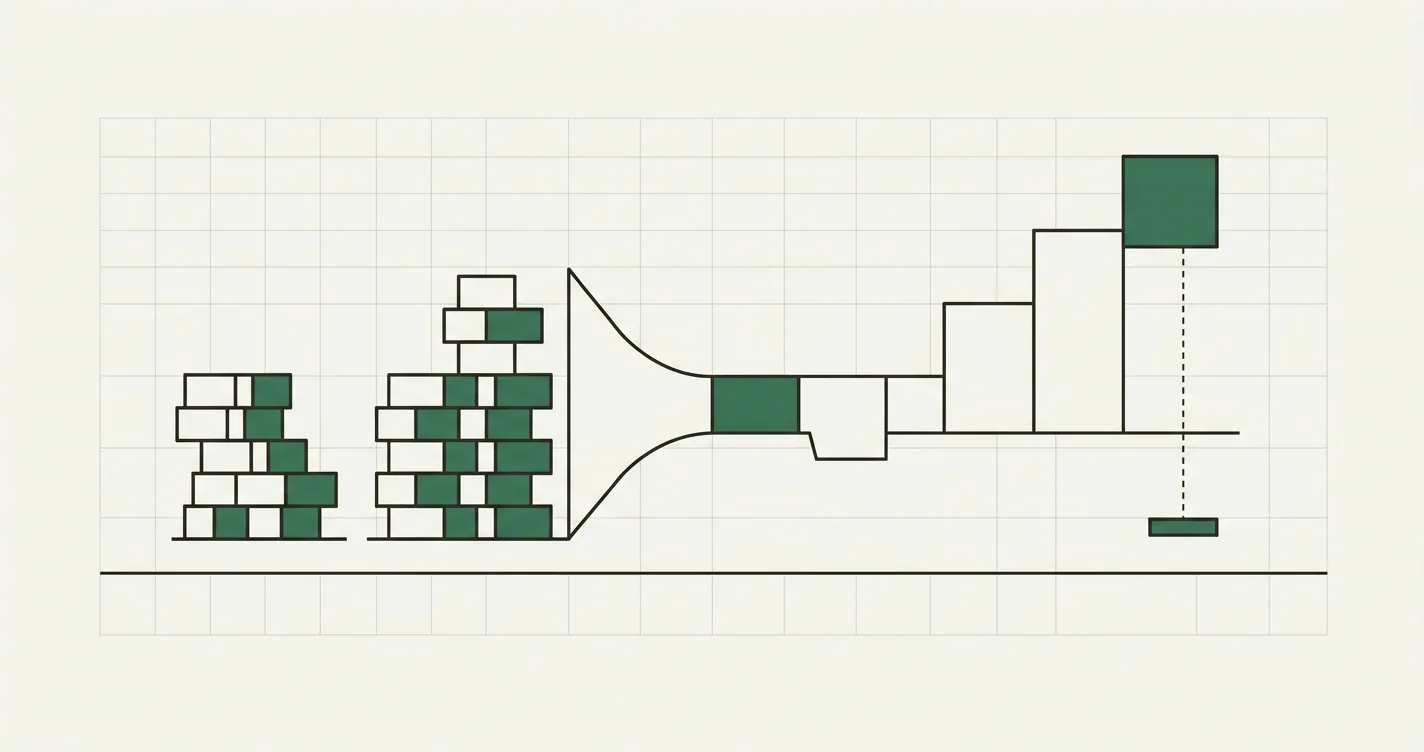
How DSCR sits between NOI and the lender's go/no-go decision on loan sizing
What DSCR Measures and Why Lenders Use It
DSCR answers one question: for every dollar of mortgage payment due this year, how many dollars of net operating income does the property actually produce? A DSCR of 1.00x means the property generates exactly enough cash to cover the mortgage, with nothing left over - a knife's edge lenders will not fund. A DSCR of 1.25x means the property generates 25% more cash than it needs, giving the lender (and the borrower) a cushion if rents soften, expenses rise, or vacancy spikes.
This is different from LTV, which compares the loan amount to the appraised value of the collateral. LTV protects the lender if they have to foreclose and resell the asset. DSCR protects the lender from ever getting to that point - it tests whether the income stream itself can service the debt, period by period, without relying on a sale. Underwriters run both tests and lend against whichever produces the smaller loan.
The DSCR Formula
DSCR = Net Operating Income (NOI) / Annual Debt Service
Both halves of the ratio need to be defined precisely, because sloppy inputs are where most DSCR miscalculations happen.
Net Operating Income (NOI) is Effective Gross Income (rent collections plus other income, net of vacancy and credit loss) less operating expenses - before debt service, income taxes, depreciation, and capital expenditures. If you need the full build from gross rent down to NOI, see our guide to building a real estate pro forma.
Annual Debt Service is the total principal and interest due on the loan over a 12-month period. On an interest-only loan, debt service is just the interest. On an amortizing loan, it includes scheduled principal too - which means two loans with identical rates and identical balances can have different DSCRs if one is interest-only and the other amortizes. Lenders sometimes also fold in ground lease payments or capital lease obligations here; check the specific loan document, since "debt service" is a defined term, not just "the mortgage payment."
Which NOI: Trailing, In-Place, or Pro Forma?
The NOI input matters as much as the formula. Lenders typically look at three versions and often take the most conservative:
- Trailing 12 months (T-12) actual NOI - the property's real, historical operating results from its own financial statements. This is the default for a stabilized, income-producing asset with an operating history.
- In-place NOI - an annualized run rate based on the current rent roll and current expenses, used when a property has recently leased up or repositioned and the trailing financials don't yet reflect current performance.
- Pro forma / stabilized NOI - a forward-looking projection assuming planned renovations, lease-up, or rent growth are achieved. Lenders discount pro forma NOI heavily (or ignore it entirely for sizing) because it hasn't happened yet; it's more common on bridge and value-add loans than on permanent financing.
Using pro forma NOI in a DSCR calculation when a lender is underwriting off T-12 actuals is a common way sponsors overstate what a deal can actually support.
Worked Example: Sizing a 24-Unit Multifamily Loan
Assume you're underwriting a 24-unit multifamily property. Rents and expenses first roll up to NOI:
| Line Item | Annual Amount |
|---|---|
| Gross Potential Rent (24 units × $1,500/mo) | $432,000 |
| Less: Vacancy & Credit Loss (5%) | ($21,600) |
| Effective Rental Income | $410,400 |
| Plus: Other Income (laundry, parking, pet fees) | $14,400 |
| Effective Gross Income (EGI) | $424,800 |
| Less: Operating Expenses (42% of EGI) | ($178,416) |
| Net Operating Income (NOI) | $246,384 |
Now assume you're financing the acquisition with a $2,400,000 loan at 6.75%, amortizing over 30 years (360 months). Annual debt service comes straight from Excel's PMT function:
// Monthly payment, then annualize
= -PMT(Rate/12, Years*12, Loan_Amount) * 12
// = -PMT(6.75%/12, 360, 2400000) * 12
// = $15,566 per month x 12 = $186,796 per year
DSCR = NOI / Annual Debt Service
DSCR = $246,384 / $186,796 = 1.32x
A DSCR of 1.32x clears most conventional and multifamily lending thresholds with room to spare. The annual cash cushion - NOI minus debt service - is $246,384 − $186,796 = $59,588, the amount left over after the mortgage is paid, before any other return of capital.
Minimum DSCR Requirements by Loan Type
Every lender sets its own threshold, but these ranges are typical starting points for underwriting:
| Loan Type | Typical Minimum DSCR |
|---|---|
| Conventional Commercial Mortgage | 1.20x – 1.25x |
| SBA 504 / 7(a) | 1.15x – 1.25x |
| DSCR (Investor / Non-QM) Loans | 1.00x – 1.25x |
| Multifamily Agency (Fannie Mae / Freddie Mac) | 1.20x – 1.30x |
Riskier property types (hospitality, single-tenant net lease with weak covenants, ground-up development) typically carry higher minimums, since cash flow is less stable. Stabilized, diversified multifamily generally clears at the lower end of the range. Always confirm the specific lender's requirement in the term sheet - these bands move with credit cycles.
Stress-Testing DSCR
A DSCR calculated at today's rate and today's NOI tells you almost nothing about resilience. Underwriters (and any sponsor doing this properly) run the ratio through two stresses: a higher interest rate and a lower NOI.
| Scenario | NOI | Annual Debt Service | DSCR |
|---|---|---|---|
| Base Case (6.75% rate) | $246,384 | $186,796 | 1.32x |
| Rate +100bps (7.75%) | $246,384 | $206,327 | 1.19x |
| NOI −10% (rate unchanged) | $221,746 | $186,796 | 1.19x |
| Combined: Rate +100bps AND NOI −10% | $221,746 | $206,327 | 1.07x |
Even under the combined stress, this deal still clears 1.0x - it can still pay its mortgage, though the cushion is thin. That gap between the base case (1.32x) and the combined stress case (1.07x) is exactly what a lender is checking for: does the deal survive a bad year, or does it break?
// Stress test: rate + 100bps
= -PMT((Rate + 0.01)/12, Years*12, Loan_Amount) * 12

// Stress test: NOI down 10%
= NOI * 0.90 / Annual_Debt_Service
DSCR-Constrained vs. LTV-Constrained Loan Sizing
Lenders don't just check DSCR - they use it to size the loan in the first place, then take the lower of the DSCR-constrained and LTV-constrained amounts. This is the step sponsors most often skip when they eyeball a deal.
Reverse the DSCR formula to find the maximum loan a lender will fund at a given minimum ratio:
// Maximum annual debt service at a 1.25x minimum DSCR
= NOI / Minimum_DSCR
= $246,384 / 1.25 = $197,107

// Reverse into maximum loan size using PV
= PV(Rate/12, Years*12, -Max_Monthly_Payment)
= PV(6.75%/12, 360, -$16,426) = $2,532,477
Now compare that to the LTV test. If the property appraises at $3,400,000 and the lender caps LTV at 75%:
LTV-Constrained Loan = $3,400,000 × 75% = $2,550,000
The DSCR-constrained loan ($2,532,477) is lower than the LTV-constrained loan ($2,550,000), so DSCR is the binding constraint on this deal - it caps the loan about $17,500 below what LTV alone would allow. On lower cap-rate, lower-yielding deals, this gap widens dramatically; DSCR, not appraised value, is usually what limits leverage on stabilized income property. For more on how appraised value and NOI relate, see our guide to cap rate.
DSCR vs. Debt Yield and Interest Coverage
Two related metrics show up alongside DSCR in loan documents and are worth distinguishing:
Debt Yield is NOI divided by loan amount (not payment), stripping out amortization and interest rate entirely: Debt Yield = NOI / Loan Amount. For the example above, $246,384 / $2,400,000 = 10.3%. Lenders like debt yield because, unlike DSCR, it can't be inflated by stretching the amortization period to 40 years - it's a pure cash-on-loan-balance test, often used as a secondary check alongside DSCR.
Interest Coverage Ratio (ICR) is NOI divided by interest expense only, excluding principal: ICR = NOI / Annual Interest. Because it ignores principal repayment, ICR is always higher than DSCR on an amortizing loan and is more common in corporate lending and interest-only commercial structures than in standard multifamily underwriting.
"DSCR Loan" as a Product, Not Just a Ratio
DSCR is also the name of a specific loan product category, which causes real confusion in search results and in conversation with lenders. A DSCR loan (sometimes called an investor cash flow loan) is a non-QM mortgage product, mostly used by real estate investors buying rental property, that qualifies the borrower off the property's DSCR instead of the borrower's personal income, tax returns, or employment history.
That distinction matters because DSCR loan products often accept a lower minimum ratio than a conventional commercial mortgage - some programs will lend down to 0.75x–1.00x DSCR, compensating the lender with a higher interest rate and a larger down payment instead of a stronger cash flow cushion. They're common for single-family and small multifamily rental investors who don't want to document W-2 income, and less common for larger commercial and institutional multifamily deals, which almost always require DSCR at or above 1.20x on conventional terms.
So when you see "DSCR loan" in a lender's product sheet, check whether they mean the underwriting ratio described in this guide, or a specific asset-based loan program named after it - the two are related but not interchangeable.
Common Mistakes
- Using EBITDA instead of NOI. NOI excludes non-cash items and is specific to the property's operations before debt and taxes; EBITDA from a corporate income statement includes items (like corporate overhead) that don't belong in a property-level test.
- Forgetting the amortizing loan includes principal. DSCR uses total debt service (principal + interest), not just the interest expense - confusing the two overstates the ratio and understates real risk.
- Ignoring how DSCR and LTV interact. Sizing a loan off LTV alone and never checking whether DSCR clears the lender's minimum is the single most common underwriting error on marginal deals.
- Skipping the stress test. A DSCR that only clears at today's rate and today's occupancy isn't a real cushion - rates and vacancy move, and the ratio needs to survive both.
- Mixing global and property-level DSCR. Some lenders (especially on portfolios) also run a "global DSCR" across all of a sponsor's income and debt, which can tell a very different story than a single property's ratio.
- Treating the lender minimum as fixed. Minimum DSCR requirements vary by property type, sponsor experience, and credit cycle - confirm the actual number in the term sheet rather than assuming a round number like 1.25x applies everywhere.
- Forgetting non-mortgage debt service. Ground leases, capital leases, and other fixed obligations sometimes count toward "debt service" in the loan agreement - leaving them out understates the true coverage requirement.

Alex Tapio
Founder of Finamodel • Professional Financial Modeller • Ex-Deloitte