Pre-Money vs Post-Money Valuation Explained

Key Takeaways
- Post-Money = Pre-Money + New Investment. The gap between the two quoted numbers is exactly the size of the round.
- Ownership is always measured against post-money. Investor % = investment divided by post-money valuation; the same headline number quoted pre vs post can swing the investor's stake by more than 8 points on a typical round.
- Price per share is set off the pre-money side. Pre-money valuation divided by pre-money fully diluted shares - never the post-money figures.
- With no option pool top-up, existing holders' post-round value equals the pre-money valuation. That is the cleanest way to sanity-check a priced round.
- The option pool shuffle lowers your effective pre-money. A pool carved out pre-money dilutes only existing shareholders; a 10% post-money pool on a $12M post-money deal costs founders $1.2M of effective pre-money value.
- Know whether a SAFE is pre-money or post-money. Post-money SAFE percentages are fixed at signing and stack - add them all up before pricing a round.
- Model it, don't eyeball it. Build the round in a cap table with linked formulas so you can flex pre-money, raise size, and pool percentage and watch the dilution move in real time.
For the mechanics of building the cap table these rounds run through, see cap table basics. For how the underlying valuation number gets set in the first place, see startup valuation methods. Or start from the cap table template and model your own round.
Pre-money valuation is what a company is agreed to be worth before it takes new investment; post-money valuation is that figure plus the new cash. The relationship is a one-line identity - Post-Money = Pre-Money + Investment - but which side of it a term sheet is quoting changes how much of the company the investor actually buys and how much founders give up. This guide covers the core pre-money vs post-money valuation math, how to calculate post-money valuation three different ways, a full worked example through the cap table, the option pool shuffle that quietly lowers your effective pre-money, and the mistakes that cost founders real percentage points.
Every priced funding round is negotiated around a single number - "we'll raise $3M at $9M" - and that number is meaningless until you know whether it is pre-money or post-money. The gap between the two is exactly the size of the round, and on a $3M raise that gap is worth several percentage points of ownership. Founders who do not force the distinction at the term-sheet stage routinely discover, after the lawyers model the cap table, that they agreed to more dilution than they thought.
Pre-money and post-money are not different valuation methods - they do not change how you arrive at the number (that is the job of comparable rounds, DCF, or the scorecard and other early-stage approaches covered in startup valuation methods). They are two reference points on the same transaction: the company's value with the new money still outside the door, and its value one second after the money lands.
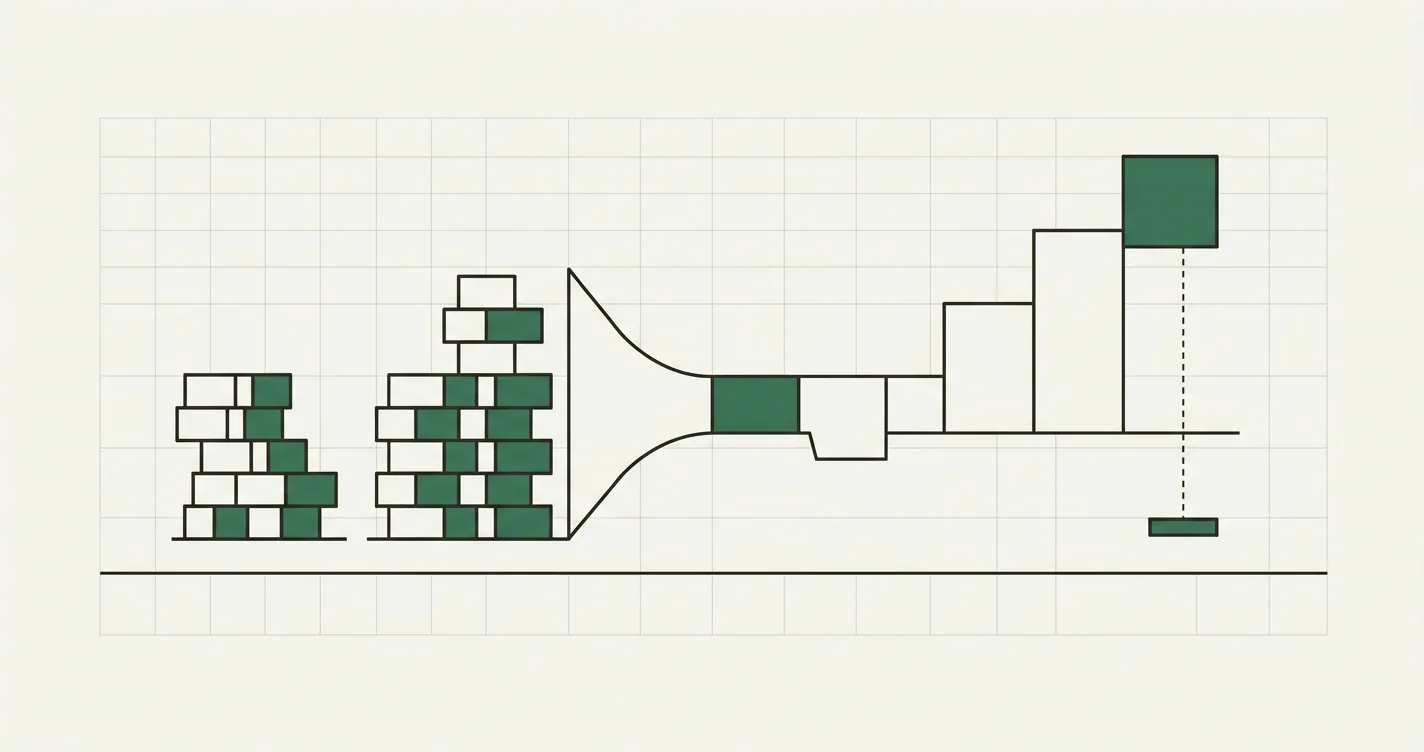
How a priced round moves from a pre-money number to post-money ownership and founder dilution
The Two Definitions
- Pre-money valuation is the value the company and the investor agree on before the new investment is added. It is what the existing shareholders' equity is worth going into the round.
- Post-money valuation is the pre-money valuation plus the amount raised. It is the value of the whole company - old shares and new shares together - immediately after closing.
The identity that links them:
Post-Money Valuation = Pre-Money Valuation + New Investment
And the reason the distinction matters at all:
Investor Ownership % = New Investment / Post-Money Valuation
The investor's stake is always measured against the post-money number, because after the round the company is worth the post-money figure and the investor's cash is part of it. Quote a valuation as pre-money and the investor owns less; quote the same number as post-money and they own more.
Why One Number, Two Meanings, Changes the Deal
Take an investor writing a $3,000,000 cheque, and a headline valuation of $9,000,000.
| Interpretation | Pre-Money | Post-Money | Investor Ownership |
|---|---|---|---|
| "$9M pre-money" | $9,000,000 | $12,000,000 | $3M / $12M = 25.0% |
| "$9M post-money" | $6,000,000 | $9,000,000 | $3M / $9M = 33.3% |
Same $9M on the term sheet. An 8.3-percentage-point swing in ownership - and every point of it comes straight out of the founders' stake. On a company that goes on to a $200M exit, those 8.3 points are worth about $16.6M. This is why "pre or post?" is the first question a founder should ask about any number an investor floats.
How to Calculate Post-Money Valuation
There are three routes to the post-money figure, and a clean deal has all three agree.
1. From pre-money plus the raise. The definitional route:
Post-Money = Pre-Money + New Investment
Post-Money = $9,000,000 + $3,000,000 = $12,000,000
If there are convertible notes or SAFEs converting in the same round, their converting value is added here too - post-money is the value of everything outstanding after the round, not just old common plus new cash.
2. From the investor's target ownership. If the negotiation is framed as "the investor gets 25%":
Post-Money = New Investment / Investor Ownership %
Post-Money = $3,000,000 / 0.25 = $12,000,000
3. From price per share and the post-money share count. The cap-table route:
Post-Money = Price per Share x Post-Money Fully Diluted Shares
If these three disagree, something in the round mechanics - usually an option pool top-up or a converting instrument - has not been accounted for.
// Post-money valuation
= Pre_Money_Valuation + New_Investment

// Investor ownership % (always measured against post-money)
= New_Investment / Post_Money_Valuation

// Implied pre-money from a quoted post-money
= Post_Money_Valuation - New_Investment
Tying It to the Cap Table: Price Per Share
Ownership percentages are settled by issuing shares at a price, and that price is set off the pre-money side of the deal:
Price per Share = Pre-Money Valuation / Pre-Money Fully Diluted Shares
New Shares Issued = New Investment / Price per Share
Post-Money Fully Diluted Shares = Pre-Money FD Shares + New Shares Issued
The single most common cap-table error is dividing by the post-money share count or using the post-money valuation in the numerator. Both silently change the price and hand the investor more or fewer shares than the deal intends.
Worked Example: A $3M Round at $9M Pre-Money
A company has two founders holding 8,000,000 fully diluted shares between them and no option pool yet. They raise $3,000,000 at a $9,000,000 pre-money valuation.
Step 1 - Post-money valuation:
Post-Money = $9,000,000 + $3,000,000 = $12,000,000
Step 2 - Price per share:
Price per Share = $9,000,000 / 8,000,000 = $1.125
Step 3 - New shares issued to the investor:
New Shares = $3,000,000 / $1.125 = 2,666,667
Step 4 - Post-money cap table:
| Holder | Shares | Ownership % |
|---|---|---|
| Founders | 8,000,000 | 8,000,000 / 10,666,667 = 75.0% |
| New Investor | 2,666,667 | 2,666,667 / 10,666,667 = 25.0% |
| Total (post-money FD shares) | 10,666,667 | 100.0% |
Check the math two ways. The investor put $3M into a $12M post-money company, so they should own $3M / $12M = 25% - and 2,666,667 / 10,666,667 = 25.0%. It ties.
Notice the other identity that falls out: the founders' post-round stake is worth 75% x $12,000,000 = $9,000,000 - exactly the pre-money valuation. That is what pre-money means in cash terms: the value of the existing shareholders' equity the moment the round closes. When there is no option pool top-up, existing-holder value after the round always equals the pre-money number.
The Option Pool Shuffle
Here is where the effective pre-money valuation quietly shrinks. Investors almost always require an unallocated employee option pool to be created or expanded as a condition of the round, and - this is the key move - they require it to be carved out of the pre-money share count. The pool shares are added before the price per share is set, so 100% of the dilution from the pool lands on existing shareholders, not the incoming investor.
Take the same round - $3,000,000 at $9,000,000 pre-money - but now the investor wants a 10% unallocated option pool measured on a post-money basis.
The post-money cap table now has to satisfy three conditions at once: the investor ends at 25% (their cheque over post-money), the pool is 10% of the post-money total, and the founders' fixed 8,000,000 shares are whatever is left:
Founders' share of post-money = 1 - 25% - 10% = 65%
Post-Money FD Shares = 8,000,000 / 0.65 = 12,307,692
New Pool Shares = 12,307,692 x 10% = 1,230,769
Investor Shares = 12,307,692 x 25% = 3,076,923
Because the 1,230,769 pool shares join the pre-money count, the price per share drops:
Price per Share = $9,000,000 / (8,000,000 + 1,230,769) = $9,000,000 / 9,230,769 = $0.975
Check: the investor's $3,000,000 / $0.975 = 3,076,923 shares = 25.0% of 12,307,692. Still 25%. The investor is completely insulated.
| Holder | No Pool | With 10% Pre-Money Pool |
|---|---|---|
| Founders | 75.0% | 65.0% |
| New Investor | 25.0% | 25.0% |
| Option Pool | - | 10.0% |
| Post-money FD shares | 10,666,667 | 12,307,692 |
The founders lost another 10 points - and their post-round value is now 65% x $12,000,000 = $7,800,000, not $9,000,000. The option pool has knocked $1,200,000 off the effective pre-money valuation (10% of the $12M post-money, borne entirely by existing holders). A "$9M pre-money" term sheet with a 10% post-money pool is really a $7.8M pre-money deal.
// Post-money FD share count when the new pool is sized as a % of post-money
= Founder_FD_Shares / (1 - Investor_Pct - Target_Pool_Pct)

// New option pool shares (added to the pre-money count)
= Post_Money_FD_Shares * Target_Pool_Pct

// Price per share is diluted by the pool sitting in the pre-money count
= Pre_Money_Valuation / (Founder_FD_Shares + New_Pool_Shares)

// Effective pre-money actually received by existing holders
= Post_Money_Valuation * (1 - Investor_Pct - Target_Pool_Pct)
The negotiating counter is well known: size the pool to the company's real 12-to-18-month hiring plan rather than a round-number percentage, or push for part of it to be created post-money so the investor shares in that dilution.
Pre-Money and Post-Money on SAFEs
Convertible instruments carry the same pre/post distinction, and it changed industry-wide in 2018 when Y Combinator moved from the pre-money SAFE to the post-money SAFE.
- Pre-money SAFE: the valuation cap is a pre-money figure. The holder's eventual ownership depends on how many other SAFEs and notes also convert - more converting paper means the SAFE holder is diluted alongside the founders.
- Post-money SAFE: the cap is a post-money figure that already includes all other converting SAFEs (but not the new priced round). The holder's percentage is locked in at signing - so any additional SAFEs raised afterward dilute the founders, not the earlier SAFE holder.
The post-money SAFE is cleaner for investors and easier to model, but founders should total up all outstanding post-money SAFE percentages before a priced round: they stack, and they come entirely out of the founders' pre-round ownership. For the full conversion mechanics, see convertible notes vs SAFEs.
Common Mistakes to Avoid
- Not pinning down pre or post. A valuation number with no "pre-money" or "post-money" label attached is not a term - it is an ambiguity that will be resolved against the founder. Always write it down explicitly.
- Computing price per share off the post-money valuation or share count. Price per share is pre-money valuation divided by pre-money fully diluted shares. Using post-money numbers in either position changes the investor's share count and breaks the deal.
- Ignoring the option pool in the pre-money share count. A "$9M pre-money" with a 10% post-money pool is really about $7.8M pre-money to existing holders. Model the pool explicitly and quote the effective pre-money.
- Treating a post-money SAFE cap as a priced post-money valuation. A SAFE cap is a ceiling on the conversion price, not an agreed company value, and post-money SAFE percentages stack on top of each other.
- Assuming Pre + Raise = Post when instruments are converting. If SAFEs or notes convert in the round, their value is part of the post-money figure too, and the simple identity understates post-money and overstates the investor's percentage.
- Backing into founder dilution from the post-money valuation alone. Founder ownership after the round is existing shares divided by post-money fully diluted shares - which includes any new option pool. The valuation ratio alone (pre divided by post) only gives dilution when there is no pool top-up.

Alex Tapio
Founder of Finamodel • Professional Financial Modeller • Ex-Deloitte