Real Estate Equity Waterfall and IRR
Key Takeaways
- A waterfall is an ordered cascade of tiers - capital must return, then pref accrues, then GP catches up, then residual splits - and cash only moves to the next tier once the current one is fully satisfied.
- The preferred return (typically 6-10%, often 8%) protects LPs by guaranteeing a minimum compounded return before the GP shares in profit.
- The GP catch-up is the tier that's most often built incorrectly - it exists solely to bring the GP's share of profit-to-date up to its target promote percentage.
- In the worked example, a GP contributing just 10% of equity earned 2.80x MOIC and a ~24% IRR versus the LP's 1.80x and ~13.5%, purely from the promote mechanics on a successful deal.
- Model each tier as a running balance in its own row rather than one nested formula - it's the only structure that stays auditable and extensible.
- Always stress-test the downside: a well-built waterfall should shrink the GP's promote to zero on a flat or losing deal.
For the IRR and MOIC math behind these tiers, see our comparison of IRR vs MOIC and our deep dive on real estate pro forma modeling. To build a full fund-level waterfall with capital calls, deployment, and LP net IRR, explore our Real Estate Fund Investment Model template.
A real estate equity waterfall decides who gets paid first, and how much extra the sponsor (GP) earns for outperforming, when a deal's cash flows and sale proceeds are split between the general partner and limited partners. Get the tiers wrong and you'll either overpay a sponsor for average performance or underpay them for a home run. This guide walks through the standard four-tier waterfall structure - return of capital, preferred return, GP catch-up, and residual split - with a full worked example showing exactly how $19M of distributions splits between LP and GP, and how to model it in Excel without formula spaghetti.
Nearly every real estate private equity deal - a single-asset syndication, a value-add fund, a development JV - uses a waterfall to allocate cash. The sponsor (GP) puts in a small slice of equity (often 5-15%) but does the work of sourcing, financing, and operating the deal. In exchange, once investors (LPs) have earned back their capital plus a minimum return, the GP starts capturing a disproportionate share of the upside. That disproportionate share is called the promote (or carried interest), and the waterfall is the mechanism that calculates it precisely, tier by tier, dollar by dollar.
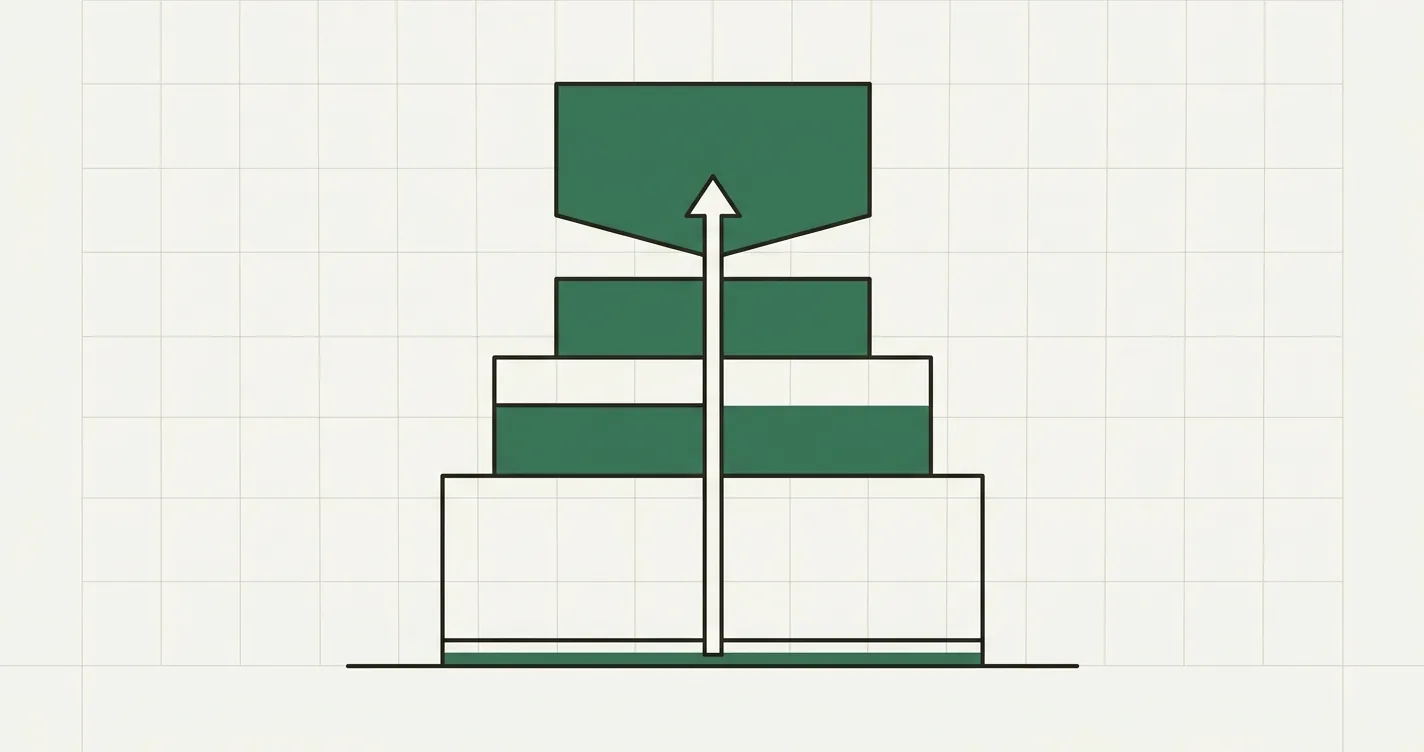
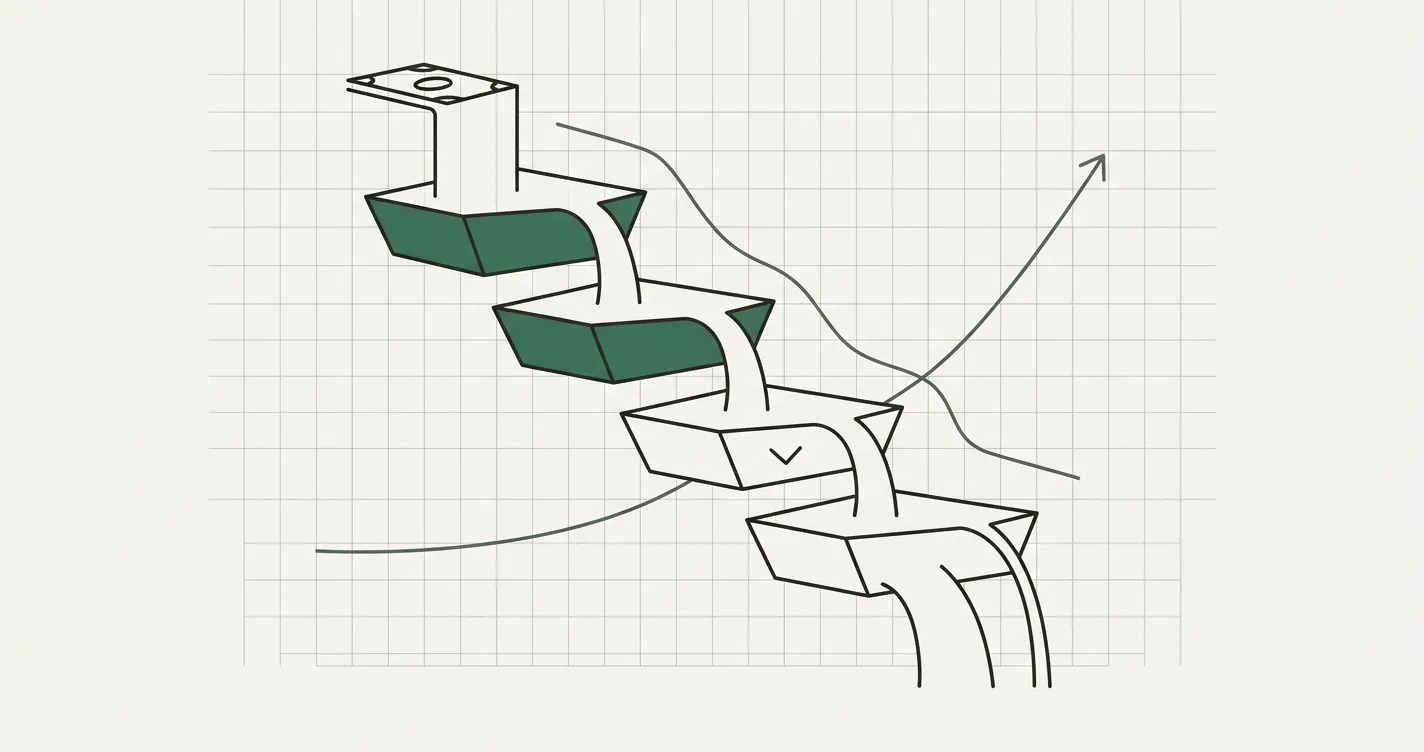
Cash cascades through each tier in order - a tier must be fully satisfied before any dollar moves to the next.
What an Equity Waterfall Actually Does
A waterfall is nothing more than an ordered set of rules for splitting cash. At each distribution date (usually annually, or at sale), you take the pool of distributable cash and pour it through the tiers from top to bottom. Each tier has a hurdle - a condition that must be met - and a split - how cash is divided once that hurdle is active. Cash only moves to the next tier once the current one is fully funded.
The two structural choices that matter most:
- European (deal-level) waterfall: the GP earns its promote only after ALL capital and preferred return has been returned across the whole fund or deal. LP-friendly; the industry standard for institutional funds.
- American (deal-by-deal) waterfall: the GP can earn its promote on a per-deal basis, even if other deals in the same fund haven't returned capital yet. More GP-friendly, more common in single-asset syndications.
This guide models a European-style, single-asset waterfall - the version you'll encounter in most syndicated real estate deals.
The Four Standard Tiers
Tier 1 - Return of Capital
Every dollar of distributable cash first returns each partner's contributed capital, split pro rata by ownership percentage. No profit is recognized here - it's simply giving investors their money back.
// Tier 1 distribution to each partner (capped at unreturned capital)
= MIN(Distributable_Cash * Ownership_Pct, Unreturned_Capital)
Tier 2 - Preferred Return
Once capital is returned, LPs (and often the GP on its own co-invest) earn a preferred return - a minimum annual return, typically 6-10%, compounded on unreturned capital. An 8% pref is the most common benchmark in the market. This tier exists so investors are made close to whole on a time-value-of-money basis before the GP shares in any upside.
// Preferred return accrued on unreturned capital, compounded annually
= Unreturned_Capital * ((1 + Pref_Rate)^Hold_Years - 1)
Tier 3 - GP Catch-Up
This is the tier most people build wrong. The catch-up lets the GP "catch up" to its target promote percentage (commonly 20%) on the profit distributed so far - that is, on the preferred return already paid out. Without this tier, the GP would only ever earn its small pro-rata ownership share on the pref tier, never reaching its target promote.
// GP catch-up: solves so GP's share of (Pref + Catch-up) = Target Promote %
= (Target_Promote_Pct * Tier2_Total - GP_Pref_Received) / (1 - Target_Promote_Pct)
Some deals use a 50/50 catch-up split instead of a full 100% GP catch-up - check the LPA (limited partnership agreement) language carefully, since this single clause materially changes GP economics.
Tier 4 - Residual Split
Everything remaining after capital, pref, and catch-up splits at the final promote ratio - commonly 80/20 or 70/30, LP/GP. This is the tier that rewards outperformance: the better the deal does, the more dollars flow through Tier 4, and the GP's blended share of total profit rises toward its target promote percentage.
Worked Example: A $10M Single-Asset Deal
Let's run real numbers through all four tiers. A sponsor raises $10.0M of equity for a value-add multifamily acquisition, split 90/10 between LPs and the GP's co-investment.
| Input | Value |
|---|---|
| Total equity raised | $10,000,000 |
| LP contribution (90%) | $9,000,000 |
| GP co-invest (10%) | $1,000,000 |
| Preferred return | 8%, compounded annually |
| GP catch-up target | 20% of profit above return of capital |
| Residual split (after catch-up) | 80% LP / 20% GP |
| Hold period | 5 years |
Cash flow assumptions: the property distributes growing operating cash flow each year, and the sale in Year 5 nets $16.0M to equity after debt payoff.
| Year | Operating distribution | Sale proceeds | Total to equity |
|---|---|---|---|
| 1 | $500,000 | - | $500,000 |
| 2 | $550,000 | - | $550,000 |
| 3 | $600,000 | - | $600,000 |
| 4 | $650,000 | - | $650,000 |
| 5 | $700,000 | $16,000,000 | $16,700,000 |
| Total | $3,000,000 | $16,000,000 | $19,000,000 |
Running the Waterfall
Tier 1 - Return of Capital ($10.0M): LP receives $9.0M, GP receives $1.0M. Remaining pool: $19.0M − $10.0M = $9.0M.
Tier 2 - 8% Preferred Return, compounded 5 years:
LP Pref = $9,000,000 × (1.08^5 − 1) = $4,223,953
GP Pref = $1,000,000 × (1.08^5 − 1) = $469,328
Tier 2 Total = $4,693,281
Remaining pool: $9.0M − $4,693,281 = $4,306,719.
Tier 3 - GP Catch-Up (to 20% of profit distributed so far):
Catch-up = (0.20 × $4,693,281 − $469,328) / 0.80 = $586,660
Remaining pool: $4,306,719 − $586,660 = $3,720,059.
Tier 4 - Residual Split (80/20):
LP Residual = $3,720,059 × 0.80 = $2,976,047
GP Residual = $3,720,059 × 0.20 = $744,012
Final Distribution Summary
| Tier | LP | GP | Total |
|---|---|---|---|
| 1. Return of Capital | $9,000,000 | $1,000,000 | $10,000,000 |
| 2. Preferred Return | $4,223,953 | $469,328 | $4,693,281 |
| 3. GP Catch-Up | - | $586,660 | $586,660 |
| 4. Residual Split (80/20) | $2,976,047 | $744,012 | $3,720,059 |
| Total Distributions | $16,200,000 | $2,800,000 | $19,000,000 |
| Contributed Capital | $9,000,000 | $1,000,000 | $10,000,000 |
| MOIC | 1.80x | 2.80x | 1.90x |
| IRR | ~13.5% | ~24.3% | ~14.8% |
Notice the wedge: the GP put in 10% of the capital but earned nearly 15% of total distributions and a MOIC more than 1.5x the LP's. That's the promote doing its job - rewarding the GP for a deal that cleared its hurdles. If the sale had only netted $10M instead of $16M (a flat deal), the waterfall would never reach Tier 3 or 4, and the GP would earn only its 10% pro-rata share, no promote at all. That asymmetry is exactly the incentive alignment a waterfall is designed to create.
Modeling the Waterfall in Excel
The most common mistake in a waterfall workbook is trying to write one giant nested formula per tier. Instead, structure the sheet as a running balance, one row per tier, so each tier's formula only needs to reference the remaining pool from the row above:
// Row: Distributable Cash (input)
Distributable_Cash = 19,000,000

// Row: Tier 1 (Return of Capital)
Tier1_LP = MIN(Distributable_Cash * 0.90, LP_Capital)
Tier1_GP = MIN(Distributable_Cash * 0.10, GP_Capital)
Remaining_After_T1 = Distributable_Cash - Tier1_LP - Tier1_GP

// Row: Tier 2 (Preferred Return)
Tier2_LP = MIN(Remaining_After_T1 * 0.90, LP_Pref_Accrued)
Tier2_GP = MIN(Remaining_After_T1 * 0.10, GP_Pref_Accrued)
Remaining_After_T2 = Remaining_After_T1 - Tier2_LP - Tier2_GP
Chain each subsequent tier off the prior "remaining" cell. This keeps every formula auditable in isolation, and it's the only structure that survives a sponsor adding a fifth tier (a "super promote" above a second IRR hurdle) later without a rebuild.
Common Mistakes
- Forgetting the catch-up tier entirely. Without it, the GP never reaches its target promote percentage - the deal quietly becomes far more LP-friendly than the LPA intended.
- Compounding the preferred return incorrectly. A pref that compounds annually on unreturned capital is very different from one that only accrues on the original capital balance - the gap widens fast over a 5+ year hold.
- Mixing up American and European waterfalls. Applying deal-by-deal promote logic to a fund-level LPA (or vice versa) can misstate GP compensation by millions on a large fund.
- Ignoring capital returned mid-hold. If a refinance returns partial capital in Year 3, the pref calculation for Years 4-5 must run on the reduced unreturned balance, not the original contribution.
- Treating the IRR hurdle and the pref rate as the same number. Some waterfalls use an IRR-based hurdle (calculated on the full cash flow timeline) instead of a simple compounded preferred return - these produce different answers when distributions are irregular.
- Not stress-testing a downside case. Always run the waterfall at a lower exit value to confirm the GP's promote correctly shrinks to zero if the deal underperforms - that's the entire point of the structure.

Alex Tapio
Founder of Finamodel • Professional Financial Modeller • Ex-Deloitte