United Rentals (URI) Financial Forecast Calculator
Interactive 5-year forecast and DCF for United Rentals. Adjust revenue growth, gross margin, capex intensity, WACC, and terminal growth - see revenue, free cash flow, and enterprise value update in real time. Seeded from United Rentals’s most recent SEC filings.
Assumptions
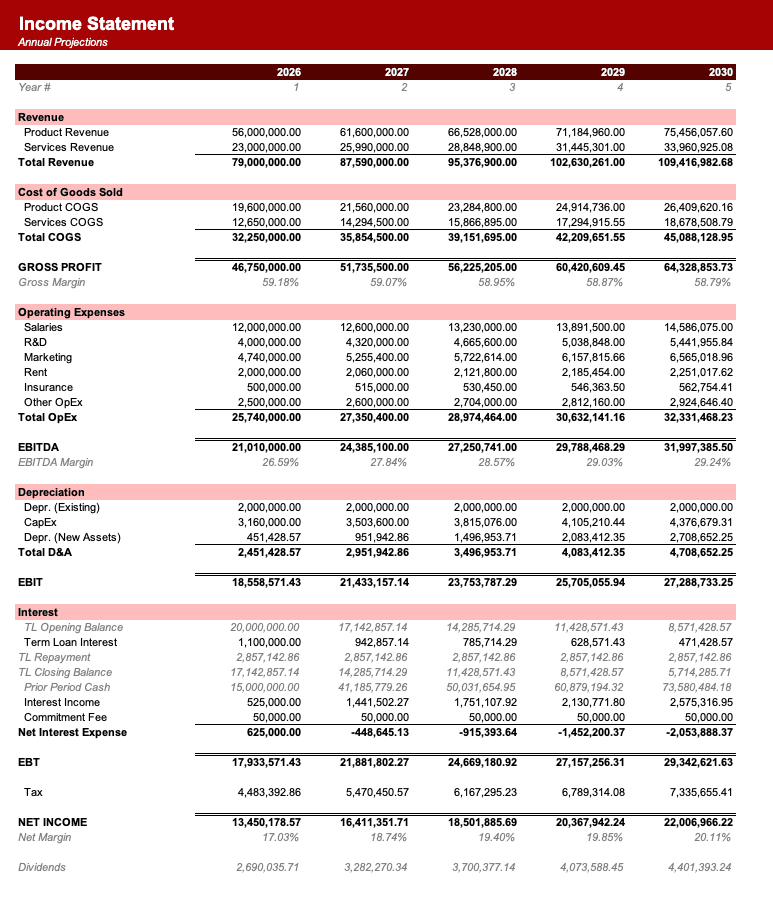
Need this as an Excel model?
Keep iterating on the United Rentals forecast in Excel. The downloadable sample has every assumption you see here plus a fully integrated income statement, balance sheet, cash flow, and debt schedule - five years of SEC historicals and live formulas in a fully editable workbook.
Other Industrials forecasts
Run the same calculator on a peer.






Frequently asked
What does United Rentals do?+
United Rentals is the largest equipment rental company globally, providing a comprehensive range of equipment to construction, industrial, utility, and municipal customers. The company operates an asset-heavy business model, purchasing equipment to rent out over its useful life before selling it in the used equipment market.
How does United Rentals generate its revenue?+
United Rentals generates revenue primarily through its two reporting segments: General Rentals, which accounts for approximately 69% of revenue, and Specialty Rentals, making up about 31%. The company rents out a wide range of equipment, mainly concentrated in North America, with a minor presence in Europe, Australia, and New Zealand.
What are the key capital expenditure assumptions in a United Rentals financial model?+
Gross rental capital expenditures for United Rentals typically run between 20% and 26% of revenue, with approximately 50% to 60% allocated to maintenance capex and 40% to 50% for growth capex. The model assumes a continuous fleet refresh cycle to maintain an optimal average fleet age, targeting around 50 to 55 months.
What is United Rentals' strategy for growth and expansion?+
United Rentals pursues growth through a mix of continuous bolt-on acquisitions to increase local density and occasional transformational acquisitions to expand specialty capabilities, such as the recent acquisitions of Yak Access and Ahern Rentals. The company also funds growth through massive capital expenditures to expand its rental fleet.
What are the primary assumptions for United Rentals' operating expenses in a financial model?+
Key operating expense assumptions in the model include COGS at 95% of revenue, SG&A at approximately 51.23% of revenue, and Depreciation & Amortization at about 16.58% of revenue. The model also incorporates a tax rate of approximately 23.72%.
Is a financial model for United Rentals available for download?+
Yes, a downloadable Excel financial model for United Rentals (URI) is available. This model projects the company's fleet dynamics, cash flow generation, and capital allocation to determine its equity valuation and assess its capacity for continued debt-funded M&A and share repurchases.
Have more financial modelling questions? Contact us