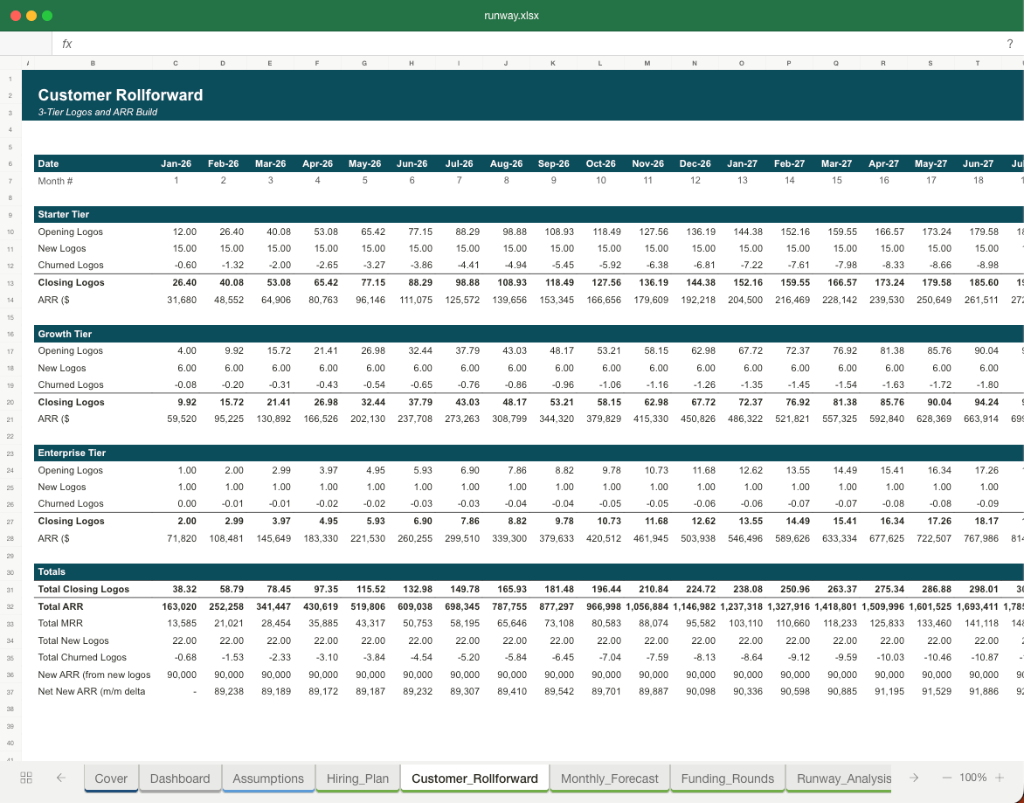
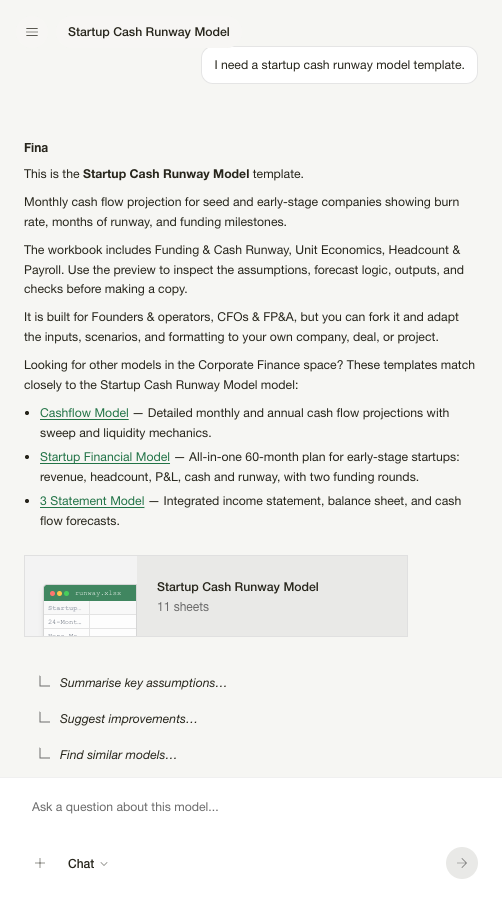
Aeris Financial Model
Health-tech Startup Financials (Free Excel Download)
Swiss-made premium air purifiers sold through DTC, retail, and dealer channels, with a recurring filter consumable attached to a connected mobile app.



professionals from Deloitte
Used by professionals from






About this model
Aeris sells Swiss-made premium air purifiers through direct, retail, and dealer channels, with connected-app functionality and recurring replacement filters. Its products serve residential, medical, and commercial use cases.
Hardware spans consumer and infection-control systems, while filters create the core repeat-purchase opportunity: the research attributes 68% of sales to recurring filter repurchases. Commercial and medical channels have different sales cycles from consumer distribution.
The model should forecast hardware units and ASP by SKU, installed base, filter replacement cadence, and channel margin. Manufacturing, dealer discounts, inventory, and app or service costs should be separated across consumer and B2B segments.
A turnkey financial model
Live formulas, no hardcoded values
Outputs are driven by live formulas, so the workbook updates from its assumptions instead of relying on hardcoded results.
All assumptions in one tab
Inputs are clearly marked in the Assumptions tab and separated from calculations, making it clear what to change and what to leave intact.
Statements always balancing
For integrated-statement models, the balance sheet, cash flow, and supporting schedules tie through properly.
Distinct schedules for clarity
Debt, working capital, taxes, and cash flow can get messy quickly. We group calculations in clear schedules, not across disconnected tabs.
No hidden macros or external links
There are no unexplained external workbook links or macros to undermine auditability or portability.
Changes flow through the model
Update a key driver and see the impact carry through the forecast, financing, and return outputs. We never use hardcoded numbers in formulas.
About Aeris
aerisweather.com
How to build a detailed financial model for Aeris
A complete walkthrough of the business, drivers, and assumptions behind the downloadable Aeris model - distilled from its pitch deck and publicly available information.
Product & value proposition
- Three residential air purifier SKUs:
- qair lite - 2 filter options, $499 retail
- qair - 3 filter options, $999 retail
- qair one - bespoke filters, $3,500 retail
- Medical Infection Control Unit - focused suction for surgeries/oral interventions, plasma unit, Zinc Pyrithione-coated surfaces, $2,499 retail
- Aeris HVAC filter module - inline duct filtration for commercial buildings, launch Q3 2020
- afleet - cloud-based fleet management platform + mobile app bundled with hardware; drives recurring filter reorders
- Core claim: cleans 3x faster than conventional purifiers; ISO18184-certified coronavirus kill; 0 ozone; no UV technology
- Positioning: tech-forward (high CADR) + premium design vs. incumbents (Dyson, Blueair, IQair, Molekule)
Market
- Global air purification market: $9B, growing +12% per year
- Google searches for "Air Purifier" up +50% in 2019
- Main competitor combined revenue proxy: ~$600M (Dyson, Molekule, Blueair, IQair)
- Tailwind noted: COVID driving building HVAC retrofits toward HEPA/UV, per Fast Company; dental/medical sector via ADA partnerships
Revenue model
Revenue streams:
- Hardware - residential (qair lite $499 / qair $999 / qair one $3,500)
- Hardware - medical (infection control unit $2,499)
- Hardware - commercial/HVAC (inline duct filter module; price not stated)
- Consumable filters - recurring; 68% of sales are recurring filter repurchases. Filter pricing not disclosed.
- afleet SaaS / platform - commercial fleet management; pricing not disclosed
Channel split (as of May 2020):
- Direct (Amazon, webshop, JD.com): 30%
- Retail (Best Buy, Target, QVC, Home Depot, Menards, Lowe's, Lotte, Shinsegae, LaneCrawford, SOGO): 30%
- Dealer (international partners): 40%
Key retail milestone: Confirmed launch in 1,000 Best Buy stores, October 2020
Traction & metrics
- Units sold: "Over X Units Sold" - exact figure redacted in deck
- Revenue growth: +800% growth for 2020 (projected or YTD not clarified)
- Monthly sales: $X'XXXk in May 2020 - exact figure redacted
- Geographies: sold in 12 countries
- Retailers: 20+ retailers, 200+ premium locations
- Recurring revenue share: 68% recurring filter sales
- Medical pre-sales: 300+ dental clinics presold in Canada and USA
- Early milestone: First dealer partnership in China for $1.5M (2017)
- Angel investment received: $1.5M (post-founding)
Unit economics
- Filter attach rate / repurchase cadence: Not explicitly stated, but 68% of revenue is recurring filters; high retention attributed to app lock-in and remote tracking
Competition / moat
- Primary competitors: Dyson, Blueair, IQair, Molekule (~$600M combined revenue)
- Aeris positioned in upper-right quadrant: high tech + strong brand
- CADR superiority claimed vs. all named competitors in large and small rooms (bar chart, no axis values)
- Competitive weaknesses of incumbents called out:
- Dyson & Blueair: residential only
- IQair: ~20-year innovation cycle
- Molekule: legal issues for misleading claims
- Moat levers: ISO certifications, proprietary filter tech, app/data lock-in, premium Swiss design, multi-segment presence (residential + medical + commercial HVAC)
Team & funding ask / use of funds
Team:
- Pierre Bi - Co-Founder & CEO; M.S. MechE MIT, B.S. ETH Zurich; Bosch, BCG
- Constantin Overlack - Co-Founder & COO; M.S. & B. MechE ETH Zurich; BMW, e-car startups
- Etienne Bougeot - Design Director; multiple iF & Red Dot Design awards; DCA, GRO Design, Native Design
- KC Wong - Head of Sales Asia; 20 years in indoor air quality; IQair, AirProce
- Scott Trowbridge - Head of Sales US; VP Sales IQair, Duracell USA; 30 years US retail experience
Funding:
- Angel round: $1.5M received (post-2015 founding)
- Current raise: Amount not stated in deck
Recommended financial model
Archetype + why: DTC/Retail Consumer Hardware P&L with recurring consumable (razor-and-blade) layered on top. Three revenue streams must be modelled separately: (1) hardware unit sales by SKU, (2) filter consumable recurring revenue tied to installed base, (3) commercial/medical as a separate B2B line with longer sales cycles. The afleet SaaS component is nascent and pricing is undisclosed - model as an optional fourth line with zero contribution until disclosed.
Forecast horizon & granularity: Monthly for Year 1 (2020 scale-up); quarterly for Years 2–3 (2021–2022). Three-year total with a Year 3 run-rate for valuation purposes.
Key drivers & assumptions:
*Hardware - Residential*
- SKU mix (qair lite / qair / qair one): 60% / 30% / 10% - lite is entry-level mass retail, one is boutique; tune once unit data disclosed
- Blended ASP: ~$720 at that mix
- Unit volume: derive from +800% growth claim applied to a base; base unknown - flag as key sensitivity
- Channel mix: Direct 30% / Retail 30% / Dealer 40%
- Retail margin give-up: 40–45% wholesale discount for Best Buy / Target tier
- Dealer margin: 35–40% distributor discount
*Hardware - Medical*
- ASP: $2,499
- Launch volume: 300+ dental clinics presold; model 300 units Year 1 at 50% conversion; ramp via ADA webinar funnel
- Sales cycle: 6–8 weeks (dental/clinical procurement)
*Hardware - Commercial HVAC*
- Volume: minimal in 2020 (launch Q3 2020); ramp 2021 as COVID-driven retrofit demand grows
*Filter consumables (recurring)*
- Installed base: cumulative hardware units sold (net of churn)
- Annual filter spend per unit: 15–20% of hardware ASP per year (industry norm for HEPA filters); no deck data
- Recurring revenue share target: 68% of total revenue - use as a model sanity-check ratio, not a driver
- Retention: 85% annual repurchase rate; justification: app lock-in + remote tracking cited as retention driver
*afleet SaaS*
- $0 recognised revenue in model years 1–2; add as optional line with placeholder pricing ($X/unit/month) once commercial terms are defined
*Costs*
- COGS / gross margin: 40–50% GM on hardware (premium hardware; Swiss-engineered; mid-tier manufacturing likely in Asia); 70–75% GM on filters (consumable refill)
- CAC - Direct: $80–$150 (digital/Amazon); Retail: effectively zero direct CAC (retailer drives traffic, offset by shelf margin)
- Opex: small team (~5 named + implied ops); $3–4M annual opex at current stage scaling to $6–8M by Year 2 with US commercial build-out
Scenarios (Base / Bull / Bear - which variables flex):
- Base: +800% 2020 growth achieved; Best Buy 1,000 stores launch in Oct 2020 converts at modest sell-through; 300 dental pre-sales convert; filter attach holds at 68%
- Bull: Best Buy drives significant volume uplift; HVAC commercial segment accelerates post-COVID; medical scales beyond dental to hospitals; filter ASP and attach rate increase
- Bear: Best Buy launch delayed or underperforms sell-through; supply chain constraints limit hardware volume; medical regulatory hurdles slow clinical sales; +800% growth was YTD projection, actual falls short
Required sheets / outputs:
- Assumptions - all drivers in one tab, toggle-able
- Revenue build - unit volume by SKU × channel × period; filter consumable on installed base; medical B2B separate
- P&L (Income Statement) - by revenue stream; gross profit by stream; consolidated EBITDA
- Channel economics - blended ASP net of channel discounts; contribution by channel
- Installed base tracker - cumulative units, annual repurchase cohort, filter revenue waterfall
- Working capital / cash flow - inventory build critical for hardware business; retailer payment terms (Best Buy Net 60–90)
- Scenarios tab - Base / Bull / Bear toggle
- KPI dashboard - monthly revenue, units sold, filter attach %, blended ASP, gross margin, implied LTV/CAC once inputs available
Frequently asked
Is the Aeris financial model free?+
Yes. The Aeris model is a free Excel (.xlsx) download with live formulas. Sign up with your email and the workbook is yours to keep, review, and edit.
What's included in the model?+
A 5-year monthly forecast with P&L, cash flow and runway, valuation (exit multiple plus a DCF cross-check), MOIC/IRR returns, and unit economics, with live formulas throughout.
How was this model built?+
It was built from Aeris's pitch deck and publicly available information, then structured to investment-banking standards as a fully editable Excel model.
Can I change the assumptions?+
Yes. You can change assumptions and the live formulas will recalculate in the downloadable Excel model.
Have more financial modelling questions? Contact us

Created by ex-finance professionals
Hey, I’m Alex and I created Finamodel.
Over my years in the finance industry I kept building the same models over and over again. Same structure, same assumptions, different logo. So I started building frameworks to turn them into clean, reusable templates.
Every model here is one I’d actually use for a client, and I personally vet each one before it goes up.
I’m not an expert in every industry, but I’ve built enough models to know what belongs in one. And when something is completely foreign to me, I reach out to my network for experts to work on our models with us.
Having a template library on hand cuts a first build from hours to minutes.
Need help finding your model? You’ll find me in the Finamodel app!
Other Health-tech Startup Financial Models
Browse another startup in the same category.
98point6
B2B SaaS platform licensing an AI-powered virtual care technology stack to health systems, pivoted from running a direct-to-employer virtual clinic.
A-Champs
IoT-powered gamified training device (ROXs PRO) for sports/health professionals, evolving into a B2C smart coach app for families.

AccuRx
Patient-centred communication platform connecting everyone involved in a patient's care, starting with near-universal penetration in UK GP practices.

Akido Labs
Akido Labs is a data-driven prevention platform that integrates siloed healthcare, municipal, and non-profit data to enable proactive outreach and case management for vulnerable populations (homeless, chronically ill, etc.).

Alloy
Telehealth + DTC subscription platform delivering menopause hormonal treatment (MHT) and holistic care to U.S. women 40+.

Astek Diagnostics
Point-of-care diagnostic device (Jiddu system) that confirms bacterial infections and antibiotic sensitivity in ~1 hour across four body fluid types (urine, CSF, effluent, blood).

Atom Limbs
Atom Limbs is building the first AI-powered, neural-controlled prosthetic arm sold direct-to-consumer on a subscription model.

Axle Health
AI-powered workforce management (scheduling, routing, patient engagement) for home health and hospice providers.