Astek Diagnostics Financial Model
Health-tech Startup Financials (Free Excel Download)
Point-of-care diagnostic device (Jiddu system) that confirms bacterial infections and antibiotic sensitivity in ~1 hour across four body fluid types (urine, CSF, effluent, blood).

professionals from Deloitte
Used by professionals from






About this model
Astek Diagnostics is developing the Jiddu point-of-care system, which confirms bacterial infection and antibiotic sensitivity in about an hour across several body fluids. It aims to improve treatment decisions in hospitals and specialist settings.
The model is classic medical-device razor-and-blade: a $10,000 device sale creates an installed base for $50 recurring test cartridges. Large MedTech distribution partners and outsourced manufacturing are central to the planned commercial route.
The model should forecast regulatory milestones, device placements, cartridge tests per installed unit, pricing, and gross margin. Manufacturing, distributor economics, hospital adoption, and pre-revenue R&D burn must be scheduled separately.
A turnkey financial model
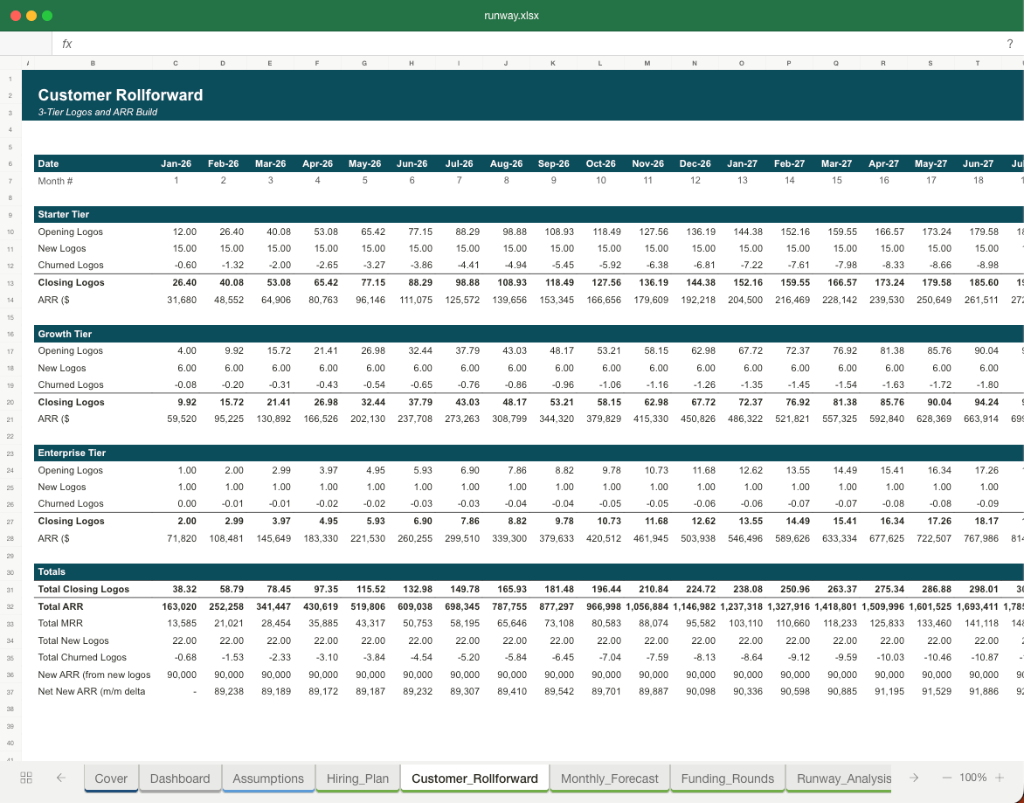
Live formulas, no hardcoded values
Outputs are driven by live formulas, so the workbook updates from its assumptions instead of relying on hardcoded results.
All assumptions in one tab
Inputs are clearly marked in the Assumptions tab and separated from calculations, making it clear what to change and what to leave intact.
Statements always balancing
For integrated-statement models, the balance sheet, cash flow, and supporting schedules tie through properly.
Distinct schedules for clarity
Debt, working capital, taxes, and cash flow can get messy quickly. We group calculations in clear schedules, not across disconnected tabs.
No hidden macros or external links
There are no unexplained external workbook links or macros to undermine auditability or portability.
Changes flow through the model
Update a key driver and see the impact carry through the forecast, financing, and return outputs. We never use hardcoded numbers in formulas.
About Astek Diagnostics
astekdx.com
How to build a detailed financial model for Astek Diagnostics
A complete walkthrough of the business, drivers, and assumptions behind the downloadable Astek Diagnostics model - distilled from its pitch deck and publicly available information.
Product & value proposition
- Device name: Jiddu system. Automated point-of-care device with disposable microfluidic cartridges.
- Current market focus: Urine - UTI confirmation + antibiotic sensitivity in 1 hour.
- Roadmap sample types: CSF (meningitis), effluent (surgical site infection), blood (bacteremia) - timelines 2026–2028 per roadmap.
- Hardware pricing: $10K one-time device purchase.
- Cartridge pricing: $50 per test (recurring revenue).
- Tests 5 antibiotics per run.
- Total test time: ~1 hour (35-min cultivation + 15-min detection + sample prep).
- Accuracy achieved: 96.97% on MedStar Pilot A.
- Key differentiator vs. standard urine culture: 1 hour vs. 24–72 hours; vs. dipstick: 97%+ vs. 50% accuracy.
Market
- 8.1M UTI-caused hospital visits per year in the US.
- $1.6B annual cost from mistreated UTIs requiring hospitalisation.
- 47% of UTIs treated with inappropriate antibiotics.
- 68,000 lives lost per annum from UTI-related sepsis.
- AMR economic cost in the US: ~$55B per year.
- No explicit TAM/SAM/SOM figures with dollar market sizing presented. No market-size slide in deck.
- Comparable transaction comps imply the point-of-care diagnostics M&A market is active (purchase prices $191M–$2B for revenue-stage companies).
Revenue model
- Two-part razor-and-blade:
- Device sale: $10K per Jiddu unit (one-time).
- Cartridge sales: $50 per test cartridge (consumable, recurring).
- Distribution: plans to partner with large MedTech players for distribution while keeping R&D in-house.
- Manufacturing: outsourced to vendors (e.g., Key Tech).
- Channels: hospitals, urology clinics, VA facilities, integrated health systems (pilots with UMB, MedStar, Johns Hopkins, Halo Dx, VA, Total Urology, Rio Grande Urology, Aceso).
- No revenue recognised yet; pre-revenue / pre-FDA clearance stage.
- Target: CLIA waiver sought (to enable non-lab settings).
- Exit path: acquisition by strategic (BioMérieux, BD, Qiagen, Bio-Rad cited) post-FDA clearance.
Traction & metrics
- Pilot tests completed: 408 urine samples total.
- UMB Pilot A (Jun–Dec 2022): 150 samples, 82.00% accuracy.
- UMB Pilot B (Jan–May 2023): 208 samples, 95.60% accuracy.
- MedStar Pilot A (Jul–Sep 2023): 50 samples, 96.97% accuracy.
- MedStar Pilot B (Oct 2023–Jan 2024): 62 samples, "Alpha Verification" (accuracy TBD).
- CSF proof-of-concept: 12 samples (Henry Jackson Foundation grant).
- Effluent proof-of-concept: 12 samples (pending DOD contract).
- Blood proof-of-concept: 59 ICU patients (NSF SBIR Phase 1 grant).
- Scientific grants awarded: $1.4M (NSF, FDA, BARDA, NIH, Maryland Industrial Partnerships).
- Investor capital raised: $2.6M (from Ayana Capital, Wexford Science+Technology, TEDCO, University System of Maryland Momentum Fund, Harvard, YC, notable angels).
- Note: $2.6M investor figure does not reconcile with the redacted $XXM raised on slides 17 and 21 - the $2.6M may be the investor subset of total funding.
- Revenue: $0 (pre-commercial).
Unit economics
- Device ASP: $10,000.
- Cartridge ASP: $50 per test.
Competition / moat
- Current standard: urine culture (24–72h, lab-based) and dipstick urinalysis (50% accuracy).
- Moat sources (implied from deck):
- 4 issued/pending patents covering test algorithm, fluidic cartridge, reagent mix, rapid cartridge modification.
- Clinical validation data from three academic medical centres (UMB, MedStar, Johns Hopkins).
- Platform architecture (same device, different cartridges across 4 fluid types) creates switching costs and expansion optionality.
- Advisory board with specialist clinical depth across urology, ICU, microbiology, infectious disease, regulatory.
- Accelerator/incubator validation: YCombinator, J&J JLABS.
- Named potential acquirers / strategics watching the space: BioMérieux, BD, Qiagen, Bio-Rad.
Team & funding ask / use of funds
Team (slide 12):
- Mustafa Al-Adhami - CEO
- Kevin Tran - CTO
- Rick Faint - CFO
- Scott O'Brian - CCO
- Engineers, microbiologist, bioengineer, computer scientist on staff.
Advisory Board (slide 13): 10 advisors covering urology, microbiology, neurogenic diseases, family medicine, intensive care, grantsmanship, regulatory affairs, infectious diseases, ICU.
Funding ask:
- Current round: convertible notes, amount redacted [$XXM].
- Pre-money cap: redacted [$XXM].
- Discount: redacted [XX%].
- Interest rate: redacted [XX%].
- BIITC incentive: investors in first $3.6M eligible for 33% Maryland state tax refund (up to $250K per investor).
- Use of funds: reach Series A milestones - specifically Alpha Prototype (April 2024), Beta Prototype (Nov 2024), Clinical Trials (Jan 2025), FDA Clearance (April 2025).
- Prior funding total: $2.6M investor equity + $1.4M grants = $4.0M confirmed; additional pre-seed/seed tranches implied but amounts redacted.
Recommended financial model
Archetype + why: Medical device razor-and-blade P&L + pre-revenue milestone/burn model, culminating in an M&A exit valuation using revenue multiples. The company is pre-revenue and targeting acquisition post-FDA clearance rather than standalone public-market operation. The model needs to:
- Project the device install base and cartridge pull-through to estimate revenue at and after commercialisation.
- Track R&D/operating burn through FDA clearance (the gating event).
- Frame an exit value using the transaction comp multiples presented in the deck.
A standard SaaS or subscription model is inappropriate; a 3-statement operating model is partially relevant but the exit/acquisition framing is the primary investor output here.
Forecast horizon & granularity:
- Pre-revenue phase (2024–2025): monthly burn/runway model through FDA clearance (April 2025 target).
- Commercial phase (2025–2027): annual P&L + revenue build (device placements + cartridge volume).
- Exit: single-year revenue run-rate × transaction comp multiple range for acquisition valuation (Year 1–2 post-FDA clearance).
- Total horizon: 2024–2028 (4–5 years), monthly for burn, annual for commercial.
Key drivers & assumptions:
*Device placement (install base):*
- Year 1 post-FDA (2025): 10 pilot/launch sites identified → 1 device per site initially = 10 devices placed; ramp to 50 in Y2, 150 in Y3 based on typical POC diagnostic rollouts.
- Device ASP: $10,000.
- Hardware gross margin: ~40–50% (outsourced manufacturing; typical for disposable-focused MedTech). No COGS data in deck.
*Cartridge volume (pull-through):*
- Tests per device per day: 5–15 (UTI is high-volume in urology/ED settings). Use 8/day base case.
- Utilisation rate: 60% of capacity = ~1,750 tests/device/year at base.
- Cartridge ASP: $50.
- Cartridge gross margin: 60–70% (microfluidic consumables industry norm).
*Revenue mix:*
- Hardware revenue declines as % of total as install base matures; consumables dominate by Year 3.
*R&D / Burn (pre-commercial):*
- Monthly burn rate: $200K–$350K during clinical trials (common for pre-Series A MedTech with 9-person team + clinical sites). Not stated in deck.
- Seed raise amount redacted; $3–5M seed round implied by milestone list (Alpha → Beta → Clinical Trials → FDA) and BIITC $3.6M threshold mention.
- Runway target: 18–24 months from seed close to FDA clearance.
*Exit valuation:*
- Transaction comp revenue multiples: Low 3.8x, Median 9.7x, Mean 19.3x, High 59.5x.
- Apply median (9.7x) and mean (19.3x) to Year 1 and Year 2 post-clearance revenue as base and bull exit scenarios.
- Acquirer set: BioMérieux, BD, Qiagen, Bio-Rad (named in deck, slide 19).
*Grant funding:*
- $1.4M received to date; additional grants (DOD contract pending, NSF SBIR Phase 2) could contribute $0.5–1.5M in non-dilutive funding - treat as offset to R&D expense.
Scenarios (Base / Bull / Bear - which variables flex):
- Base: 10 device placements at launch, 8 tests/device/day, 60% utilisation, 9.7x exit multiple on Year 2 revenue.
- Bull: 25 placements at launch, 12 tests/device/day, 80% utilisation, FDA clearance on time (April 2025), 19.3x exit multiple; additional sample types (CSF/blood) approved by 2027 adding 2nd cartridge SKU.
- Bear: FDA delay to Q3 2025, 5 placements, 4 tests/device/day, 40% utilisation, 3.8x exit multiple; seed runway extended, requiring bridge financing.
Required sheets / outputs:
- Assumptions - all drivers in one place, clearly flagged vs..
- Burn / Runway - monthly cash burn from model date to FDA clearance; funding sources (seed raise, grants).
- Device Install Base - annual cohort model of device placements; cumulative installed base.
- Revenue Build - device revenue + cartridge pull-through by cohort; total revenue by year.
- P&L - Revenue → Gross Profit → EBITDA (R&D, S&M, G&A); pre-commercial losses, first revenue year, path to breakeven.
- Exit Valuation - revenue × comp multiple matrix (3 multiples × 3 revenue years) → implied acquisition price range.
- Transaction Comps - static table from slide 20 (already structured; populate directly).
- Dashboard - KPIs: devices placed, tests/year, cartridge revenue, gross margin %, burn rate, months of runway, implied exit value at median multiple.
Frequently asked
Is the Astek Diagnostics financial model free?+
Yes. The Astek Diagnostics model is a free Excel (.xlsx) download with live formulas. Sign up with your email and the workbook is yours to keep, review, and edit.
What's included in the model?+
A 5-year monthly forecast with P&L, cash flow and runway, valuation (exit multiple plus a DCF cross-check), MOIC/IRR returns, and unit economics, with live formulas throughout.
How was this model built?+
It was built from Astek Diagnostics's pitch deck and publicly available information, then structured to investment-banking standards as a fully editable Excel model.
Can I change the assumptions?+
Yes. You can change assumptions and the live formulas will recalculate in the downloadable Excel model.
Have more financial modelling questions? Contact us

Created by ex-finance professionals
Hey, I’m Alex and I created Finamodel.
Over my years in the finance industry I kept building the same models over and over again. Same structure, same assumptions, different logo. So I started building frameworks to turn them into clean, reusable templates.
Every model here is one I’d actually use for a client, and I personally vet each one before it goes up.
I’m not an expert in every industry, but I’ve built enough models to know what belongs in one. And when something is completely foreign to me, I reach out to my network for experts to work on our models with us.
Having a template library on hand cuts a first build from hours to minutes.
Need help finding your model? You’ll find me in the Finamodel app!
Other Health-tech Startup Financial Models
Browse another startup in the same category.
98point6
B2B SaaS platform licensing an AI-powered virtual care technology stack to health systems, pivoted from running a direct-to-employer virtual clinic.
A-Champs
IoT-powered gamified training device (ROXs PRO) for sports/health professionals, evolving into a B2C smart coach app for families.

AccuRx
Patient-centred communication platform connecting everyone involved in a patient's care, starting with near-universal penetration in UK GP practices.

Aeris
Swiss-made premium air purifiers sold through DTC, retail, and dealer channels, with a recurring filter consumable attached to a connected mobile app.

Akido Labs
Akido Labs is a data-driven prevention platform that integrates siloed healthcare, municipal, and non-profit data to enable proactive outreach and case management for vulnerable populations (homeless, chronically ill, etc.).

Alloy
Telehealth + DTC subscription platform delivering menopause hormonal treatment (MHT) and holistic care to U.S. women 40+.

Atom Limbs
Atom Limbs is building the first AI-powered, neural-controlled prosthetic arm sold direct-to-consumer on a subscription model.

Axle Health
AI-powered workforce management (scheduling, routing, patient engagement) for home health and hospice providers.