 Axle Health Financial Model
Health-tech Startup Financials (Free Excel Download)
AI-powered workforce management (scheduling, routing, patient engagement) for home health and hospice providers.



professionals from Deloitte
Used by professionals from






About this model
Axle Health provides AI-powered scheduling, routing, and patient-engagement software for home-health and hospice providers. It helps care agencies run distributed clinical workforces more efficiently while improving patient communication.
The company is B2B SaaS, sold directly to agencies with enterprise onboarding and implementation support. Documented net revenue retention of 121% makes expansion within existing providers a central part of the commercial model.
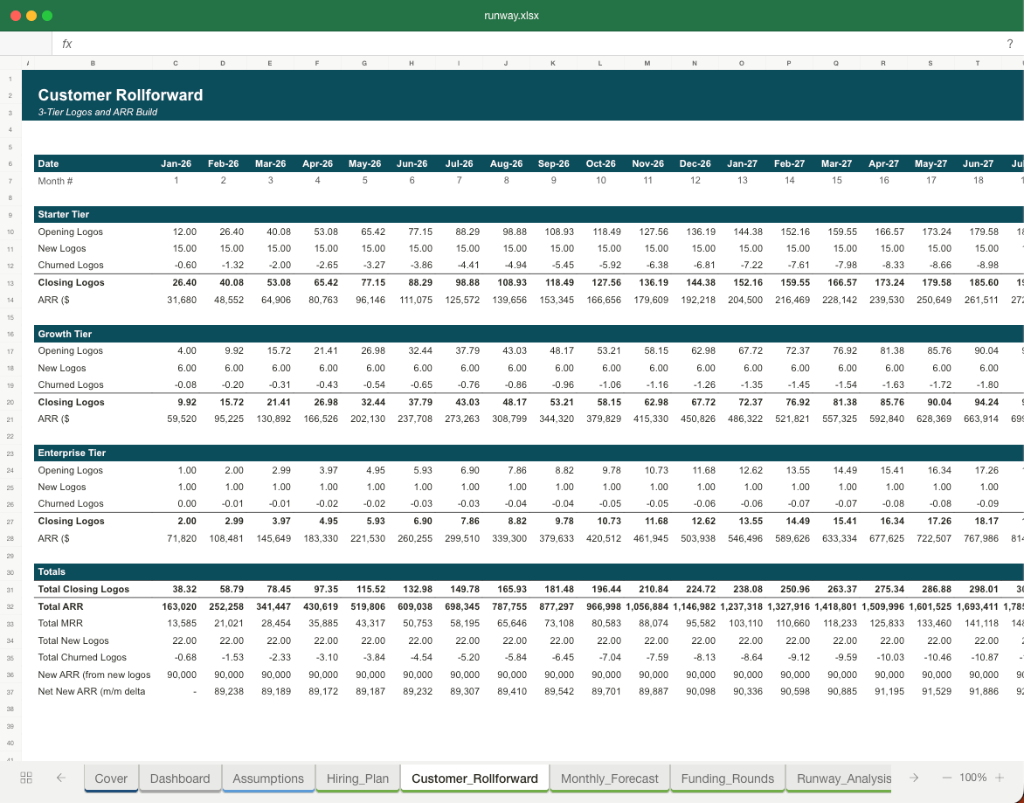
The model should forecast agency logos, initial ACV, clinician or visit expansion, new ARR, expansion ARR, churn, and implementation timing. Sales capacity, onboarding cost, and support margin should be tracked alongside the ARR bridge.
A turnkey financial model
Live formulas, no hardcoded values
Outputs are driven by live formulas, so the workbook updates from its assumptions instead of relying on hardcoded results.
All assumptions in one tab
Inputs are clearly marked in the Assumptions tab and separated from calculations, making it clear what to change and what to leave intact.
Statements always balancing
For integrated-statement models, the balance sheet, cash flow, and supporting schedules tie through properly.
Distinct schedules for clarity
Debt, working capital, taxes, and cash flow can get messy quickly. We group calculations in clear schedules, not across disconnected tabs.
No hidden macros or external links
There are no unexplained external workbook links or macros to undermine auditability or portability.
Changes flow through the model
Update a key driver and see the impact carry through the forecast, financing, and return outputs. We never use hardcoded numbers in formulas.
About Axle Health
axlehealth.com
How to build a detailed financial model for Axle Health
A complete walkthrough of the business, drivers, and assumptions behind the downloadable Axle Health model - distilled from its pitch deck and publicly available information.
Product & value proposition
Three core modules:
- AI Scheduling - assigns best clinician, day, and time per patient; office-driven or clinician-driven; continuity-of-care prioritization.
- Workforce Management - headcount demand forecasting by geography and time period; real-time utilization projections.
- AI Patient Engagement - automated visit confirmation, reminder, and ETA texts/calls; detects mobile vs landline and routes accordingly.
Supporting capabilities: route optimization (proprietary home health logistics algorithms), advanced analytics (heatmaps, custom reporting, no-show rate, mileage by clinician), white-glove onboarding with dedicated implementation manager.
EMR integration via bidirectional read/write (reads orders/demographics, writes appointment assignments back); integration with HCHB specifically called out. RPA used for EMR integrations where API unavailable.
Market
- Home health market size: ~$150B today, growing at ~8% CAGR, projected ~$230–240B by 2030.
- Demand driver: 65+ population growing 27% by 2040; 88% of seniors prefer aging in place.
- Labor constraint: Industry was 25% undersupplied before COVID; gap projected to reach 33% by 2030 (clinician supply growing ~1% CAGR vs revenue growing ~8% CAGR).
- Non-clinical labor waste: Providers spend $45B on labor for non-clinical activities; clinicians spend less than half their workday with patients (~3 of ~9 hours).
Revenue model
- Business model: B2B SaaS sold to home health and hospice agencies.
- Pricing: Not in deck. No ACV, per-clinician seat, per-visit, or per-agency pricing disclosed.
- Channels: Direct sales implied (dedicated implementation manager, enterprise onboarding process).
Traction & metrics
- NRR: 121% annual
- Cohort 1 at period 5: 122%
- Cohort 2 at period 4: 117%
- Cohort 3 at period 3: 110%
- Cohort 4 at period 2: 103%
- 5 cohorts shown total
- Cohort period unit: Not labeled (likely quarters or months - "annual NRR" headline with 5 periods suggests likely quarters).
Unit economics
ROI metrics delivered to customers:
- +17% increase in clinician productivity
- -55% decrease in patient missed visits
- -32% decrease in mileage costs
- Customer EBITDA impact: +8.5% EBITDA increase, +7% revenue increase, +1% additional EBITDA
- Note: the deck shows two separate "Increase in EBITDA" rows (+8.5% and +1%) - likely productivity gain vs mileage savings decomposed separately.
Competition / moat
- Axle positioned as "the most advanced field operations product on the market".
- Competitive moat sources:
- Proprietary home health logistics / routing algorithms
- Deep EMR integrations (bidirectional, HCHB cited)
- AI scheduling that writes back into EMR (vs manual or scheduler-only tools)
- High switching cost: white-glove onboarding, workflow mapping, trained staff
- No direct competitor named in deck. "We've looked at a lot of home health scheduling tools" quote implies multiple alternatives exist.
- Why now: CURES Act interoperability regs enable modular product strategy; rising labor gap increases provider desperation; AI advances unlock new scheduling logic and RPA-based EMR integrations.
Team & funding ask / use of funds
Team:
- Prior employer logos: Uber, Apple, Amazon, Google, Microsoft, Salesforce, Intuit, IBM, Heal, Komodo Health, Philips Healthcare, Kaiser Permanente, Mass General Brigham, Mount Sinai, Evernorth.
- Academic backgrounds: Yale, Harvard, Stanford, MIT, Columbia, Penn, Cornell, Northwestern, Johns Hopkins, U Chicago, USC, U Michigan.
- Individual names/titles: Not shown.
Investors: Y Combinator, Pear, TRAC AI/VC, Pioneer, Soma Capital.
Funding ask:
- Round: $10M Series A
- Use of funds:
- R&D: $7M (70%)
- S&M: $2M (20%)
- G&A: $1M (10%)
Recommended financial model
Archetype + why: B2B SaaS ARR model. Revenue is recurring software subscription sold to home health agencies. Expansion NRR of 121% is the central mechanic - new logo acquisition plus upsell/seat expansion drives ARR compounding. Standard SaaS ARR waterfall (new ARR, expansion ARR, churned ARR) is the right frame.
Forecast horizon & granularity:
- 3-year forecast (Year 1–3 from Series A close), monthly for Year 1, quarterly for Years 2–3.
- Rationale: Series A with R&D-heavy spend profile ($7M of $10M) suggests 18–24 months to meaningful revenue scale; 3-year horizon captures path to Series B metrics.
Key drivers & assumptions:
*Revenue / ARR:*
- Starting ARR: ~$500K–$1.5M implied by 5 visible cohorts and expansion ratios, but no number in deck. Must confirm with company. Model placeholder: $750K ARR at Series A close.
- ACV per agency: $30K–$80K/year (typical vertical SaaS for mid-market healthcare agencies). No pricing in deck. Sensitivity driver.
- New logos per quarter: 2–5 agencies/quarter in Year 1, ramping with S&M spend ($2M budgeted = ~2 quota-carrying reps at $150K OTE).
- Net Revenue Retention: 121%. Use as base case; expansion mechanism is likely seat/clinician count or branch adds.
- Gross Revenue Churn: ~5–8%/year (implied by NRR >120% with some churn; healthcare agencies have sticky workflows post-onboarding).
*Cost structure:*
- R&D spend: $7M of $10M raise deployed over ~18–24 months.
- S&M spend: $2M over ~18–24 months.
- G&A spend: $1M over ~18–24 months.
- Gross margin: 65–75% (vertical SaaS with implementation services component; white-glove onboarding may weigh on gross margin initially).
- COGS includes: implementation manager labor, customer success, hosting/infrastructure.
*Headcount:*
- S&M headcount: 2–3 AEs + 1 SDR in Year 1, given $2M budget.
- R&D headcount: 6–10 engineers/PMs given $7M budget.
- CS/Implementation: 1–2 dedicated implementation managers per 8–12 active customers (based on onboarding process described in slide 13).
Scenarios (Base / Bull / Bear):
| Variable | Bear | Base | Bull |
|---|---|---|---|
| New logos/qtr (Yr 1) | 1–2 | 3–4 | 5–7 |
| ACV | $25K | $50K | $80K |
| NRR | 110% | 121% | 130% |
| Gross churn | 12% | 7% | 3% |
| Gross margin | 55% | 68% | 78% |
| Cash runway from $10M | 18 mo | 24 mo | 30 mo |
Required sheets / outputs:
- ARR Waterfall - Beginning ARR, New ARR, Expansion ARR, Churned ARR, Ending ARR (monthly Yr 1, quarterly Yr 2–3)
- Income Statement - Revenue, COGS, Gross Profit, S&M, R&D, G&A, EBITDA, Net Income
- Cash Flow & Runway - Monthly cash burn, cash balance, months of runway from $10M raise
- Cohort Model - NRR by cohort to validate 121% assumption and project expansion revenue
- Headcount Plan - Hires by function by quarter, fully-loaded costs
- Unit Economics Dashboard - CAC (once sales data available), LTV, LTV/CAC, payback period, magic number
- Scenario Toggle - Single input sheet driving Base/Bull/Bear outputs
Frequently asked
Is the Axle Health financial model free?+
Yes. The Axle Health model is a free Excel (.xlsx) download with live formulas. Sign up with your email and the workbook is yours to keep, review, and edit.
What's included in the model?+
A 5-year monthly forecast with P&L, cash flow and runway, valuation (exit multiple plus a DCF cross-check), MOIC/IRR returns, and unit economics, with live formulas throughout.
How was this model built?+
It was built from Axle Health's pitch deck and publicly available information, then structured to investment-banking standards as a fully editable Excel model.
Can I change the assumptions?+
Yes. You can change assumptions and the live formulas will recalculate in the downloadable Excel model.
Have more financial modelling questions? Contact us

Created by ex-finance professionals
Hey, I’m Alex and I created Finamodel.
Over my years in the finance industry I kept building the same models over and over again. Same structure, same assumptions, different logo. So I started building frameworks to turn them into clean, reusable templates.
Every model here is one I’d actually use for a client, and I personally vet each one before it goes up.
I’m not an expert in every industry, but I’ve built enough models to know what belongs in one. And when something is completely foreign to me, I reach out to my network for experts to work on our models with us.
Having a template library on hand cuts a first build from hours to minutes.
Need help finding your model? You’ll find me in the Finamodel app!
Other Health-tech Startup Financial Models
Browse another startup in the same category.
98point6
B2B SaaS platform licensing an AI-powered virtual care technology stack to health systems, pivoted from running a direct-to-employer virtual clinic.
A-Champs
IoT-powered gamified training device (ROXs PRO) for sports/health professionals, evolving into a B2C smart coach app for families.

AccuRx
Patient-centred communication platform connecting everyone involved in a patient's care, starting with near-universal penetration in UK GP practices.

Aeris
Swiss-made premium air purifiers sold through DTC, retail, and dealer channels, with a recurring filter consumable attached to a connected mobile app.

Akido Labs
Akido Labs is a data-driven prevention platform that integrates siloed healthcare, municipal, and non-profit data to enable proactive outreach and case management for vulnerable populations (homeless, chronically ill, etc.).

Alloy
Telehealth + DTC subscription platform delivering menopause hormonal treatment (MHT) and holistic care to U.S. women 40+.

Astek Diagnostics
Point-of-care diagnostic device (Jiddu system) that confirms bacterial infections and antibiotic sensitivity in ~1 hour across four body fluid types (urine, CSF, effluent, blood).

Atom Limbs
Atom Limbs is building the first AI-powered, neural-controlled prosthetic arm sold direct-to-consumer on a subscription model.