 Audoo Financial Model
Media/Gaming Startup Financials (Free Excel Download)
IoT + SaaS platform that captures real-time public music performance data and reports it to Performing Rights Organisations (PROs) to enable accurate royalty distribution.



professionals from Deloitte
Used by professionals from






About this model
Audoo combines an Audio Meter device, cloud reporting platform, and analytics dashboard to identify music played in cafés, gyms, retail venues, and other licensed premises. The plug-in hardware captures compressed audio fingerprints, while the platform reconciles songs and reports playback to performing-rights organisations in real time.
The proposition replaces paper set lists, spreadsheet broadcast logs, and sampling-based attribution with verified, auditable usage data for royalty allocation. Performing-rights organisations appear to be the primary customers; record labels, publishers, and talent agencies can buy the analytics layer.
Its model has three revenue streams: hardware sold or leased to premises, platform licences for rights organisations, and dashboard subscriptions or data access. The research does not provide pricing, contract values, deployment counts, or revenue. It does record Cannes 2020 and Sydney 2019 awards plus public-sector support.
A turnkey financial model
Live formulas, no hardcoded values
Outputs are driven by live formulas, so the workbook updates from its assumptions instead of relying on hardcoded results.
All assumptions in one tab
Inputs are clearly marked in the Assumptions tab and separated from calculations, making it clear what to change and what to leave intact.
Statements always balancing
For integrated-statement models, the balance sheet, cash flow, and supporting schedules tie through properly.
Distinct schedules for clarity
Debt, working capital, taxes, and cash flow can get messy quickly. We group calculations in clear schedules, not across disconnected tabs.
No hidden macros or external links
There are no unexplained external workbook links or macros to undermine auditability or portability.
Changes flow through the model
Update a key driver and see the impact carry through the forecast, financing, and return outputs. We never use hardcoded numbers in formulas.
About Audoo
audoo.com
How to build a detailed financial model for Audoo
A complete walkthrough of the business, drivers, and assumptions behind the downloadable Audoo model - distilled from its pitch deck and publicly available information.
Product & value proposition
Three-layer product stack:
- Audio Meter - low-cost plug-in hardware device installed at licensed premises (cafes, gyms, retail, etc.); captures, analyses, and transmits compressed audio fingerprints.
- Platform - cloud platform reconciling tens of millions of songs; tags, sorts, and reports music playback to PROs in real time.
- Analytics Dashboard - data and insights layer sold as upsell to record labels, publishers, and talent agencies.
Value proposition: replaces the current statistical/sampling-based royalty attribution system (paper set-lists, Excel broadcast logs) with verified, real-world play data - enabling accurate, auditable royalty payments to artists and composers.
Market
- Global TAM: 400+ performing right and collection societies distributing over $55bn annually.
- Initial target markets:
- UK: 400,000+ licensed premises; PROs (PRS + PPL) distribute £823m/yr (PRS £746m 2017, PPL £77m 2018)
- Australia: 120,000+ licensed premises; APRA AMCOS + PPCA distribute $528m/yr (APRA $478m 2018, PPCA $50m 2018)
- Ireland: 25,000+ licensed premises; IMRO distributes €33m/yr (2018)
- USA: 3,500,000+ licensed premises; ASCAP + BMI + SESAC + Global Music Rights distribute $2.7b/yr (ASCAP $1.2b, BMI $1.1b, SESAC $274m, GMR $130m - all 2018)
- Problem quantification: over $2.7bn lost globally by artists annually due to statistical attribution process.
Revenue model
Three revenue streams identified from product architecture:
- Audio Meter (hardware) - device sold or leased to licensed premises. Pricing not in deck.
- Platform licensing - PROs pay for access to Audoo's real-time reporting data feed. Pricing / contract structure not in deck.
- Analytics Dashboard (SaaS upsell) - subscription or data-access fee for record labels, publishers, and talent agencies. Pricing not in deck.
Primary paying customers appear to be PROs (B2B), with licensed premises as the deployment channel and music rights-holders as ultimate beneficiaries.
Traction & metrics
Awards / credibility signals:
- Winner, Cannes 2020
- Winner, Sydney 2019
- Alumni of (unnamed accelerator/program)
- Supported by UK Department for International Trade and Mayor of London
Competition / moat
Not explicitly addressed in deck. Implied moat:
- Proprietary audio fingerprinting + real-time reconciliation against tens of millions of songs.
- First-mover framing ("The Royalty Revolution is Coming…") and PRO relationships implied by workflow diagram.
- Network effect: more Audio Meters deployed → richer data → more accurate PRO reporting → stronger PRO contracts.
- Switching cost for PROs once data feed is embedded in payment workflow.
Direct competitors not named in deck.
Team & funding ask / use of funds
Recommended financial model
- Archetype + why: Hardware + SaaS (device-led growth with recurring platform revenue). Three revenue streams need separate treatment: (1) Audio Meter unit economics (COGS, deployment ramp), (2) PRO platform contract ARR, (3) analytics dashboard SaaS ARR. Closest archetype is IoT/device + SaaS 3-statement model - similar to a connected-device company where hardware enables recurring software revenue.
- Forecast horizon & granularity: 5 years; monthly for Years 1–2 (device deployment ramp is lumpy), annual for Years 3–5.
- Key drivers & assumptions:
*Device deployment*
- UK licensed premises addressable: 400,000; initial penetration rate 1% Y1 → 5% Y5 (early-stage B2B hardware rollout)
- Audio Meter ASP / monthly rental fee: £10–£20/month per device (plug-in IoT devices in comparable markets; no deck data)
- Hardware COGS per unit: 40–50% of device revenue (typical for IoT hardware at low volumes)
- Deployment pace: driven by PRO partnership contracts; PRO signs → batch rollout to their licensed premises network
*Platform (PRO licensing)*
- Number of PRO contracts: 1–2 in Year 1 (UK + 1 other initial market), scaling to 6–8 by Year 5 across 4 initial geographies
- Annual platform fee per PRO: £500k–£2m/yr per PRO (data feed displacing statistical sampling; value-based pricing against royalty pools of £33m–$2.7b)
- Contract length: 3-year minimum (infrastructure contracts)
*Analytics Dashboard (SaaS upsell)*
- Addressable buyers: record labels, publishers, talent agencies; demand proportional to device footprint
- Annual subscription per customer: £20k–£100k depending on tier
- Attach rate to PRO network: 5–15% of labels/publishers in PRO's membership
*Cost structure*
- R&D / platform engineering: largest opex line for early stage; ~40% of opex
- Sales & BD: ~30% of opex (enterprise PRO sales is long-cycle)
- G&A: ~20% of opex
- Hardware logistics / support: ~10% of opex
- Scenarios (Base / Bull / Bear - which variables flex):
- Bear: PRO adoption slow (1 PRO live by Y3); device penetration <1%; dashboard upsell minimal. Revenue driven by single UK market.
- Base: 2 PROs signed by Y2 (UK + Australia); UK penetration 2–3% by Y5; analytics dashboard 10–15 customers by Y5.
- Bull: US PRO partnership signed by Y3 (massive premise count: 3.5m+); PRO data-fee pricing at high end; analytics dashboard scales as primary revenue driver.
- Required sheets / outputs:
- Assumptions dashboard (all drivers in one place)
- Device deployment model (units deployed by geography, monthly)
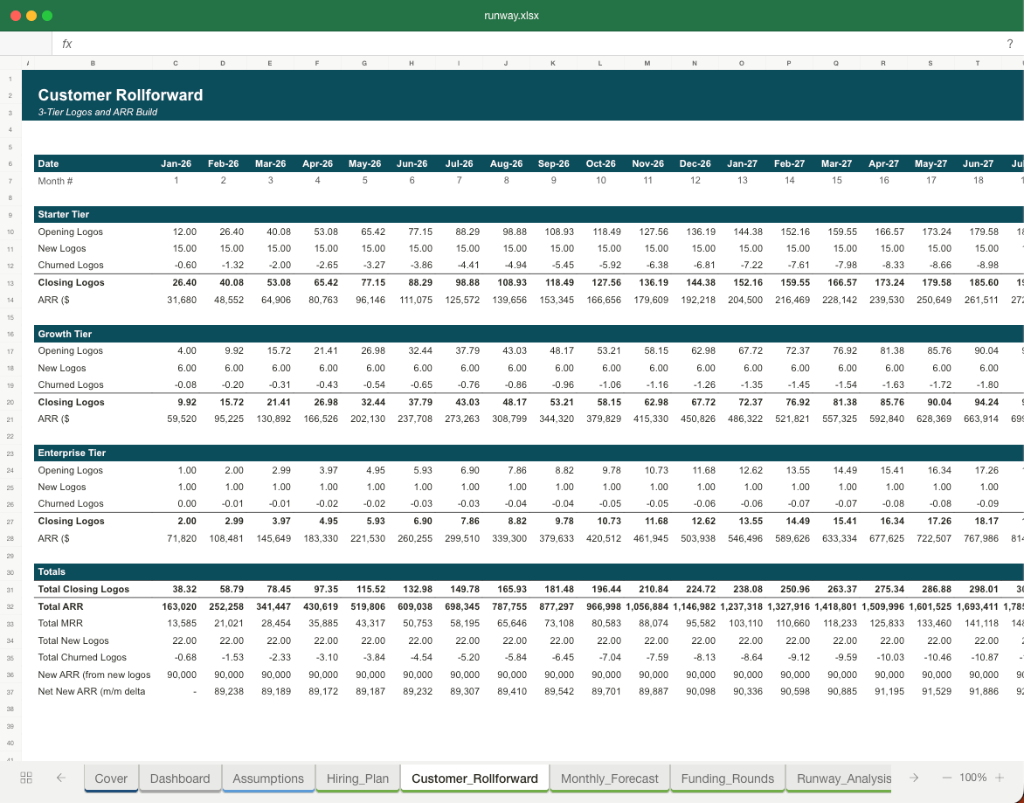
- Revenue build: Device rental | PRO platform fees | Analytics Dashboard SaaS
- P&L (Income Statement): Revenue → Gross Profit (hardware vs. software blended) → EBITDA
- Headcount & opex schedule
- Balance Sheet (hardware inventory, deferred revenue on multi-year PRO contracts)
- Cash Flow Statement (capex for hardware inventory is key)
- Scenario toggle (Bear / Base / Bull)
- Valuation bridge (ARR multiple on software revenue + hardware asset value)
Frequently asked
Is the Audoo financial model free?+
Yes. The Audoo model is a free Excel (.xlsx) download with live formulas. Sign up with your email and the workbook is yours to keep, review, and edit.
What's included in the model?+
A 5-year monthly forecast with P&L, cash flow and runway, valuation (exit multiple plus a DCF cross-check), MOIC/IRR returns, and unit economics, with live formulas throughout.
How was this model built?+
It was built from Audoo's pitch deck and publicly available information, then structured to investment-banking standards as a fully editable Excel model.
Can I change the assumptions?+
Yes. You can change assumptions and the live formulas will recalculate in the downloadable Excel model.
Have more financial modelling questions? Contact us

Created by ex-finance professionals
Hey, I’m Alex and I created Finamodel.
Over my years in the finance industry I kept building the same models over and over again. Same structure, same assumptions, different logo. So I started building frameworks to turn them into clean, reusable templates.
Every model here is one I’d actually use for a client, and I personally vet each one before it goes up.
I’m not an expert in every industry, but I’ve built enough models to know what belongs in one. And when something is completely foreign to me, I reach out to my network for experts to work on our models with us.
Having a template library on hand cuts a first build from hours to minutes.
Need help finding your model? You’ll find me in the Finamodel app!
Other Media/Gaming Startup Financial Models
Browse another startup in the same category.

Almost Friday
Almost Friday is a multi-platform comedy/lifestyle media brand built around the "Friday Beers" universe, monetising through apparel, brand partnerships, events, podcasts, and music.

Amagi
Cloud-native SaaS platform for TV/OTT channel creation, distribution, and ad monetization (FAST-focused)
Backbone
Backbone makes a mobile gaming controller (hardware) + unified software platform (Backbone app) that aggregates all game streaming services in one place.
Beacon Pines
Beacon Pines is a cute-and-creepy narrative adventure game set inside a magical storybook, developed by indie studio Hiding Spot Games.
Bear and Breakfast
A management/adventure video game where you play as a bear running a B&B cabin in the woods.
Bioshock
BioShock is a first-person action horror game pitched to a publisher for development funding - a game-development studio deal, not an operating startup.

Button City 2018
Indie narrative adventure game about cute animal kids saving their local arcade, targeting console and PC.

Button City 2020
Narrative adventure game about saving a local arcade, featuring three embedded mini-games, built by indie studio Subliminal Gaming LLC.