BABackbone Financial Model
Media/Gaming Startup Financials (Free Excel Download)
Backbone makes a mobile gaming controller (hardware) + unified software platform (Backbone app) that aggregates all game streaming services in one place.



professionals from Deloitte
Used by professionals from






About this model
Backbone makes the Backbone One controller, which clips onto an iPhone to create a console-like handheld experience. Its companion app is a unified launcher for cloud, remote-play, and native games, with social and recording features alongside services including Xbox Game Pass and PlayStation Remote Play.
The company positions itself as an independent layer that helps game services reach mobile players. Revenue comes from controller sales, commercial tie-ups with platform holders, and the Backbone+ subscription product. The deck confirms an Xbox partnership but does not disclose device pricing, subscription features, margins, or partner terms.
This is a hardware-and-subscription business with a third, lumpy B2B revenue line. A model should track sell-through and inventory separately from subscription cohorts, churn, and deferred revenue, then schedule partner agreements deal by deal. The research gives no unit sales, user, or retention metrics.
A turnkey financial model
Live formulas, no hardcoded values
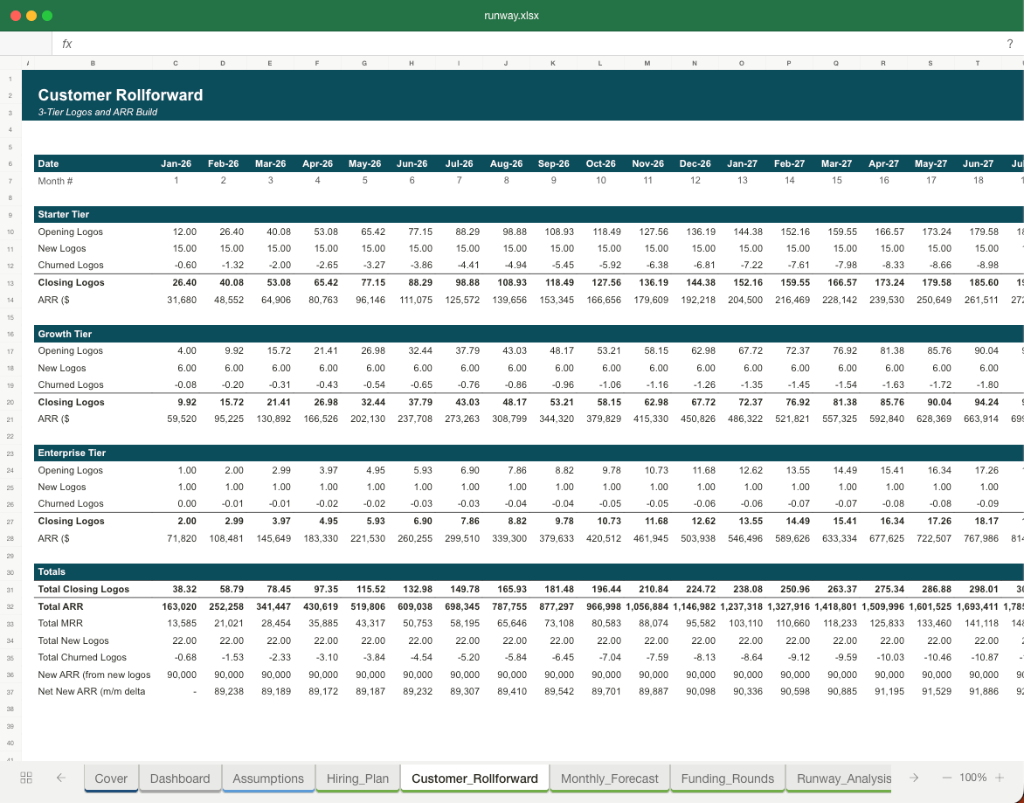
Outputs are driven by live formulas, so the workbook updates from its assumptions instead of relying on hardcoded results.
All assumptions in one tab
Inputs are clearly marked in the Assumptions tab and separated from calculations, making it clear what to change and what to leave intact.
Statements always balancing
For integrated-statement models, the balance sheet, cash flow, and supporting schedules tie through properly.
Distinct schedules for clarity
Debt, working capital, taxes, and cash flow can get messy quickly. We group calculations in clear schedules, not across disconnected tabs.
No hidden macros or external links
There are no unexplained external workbook links or macros to undermine auditability or portability.
Changes flow through the model
Update a key driver and see the impact carry through the forecast, financing, and return outputs. We never use hardcoded numbers in formulas.
About Backbone
playbackbone.com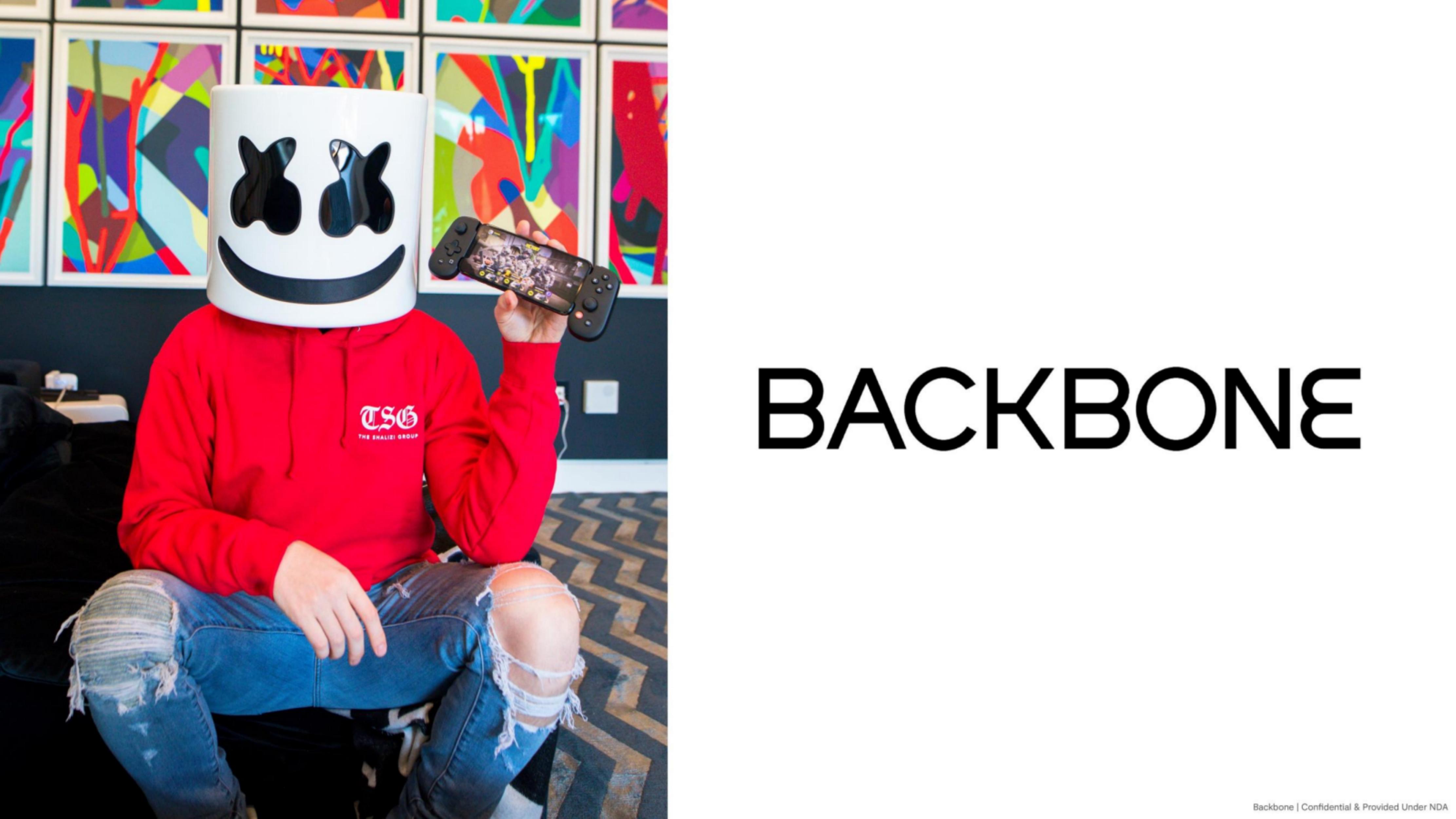
How to build a detailed financial model for Backbone
A complete walkthrough of the business, drivers, and assumptions behind the downloadable Backbone model - distilled from its pitch deck and publicly available information.
Product & value proposition
- Hardware: Backbone One - a physical game controller that clips onto an iPhone, turning it into a console-like handheld.
- Software: Backbone app - a unified launcher that aggregates cloud gaming services (Xbox Game Pass / xCloud, PlayStation Remote Play, Amazon Luna, Nvidia GeForce Now, Google Stadia, Apple Arcade, App Store native games) plus social/recording features.
- Value prop: Mobile phones are more powerful than the Nintendo Switch, but the experience of actually playing games on mobile is poor. Backbone solves the experience layer that all major gaming platforms have ignored.
- Positioning: "Independent and neutral third party" whose goal is to optimise any game or hero service's ability to reach players.
- Notable endorsement: TechCrunch Editor-in-Chief Matthew Panzarino quoted calling it "the way of the future for mobile gaming."
Market
- Mobile games generated $86.3B in 2020, representing 49% of the global gaming market.
- Total addressable market framing: 2 billion gamers worldwide.
- No SAM or SOM breakdown in deck.
- No market growth CAGR cited.
Revenue model
Three stated revenue streams:
- Devices - hardware sales of the Backbone One controller (sold direct or through retail; price not stated in deck).
- Partner tie-ups - B2B commercial arrangements with platform holders (Xbox partnership confirmed; others implied via logo grid on slides 8, 17). Revenue structure (rev-share, fixed fee, co-marketing) not specified.
- Backbone+ - subscription product (name only; tier, price, and included features not specified in deck).
No ASP, unit economics, margin, or pricing disclosed.
Traction & metrics
- Xbox partnership launched "In June" (year not stated, context suggests 2021).
- No revenue figures, user counts, unit sales, DAU/MAU, retention, or GMV disclosed in deck.
Competition / moat
- Direct competitive framing: Backbone positions against all the major gaming platforms (Microsoft, Sony, Apple, Nvidia, EA, Google, Nintendo, Amazon) not as competitors but as content partners it aggregates.
- Moat claims: Neutral aggregator positioning; Xbox partnership (exclusive or preferred status not stated); TechCrunch editorial endorsement.
- Traditional hardware comps (Razer Kishi, GameSir) not mentioned.
Team & funding ask / use of funds
- Presenter/backer: The Shalizi Group (TSG) - appears as the presenting entity, likely an influencer/talent management firm (Marshmello appears in cover image wearing Backbone controller).
- No founding team slides, no named executives.
- No funding ask, valuation, or use-of-funds slide in deck.
Recommended financial model
- Archetype + why: Hardware + SaaS hybrid (consumer electronics + recurring subscription). Two distinct P&L legs: (1) device revenue with COGS/gross margin, inventory, and channel mix; (2) Backbone+ subscription ARR with MRR build, churn, and LTV. Partner tie-up revenue is a third, lumpy B2B revenue line. Closest archetype: DTC hardware + subscription (Peloton-style 3-statement model).
- Forecast horizon & granularity: 5 years (FY1–FY5), monthly for Year 1–2 (hardware sell-through cycles + subscription cohort build), quarterly thereafter.
- Key drivers & assumptions:
| Driver | Seed value |
|---|---|
| Addressable mobile gamers (global) | 2 billion |
| Mobile gaming market size (2020) | $86.3B |
| Mobile gaming share of total gaming | 49% |
| Hardware ASP (Backbone One) | ~$99–$149 |
| Hardware COGS % | ~40–50% |
| Backbone+ attach rate (% of hardware buyers) | 20–40% |
| Backbone+ monthly churn | 5% |
| S&M as % of revenue | 25–35% |
| R&D as % of revenue | 15–20% |
- Scenarios (Base / Bull / Bear - which variables flex):
- Bear: Low hardware unit sell-through, low Backbone+ attach rate, no new partner deals signed.
- Base: Steady hardware growth via Xbox partnership distribution lift, Backbone+ attach at 25%, 1–2 new platform partner deals per year.
- Bull: Hardware becomes the de-facto mobile gaming accessory (Razer/Peloton analogy), Backbone+ reaches 100k+ subscribers, multiple platform rev-share deals.
- Key flex variables: units sold, Backbone+ attach rate, partner deal count/value, hardware ASP (potential Android expansion).
- Required sheets / outputs:
- Assumptions & drivers (single input sheet)
- Hardware revenue (units × ASP, channel split DTC vs retail, returns reserve)
- Backbone+ ARR (cohort waterfall: new subs, churn, net revenue, deferred revenue)
- Partner / B2B revenue (deal-by-deal schedule)
- COGS & gross margin bridge (hardware COGS, content/platform costs, payment processing)
- Operating expenses (S&M, R&D, G&A)
- Income statement (3-statement)
- Balance sheet (3-statement) - inventory is material
- Cash flow statement (3-statement) - working capital: inventory build ahead of hardware launches
- Scenario toggle (Base / Bull / Bear)
- KPI dashboard: units sold, Backbone+ subscribers, MRR, gross margin %, CAC, LTV/CAC
Frequently asked
Is the Backbone financial model free?+
Yes. The Backbone model is a free Excel (.xlsx) download with live formulas. Sign up with your email and the workbook is yours to keep, review, and edit.
What's included in the model?+
A 5-year monthly forecast with P&L, cash flow and runway, valuation (exit multiple plus a DCF cross-check), MOIC/IRR returns, and unit economics, with live formulas throughout.
How was this model built?+
It was built from Backbone's pitch deck and publicly available information, then structured to investment-banking standards as a fully editable Excel model.
Can I change the assumptions?+
Yes. You can change assumptions and the live formulas will recalculate in the downloadable Excel model.
Have more financial modelling questions? Contact us

Created by ex-finance professionals
Hey, I’m Alex and I created Finamodel.
Over my years in the finance industry I kept building the same models over and over again. Same structure, same assumptions, different logo. So I started building frameworks to turn them into clean, reusable templates.
Every model here is one I’d actually use for a client, and I personally vet each one before it goes up.
I’m not an expert in every industry, but I’ve built enough models to know what belongs in one. And when something is completely foreign to me, I reach out to my network for experts to work on our models with us.
Having a template library on hand cuts a first build from hours to minutes.
Need help finding your model? You’ll find me in the Finamodel app!
Other Media/Gaming Startup Financial Models
Browse another startup in the same category.

Almost Friday
Almost Friday is a multi-platform comedy/lifestyle media brand built around the "Friday Beers" universe, monetising through apparel, brand partnerships, events, podcasts, and music.

Amagi
Cloud-native SaaS platform for TV/OTT channel creation, distribution, and ad monetization (FAST-focused)

Audoo
IoT + SaaS platform that captures real-time public music performance data and reports it to Performing Rights Organisations (PROs) to enable accurate royalty distribution.
Beacon Pines
Beacon Pines is a cute-and-creepy narrative adventure game set inside a magical storybook, developed by indie studio Hiding Spot Games.
Bear and Breakfast
A management/adventure video game where you play as a bear running a B&B cabin in the woods.
Bioshock
BioShock is a first-person action horror game pitched to a publisher for development funding - a game-development studio deal, not an operating startup.

Button City 2018
Indie narrative adventure game about cute animal kids saving their local arcade, targeting console and PC.

Button City 2020
Narrative adventure game about saving a local arcade, featuring three embedded mini-games, built by indie studio Subliminal Gaming LLC.