Belong Health Financial Model
Health-tech Startup Financials (Free Excel Download)
Tech-enabled full-stack operating partner for regional health plans launching Dual-Eligible Special Needs Plans (D-SNPs) for Medicare + Medicaid dual-eligible beneficiaries.



professionals from Deloitte
Used by professionals from






About this model
Belong Health is a technology-enabled operating partner for regional health plans launching D-SNPs for Medicare and Medicaid dual-eligible members. It provides platform and operating expertise while its plan partners retain the insurance licence and statutory capital.
Its revenue is expected to be a management fee per enrolled member, with potential shared-savings upside. Partner-plan growth and beneficiary enrolment therefore matter more than conventional software seats.
The model should forecast plan partners, enrolled members per partner, PMPM fees, implementation, and shared-savings assumptions. Care operations, partner concentration, enrolment ramp, and any insurance-risk exposure should be kept separate from the platform fee.
A turnkey financial model
Live formulas, no hardcoded values
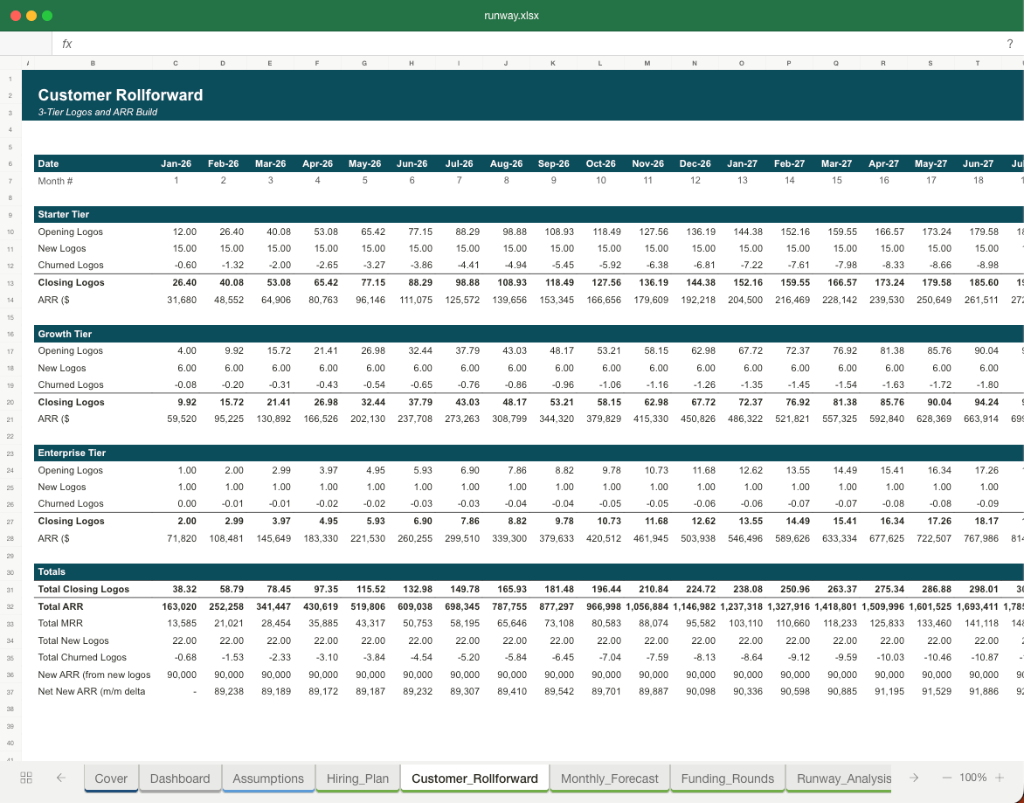
Outputs are driven by live formulas, so the workbook updates from its assumptions instead of relying on hardcoded results.
All assumptions in one tab
Inputs are clearly marked in the Assumptions tab and separated from calculations, making it clear what to change and what to leave intact.
Statements always balancing
For integrated-statement models, the balance sheet, cash flow, and supporting schedules tie through properly.
Distinct schedules for clarity
Debt, working capital, taxes, and cash flow can get messy quickly. We group calculations in clear schedules, not across disconnected tabs.
No hidden macros or external links
There are no unexplained external workbook links or macros to undermine auditability or portability.
Changes flow through the model
Update a key driver and see the impact carry through the forecast, financing, and return outputs. We never use hardcoded numbers in formulas.
About Belong Health
belong.life
How to build a detailed financial model for Belong Health
A complete walkthrough of the business, drivers, and assumptions behind the downloadable Belong Health model - distilled from its pitch deck and publicly available information.
Product & value proposition
Belong Health provides a "full-stack health plan operating platform" - a bundled set of services, technology, and owned care delivery assets that a regional health plan partner plugs in to run a D-SNP. The four pillars:
- Health Plan Infrastructure - provider network, MSO, IPA management, sales & brokerage, statutory capital support.
- Clinical Management - care coordination, care management, transitions of care, social determinants, behavioral health.
- Care Delivery Assets - in-home care, extensivists, owned primary care clinics.
- Analytics & Technology - data lake, analytics platform, AI/ML-driven care management workflow, member/provider portals.
The value prop to the health plan partner: Belong supplies what they lack (D-SNP operating expertise, tech, clinical assets) while the partner supplies what Belong lacks (health plan license, statutory capital, claims infrastructure, existing member base).
Market
- Medicare Advantage: $320B market, 5.6% CAGR forecast through 2030 (Congressional Budget Office).
- Dual Eligible segment: $330B spend, 11M individuals, 7.3% growth rate.
- Dual Enrolled (currently in a coordinated plan): $90B, 3M individuals, 2.5% growth.
- Medicare total: $800B, 60M individuals, 6.7% growth.
- Medicaid total: $621B, 74M individuals, 3.9% growth.
- National Healthcare Expenditure 2019: $3.8T, forecast 5.4%/yr growth.
- Market growth signal: Age-ins add $1B in new annual premium every 10 days (assumes 10,000 age-ins/day × $800 PMPM).
- SNP eligibility growth materially outpacing MA enrollment.
- Addressable partner universe: 104 regional health plans + 20 independent BCBS licensees + 4 multi-state BCBS licensees + 161 Medicaid MCOs with 5,000+ lives but no MA offering + 21 regional provider systems with no insurance offering = ~310 prospective partner targets.
- Competitive context: Innovative MA insurers (Oscar, Devoted, Clover, Alignment, Bright) collectively serve <250K lives vs. 26.4M MA enrollees and 62.7M Medicare-eligible. Market penetration by next-gen models is <1%.
Revenue model
Not explicitly disclosed in deck. Based on the business model described:
- Belong is a platform + services provider to health plan partners, not itself a licensed insurer (the partner holds the license and statutory capital).
- Revenue is most likely structured as: (a) a PMPM management fee paid by the partner plan for each enrolled dual-eligible member, and/or (b) a percentage of the premium revenue the plan earns from CMS/state Medicaid agencies, plus (c) potential shared savings participation on medical cost reduction.
- The anchor contract with MVP Health Care has a disclosed "estimated total contract value" - but the dollar amount is redacted in the deck image (slide 5 shows the phrase but the number is blank/redacted).
- Channels: Direct B2B sales to health plan partners; pipeline includes regional health plans, BCBS licensees, Medicaid MCOs, and provider systems.
Traction & metrics
- Anchor partner signed: MVP Health Care, definitive operating agreement August 23, 2021.
- Launch date: January 1, 2022, upstate New York (Hudson Valley + Capital District).
- Estimated total contract value with MVP: REDACTED in deck image.
- Pipeline: Active pipeline with prospects at "Early Conversation," "Moving Towards LOI," and "LOI Near Completion" stages; specific names and counts redacted.
- Financial Forecast section (slides 27+): Entire section redacted.
Unit economics
- Revenue per partner is likely large (multi-year contract, PMPM × member count × 12 months).
- Medical Loss Ratio (MLR) risk: If Belong bears any insurance risk on medical costs, MLR is the dominant margin driver. If pure fee-for-service/PMPM management model, MLR risk stays with the health plan partner.
- Dual-eligible PMPM premiums are high (~$800/month implied by slide 9 footnote), but medical costs for this population are also very high.
Competition / moat
- Competitive landscape (next-gen MA insurers): Oscar (3K lives), Devoted (39K), Bright + Brand New Day (63K), Clover (66K), Alignment Healthcare (77K) - all direct insurers, not platform/partner model.
- Advanced practice provider models: Village MD (600K), ChenMed (200K), Landmark (150K), Oak Street (109K), Iora (30K) - these are provider-side, not health plan enablement.
- Belong's moat claim: No direct competitor identified in deck for the "full-stack D-SNP operating partner" model for regional health plans. Moat relies on: (1) first-mover with anchor partner; (2) proprietary tech stack; (3) experienced leadership team with deep D-SNP / MA operational backgrounds; (4) network effects as more partners join the platform.
- Leadership backgrounds (moat evidence): CEO managed 9th largest MA+D-SNP plan at Cigna-HealthSpring ($1.5B premium) and a 5-star MA plan at Essence Healthcare.
Team & funding ask / use of funds
Team (co-founders + key hires):
- J. Patrick Foley - Co-Founder + CEO. Cigna-HealthSpring ($1.5B premium MA+D-SNP), Essence Healthcare (5-star MA plan).
- Dr. Jennie Byrne - Co-Founder + Chief Patient Officer. Chief Behavioral Health Officer at CareMore.
- Tahasin Alam - Co-Founder + CTO. Co-founder of Centivo (tech-led employer insurance platform).
- Gen Gillespie - Co-Founder + CRO. National sales responsibility at Lumeris.
- Lewis Biggers - Co-Founder + Chief Provider Officer. Accountable care at Stanford Health Care.
- Alon Krashinsky - Co-Founder. 15+ years launching built-for-purpose companies.
- Brian Lovett - Co-Founder. 5+ years launching built-for-purpose companies.
- Maura McGinn - SVP People + Ops. Led people/recruitment at Bright Health.
- Natasha VanWright - VP Care Management. 20 years health plan leadership.
- Julie Berez - VP Partner Operations. RubiconMD and Bain.
Funding ask: Series A - amount not disclosed in deck (redacted or not stated).
Use of funds: Implied from exec summary: (1) fund the MVP Health Care D-SNP launch (Jan 2022); (2) build out tech-enabled clinical model; (3) expand team (care management, growth, provider engagement, analytics, health IT); (4) pursue pipeline of additional health plan partners.
Recommended financial model
Archetype + why: Managed Care Enablement / PMPM Partner Revenue model - specifically a multi-partner PMPM-based P&L with insurance economics layered in. This is closest to a B2B SaaS-meets-managed-care hybrid. The core mechanics: number of partners × enrolled members per partner × PMPM fee = revenue. Optionally add shared savings upside. On the cost side: clinical delivery costs (CHW, NP, RNCM, behavioral health), technology OpEx, G&A, and sales/BD. If Belong carries any capitation or risk corridor, an MLR/medical expense line is required. Given the redacted financial section, the model must be built from structural assumptions.
Forecast horizon & granularity:
- 5-year annual model (2022–2026), with 2022 monthly build for the first year (MVP launch ramp).
- Quarterly suffices for years 2–5.
Key drivers & assumptions:
*Partner/enrollment funnel:*
- Partners live (Year 1): 1; subsequent years.
- Members per partner (Year 1, MVP):.
- Member growth per partner per year:.
- Churn/attrition of members:.
*Revenue:*
- PMPM management fee to Belong:.
- Shared savings upside:.
- Contract duration:.
*Cost structure:*
- Clinical staffing (CHW, RNCM, NP, behavioral health, social work):.
- Technology platform (build/maintain):.
- G&A and corporate overhead:.
- Sales & BD (partner acquisition):].
*Insurance/MLR economics (if risk-bearing):*
- Medical Loss Ratio:.
- If fee-for-service/PMPM management only: MLR stays with health plan partner; Belong's P&L is a services business with ~40–60% gross margins.
*Capital & funding:*
- Series A raise:.
- Pre-revenue through end of 2021.
- Cash burn pre-revenue:.
Scenarios (Base / Bull / Bear - which variables flex):
- Base: 1 partner live in 2022 (MVP, ~1,000 members), 1 additional signed in 2023, 2 in 2024; PMPM fee $150; clinical costs scale efficiently with volume.
- Bull: 2 additional partners LOI to signed in 2022 (consistent with pipeline stage disclosed); members per partner grow faster (200% YoY); shared savings upside materializes; PMPM fee negotiated higher as value demonstrated.
- Bear: MVP launch delayed or enrollment misses ramp; no new partners signed until 2024; regulatory / CMS compliance costs higher than expected; clinical costs don't scale (high per-member cost for complex population).
Required sheets / outputs:
- Assumptions - all drivers with Base/Bull/Bear toggles.
- Partner & Member Ramp - partners signed × go-live date × member enrollment curve per partner.
- Revenue Build - members × PMPM fee × months live; shared savings upside (optional toggle).
- Clinical & Operational Cost Build - headcount by role × cost per FTE, scaling with member count; non-headcount clinical OpEx (home visits, labs, etc.).
- Technology & G&A - platform build costs (capex), hosting, corporate overhead.
- Income Statement - revenue, gross profit (if fee-based), EBITDA, net income; or medical expense / MLR if risk-bearing.
- Cash Flow & Runway - burn rate, Series A proceeds, months of runway.
- Sensitivity Table - PMPM fee vs. members per partner; MLR vs. gross margin.
- Dashboard - KPIs: partners live, total members, revenue, burn, runway.
Frequently asked
Is the Belong Health financial model free?+
Yes. The Belong Health model is a free Excel (.xlsx) download with live formulas. Sign up with your email and the workbook is yours to keep, review, and edit.
What's included in the model?+
A 5-year monthly forecast with P&L, cash flow and runway, valuation (exit multiple plus a DCF cross-check), MOIC/IRR returns, and unit economics, with live formulas throughout.
How was this model built?+
It was built from Belong Health's pitch deck and publicly available information, then structured to investment-banking standards as a fully editable Excel model.
Can I change the assumptions?+
Yes. You can change assumptions and the live formulas will recalculate in the downloadable Excel model.
Have more financial modelling questions? Contact us

Created by ex-finance professionals
Hey, I’m Alex and I created Finamodel.
Over my years in the finance industry I kept building the same models over and over again. Same structure, same assumptions, different logo. So I started building frameworks to turn them into clean, reusable templates.
Every model here is one I’d actually use for a client, and I personally vet each one before it goes up.
I’m not an expert in every industry, but I’ve built enough models to know what belongs in one. And when something is completely foreign to me, I reach out to my network for experts to work on our models with us.
Having a template library on hand cuts a first build from hours to minutes.
Need help finding your model? You’ll find me in the Finamodel app!
Other Health-tech Startup Financial Models
Browse another startup in the same category.
98point6
B2B SaaS platform licensing an AI-powered virtual care technology stack to health systems, pivoted from running a direct-to-employer virtual clinic.
A-Champs
IoT-powered gamified training device (ROXs PRO) for sports/health professionals, evolving into a B2C smart coach app for families.

AccuRx
Patient-centred communication platform connecting everyone involved in a patient's care, starting with near-universal penetration in UK GP practices.

Aeris
Swiss-made premium air purifiers sold through DTC, retail, and dealer channels, with a recurring filter consumable attached to a connected mobile app.

Akido Labs
Akido Labs is a data-driven prevention platform that integrates siloed healthcare, municipal, and non-profit data to enable proactive outreach and case management for vulnerable populations (homeless, chronically ill, etc.).

Alloy
Telehealth + DTC subscription platform delivering menopause hormonal treatment (MHT) and holistic care to U.S. women 40+.

Astek Diagnostics
Point-of-care diagnostic device (Jiddu system) that confirms bacterial infections and antibiotic sensitivity in ~1 hour across four body fluid types (urine, CSF, effluent, blood).

Atom Limbs
Atom Limbs is building the first AI-powered, neural-controlled prosthetic arm sold direct-to-consumer on a subscription model.