CHChargebee Financial Model
Enterprise/Security Startup Financials (Free Excel Download)
Subscription billing and revenue management platform that enables businesses to launch, iterate, and scale recurring revenue models.



professionals from Deloitte






About this model
Chargebee is subscription billing and revenue-management infrastructure for businesses with recurring revenue. It supports billing, invoicing, payments, revenue operations, and the product and pricing changes that become difficult as a subscription business scales.
Its customers range from growing software companies to larger organisations managing increasing billing complexity. The commercial opportunity expands with customers' recurring revenue and billing activity, creating a natural path from an initial software subscription to broader account value.
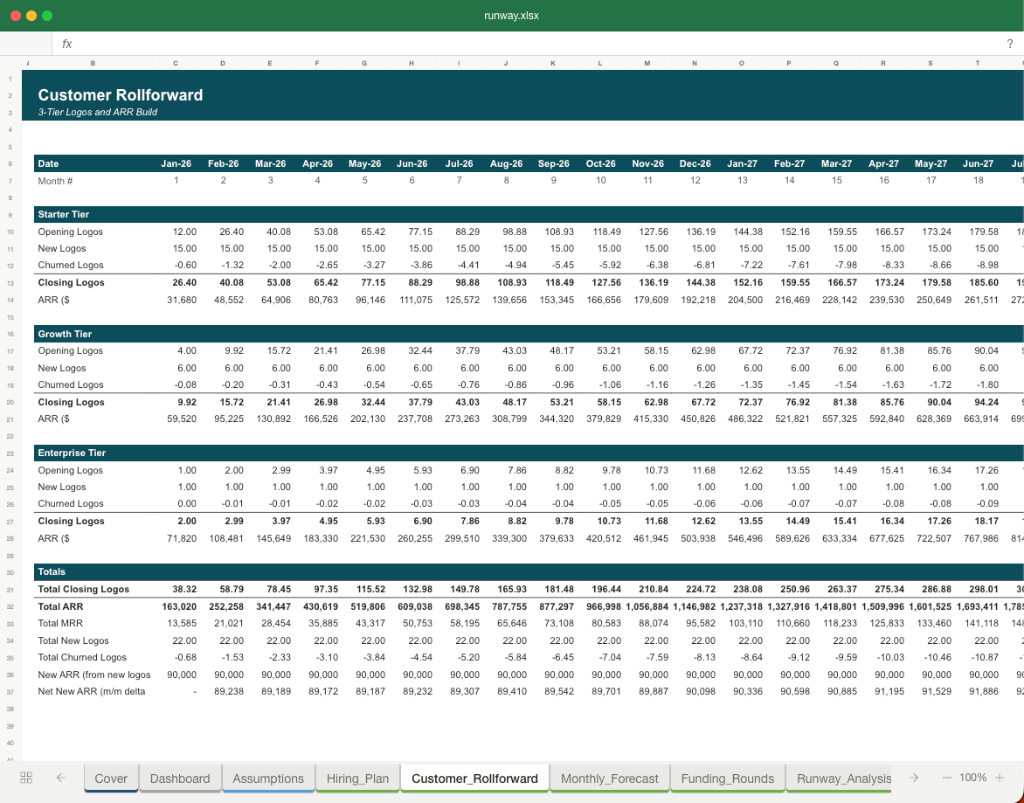
The model uses a multi-cohort ARR waterfall with new subscriptions, upgrades, churn, and expansion. Customer count and ACV form the core build, while a spend or billing-volume sensitivity can test usage-linked upside; gross margin, sales efficiency, headcount, and cash flow complete the plan.
A turnkey financial model
Live formulas, no hardcoded values
Outputs are driven by live formulas, so the workbook updates from its assumptions instead of relying on hardcoded results.
All assumptions in one tab
Inputs are clearly marked in the Assumptions tab and separated from calculations, making it clear what to change and what to leave intact.
Statements always balancing
For integrated-statement models, the balance sheet, cash flow, and supporting schedules tie through properly.
Distinct schedules for clarity
Debt, working capital, taxes, and cash flow can get messy quickly. We group calculations in clear schedules, not across disconnected tabs.
No hidden macros or external links
There are no unexplained external workbook links or macros to undermine auditability or portability.
Changes flow through the model
Update a key driver and see the impact carry through the forecast, financing, and return outputs. We never use hardcoded numbers in formulas.
About Chargebee

How to build a detailed financial model for Chargebee
A complete walkthrough of the business, drivers, and assumptions behind the downloadable Chargebee model - distilled from its pitch deck and publicly available information.
Product & value proposition
Chargebee is a subscription management and billing automation platform structured around four core pillars:
- Agile experiment engine - pricing & bundling, promos & campaigns, product bundle configuration.
- Billing lifecycle automation - billing automation, workflow management.
- Flexible & extensible platform - integrations and adaptability for changing business models.
- Real-time revenue telemetry - business metrics and reporting.
Value proposition: enables businesses to rapidly change business models (delivery, consumption, supply, service, revenue models) without re-engineering billing infrastructure. Pitch frames adaptability as the core survival/growth lever; businesses that adapt grow 3x faster.
Revenue model
Not explicitly stated in deck. Based on product positioning as a SaaS billing platform, Chargebee charges customers (the 20,000+ businesses) a recurring subscription fee - likely tiered by revenue processed or by feature set. No pricing page, no per-seat/revenue-share data appears in the deck.
Traction & metrics
From slide 7:
- 20,000+ high-growth businesses (customers)
- 410+ business model iterations facilitated on the platform
- $3 Bn+ ARR enabled via new models (this is aggregate ARR of Chargebee's customers, not Chargebee's own ARR)
Customer logos (slide 7) include: Calendly, Philo, Freshworks, Thomas, GetAccept, Sonovate, Study.com, Shaw Academy, Okta, Railsbank, Yousign, Sendinblue, Arbor, Coorpacademy, Proxyclick.
Case study metrics:
- MakeSpace (slide 8): scaled to 31 new markets in 1 year.
- Yousign (slide 9): 2X customer base in 6 months; 10% MRR addition in 2 months from new-market plans.
- New York Times (slide 5, illustrative): 5 Mn+ subscribers; $800 Mn+ annual digital revenues (used as market narrative example, not a Chargebee customer claim).
Competition / moat
Not explicitly named. Moat is implied by:
- Depth of billing lifecycle coverage (pricing experiments, workflow, revenue telemetry in one platform).
- Network effect of 410+ business model iteration templates/playbooks across 20,000+ customers.
- International billing infrastructure already built out (multi-language, multi-regulation, multi-payment method - Yousign EU case study).
- No competitor names or positioning matrix in the deck.
Team & funding ask / use of funds
Recommended financial model
- Archetype + why: SaaS ARR / subscription revenue model. Chargebee is a classic B2B SaaS company - recurring subscription fees from business customers, with expansion revenue potential as customer MRR/billing volume grows. A multi-cohort ARR waterfall is the natural structure.
- Forecast horizon & granularity: 5 years (Year 1 monthly, Years 2–5 annual); monthly detail in Year 1 to capture cohort-level churn and expansion properly.
- Key drivers & assumptions:
| Driver | Value | Source |
|---|---|---|
| Starting customer count | 20,000 | - |
| New customer adds per month | ~500–1,000 | high-growth SaaS at this scale; no deck figure |
| Monthly gross churn rate | 1.0–1.5% | B2B SaaS midmarket benchmark |
| Net revenue retention (NRR) | 110–120% | typical for billing-infra SaaS with expansion based on customer billing volume growth |
| Average contract value (ACV) | $12,000–$24,000/yr | midmarket SaaS billing platform; no deck figure |
| Gross margin | 70–75% | SaaS infrastructure; hosting + support costs |
| S&M as % of revenue | 25–35% | growth-stage SaaS |
| R&D as % of revenue | 15–20% | - |
| G&A as % of revenue | 8–12% | - |
| $3 Bn+ customer ARR enabled | - | Used as sanity check on platform scale, not Chargebee's own ARR |
- Scenarios (Base / Bull / Bear - which variables flex):
- Bear: Gross churn rises to 2.5%/mo; new logo growth slows; NRR drops to 100% (no expansion).
- Base: 1.0–1.5% gross churn; steady new logo adds; NRR ~110%.
- Bull: Accelerated new logo adds (product-led growth kicking in); NRR 120%+; ACV uplift from enterprise segment.
- Primary flex variables: new customer adds per period, gross churn rate, NRR, ACV.
- Required sheets / outputs:
- Assumptions dashboard (all drivers toggled by scenario)
- Customer cohort waterfall (monthly cohorts, gross churn, net expansion)
- ARR bridge (new ARR, expansion ARR, churn ARR, net ARR)
- Revenue & P&L (revenue → gross profit → EBITDA → FCF)
- Headcount & opex build (S&M, R&D, G&A)
- Summary KPIs (ARR, MRR, customer count, NRR, gross margin, burn/FCF)
Frequently asked
Is the Chargebee financial model free?+
Yes. The Chargebee model is a free Excel (.xlsx) download with live formulas. Sign up with your email and the workbook is yours to keep, review, and edit.
What's included in the model?+
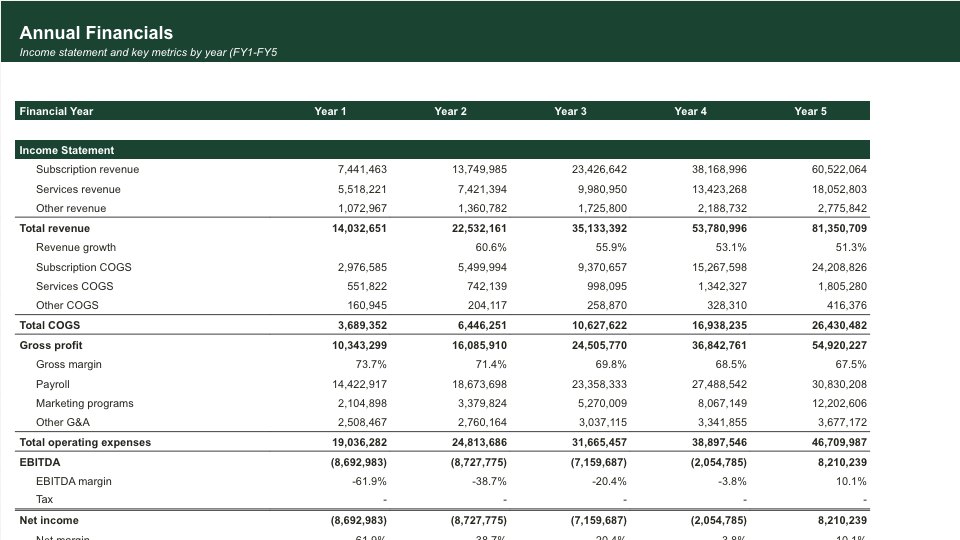
A 5-year monthly forecast with P&L, cash flow and runway, valuation (exit multiple plus a DCF cross-check), MOIC/IRR returns, and unit economics, with live formulas throughout.
How was this model built?+
It was built from Chargebee's pitch deck and publicly available information, then structured to investment-banking standards as a fully editable Excel model.
Can I change the assumptions?+
Yes. You can change assumptions and the live formulas will recalculate in the downloadable Excel model.
Have more financial modelling questions? Contact us

Created by ex-finance professionals
Hey, I’m Alex and I created Finamodel.
Over my years in the finance industry I kept building the same models over and over again. Same structure, same assumptions, different logo. So I started building frameworks to turn them into clean, reusable templates.
Every model here is one I’d actually use for a client, and I personally vet each one before it goes up.
I’m not an expert in every industry, but I’ve built enough models to know what belongs in one. And when something is completely foreign to me, I reach out to my network for experts to work on our models with us.
Having a template library on hand cuts a first build from hours to minutes.
Other Enterprise/Security Startup Financial Models
Browse another startup in the same category.
AgBiome
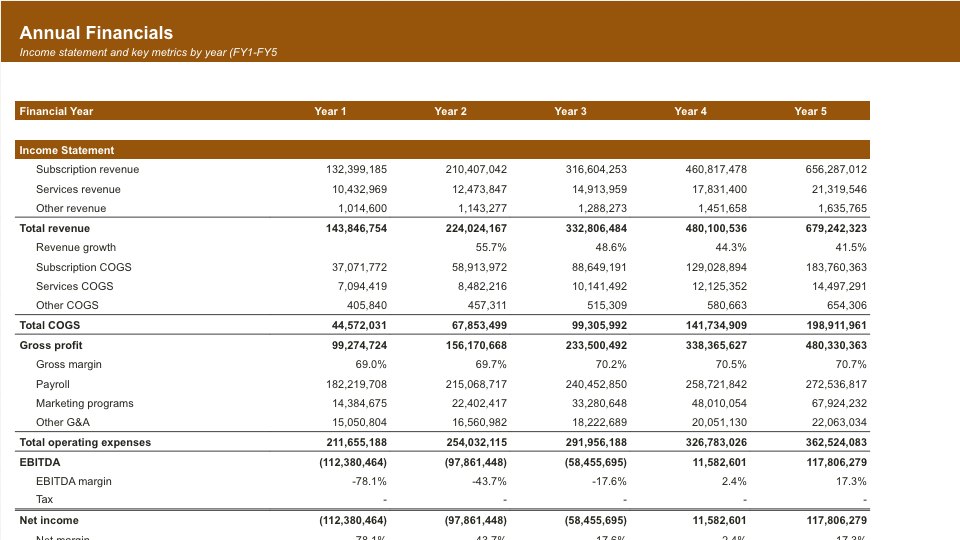
AgBiome is a microbial-platform agtech company that discovers, develops, and commercialises biological crop protection products (and licences the platform across adjacent markets).

Alation
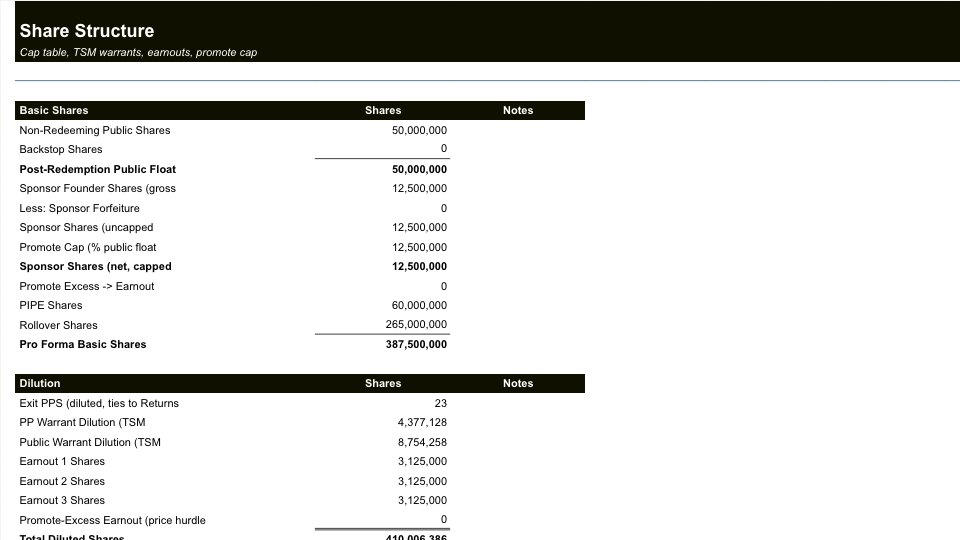
Enterprise data intelligence platform - data catalog, governance, and metadata management for large organisations.

Archer SPAC
Archera
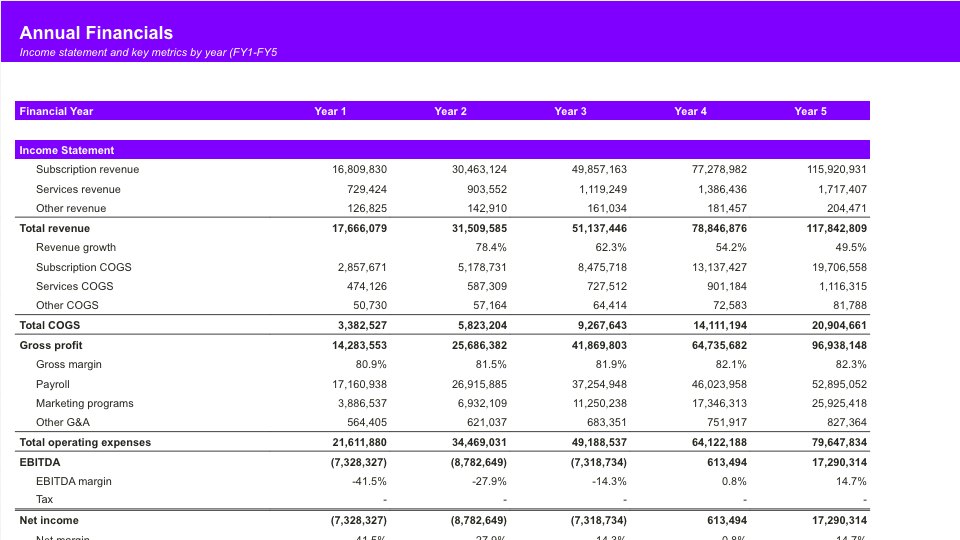
Cloud resource automation platform that continuously optimizes AWS commitment purchases, de-risks overcommitment, and automates FinOps workflows.

Ardoq
Cloud-native Enterprise Architecture (EA) SaaS platform that helps large enterprises navigate digital transformation through automated data collection, graph-based architecture modelling, and change impact analysis.
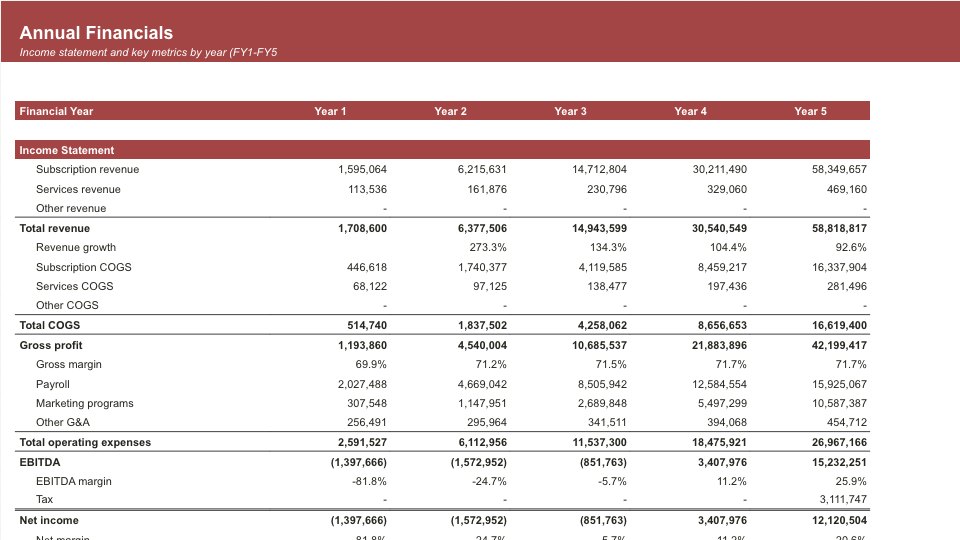

Ascend
Ascend.io is an enterprise big data automation platform ("Enterprise Intelligence Platform") that abstracts away the complexity of big data engineering so non-experts can build and run data pipelines.
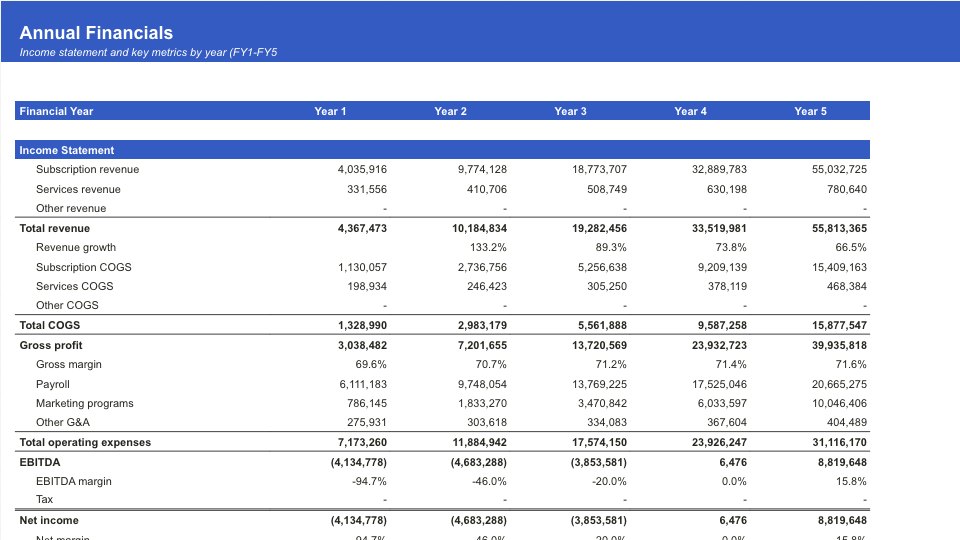

Athennian
Cloud-based legal entity management system (EMS) uniting entity data with workflow and document automation.
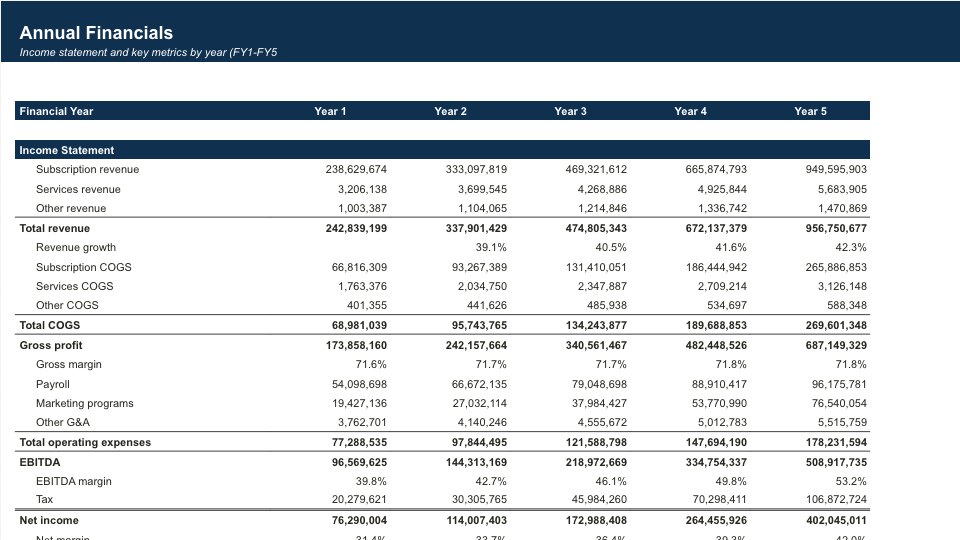

Auditboard
Cloud-based integrated risk management platform connecting audit, risk, compliance, and ESG teams across the enterprise.