 Dixa Financial Model
Enterprise/Security Startup Financials (Free Excel Download)
Conversational customer service SaaS platform enabling "Customer Friendship" - a channel-neutral, multiexperience approach to customer engagement.



professionals from Deloitte
Used by professionals from






About this model
Dixa is a conversational customer-service platform built around a channel-neutral view of customer engagement. Its Customer Friendship approach brings voice, messaging, email, and other interactions into one experience for support teams and the customers they serve.
The company sells subscription software to mid-market and enterprise brands, with agent seats as the natural unit of deployment. Its materials include a 120-agent Rapha implementation, illustrating how account value can grow with the size and use of a customer-support operation.
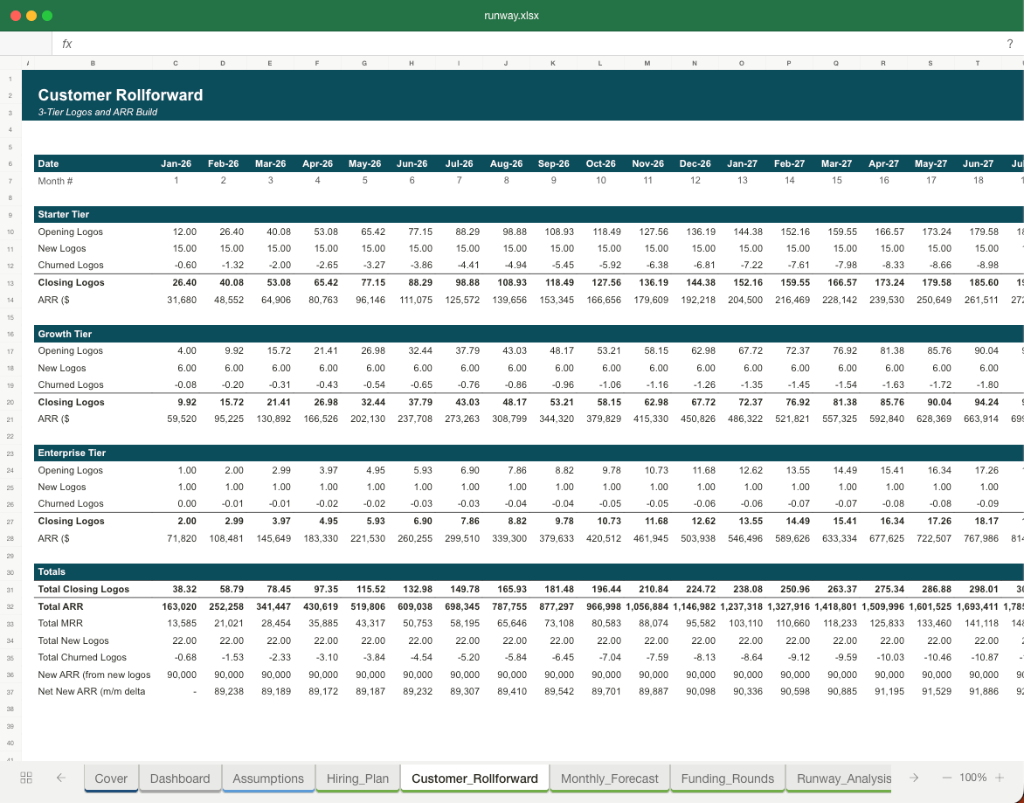
The model uses a seat-based ARR waterfall, separating new customers, agent-seat expansion, churn, and ending ARR. Sales hiring, pipeline conversion, average seats per brand, retention, support delivery costs, and SaaS gross margin drive the forecast and cash runway.
A turnkey financial model
Live formulas, no hardcoded values
Outputs are driven by live formulas, so the workbook updates from its assumptions instead of relying on hardcoded results.
All assumptions in one tab
Inputs are clearly marked in the Assumptions tab and separated from calculations, making it clear what to change and what to leave intact.
Statements always balancing
For integrated-statement models, the balance sheet, cash flow, and supporting schedules tie through properly.
Distinct schedules for clarity
Debt, working capital, taxes, and cash flow can get messy quickly. We group calculations in clear schedules, not across disconnected tabs.
No hidden macros or external links
There are no unexplained external workbook links or macros to undermine auditability or portability.
Changes flow through the model
Update a key driver and see the impact carry through the forecast, financing, and return outputs. We never use hardcoded numbers in formulas.
About Dixa
dixa.com
How to build a detailed financial model for Dixa
A complete walkthrough of the business, drivers, and assumptions behind the downloadable Dixa model - distilled from its pitch deck and publicly available information.
Product & value proposition
- Unified "Customer Friendship™" platform replacing legacy ticketing and omnichannel point-solutions with a single, channel-neutral interface.
- Multiexperience approach: agents get one screen with full context, intelligent routing, LTV-based prioritization, AI-assisted knowledge base, and customer history - regardless of whether contact arrives via chat, phone, email, or messaging apps.
- Positioned against three incumbent categories it sits at the intersection of: ticketing/email (Zendesk, Salesforce), chat/messaging (Intercom, LivePerson, Olark), and call-center/voice (Genesys, Avaya, Talkdesk, Aircall).
- Key differentiator framed as moving from efficiency-centric KPIs (Zendesk era) to value/LTV-centric outcomes, unlocking profitability rather than just cost savings.
Market
- TAM: $90bn by 2027 (CAGR 10% from 2020), sourced from GVC Report Feb 2020 "Contact Center Software Market Size Worth $72.3 Billion By 2027".
- The Venn diagram on slide 5 shows Dixa positioned at the intersection of all three legacy categories, implying addressable market spans the full contact-center software TAM.
Revenue model
- B2B SaaS subscription; pricing unit appears to be per-agent seat (Rapha case study cites "120 agents" as the deployment size, implying per-seat licensing).
- No explicit pricing tiers, ACV, or ARPU/ARPA figures disclosed in the deck.
- Sales channels: direct (CRO in SF suggests enterprise direct sales); mid-market focus per G2 badges.
- Integrations with Shopify, Salesforce, Magento, HubSpot visible on slide 12, indicating marketplace/ecosystem distribution.
Traction & metrics
- $50M+ total funding raised to date.
- 170+ employees.
- Founded 2015.
- "Hundreds of customer-loving brands" as customers (no precise count).
- Customer logos shown include Too Good To Go, Epic Games, HAY, Thule, Lingoda, Rapha, Podimo, Staples, LiveRamp, AccuWeather and ~35 others.
- No ARR, MRR, revenue growth rate, NRR, or churn figures disclosed in the deck.
- Case study - Rapha (120 agents, switched from Zendesk Support, Chat & Talk): +14% customer experience lift, +22% retention boost, +17% efficiency increase.
- Third-party stat: "3.5x higher financial performance YoY according to Accenture" cited as outcome for multiexperience deployments. (This is an Accenture industry claim used as supporting evidence, not Dixa's own metric.)
Competition / moat
- Direct competitive set: Zendesk (ticketing), Salesforce Service Cloud, Freshdesk, Office 365 (ticket/email); Intercom, LivePerson, Olark (chat/messaging); Genesys, Avaya, Talkdesk, Aircall (voice/call center).
- Moat framing: "Customer Friendship" brand positioning + multiexperience architecture that avoids the "omnichannel never-ending tech fix" problem.
- G2 awards: Best Est. ROI, Best Usability, Easiest Admin, Easiest Setup, Fastest Implementation, Highest User Adoption - all Mid-Market, Fall 2020.
- External validation: EY Entrepreneur of the Year, TNW Tech5 Hottest Startup, TechCrunch coverage.
Team & funding ask / use of funds
- Co-founder & CEO: Mads Fosselius (ex-TDC, Cirque).
- Co-founder & Head of Engineering: Jakob Nederby (ex-DR, GAFFA).
- CRO: Scott Sinatra (ex-LinkedIn, Glint).
- CFO: Kasper Sommer (ex-Trustpilot, Planday).
- CSO: Christian Lohmann (ex-Carnegie, TDC).
- VP Customer Success: Pamela Alvarez (ex-LinkedIn, Glint).
- VP Marketing: Dayana Orlan-Nevo (ex-WalkMe, Microsoft).
- Head of Product: Rob Krassowski (ex-Brazen).
- VP People & Culture: Nina Caroe (ex-Unity, Emmerys).
Recommended financial model
- Archetype + why: SaaS ARR model with per-seat expansion mechanics. Dixa is a pure B2B subscription platform; the natural units are seats (agents), customers (brands), and ARR. A seat-based ARR model best maps to the disclosed deployment evidence (Rapha: 120 agents) and the mid-market/enterprise GTM. Include a simple revenue-retention waterfall (new ARR, expansion ARR, churned ARR → net ARR).
- Forecast horizon & granularity: 5 years (2021–2025), monthly for Year 1 then quarterly for Years 2–5. Monthly detail in Year 1 captures the ramp dynamics of a Series C deployment; quarterly thereafter is sufficient for a growth equity model.
- Key drivers & assumptions:
| Driver | Value |
|---|---|
| Starting customer count | ~200–300 brands (deck says "hundreds") |
| Average agents per customer | 50–100 seats |
| Headcount (total) | 170+ as of May 2021 |
| Market CAGR | 10% (contact center software) |
- Scenarios (Base / Bull / Bear - which variables flex):
- *Base:* NRR = 115%, new logos at moderate pace, gross margin 72%, S&M = 45% rev.
- *Bull:* NRR = 125% (strong seat expansion), faster new logo wins in US (Scott Sinatra SF GTM ramps), gross margin 75%.
- *Bear:* NRR = 105%, higher churn in mid-market (Zendesk competitive pressure), slower US expansion.
- Primary flex variables: NRR, new logo growth rate, ACV/seat price, S&M efficiency (magic number).
- Required sheets / outputs:
- Assumptions - all drivers in one input block.
- ARR Waterfall - beginning ARR, new ARR, expansion ARR, churned ARR, ending ARR by period.
- Seat / Customer build - logo count × avg seats × ASP.
- P&L - Revenue, COGS, Gross Profit, S&M, R&D, G&A, EBITDA, net loss.
- Headcount plan - by department (Eng, S&M, CS, G&A) linked to opex.
- Cash / runway - cumulative cash burn vs. funding.
- KPI dashboard - ARR, NRR, magic number, CAC payback (once CAC seeded), LTV/CAC.
Frequently asked
Is the Dixa financial model free?+
Yes. The Dixa model is a free Excel (.xlsx) download with live formulas. Sign up with your email and the workbook is yours to keep, review, and edit.
What's included in the model?+
A 5-year monthly forecast with P&L, cash flow and runway, valuation (exit multiple plus a DCF cross-check), MOIC/IRR returns, and unit economics, with live formulas throughout.
How was this model built?+
It was built from Dixa's pitch deck and publicly available information, then structured to investment-banking standards as a fully editable Excel model.
Can I change the assumptions?+
Yes. You can change assumptions and the live formulas will recalculate in the downloadable Excel model.
Have more financial modelling questions? Contact us

Created by ex-finance professionals
Hey, I’m Alex and I created Finamodel.
Over my years in the finance industry I kept building the same models over and over again. Same structure, same assumptions, different logo. So I started building frameworks to turn them into clean, reusable templates.
Every model here is one I’d actually use for a client, and I personally vet each one before it goes up.
I’m not an expert in every industry, but I’ve built enough models to know what belongs in one. And when something is completely foreign to me, I reach out to my network for experts to work on our models with us.
Having a template library on hand cuts a first build from hours to minutes.
Need help finding your model? You’ll find me in the Finamodel app!
Other Enterprise/Security Startup Financial Models
Browse another startup in the same category.
AgBiome
AgBiome is a microbial-platform agtech company that discovers, develops, and commercialises biological crop protection products (and licences the platform across adjacent markets).

Alation
Enterprise data intelligence platform - data catalog, governance, and metadata management for large organisations.

Archer SPAC
Archera
Cloud resource automation platform that continuously optimizes AWS commitment purchases, de-risks overcommitment, and automates FinOps workflows.

Ardoq
Cloud-native Enterprise Architecture (EA) SaaS platform that helps large enterprises navigate digital transformation through automated data collection, graph-based architecture modelling, and change impact analysis.

Ascend
Ascend.io is an enterprise big data automation platform ("Enterprise Intelligence Platform") that abstracts away the complexity of big data engineering so non-experts can build and run data pipelines.

Athennian
Cloud-based legal entity management system (EMS) uniting entity data with workflow and document automation.

Auditboard
Cloud-based integrated risk management platform connecting audit, risk, compliance, and ESG teams across the enterprise.