 Empowerly Financial Model
Health-tech Startup Financials (Free Excel Download)
Tech-enabled marketplace matching high school students with vetted college and career counselors via a proprietary software platform.



professionals from Deloitte
Used by professionals from






About this model
Empowerly is a tech-enabled marketplace matching high-school students with vetted college and career counsellors. It combines human guidance with software and aims to make a complex admissions journey more accessible to families.
Counselling packages are sold to students and parents, with referrals, content, and paid advertising driving acquisition. A future self-service programme can expand the addressable market at a lower price point.
The model should forecast student leads, package conversion, average selling price, counsellor capacity, engagement length, upsell, and repeat referrals. Counsellor payouts, CAC by channel, and self-service subscription economics should be tracked separately.
A turnkey financial model
Live formulas, no hardcoded values
Outputs are driven by live formulas, so the workbook updates from its assumptions instead of relying on hardcoded results.
All assumptions in one tab
Inputs are clearly marked in the Assumptions tab and separated from calculations, making it clear what to change and what to leave intact.
Statements always balancing
For integrated-statement models, the balance sheet, cash flow, and supporting schedules tie through properly.
Distinct schedules for clarity
Debt, working capital, taxes, and cash flow can get messy quickly. We group calculations in clear schedules, not across disconnected tabs.
No hidden macros or external links
There are no unexplained external workbook links or macros to undermine auditability or portability.
Changes flow through the model
Update a key driver and see the impact carry through the forecast, financing, and return outputs. We never use hardcoded numbers in formulas.
About Empowerly
empowerly.com
How to build a detailed financial model for Empowerly
A complete walkthrough of the business, drivers, and assumptions behind the downloadable Empowerly model - distilled from its pitch deck and publicly available information.
Product & value proposition
- Platform that matches students to counselors based on fit; proprietary "Empowerly Score" tracks college readiness.
- Counselors assigned are primary + secondary; sessions conducted via integrated video portal.
- Software stack: student dashboard, to-do lists, school list builder, essay tracking, time management, resources, student folder.
- Technology roadmap (Q3 '21–Q4 '22) targets: internship program integration, mobile app, ML-enabled guidance, self-service tier, API optimization.
- Value prop: democratizes access to high-quality counseling (vs. 470:1 student-to-counselor ratio in public schools; 38 min/year average counseling).
Market
- Total addressable US market claimed at $47B (2021):
- College counseling: $10B TAM
- Internship & career counseling: $14B TAM
- Graduate school counseling: $3B TAM
- Staffing & recruiting: $20B TAM
- Note: $47B is presented as the sum of four adjacent segments; Empowerly currently competes primarily in college counseling. The larger segments (staffing, internship) represent future expansion.
Revenue model
- Counseling packages sold to students/parents (B2C); exact pricing not disclosed.
- Three acquisition channels ranked: (1) Referrals, (2) SEO/Content Marketing, (3) Paid Ads.
- Upselling flagged as a platform feature.
- Future: "Empowerly Basic Self Service Program" (lower-price self-serve tier) on roadmap.
- Revenue unit = per-student package or subscription (duration and price not in deck).
Traction & metrics
- 6x revenue growth in one year.
- 20% month-over-month (MoM) sales growth.
- Monthly sales line shows consistent upward trajectory from Oct 2020 through Aug 2022 (projected).
- Gross margins: XX% (redacted).
- Reaches students across 30+ US states and 10+ countries.
- 98% of students accepted into a top-100 school.
- 3x improved admissions rates vs. baseline.
- 94% of students accepted into one of their top 3 choice schools.
- Counselor rating: 4.8/5.
Unit economics
- LTV:CAC ratio: X:X (redacted).
- Margins: XX% (redacted).
- Organic + Referral mix: XX% (redacted).
- Paid / Organic split: XX% / XX% (redacted).
- Average counselor capacity: XX students (redacted).
- Annual counselor retention: XX% (redacted).
- Average Empowerly customer tenure: XX months (redacted).
- Close rate from consult to close: XX% (redacted).
- Average close time: XX (redacted).
- Note: All key unit economics are present in the deck but numerically redacted. The structure confirms CAC, LTV, margins, close rate, and tenure are tracked and disclosed to investors on request.
Competition / moat
- Implicit competitive moat: proprietary matching algorithm, Empowerly Score, integrated curriculum, and counselor supply management.
- No explicit competitor comparison slide in deck.
- Structural moat: two-sided marketplace with supply buffer policy ("always maintain 2 months ahead of available counselor capacity").
- Student success outcomes (98% top-100 acceptance, 3x improved rates) cited as demand-side proof.
Team & funding ask / use of funds
- Existing investors: Goodwater Capital, Spero Ventures, FJ Labs, Berkeley SkyDeck, Azure Capital Partners, Translink Capital, Scrum Ventures, StartX.
- Use of funds:
- Grow product & engineering team
- Invest in existing and new acquisition channels
- Build mobile app
Recommended financial model
- Archetype + why: Marketplace / EdTech subscription P&L with cohort-based LTV model. Empowerly is a two-sided marketplace (counselors = supply, students = demand) where revenue is driven by student package volume × ASP. A cohort model captures the recurring/tenure dynamic (XX-month average tenure implies multi-month engagements). Margins and CAC are tracked, so a unit-economics-first build is appropriate.
- Forecast horizon & granularity: 3 years (2022–2024), monthly for Year 1, quarterly for Years 2–3. Monthly granularity in Year 1 is warranted given the 20% MoM growth rate and the operational detail visible in the roadmap.
- Key drivers & assumptions:
| Driver | Value / Rationale |
|---|---|
| Starting monthly revenue (Oct 2021 base) | Derive from 6x growth claim; if Oct 2020 = base, Oct 2021 ≈ 6× that; absolute unknown - placeholder needed from company |
| MoM revenue growth rate | 20% MoM (slide 2) |
| MoM growth decay (taper) | Growth tapers from 20% to ~5% by end of Year 3; hypergrowth rarely sustains |
| Average selling price (ASP) per student package | ~$2,000–$4,000 based on private college counseling market benchmarks; confirm with company |
| Average engagement tenure | Multi-month (XX months redacted); model as 6–12 months pending data |
| Gross margin | 50–65% placeholder; consistent with marketplace/services hybrid; exact % redacted |
| LTV:CAC | >3:1 (redacted); use 3:1 as floor |
| Counselor capacity per counselor | ~10–20 students (redacted); drives supply headcount model |
| Counselor retention rate | ~80–90% annualized (redacted) |
| Organic + referral % of new customers | ~50–70% (redacted); remainder via paid |
| Paid CAC | Derive from LTV and LTV:CAC ratio once ASP/margin confirmed |
| Headcount growth (eng + product) | Primary use of funds; model as 2–3 hires/quarter starting Q1 2022 |
| Mobile app launch | Q2–Q3 2022 per roadmap; model incremental demand uplift |
- Scenarios (Base / Bull / Bear - which variables flex):
- Base: 20% MoM growth tapering to 8% by end of Year 2; margin holds at midpoint.
- Bull: Growth sustains at 15%+ through Year 2 driven by mobile app launch + new acquisition channels; margin expands as organic mix rises.
- Bear: Growth decelerates to 5% MoM by end of Year 1 (counselor supply constraint or demand softening); CAC rises as paid mix increases.
- Flex variables: MoM growth rate, gross margin %, organic/paid mix, counselor capacity utilization.
- Required sheets / outputs:
- Assumptions - all drivers in one editable block
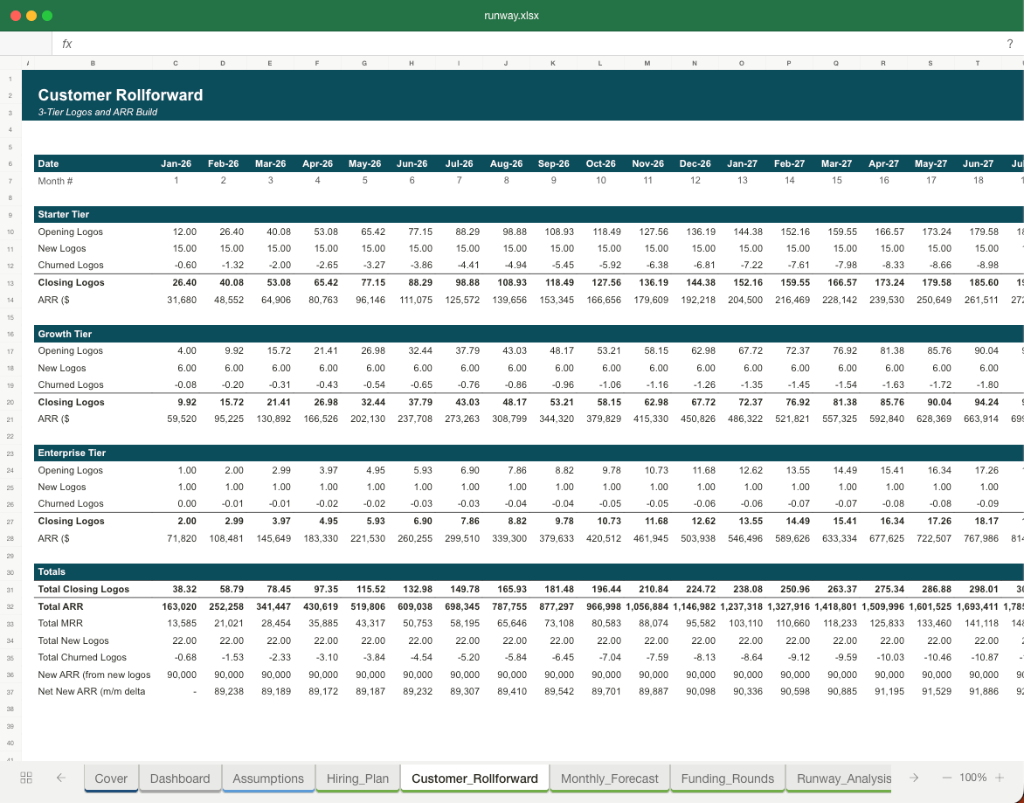
- Revenue build - monthly new students × ASP, existing student retention, total MRR/ARR
- Cohort model - LTV by cohort, cumulative revenue per cohort
- Unit economics - CAC by channel, LTV, payback period, LTV:CAC
- P&L - revenue, COGS (counselor payouts), gross profit, S&M, R&D, G&A, EBITDA
- Headcount plan - eng/product, sales, ops; links to opex
- Supply model - counselor headcount, capacity utilization, buffer metric
- Cash flow & runway - monthly burn, cash balance
- Scenario toggle - Base / Bull / Bear switcher feeding P&L and runway
Frequently asked
Is the Empowerly financial model free?+
Yes. The Empowerly model is a free Excel (.xlsx) download with live formulas. Sign up with your email and the workbook is yours to keep, review, and edit.
What's included in the model?+
A 5-year monthly forecast with P&L, cash flow and runway, valuation (exit multiple plus a DCF cross-check), MOIC/IRR returns, and unit economics, with live formulas throughout.
How was this model built?+
It was built from Empowerly's pitch deck and publicly available information, then structured to investment-banking standards as a fully editable Excel model.
Can I change the assumptions?+
Yes. You can change assumptions and the live formulas will recalculate in the downloadable Excel model.
Have more financial modelling questions? Contact us

Created by ex-finance professionals
Hey, I’m Alex and I created Finamodel.
Over my years in the finance industry I kept building the same models over and over again. Same structure, same assumptions, different logo. So I started building frameworks to turn them into clean, reusable templates.
Every model here is one I’d actually use for a client, and I personally vet each one before it goes up.
I’m not an expert in every industry, but I’ve built enough models to know what belongs in one. And when something is completely foreign to me, I reach out to my network for experts to work on our models with us.
Having a template library on hand cuts a first build from hours to minutes.
Need help finding your model? You’ll find me in the Finamodel app!
Other Health-tech Startup Financial Models
Browse another startup in the same category.
98point6
B2B SaaS platform licensing an AI-powered virtual care technology stack to health systems, pivoted from running a direct-to-employer virtual clinic.
A-Champs
IoT-powered gamified training device (ROXs PRO) for sports/health professionals, evolving into a B2C smart coach app for families.

AccuRx
Patient-centred communication platform connecting everyone involved in a patient's care, starting with near-universal penetration in UK GP practices.

Aeris
Swiss-made premium air purifiers sold through DTC, retail, and dealer channels, with a recurring filter consumable attached to a connected mobile app.

Akido Labs
Akido Labs is a data-driven prevention platform that integrates siloed healthcare, municipal, and non-profit data to enable proactive outreach and case management for vulnerable populations (homeless, chronically ill, etc.).

Alloy
Telehealth + DTC subscription platform delivering menopause hormonal treatment (MHT) and holistic care to U.S. women 40+.

Astek Diagnostics
Point-of-care diagnostic device (Jiddu system) that confirms bacterial infections and antibiotic sensitivity in ~1 hour across four body fluid types (urine, CSF, effluent, blood).

Atom Limbs
Atom Limbs is building the first AI-powered, neural-controlled prosthetic arm sold direct-to-consumer on a subscription model.