Ethos Financial Model
InsurTech Startup Financials (Free Excel Download)
Digital-first term life insurance sold direct-to-consumer - apply in 10 minutes, instant underwriting, no medical exam.



professionals from Deloitte
Used by professionals from






About this model
Ethos is a digital term-life insurance distributor built around a short online application, instant underwriting, and no medical exam for many applicants. It seeks to replace slow, agent-heavy life-insurance buying with a direct digital journey.
The company earns commission on premiums written while carrier and reinsurer partners hold underwriting risk. Early traction showed growing protected families and strong revenue momentum, with word of mouth described as its largest acquisition channel.
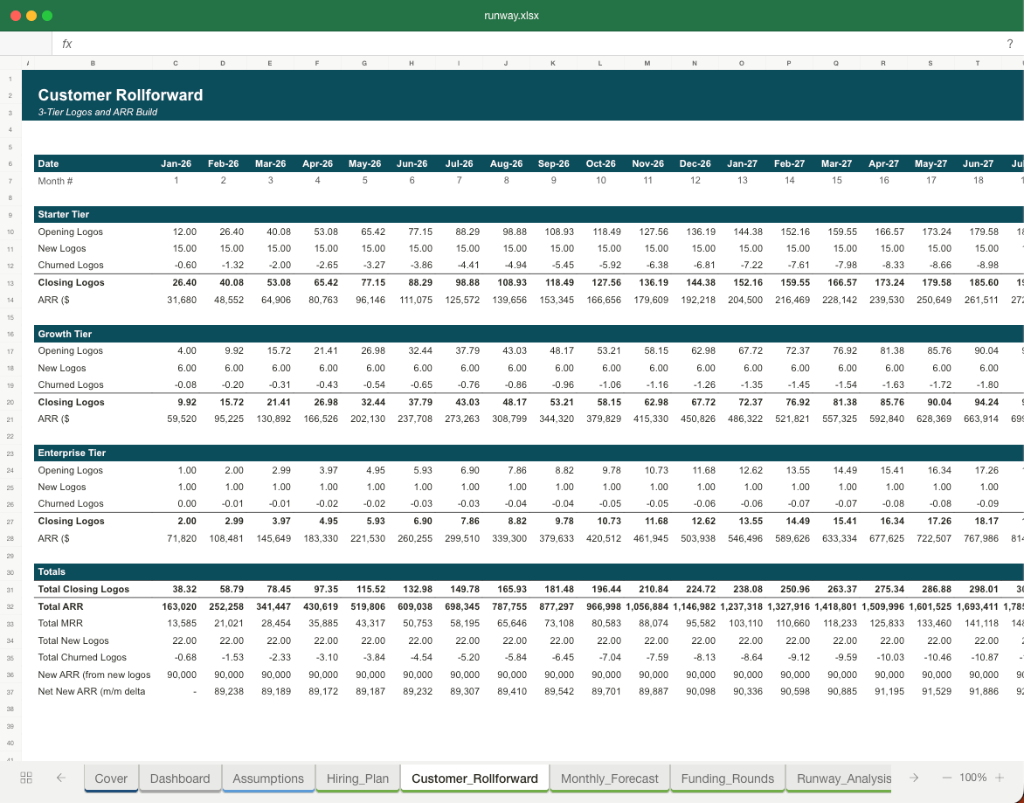
The model is DTC broker-commission economics. Applications, approval rate, policies issued, average premium, first-year commission, renewal commission, and persistency build revenue. CAC, channel mix, underwriting conversion, and customer retention determine LTV and margin.
A turnkey financial model
Live formulas, no hardcoded values
Outputs are driven by live formulas, so the workbook updates from its assumptions instead of relying on hardcoded results.
All assumptions in one tab
Inputs are clearly marked in the Assumptions tab and separated from calculations, making it clear what to change and what to leave intact.
Statements always balancing
For integrated-statement models, the balance sheet, cash flow, and supporting schedules tie through properly.
Distinct schedules for clarity
Debt, working capital, taxes, and cash flow can get messy quickly. We group calculations in clear schedules, not across disconnected tabs.
No hidden macros or external links
There are no unexplained external workbook links or macros to undermine auditability or portability.
Changes flow through the model
Update a key driver and see the impact carry through the forecast, financing, and return outputs. We never use hardcoded numbers in formulas.
About Ethos
ethoslife.com
How to build a detailed financial model for Ethos
A complete walkthrough of the business, drivers, and assumptions behind the downloadable Ethos model - distilled from its pitch deck and publicly available information.
Product & value proposition
- Term life insurance sold 100% online.
- 10-minute application, instant or same-day approval, usually no medical exam or blood test.
- No commissioned salespeople or upselling.
- Positioned against traditional 15-week paper process requiring agent meetings, medical exams, blood/urine tests, and snail-mail policy delivery.
- Comparable digital-disruption analogies cited: Oscar (health insurance), Opendoor (home sale), Rocket Mortgage (mortgage), Geico (P&C).
Market
- 10 million Americans buy individual life insurance each year.
- No TAM/SAM/SOM dollar figures provided in deck.
- Problem framing: 5% of US kids lose a parent before age 15; 70% of US families go bankrupt within 3 months of losing the breadwinner.
- Ethos claims to "grow the market" - most applicants were not actively looking for life insurance before finding Ethos.
Revenue model
- Revenue source: Not explicitly stated in deck, but consistent with InsurTech distribution model - Ethos earns a commission on premiums written (first-year and renewal). Carrier/reinsurer partners bear the actuarial risk.
- Pricing to customer: standard term life premiums (face amount × age/health rate); no proprietary pricing disclosed.
- Channels: Word of mouth is largest channel; highly diversified mix shown in donut chart (breakdown by channel not labeled - dark vs. light segments visible but unlabeled; word of mouth appears to be largest single segment ~30–35% visually).
- Units: "Families protected" (policies issued) is the primary volume metric.
Traction & metrics
- 13 months of operating history shown in charts.
- Families protected: consistent month-over-month growth across 13 months; bar chart shows strong upward trajectory but y-axis carries no numeric labels - absolute count not readable.
- Revenue: "Spectacular Revenue Growth" - same shape bar chart over 13 months, strong upward trajectory, no y-axis values shown.
- NPS score: 86 (2018).
- Trustpilot: 9/10.
- Google: 4.6/5.
- NPS benchmark: Ethos shown as #2 overall (behind Tesla, ahead of USAA, Amazon, Apple, Airbnb) and far above any life insurer.
- Cohort retention: improving across 9 cohorts; 5-yr retention figure redacted ("XX%").
- No absolute revenue, policy count, GWP, or premium figures disclosed.
Competition / moat
- Incumbents: traditional life insurers (New York Life, Allstate, Liberty Mutual, avg. life insurer - all with negative NPS).
- Moat claimed: superior customer experience (NPS 86 vs. industry avg ~negative); digital underwriting speed; no conflict-of-interest sales model; diversified acquisition channels reducing dependency.
- Comparison set in deck: Oscar, Opendoor, Rocket Mortgage, Geico as category analogues (validating digital disruption thesis).
- Network effects / data moat: not explicitly stated in deck.
Team & funding ask / use of funds
- Peter Colis, CEO/Co-Founder - prior co-founder of Ovid Corp. (online life insurance exchange), Stanford MBA.
- Lingke Wang, CTO/Co-Founder - prior co-founder of Ovid Corp., Stanford MBA.
- Brett Wilson, VP Risk - prior CFO & Chief Actuary of global life insurer, Stanford MSx (Valedictorian).
- Brittany Yoon, VP People - prior GM of Uber Korea, Harvard MBA.
- Gokul Dhingra, VP Product - prior PM leader at Facebook, Instagram, Snapchat, Stanford MBA.
- Phil Murphy, VP Insurance - prior VP of Underwriting at MunichRe, DePaul MBA.
- David Zhang, VP Finance - prior investor at hedge fund & Yale endowment, Stanford MBA (Valedictorian).
- Vipul Sharma, VP Engineering - prior founder of Simppler (acquired), leader at Eventbrite.
- Investors shown: Goldman Sachs, Google Ventures, Sequoia, Stanford University, Accel.
Recommended financial model
- Archetype + why: InsurTech DTC commission-revenue P&L with cohort-based retention. Ethos is a distributor, not a carrier - it earns first-year and renewal commissions; it does not carry underwriting risk. Model should track gross written premium (GWP) volume as the top-line driver, then apply commission rate to derive revenue. This is closer to a marketplace/agency P&L than a traditional insurance GWP/loss-ratio model. Pair with a cohort retention waterfall to capture multi-year renewal revenue.
- Forecast horizon & granularity: 3 years monthly (Years 1–2) then annual (Year 3), matching the early-growth stage and monthly traction data already visible in the deck.
- Key drivers & assumptions:
| Driver | Value | Source |
|---|---|---|
| New policies issued per month (Month 1) | shape shown, absolute count not readable | Need from company |
| MoM growth rate in policies (first 13 months) | ~15–25% estimated from bar chart shape - bars roughly double every 4–5 months | |
| Average annual premium per policy | ~$400–$700 - typical US term life DTC; no deck figure | |
| Commission rate (% of first-year premium) | ~50–80% - typical life insurance distributor range | |
| Renewal commission rate | ~5–10% of annual premium per renewal year - industry norm | |
| Gross margin | ~40–60% after marketing; no figures in deck |
- Scenarios (Base / Bull / Bear - which variables flex):
- Base: MoM policy growth ~15%, lapse 18%, commission 65% of first-year premium.
- Bull: MoM growth ~25% (word-of-mouth flywheel accelerates), lapse 12%, CAC declines.
- Bear: Growth slows to ~8% MoM post-Month 13, lapse 25%, CAC rises as word-of-mouth plateaus and paid channels dominate.
- Required sheets / outputs:
- Assumptions - all drivers, tagged or.
- Policy volume - new policies per month, active in-force book by cohort.
- Revenue - first-year commissions + renewal commissions by cohort.
- P&L - Revenue → Gross Profit → EBITDA (CAC, ops, headcount).
- Cohort waterfall - retention by cohort, renewal revenue build.
- KPI dashboard - NPS (static), in-force policies, GWP, revenue, CAC, LTV, payback period.
- Scenario toggle - Base / Bull / Bear.
Frequently asked
Is the Ethos financial model free?+
Yes. The Ethos model is a free Excel (.xlsx) download with live formulas. Sign up with your email and the workbook is yours to keep, review, and edit.
What's included in the model?+
A 5-year monthly forecast with P&L, cash flow and runway, valuation (exit multiple plus a DCF cross-check), MOIC/IRR returns, and unit economics, with live formulas throughout.
How was this model built?+
It was built from Ethos's pitch deck and publicly available information, then structured to investment-banking standards as a fully editable Excel model.
Can I change the assumptions?+
Yes. You can change assumptions and the live formulas will recalculate in the downloadable Excel model.
Have more financial modelling questions? Contact us

Created by ex-finance professionals
Hey, I’m Alex and I created Finamodel.
Over my years in the finance industry I kept building the same models over and over again. Same structure, same assumptions, different logo. So I started building frameworks to turn them into clean, reusable templates.
Every model here is one I’d actually use for a client, and I personally vet each one before it goes up.
I’m not an expert in every industry, but I’ve built enough models to know what belongs in one. And when something is completely foreign to me, I reach out to my network for experts to work on our models with us.
Having a template library on hand cuts a first build from hours to minutes.
Need help finding your model? You’ll find me in the Finamodel app!
Other InsurTech Startup Financial Models
Browse another startup in the same category.
Ark Kapital
AI-powered precision lending platform for European tech startups, providing non-dilutive growth loans using real-time raw data analytics.

Battleface
Tech-enabled travel insurance platform covering high-risk and non-standard destinations globally, sold direct and via B2B2C partners.
Beam
Digital-first dental insurance company selling group dental (and ancillary) benefits to employers via brokers

Branch
Tech-enabled home & auto insurance company operating as a reciprocal exchange, selling bundled policies via embedded, direct, and agency channels.
Cachet
B2B2C insurtech marketplace offering flexible, usage-based insurance products to gig/platform economy workers via partnerships with ride-hailing, delivery, and gig platforms.

Caura
Mobile app that aggregates all car-related payments (parking, congestion/ULEZ, tolls, tax, insurance) into a single platform, with insurance comparison as a key monetisation layer.

Clark
Digital insurance broker (Makler) providing a robo-advisor + human expert hybrid platform to manage and purchase all insurance lines via mobile app

Counterpart
Digital MGA (managing general agent) selling D&O and management liability insurance to US SMEs via a tech-enabled underwriting platform.