FLFleetDM Financial Model
Enterprise/Security Startup Financials (Free Excel Download)
Open-source device management and security platform built on osquery, positioned as the universal, cross-platform layer above MDM.



professionals from Deloitte
Used by professionals from






About this model
FleetDM is an open-source device-management and security platform built on osquery. It aims to serve as a universal cross-platform control layer above traditional MDM, helping IT and security teams manage endpoint visibility and policy across a diverse device fleet.
The company uses an open-core model: a community edition builds developer and administrator adoption, while a paid commercial tier monetises organisations that need enterprise capabilities. Its natural pricing and expansion unit is the host, making growth closely tied to devices under management.
The model combines an OSS-to-paid funnel with host-based subscription ARR. Community adoption, conversion, paid hosts per customer, expansion, renewal, and support costs drive revenue and gross profit, while product-led acquisition efficiency, sales hiring, and R&D determine cash runway.
A turnkey financial model
Live formulas, no hardcoded values
Outputs are driven by live formulas, so the workbook updates from its assumptions instead of relying on hardcoded results.
All assumptions in one tab
Inputs are clearly marked in the Assumptions tab and separated from calculations, making it clear what to change and what to leave intact.
Statements always balancing
For integrated-statement models, the balance sheet, cash flow, and supporting schedules tie through properly.
Distinct schedules for clarity
Debt, working capital, taxes, and cash flow can get messy quickly. We group calculations in clear schedules, not across disconnected tabs.
No hidden macros or external links
There are no unexplained external workbook links or macros to undermine auditability or portability.
Changes flow through the model
Update a key driver and see the impact carry through the forecast, financing, and return outputs. We never use hardcoded numbers in formulas.
About FleetDM
fleetdm.com
How to build a detailed financial model for FleetDM
A complete walkthrough of the business, drivers, and assumptions behind the downloadable FleetDM model - distilled from its pitch deck and publicly available information.
Product & value proposition
Fleet is an osquery management server that lets security, IT, and compliance teams query and manage any device - macOS, Linux, Windows, and cloud servers - using SQL. It sits above (and complements) existing MDMs (Jamf, Kandji, SimpleMDM) rather than replacing them, providing:
- Cross-platform, universal device inventory and visibility
- Compliance scanning and vulnerability management
- Self-service IT / two-way help desk via Fleet Desktop
- Open APIs for integration into SSO (BeyondCorp/zero trust), CI/CD pipelines, and data platforms
- Programmable security workflows and policy automations (Zendesk, Jira integrations)
Positioning: "The future of device management is bigger than MDM" - open, programmable, universal, inspectable/modifiable as OSS.
Revenue model
- Model: Subscription SaaS, priced per host (device/endpoint).
- Billing: Annual subscriptions with renewals tracked in Salesforce.
- Channel: Direct (sales team + self-serve free trial funnel from OSS community).
- GTM motion: OSS-led / product-led growth - users discover Fleet via osquery community or DIY installs, then convert to paid commercial.
- Free tier: OSS self-hosted edition; paid tier adds enterprise support, hosted options, and advanced features.
- Pricing unit: Per host/device; specific price per host not disclosed in deck.
Traction & metrics
- ARR chart shown (slide 17): cumulative ARR in millions, Jan 2021 – Apr 2022 time range, upward growth curve - all Y-axis values and data-point labels are redacted.
- ARR target shown (slide 18): "$M ARR" - exact figure blacked out.
- Renewals table (slide 21): ~9 renewal opportunities visible in Salesforce list; all amounts, host counts, customer names, and dates are redacted.
- Named enterprise users referenced in testimonials: Square (Wesley Whetstone, CPE), Uber (Erik Gomez, Staff Software Engineer).
- Deck dated ~Q1 2022 (roadmap references "Q1 2022" as current period).
- Funding timeline: Founded/started Oct 31, 2020 (Sid); Seed raised 2021; Series A targeted 2022; Series B targeted 2023; $1B valuation targeted 2024.
Competition / moat
- Explicit competitive framing: Fleet is not a replacement for MDM (Jamf, Kandji, SimpleMDM) but a complementary layer. Key differentiators stated:
- Open source (inspectable, modifiable, no vendor lock-in)
- Cross-platform (macOS, Linux, Windows, cloud servers - beyond Apple/Windows MDM)
- Osquery standard (SQL-based, portable, open)
- "Who's watching the watchers?" - validates and cross-checks MDM enrollment status independently
- Named or implied competitors: MDM vendors (Jamf, Kandji, SimpleMDM), proprietary endpoint security platforms, DIY osquery deployments.
- Moat: OSS community flywheel (osquery evangelism → DIY fork users → Fleet commercial conversion); developer/security-team trust from open-core transparency.
Team & funding ask / use of funds
- Founder: "Sid" referenced as founder/CEO (Oct 31, 2020 founding). - likely Mike McNeil (mentioned in customer email quotes on slides 9, 20) and co-founders; "Mike & Zach" named in testimonial.
- Stage targeted: Series A (2022 per inflection-point timeline).
- Prior funding: Seed round raised 2021; amount not disclosed.
Recommended financial model
- Archetype + why: Open-core SaaS ARR model with host-based seat expansion. Fleet is a subscription business with per-host pricing, annual renewals, and an OSS-to-paid conversion funnel - a classic product-led growth (PLG) SaaS with expansion revenue as customers add hosts. The open-core layer adds a community-to-commercial conversion rate driver not present in pure enterprise SaaS.
- Forecast horizon & granularity: 3 years (2022–2024), monthly for Year 1 (to track PLG conversion ramp and early cohort behavior), quarterly for Years 2–3. This matches the deck's own inflection-point roadmap (Series A 2022 → Series B 2023 → $1B 2024).
- Key drivers & assumptions:
- Starting ARR: ~$1–3M based on early-stage Series A context and redacted ARR chart shape (near-zero Jan 2021, modest curve through Apr 2022); treat as a model input.
- New logo ARR per quarter: 3–6 new enterprise logos/quarter in Year 1, growing 20–30% q/q through PLG funnel; calibrate once actual customer count known.
- Average contract value (ACV): $30–100K/year based on host-based pricing (1,000–10,000 hosts at typical osquery-tier pricing of $3–10/host/year); wide range - model input to stress.
- Host expansion rate (NRR driver): 110–130% net revenue retention; enterprises tend to add hosts and servers as Fleet proves out - typical for infrastructure SaaS.
- OSS-to-paid conversion rate: 1–3% of active OSS community instances convert to paid annually; community size not disclosed so this feeds a top-of-funnel sensitivity.
- Gross margin: 70–80%; open-source infrastructure SaaS with cloud hosting costs and customer success headcount; no hardware.
- Headcount / burn: 10–20 FTEs at Series A; S&M spend elevated due to PLG investment (content, community, field); R&D heavy (open-source maintenance + product).
- Churn / logo churn: <5% annual logo churn; enterprise security tooling is sticky once embedded into compliance workflows.
- Series A raise: $10–20M; typical for this stage/sector in 2022; treat as model input.
- Scenarios (Base / Bull / Bear - which variables flex):
- Base: NRR 115%, 4 new logos/quarter, ACV $50K, conversion rate 1.5%, gross margin 75%.
- Bull: NRR 130%, 8 new logos/quarter (PLG flywheel accelerates), ACV $75K (upmarket motion), $1B valuation achieved by 2024 as stated.
- Bear: NRR 105%, 2 new logos/quarter, ACV $30K (SMB skew), longer sales cycles in enterprise security procurement.
- Required sheets / outputs:
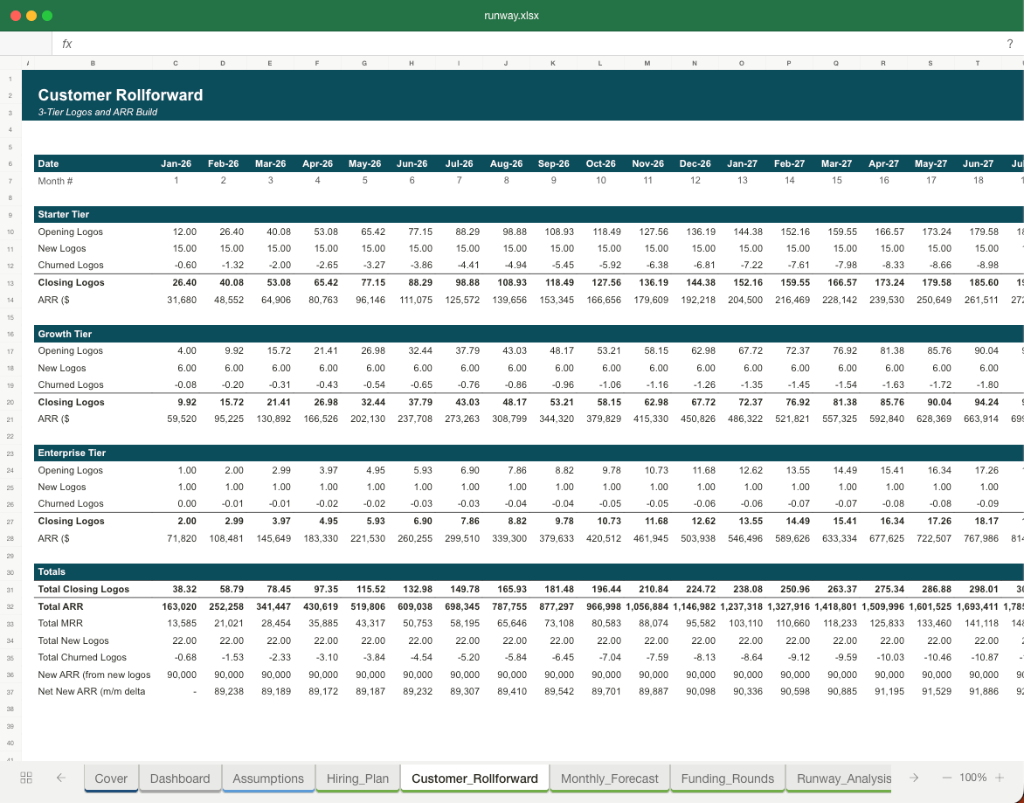
- ARR Bridge - new ARR, expansion ARR, churned ARR, net new ARR per period.
- Customer Cohort Table - logo count, ACV, and host expansion by cohort vintage.
- P&L - Revenue, COGS (hosting + CS), gross profit, S&M, R&D, G&A, EBITDA.
- Headcount Plan - by function (R&D, S&M, G&A), feeding into OpEx.
- Cash / Runway - monthly cash burn, runway from Series A proceeds.
- Valuation Bridge (optional) - implied ARR multiple path to $1B valuation by 2024.
Frequently asked
Is the FleetDM financial model free?+
Yes. The FleetDM model is a free Excel (.xlsx) download with live formulas. Sign up with your email and the workbook is yours to keep, review, and edit.
What's included in the model?+
A 5-year monthly forecast with P&L, cash flow and runway, valuation (exit multiple plus a DCF cross-check), MOIC/IRR returns, and unit economics, with live formulas throughout.
How was this model built?+
It was built from FleetDM's pitch deck and publicly available information, then structured to investment-banking standards as a fully editable Excel model.
Can I change the assumptions?+
Yes. You can change assumptions and the live formulas will recalculate in the downloadable Excel model.
Have more financial modelling questions? Contact us

Created by ex-finance professionals
Hey, I’m Alex and I created Finamodel.
Over my years in the finance industry I kept building the same models over and over again. Same structure, same assumptions, different logo. So I started building frameworks to turn them into clean, reusable templates.
Every model here is one I’d actually use for a client, and I personally vet each one before it goes up.
I’m not an expert in every industry, but I’ve built enough models to know what belongs in one. And when something is completely foreign to me, I reach out to my network for experts to work on our models with us.
Having a template library on hand cuts a first build from hours to minutes.
Need help finding your model? You’ll find me in the Finamodel app!
Other Enterprise/Security Startup Financial Models
Browse another startup in the same category.
AgBiome
AgBiome is a microbial-platform agtech company that discovers, develops, and commercialises biological crop protection products (and licences the platform across adjacent markets).

Alation
Enterprise data intelligence platform - data catalog, governance, and metadata management for large organisations.

Archer SPAC
Archera
Cloud resource automation platform that continuously optimizes AWS commitment purchases, de-risks overcommitment, and automates FinOps workflows.

Ardoq
Cloud-native Enterprise Architecture (EA) SaaS platform that helps large enterprises navigate digital transformation through automated data collection, graph-based architecture modelling, and change impact analysis.

Ascend
Ascend.io is an enterprise big data automation platform ("Enterprise Intelligence Platform") that abstracts away the complexity of big data engineering so non-experts can build and run data pipelines.

Athennian
Cloud-based legal entity management system (EMS) uniting entity data with workflow and document automation.

Auditboard
Cloud-based integrated risk management platform connecting audit, risk, compliance, and ESG teams across the enterprise.