Flux Financial Model
Health-tech Startup Financials (Free Excel Download)
B2B SaaS platform enabling internal talent mobility - connects employees to career paths, part-time projects, and rotations to reduce attrition.



professionals from Deloitte
Used by professionals from






About this model
Flux is B2B SaaS for internal talent mobility, connecting employees to career paths, projects, and rotations. It gives employers a way to improve workforce deployment and retain talent by making internal opportunities more visible and actionable.
The product is sold to employers as a recurring people-technology platform. Customer value grows with employee participation, workforce coverage, and integration into talent-management processes, creating expansion potential as departments, geographies, and use cases adopt the service.
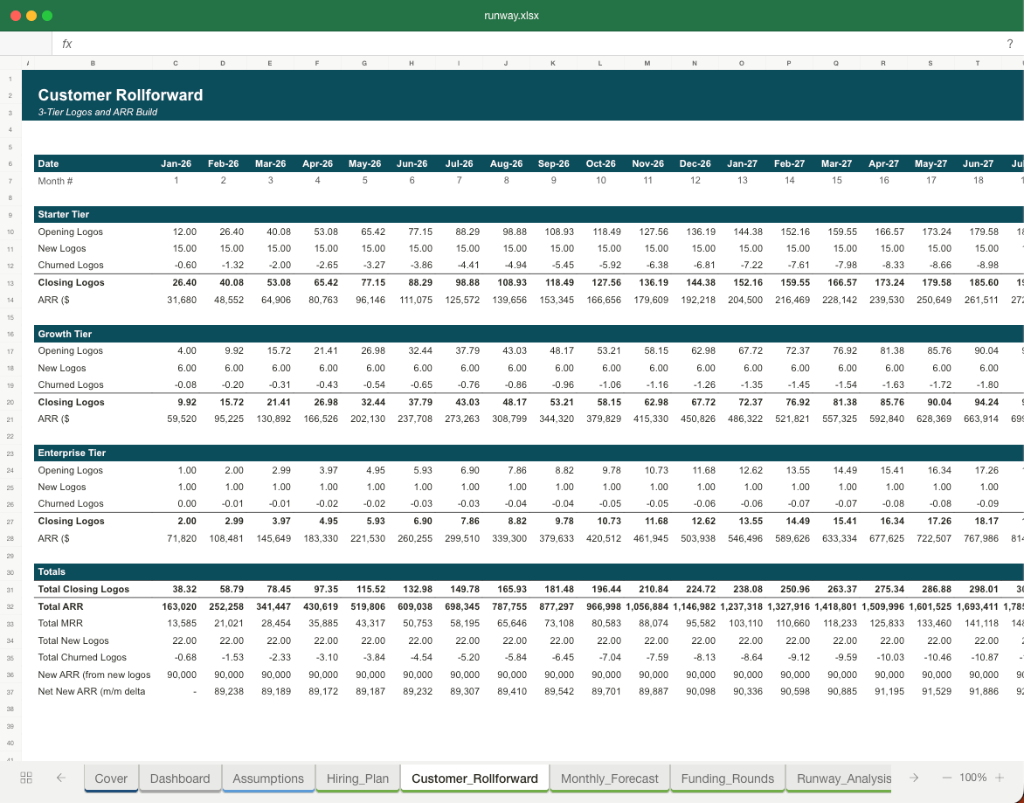
The model forecasts employer contracts, employee seats, subscription ARPU, implementation, expansion, and churn. It tracks activation and engagement as leading indicators, then includes enterprise sales cycles, onboarding capacity, customer success, product investment, gross margin, cash burn, and runway.
A turnkey financial model
Live formulas, no hardcoded values
Outputs are driven by live formulas, so the workbook updates from its assumptions instead of relying on hardcoded results.
All assumptions in one tab
Inputs are clearly marked in the Assumptions tab and separated from calculations, making it clear what to change and what to leave intact.
Statements always balancing
For integrated-statement models, the balance sheet, cash flow, and supporting schedules tie through properly.
Distinct schedules for clarity
Debt, working capital, taxes, and cash flow can get messy quickly. We group calculations in clear schedules, not across disconnected tabs.
No hidden macros or external links
There are no unexplained external workbook links or macros to undermine auditability or portability.
Changes flow through the model
Update a key driver and see the impact carry through the forecast, financing, and return outputs. We never use hardcoded numbers in formulas.
About Flux
flux.io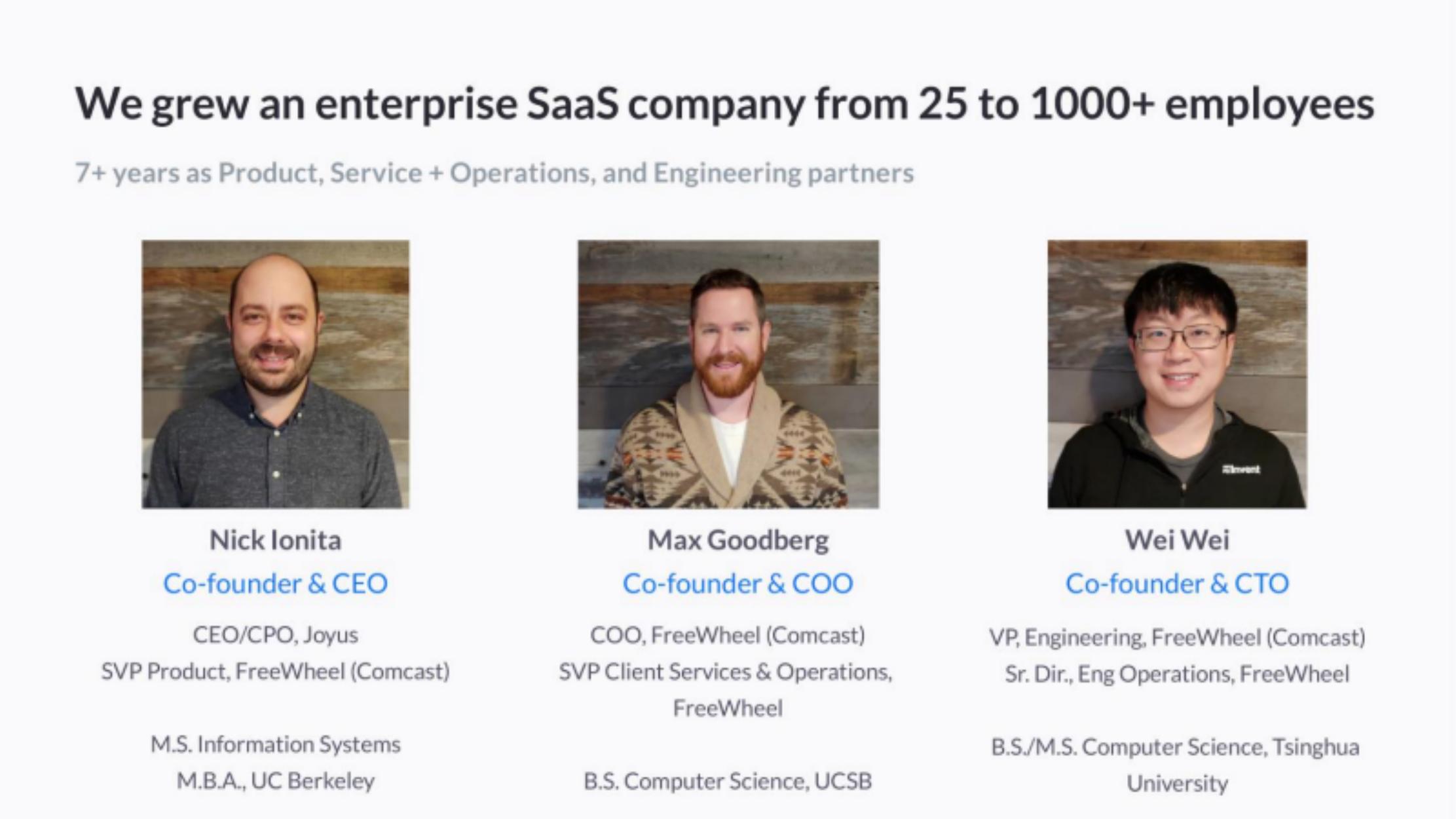
How to build a detailed financial model for Flux
A complete walkthrough of the business, drivers, and assumptions behind the downloadable Flux model - distilled from its pitch deck and publicly available information.
Product & value proposition
Three core modules visible in product screenshots:
- Flux Pathways - employee-facing career trajectory visualizer; self-directed exploration of personalized career paths within the company.
- Opportunities feed - internal marketplace for full-time transfers, part-time projects (25% time), rotations (2-week), and bootcamps; matched to employee skill/interest profile.
- Work Genome + predictive matching - proprietary skill/interest/ambition profile ("Work Genome") combined with predictive intelligence to match employees to opportunities based on holistic "fit".
Value prop: reduce costly attrition by giving employees visible career growth without leaving the company; equip managers and People Ops teams with data-driven development tools.
Market
No explicit TAM/SAM/SOM figures in deck.
Market framing provided:
- Millennial turnover due to lack of engagement costs $30.5B annually (domestic aggregate).
- Turnover costs 1.5–2x annual salary per individual.
- Millennials are the largest workforce segment; avg time in role: 17 months vs. 52 months (non-Millennial).
- 60% of Millennials are open to a new job at any time.
- Proactive development focused on top 5% of talent only - leaving 95% underserved.
- Regular manager development meetings produce 24% lift in engagement for Millennials.
Revenue model
Not explicitly stated in deck. Business model inferred from product and positioning:
- B2B SaaS subscription sold to employers; pricing likely per-seat (per employee) or per-company-tier, given People Ops tooling comparables. No pricing slide present.
- Implementation/onboarding fees possible given enterprise HR integration complexity (HRIS, data warehouses, BI tools shown in stack diagram slide 06).
- Channels: direct enterprise sales; People Ops / HR buyer persona.
Traction & metrics
- 97% of employees who completed work on Flux report confidence in their ability to navigate their career within their company. Source: Flux.
- No revenue, customer count, ARR, growth rate, or retention figures disclosed.
- Deck is marked "© 2020 - FLUX - PROPRIETARY AND CONFIDENTIAL" - early-stage pre-revenue or very early revenue likely.
Competition / moat
No explicit competitive landscape slide.
Implied moat / differentiation:
- "Work Genome" proprietary data asset - holistic employee profile combining skills, experience, work styles, goals, interests, ambitions.
- Predictive matching intelligence vs. passive HRIS record-keeping.
- Integration layer connecting HRIS, data warehouses, BI tools and the employee lifecycle - positioned as the "modern People stack" vs. legacy on-prem HR software.
- Founders' 7+ years together scaling FreeWheel (Comcast) from 25 to 1,000+ employees - domain credibility.
Team & funding ask / use of funds
Team:
- Nick Ionita - Co-founder & CEO. Prior: CEO/CPO Joyus; SVP Product FreeWheel (Comcast). M.S. Information Systems; MBA UC Berkeley.
- Max Goodberg - Co-founder & COO. Prior: COO FreeWheel (Comcast); SVP Client Services & Operations FreeWheel. B.S. CS UCSB.
- Wei Wei - Co-founder & CTO. Prior: VP Engineering FreeWheel (Comcast); Sr. Dir. Eng Operations FreeWheel. B.S./M.S. CS Tsinghua University.
Recommended financial model
- Archetype + why: SaaS ARR model. Flux sells to employers on subscription; the natural unit is seats (employees on platform) or contracts (companies). A per-seat SaaS ARR build is the cleanest fit - mirrors how HR Tech peers (Lattice, Leapsome, 15Five) are modeled. No marketplace GMV take-rate or usage-based billing signals in the deck.
- Forecast horizon & granularity: 3 years monthly (Years 1–3), collapsing to annual summary. Monthly needed to track sales cycles, implementation lag, and churn cohorts.
- Key drivers & assumptions:
| Driver | Value |
|---|---|
| Target customer | Mid-market / enterprise employers (100–5,000 employees) |
| Seats per customer (avg employees on platform) | 500 |
| ACV per customer | $50K–$150K/yr |
| New logos per quarter (Yr 1) | 2–4 |
| Sales cycle length | 3–6 months |
| Implementation lag to revenue | 1–2 months post-close |
| Gross churn (annual) | 10–15% |
| Net revenue retention | 105–115% |
| Gross margin | 70–80% |
| S&M as % revenue | 40–50% (early), declining to 30% |
| R&D as % revenue | 25–35% |
| G&A as % revenue | 10–15% |
| Millennial turnover market (problem size) | $30.5B domestic annually |
| Employee engagement lift from development meetings | 24% |
| Platform satisfaction (post-use) | 97% report career navigation confidence |
- Scenarios (Base / Bull / Bear):
- Base: 3–4 new logos/quarter Yr1, 120% NRR, 12% gross churn, ACV $75K.
- Bull: Faster enterprise pull-through (6–8 logos/quarter by Yr2), 130% NRR driven by rapid headcount expansion at customers, ACV $100K+.
- Bear: Long sales cycles + budget freeze (HR discretionary spend), 1–2 logos/quarter, 20% gross churn, ACV $50K.
- Flex variables: new logo velocity, ACV, gross churn, implementation lag.
- Required sheets / outputs:
- Assumptions - all drivers in one place, clearly tagged.
- ARR Bridge - new ARR, expansion ARR, churned ARR, net new ARR, ending ARR by month.
- Customer Cohort Table - logos by quarter, churn waterfall.
- P&L (Income Statement) - revenue, COGS, gross profit, S&M, R&D, G&A, EBITDA, net income.
- Headcount Plan - sales, CS, eng, G&A; ties to opex.
- Cash / Runway - cash burn by month; runway from (assumed) raise.
- Dashboard - ARR, logo count, NRR, gross margin, burn, runway KPIs.
Frequently asked
Is the Flux financial model free?+
Yes. The Flux model is a free Excel (.xlsx) download with live formulas. Sign up with your email and the workbook is yours to keep, review, and edit.
What's included in the model?+
A 5-year monthly forecast with P&L, cash flow and runway, valuation (exit multiple plus a DCF cross-check), MOIC/IRR returns, and unit economics, with live formulas throughout.
How was this model built?+
It was built from Flux's pitch deck and publicly available information, then structured to investment-banking standards as a fully editable Excel model.
Can I change the assumptions?+
Yes. You can change assumptions and the live formulas will recalculate in the downloadable Excel model.
Have more financial modelling questions? Contact us

Created by ex-finance professionals
Hey, I’m Alex and I created Finamodel.
Over my years in the finance industry I kept building the same models over and over again. Same structure, same assumptions, different logo. So I started building frameworks to turn them into clean, reusable templates.
Every model here is one I’d actually use for a client, and I personally vet each one before it goes up.
I’m not an expert in every industry, but I’ve built enough models to know what belongs in one. And when something is completely foreign to me, I reach out to my network for experts to work on our models with us.
Having a template library on hand cuts a first build from hours to minutes.
Need help finding your model? You’ll find me in the Finamodel app!
Other Health-tech Startup Financial Models
Browse another startup in the same category.
98point6
B2B SaaS platform licensing an AI-powered virtual care technology stack to health systems, pivoted from running a direct-to-employer virtual clinic.
A-Champs
IoT-powered gamified training device (ROXs PRO) for sports/health professionals, evolving into a B2C smart coach app for families.

AccuRx
Patient-centred communication platform connecting everyone involved in a patient's care, starting with near-universal penetration in UK GP practices.

Aeris
Swiss-made premium air purifiers sold through DTC, retail, and dealer channels, with a recurring filter consumable attached to a connected mobile app.

Akido Labs
Akido Labs is a data-driven prevention platform that integrates siloed healthcare, municipal, and non-profit data to enable proactive outreach and case management for vulnerable populations (homeless, chronically ill, etc.).

Alloy
Telehealth + DTC subscription platform delivering menopause hormonal treatment (MHT) and holistic care to U.S. women 40+.

Astek Diagnostics
Point-of-care diagnostic device (Jiddu system) that confirms bacterial infections and antibiotic sensitivity in ~1 hour across four body fluid types (urine, CSF, effluent, blood).

Atom Limbs
Atom Limbs is building the first AI-powered, neural-controlled prosthetic arm sold direct-to-consumer on a subscription model.