 Juno Financial Model
Health-tech Startup Financials (Free Excel Download)
Hello Heart is an AI-powered mobile app for heart health management, sold B2B2C to self-insured employers and health plans.



professionals from Deloitte
Used by professionals from






About this model
Juno, branded Hello Heart in the research, is an AI-powered heart-health app for employers and health plans. It supports participants with a consumer-facing experience aimed at improving engagement and management of cardiovascular health.
Health plans and PBMs support distribution to self-insured employers, with committed per-participant ARR. The commercial model depends on client logos, covered populations, activation, engagement, outcomes, expansion, and the ability to retain institutional buyers over multi-year benefit cycles.
The model forecasts client logos, covered participants, activation, PMPM pricing, engagement, expansion, and churn. It includes care and technology costs, partner distribution economics, employer sales capacity, outcomes incentives, gross margin, cash burn, and runway.
A turnkey financial model
Live formulas, no hardcoded values
Outputs are driven by live formulas, so the workbook updates from its assumptions instead of relying on hardcoded results.
All assumptions in one tab
Inputs are clearly marked in the Assumptions tab and separated from calculations, making it clear what to change and what to leave intact.
Statements always balancing
For integrated-statement models, the balance sheet, cash flow, and supporting schedules tie through properly.
Distinct schedules for clarity
Debt, working capital, taxes, and cash flow can get messy quickly. We group calculations in clear schedules, not across disconnected tabs.
No hidden macros or external links
There are no unexplained external workbook links or macros to undermine auditability or portability.
Changes flow through the model
Update a key driver and see the impact carry through the forecast, financing, and return outputs. We never use hardcoded numbers in formulas.
About Juno
withjuno.com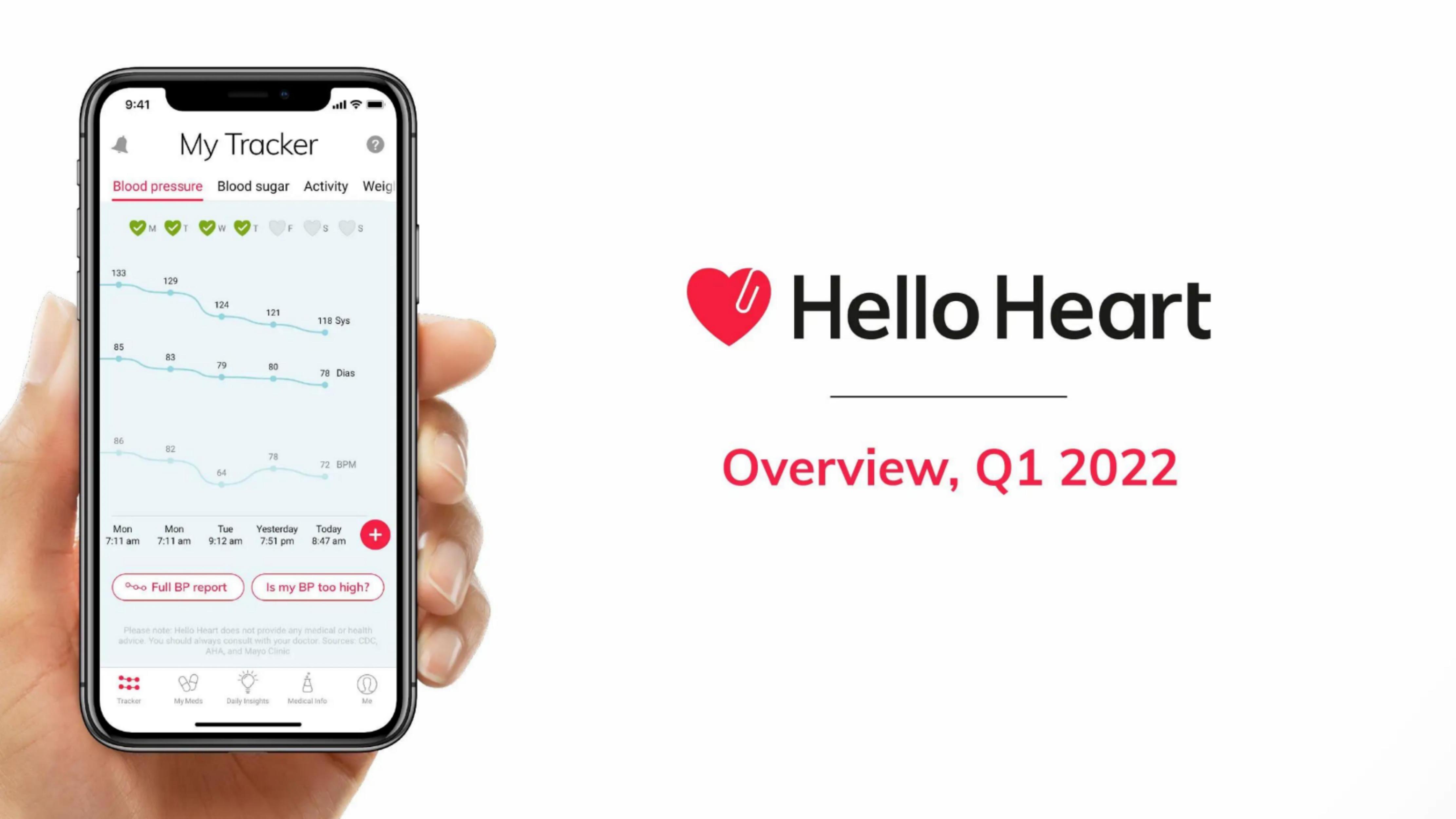
How to build a detailed financial model for Juno
A complete walkthrough of the business, drivers, and assumptions behind the downloadable Juno model - distilled from its pitch deck and publicly available information.
Product & value proposition
- Mobile app tracking blood pressure, blood sugar, activity, and weight with daily line-chart trending.
- Medication management and reminders.
- Personalised AI-driven coaching (hub-and-spoke engagement model: Hooked → Loyal → Influenced → Not Engaged).
- Clinical efficacy published: 84% of Hypertension Stage 2 users improved BP within year 1; 21 mmHg systolic reduction over 3 years; 28,189 study participants (JAMA Network Open, Oct 2021).
- Value to employer/health plan: $1,865 reduction in total medical costs per participant per year (Validation Institute certified, Oct 2021).
- ROI to employer: 2:1 depending on employer size.
Market
- Problem size: 1 in 2 Americans have high blood pressure and are at risk.
- Heart disease is the #1 cause of death globally.
- Source cited: Cleveland Clinic survey 2013 and AHA 2015 statistics.
Revenue model
- GTM channel: Self-insured employers, sold via health plans and PBMs (which act as distribution layer to reduce direct employer sales friction).
- Revenue type: Committed accumulated ARR (subscription).
- Pricing unit: Per participant / per member. Exact PMPM rate not stated in deck.
- Contract type: Employer/health-plan contracts (B2B); end users are employees/members.
Traction & metrics
- 60+ employer clients as of Jan 2022.
- ARR growth trajectory (committed accumulated ARR):
- Jan 2019 → Jan 2020: 3x
- Jan 2020 → Jan 2021: 3x
- Jan 2021 → Jan 2022: 2x
- Absolute ARR figures not labelled on chart (y-axis has no scale markings).
- 28,189 study participants over 3-year clinical study (proxy for engaged user base scale).
- Cost savings validated: $1,865 per participant per year; 2:1 employer ROI.
Unit economics
- Validated cost savings per participant per year: $1,865 (independent third-party, Validation Institute).
- Employer ROI: 2:1 depending on employer size.
- Claims spend delta vs. matched controls (per participant, employer dataset 2017–2020):
- Surgery/Inpatient: controls +$34, Hello Heart users -$482
- ER: controls +$193, Hello Heart users -$111
- Diagnostic: controls +$580, Hello Heart users -$298
- Physician Visits: controls +$40, Hello Heart users +$218
- Routine Care: controls +$45, Hello Heart users +$5
- Other: controls +$93, Hello Heart users -$210
- Total: controls +$985, Hello Heart users -$880
Competition / moat
- Deck positions Hello Heart within a broad digital health 2021 CBInsights landscape across categories (Digital Therapeutics, Virtual Care, etc.).
- Moat claimed: AI engagement engine (Hooked/Loyal/Influenced model) and peer-reviewed clinical evidence (JAMA Network Open).
Team & funding ask / use of funds
- Team (C-suite):
- Maayan Cohen - CEO
- Michal Gutman - CTO & CISO
- Jony Hartono - CFO
- Tom Kahl - CRO
- Jesus Bermudez - Chief Growth Officer
- Ido Milstein - SVP Product
- Ayal Levin - SVP Corporate Strategy
- Ziv Meltzer - IC Founder, Design Leader
- Sue Giordano - Head of Client Experience
- Valarie Arismendez - SVP People
- Orit Wohl - Head of Product Marketing
Recommended financial model
- Archetype + why: B2B SaaS ARR model with PMPM revenue mechanics. Hello Heart sells annual committed contracts to employers/health plans at a per-participant rate - the natural model is an ARR build tracking new logos, expansion, churn, and per-member economics. A healthcare-adjusted P&L is needed to capture clinical operations costs (coaching staff, data science) alongside standard SaaS opex.
- Forecast horizon & granularity: 3 years (2022–2024), quarterly for Year 1, annual thereafter. Deck is Q1 2022 so near-term quarterly visibility is warranted.
- Key drivers & assumptions:
| Driver | Value |
|---|---|
| Number of employer clients | 60+ as of Jan 2022 |
| ARR growth rate - Year 1 (2022) | 100% (matching the x2 observed 2021→2022) |
| ARR growth rate - Year 2 (2023) | 75% |
| ARR growth rate - Year 3 (2024) | 50% |
| Net revenue retention (NRR) | 110% |
| Logo churn rate | 5% annually |
| Avg contract value per client | derived from ARR ÷ 60 clients |
| PMPM pricing | ~$5–$15/member/month |
| Avg members per employer | ~500–2,000 |
| Gross margin | 70–75% |
| S&M as % of revenue | 30–40% |
| R&D as % of revenue | 15–20% |
| G&A as % of revenue | 10–12% |
| Clinical/outcomes cost | 5–8% of revenue |
| Cost savings per participant per year | $1,865 |
| Employer ROI | 2:1 |
- Scenarios (Base / Bull / Bear - which variables flex):
- Base: ARR growth 100%/75%/50%; NRR 110%; logo churn 5%; gross margin 72%.
- Bull: Growth 150%/100%/75%; health plan channel accelerates new logo adds; NRR 120%.
- Bear: Growth slows to 50%/40%/30%; logo churn 10% (employer budget freezes); margin compression from clinical ops.
- Required sheets / outputs:
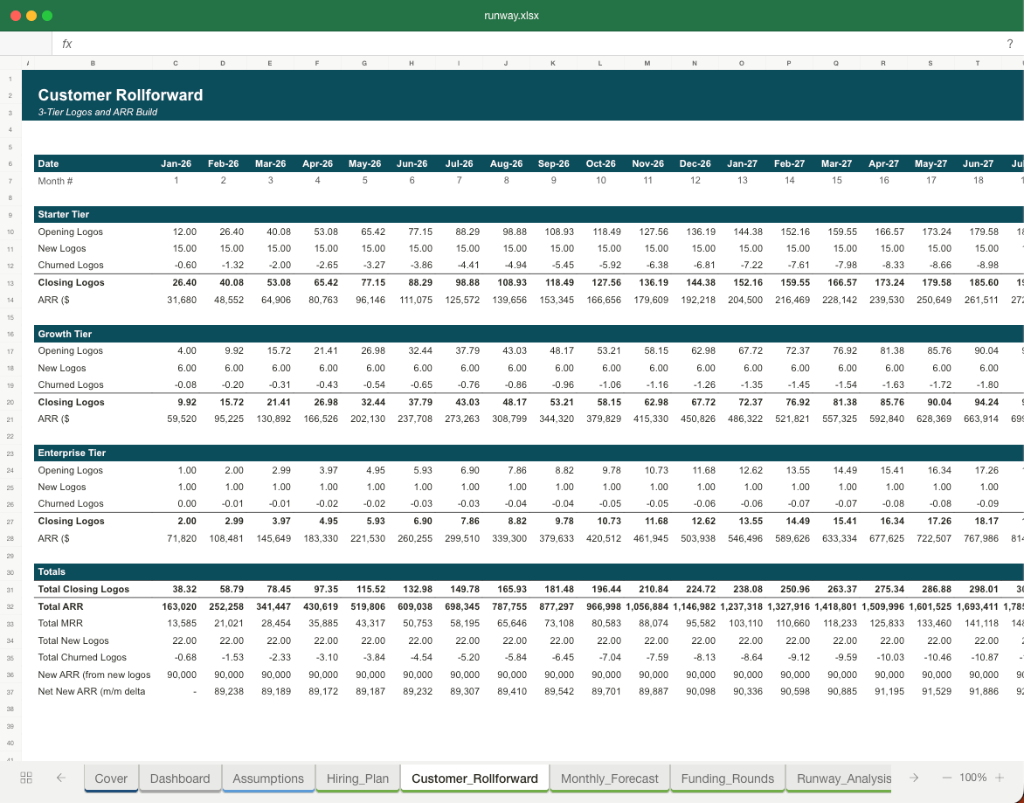
- ARR Waterfall - Beginning ARR, new logo ARR, expansion ARR, churned ARR, Ending ARR (quarterly Y1, annual Y2–Y3).
- Client & Member Build - Logo count, avg members per client, total enrolled members, PMPM pricing, total contract value.
- P&L - Revenue, COGS (clinical ops + infrastructure), Gross Profit, S&M, R&D, G&A, EBITDA.
- Unit Economics Summary - LTV, CAC, LTV:CAC, payback period (inputs partially assumed).
- Value / ROI Model - Employer savings vs. program cost at $1,865/participant/year; break-even member count per employer.
- Assumptions Dashboard - All tagged inputs with / source column.
Frequently asked
Is the Juno financial model free?+
Yes. The Juno model is a free Excel (.xlsx) download with live formulas. Sign up with your email and the workbook is yours to keep, review, and edit.
What's included in the model?+
A 5-year monthly forecast with P&L, cash flow and runway, valuation (exit multiple plus a DCF cross-check), MOIC/IRR returns, and unit economics, with live formulas throughout.
How was this model built?+
It was built from Juno's pitch deck and publicly available information, then structured to investment-banking standards as a fully editable Excel model.
Can I change the assumptions?+
Yes. You can change assumptions and the live formulas will recalculate in the downloadable Excel model.
Have more financial modelling questions? Contact us

Created by ex-finance professionals
Hey, I’m Alex and I created Finamodel.
Over my years in the finance industry I kept building the same models over and over again. Same structure, same assumptions, different logo. So I started building frameworks to turn them into clean, reusable templates.
Every model here is one I’d actually use for a client, and I personally vet each one before it goes up.
I’m not an expert in every industry, but I’ve built enough models to know what belongs in one. And when something is completely foreign to me, I reach out to my network for experts to work on our models with us.
Having a template library on hand cuts a first build from hours to minutes.
Need help finding your model? You’ll find me in the Finamodel app!
Other Health-tech Startup Financial Models
Browse another startup in the same category.
98point6
B2B SaaS platform licensing an AI-powered virtual care technology stack to health systems, pivoted from running a direct-to-employer virtual clinic.
A-Champs
IoT-powered gamified training device (ROXs PRO) for sports/health professionals, evolving into a B2C smart coach app for families.

AccuRx
Patient-centred communication platform connecting everyone involved in a patient's care, starting with near-universal penetration in UK GP practices.

Aeris
Swiss-made premium air purifiers sold through DTC, retail, and dealer channels, with a recurring filter consumable attached to a connected mobile app.

Akido Labs
Akido Labs is a data-driven prevention platform that integrates siloed healthcare, municipal, and non-profit data to enable proactive outreach and case management for vulnerable populations (homeless, chronically ill, etc.).

Alloy
Telehealth + DTC subscription platform delivering menopause hormonal treatment (MHT) and holistic care to U.S. women 40+.

Astek Diagnostics
Point-of-care diagnostic device (Jiddu system) that confirms bacterial infections and antibiotic sensitivity in ~1 hour across four body fluid types (urine, CSF, effluent, blood).

Atom Limbs
Atom Limbs is building the first AI-powered, neural-controlled prosthetic arm sold direct-to-consumer on a subscription model.