LSLambda School Financial Model
EdTech Startup Financials (Free Excel Download)
Online coding bootcamp that charges $0 upfront and takes 17% of income for 2 years once a graduate earns $50k+, capped at $30k total.



professionals from Deloitte
Used by professionals from






About this model
Lambda School is an online coding bootcamp with no upfront tuition for many students. Graduates pay 17% of income for two years after earning at least $50,000, subject to a $30,000 cap.
Its commercial model links revenue to graduate outcomes rather than enrollment alone. This creates a financing and collections component alongside education delivery, with employer demand and job placement central to value.
The model is income-share education finance. Enrollments, completion, job placement, salary, payment rate, defaults, servicing, and instructional cost determine revenue and cash flow. Cohort outcomes are the key sensitivity.
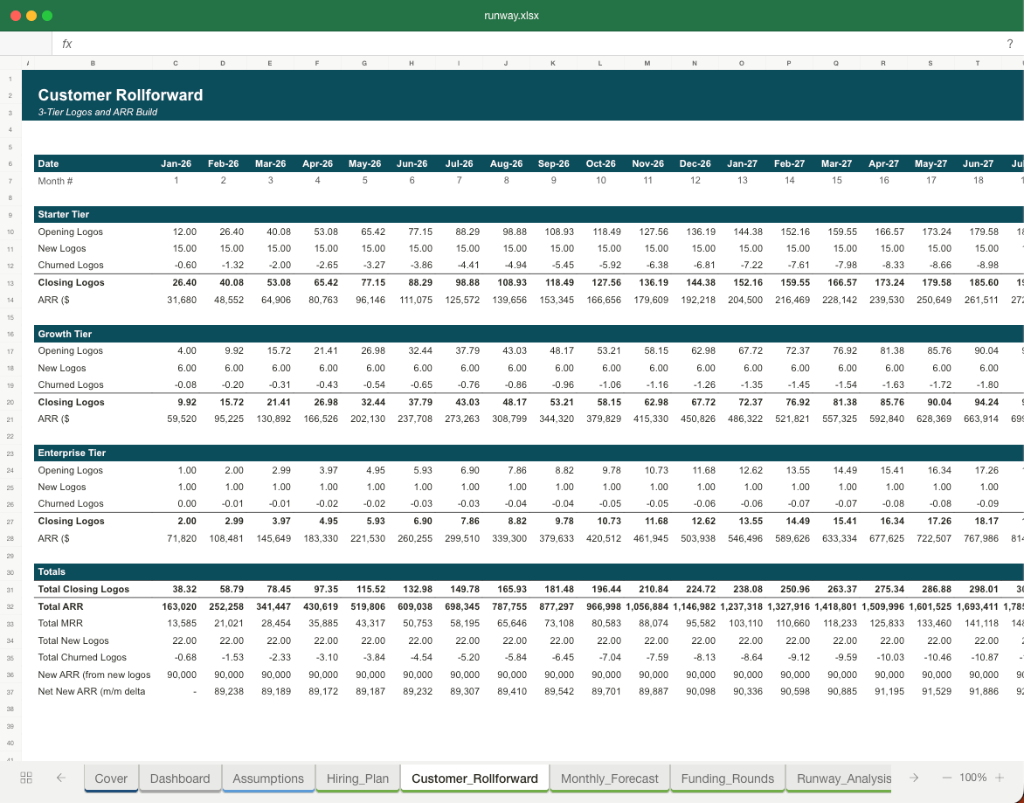
A turnkey financial model
Live formulas, no hardcoded values
Outputs are driven by live formulas, so the workbook updates from its assumptions instead of relying on hardcoded results.
All assumptions in one tab
Inputs are clearly marked in the Assumptions tab and separated from calculations, making it clear what to change and what to leave intact.
Statements always balancing
For integrated-statement models, the balance sheet, cash flow, and supporting schedules tie through properly.
Distinct schedules for clarity
Debt, working capital, taxes, and cash flow can get messy quickly. We group calculations in clear schedules, not across disconnected tabs.
No hidden macros or external links
There are no unexplained external workbook links or macros to undermine auditability or portability.
Changes flow through the model
Update a key driver and see the impact carry through the forecast, financing, and return outputs. We never use hardcoded numbers in formulas.
About Lambda School

How to build a detailed financial model for Lambda School
A complete walkthrough of the business, drivers, and assumptions behind the downloadable Lambda School model - distilled from its pitch deck and publicly available information.
Product & value proposition
- 10-month, online, full-time software engineering program.
- No upfront cost; Lambda bears training cost risk; student pays only on successful outcome.
- ISA terms: 17% of income for 2 years, triggered at $50,000+ salary, capped at $30,000 total.
- Data-led admissions: aptitude and potential battery; 5,000+ applications/month.
- Mastery-based progression; live classes from industry practitioners; 95 curriculum iterations logged.
- Full-time placement team; pursuing deep employer partnerships.
- Flywheel: better students → better employers → better alumni → better word-of-mouth → lower cost of capital.
Market
- 22 million PSE (post-secondary education) students in the US.
- 840 million PSE students globally.
- 3.7 million unfilled tech jobs in the US.
- 261k new tech jobs created annually in the US.
- 71k unfilled technical Salesforce roles in the US.
- University tuition rose ~200% since 1987 (inflation-adjusted); early career salary flat/negative over same period.
- No explicit TAM dollar figure provided. Future expansion labeled: Placement, Upskilling, Financial Products, Healthcare, Engineering, Sales, Skilled Trades, Finance.
Revenue model
- Primary revenue: ISA repayments - 17% of placed graduate's annual salary × 2 years, capped at $30,000/student.
- Revenue is deferred: cash arrives 6–18 months post-enrollment depending on job-search duration.
- Revenue recognition follows employment event, not enrollment.
- Future revenue lines mentioned but not modeled in deck: employer partnerships/placement fees, upskilling, financial products.
- No pricing for any future product lines disclosed.
Traction & metrics
- 5,000+ applications per month.
- Students in all 50 US states.
- Lambda Today: ~3k enrolled/active students (pictogram, approximate read).
- Average pre-Lambda salary: $23,000.
- Average placed salary post-Lambda: $74,000.
- 95 curriculum iterations.
- No revenue figure, cohort size, placement rate, or time-to-placement disclosed.
Unit economics
- Implied LTV per placed student: up to $30,000 ISA cap (17% × $74k avg salary × 2 years ≈ $25,160 at average placed salary, below the $30k cap).
Competition / moat
- Competitors referenced only implicitly (Dev Mountain 1k students, City College of San Francisco 20k, University of Phoenix 477k) as scale comparisons, not as named competitors.
- Moat framed as flywheel: best student selection data → best outcomes → best employer relationships → best alumni network → lowest cost of capital.
- Curriculum iteration velocity (95 iterations) cited as differentiation.
- No direct bootcamp competitor (General Assembly, Flatiron, Hack Reactor) named in deck.
Team & funding ask / use of funds
Recommended financial model
Archetype + why: ISA portfolio / income-share lender model, layered on a cohort P&L. Lambda is economically a lender that funds human capital: each enrolled student is a loan-like asset with probabilistic repayment. The right model is a cohort-based ISA portfolio model - track each cohort's deployment cost vs. expected ISA cash inflow, with credit-loss adjustments for non-placement and default. Secondary layer: operating P&L (instruction + admissions + placement costs vs. ISA revenue recognized). This is not a standard SaaS or DTC model.
Forecast horizon & granularity:
- 5 years, monthly granularity for cohort cash flow (ISA receipts are lumpy and lagged).
- Quarterly roll-up for P&L and balance sheet.
- Cohort vintage tracking: each cohort modeled separately through enrollment → graduation → placement → repayment → cap-out.
Key drivers & assumptions:
| Driver | Value |
|---|---|
| Monthly applications | 5,000+ |
| Admission rate | 5% |
| Monthly enrollments | ~250 |
| Program duration | 10 months |
| Time to placement post-graduation | 3 months |
| Placement rate (% of grads earning $50k+) | 70% |
| Average placed salary | $74,000 |
| ISA rate | 17% of income |
| ISA duration | 2 years |
| ISA cap | $30,000 |
| ISA floor (salary trigger) | $50,000 |
| Annual ISA payment per placed grad (at $74k salary) | ~$12,580 |
| Total ISA receipts per placed grad | ~$25,160 (below cap) |
| Non-placement / default rate | 30% |
| Cost per student trained (instruction + support) | $8,000–$12,000 |
| CAC (marketing + admissions per enrolled student) | $1,500 |
| Placement team cost per grad | $500 |
| Gross revenue recognition | On ISA payment receipt |
| Cohort growth rate (MoM enrollments) | 5% |
Scenarios (Base / Bull / Bear - which variables flex):
- Base: 70% placement rate, $74k avg salary, 5% monthly enrollment growth, $10k cost/student.
- Bull: 80% placement rate, $80k avg salary (employer partnerships lift salaries), 10% enrollment growth, costs scale sub-linearly.
- Bear: 55% placement rate (tighter job market), $65k avg salary (more students near $50k floor), 0% enrollment growth (capacity constraint), cost/student rises to $14k.
Required sheets / outputs:
- Cohort tracker - one row per monthly cohort: enrollment count, graduation date, placement date, ISA start, monthly ISA receipts by period, cumulative receipts vs. cap, write-off on non-placement.
- ISA portfolio roll-forward - outstanding ISA receivables, new originations, collections, defaults, carrying value.
- P&L - revenue (ISA receipts by period), COGS (instruction, section leads, content), gross profit, OpEx (admissions, placement, G&A, tech), EBITDA.
- Cash flow - critical: Lambda funds training upfront and waits 13–24 months for repayment; model cash burn carefully.
- Unit economics summary - LTV per cohort member, cost per placed grad, LTV/CAC, payback period.
- Scenario toggle - placement rate, avg salary, enrollment growth rate, cost/student as flex inputs.
- Sensitivity table - LTV and IRR sensitivity to placement rate (50–85%) × avg placed salary ($55k–$90k).
Frequently asked
Is the Lambda School financial model free?+
Yes. The Lambda School model is a free Excel (.xlsx) download with live formulas. Sign up with your email and the workbook is yours to keep, review, and edit.
What's included in the model?+
A 5-year monthly forecast with P&L, cash flow and runway, valuation (exit multiple plus a DCF cross-check), MOIC/IRR returns, and unit economics, with live formulas throughout.
How was this model built?+
It was built from Lambda School's pitch deck and publicly available information, then structured to investment-banking standards as a fully editable Excel model.
Can I change the assumptions?+
Yes. You can change assumptions and the live formulas will recalculate in the downloadable Excel model.
Have more financial modelling questions? Contact us

Created by ex-finance professionals
Hey, I’m Alex and I created Finamodel.
Over my years in the finance industry I kept building the same models over and over again. Same structure, same assumptions, different logo. So I started building frameworks to turn them into clean, reusable templates.
Every model here is one I’d actually use for a client, and I personally vet each one before it goes up.
I’m not an expert in every industry, but I’ve built enough models to know what belongs in one. And when something is completely foreign to me, I reach out to my network for experts to work on our models with us.
Having a template library on hand cuts a first build from hours to minutes.
Need help finding your model? You’ll find me in the Finamodel app!
Other EdTech Startup Financial Models
Browse another startup in the same category.

Green Flower Media
Cannabis education platform offering streaming video content, professional certificate programs, and college/university partnerships.

Labster
Web-based virtual science lab platform that replaces or supplements physical labs for higher ed and high school students.

Learn.xyz
AI-powered mobile learning app that lets anyone create and consume short lessons on any topic in seconds.

Our Future
Short-form video business news and education platform targeting Gen Z, positioned as the missing media brand for that demographic.
Paper
Paper.co sells a cloud-based tutoring/academic-support platform ("Platform as a Service") to K-12 school districts on an annual subscription basis.

Pilgrim Soul
Cannabis brand positioned as the "creativity" category king - proprietary live resin blends, branded journals, and content ecosystem targeting the Creative Class.
Pluralsight Acquisition
Proxy/shareholder vote presentation defending the Vista Equity Partners take-private acquisition of Pluralsight at $20.26/share (all-cash).

Replit
Browser-based coding environment ("REPL") for learning, building, and sharing code - no local setup required.