 MedArrive Financial Model
Health-tech Startup Financials (Free Excel Download)
B2B platform pairing telehealth physicians with field EMS/paramedics to deliver in-home care on behalf of health payors and providers.



professionals from Deloitte
Used by professionals from






About this model
MedArrive pairs telehealth physicians with field EMS and paramedics to provide in-home care for payors and providers. Its model combines remote clinical oversight with a mobile field workforce, allowing institutional buyers to deliver care beyond conventional clinics.
The business earns on visits or member populations rather than conventional software seats. Growth depends on payer and provider contracts, covered members, visit demand, geographic density, clinical protocols, and the availability of EMS and paramedic capacity in each market.
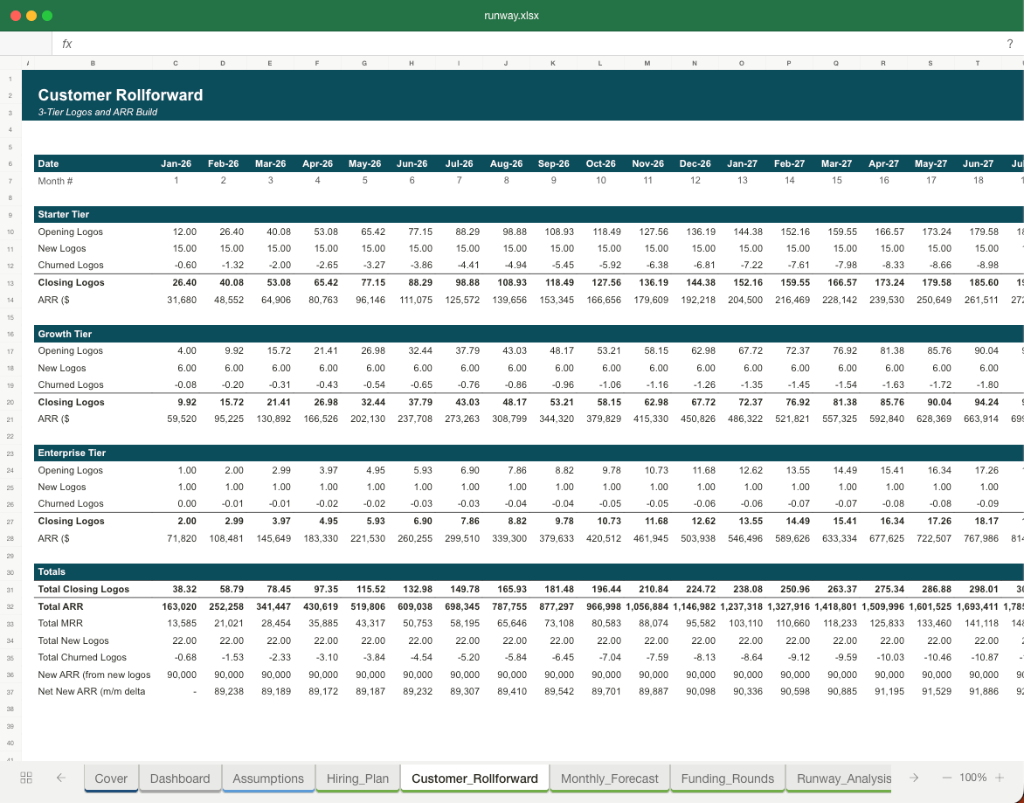
The model forecasts payer clients, covered members, visit volume, fee per visit or PMPM, field capacity, and contract renewal. It includes clinician and paramedic labour, dispatch, travel, supplies, market-launch costs, collections, gross margin, cash burn, and runway.
A turnkey financial model
Live formulas, no hardcoded values
Outputs are driven by live formulas, so the workbook updates from its assumptions instead of relying on hardcoded results.
All assumptions in one tab
Inputs are clearly marked in the Assumptions tab and separated from calculations, making it clear what to change and what to leave intact.
Statements always balancing
For integrated-statement models, the balance sheet, cash flow, and supporting schedules tie through properly.
Distinct schedules for clarity
Debt, working capital, taxes, and cash flow can get messy quickly. We group calculations in clear schedules, not across disconnected tabs.
No hidden macros or external links
There are no unexplained external workbook links or macros to undermine auditability or portability.
Changes flow through the model
Update a key driver and see the impact carry through the forecast, financing, and return outputs. We never use hardcoded numbers in formulas.
About MedArrive
medarrive.com
How to build a detailed financial model for MedArrive
A complete walkthrough of the business, drivers, and assumptions behind the downloadable MedArrive model - distilled from its pitch deck and publicly available information.
Product & value proposition
- Platform connects payors/providers (demand side) to a network of field providers - EMTs, paramedics, RNs, nurses, community health workers, phlebotomists (supply side) - and pairs them with telehealth physicians to deliver in-home clinical visits.
- Value to payors: reduce hospitalizations, readmissions, and ER utilization; improve quality ratings (STAR scores); gather richer in-home member data.
- Value to providers: extend reach to high-acuity patients remotely; expand virtual care capabilities.
- Value to field providers: increase labor utilization and revenue diversification; practice at top of scope.
- Value to patients: preventive, convenient, at-home care without exposure risk.
- ~95% daily cost savings vs. hospital setting ($189/day homecare vs. $2,882/day hospital).
Market
- Global Home Healthcare Market: $282B (2019) → $518B (2027E), CAGR 7.9%
- Daily cost of care by setting: Hospital $2,882 | LTACH $1,512 | IRF $1,415 | SNF $388 | Homecare $189
- 65+ U.S. population: 49.2M (2016) → 56.1M (2020) → 73.1M (2030) → 94.7M (2060), growing from 15% to 23% of total population
- Regulatory tailwinds: expanded telehealth reimbursement post-COVID, value-based care shift cited as structural drivers.
Revenue model
- Not explicitly stated in deck. Based on business model description, the likely model is:
- Per-visit or per-member-per-month (PMPM) fees charged to payors/providers for coordinating and dispatching in-home visits.
- Possible program management / SaaS fee layered on top.
- Channels: direct B2B sales to health plans and health systems (Dan Trigub CEO leads; Bryant Hutson VP BD named).
- No per-visit pricing, contract values, PMPM rates, or revenue split disclosed.
Traction & metrics
- Named payor/provider clients: SCAN Health Plan, Bright HealthCare, Clover Health, LA County Public Health, Molina Healthcare
- Over 100 SCAN members and their families vaccinated at home (one program)
- No revenue, visit volume, growth rate, or other quantitative traction metrics disclosed.
Competition / moat
- No direct competitor slide. Moat framing:
- Platform is described as "critical infrastructure" for the in-home visit ecosystem - three-sided marketplace (payors, patients, field providers).
- Network of field providers (EMS/paramedics) is the supply-side differentiator; EMS is a credentialed, regulated workforce not easily replicated.
- Regulatory expertise: adviser Sarah Fenn (former US Legal Director Uber Health, Obama White House ACA team); Dr. Andrey Ostrovsky (former CMS Chief Medical Officer of US Medicaid).
- Named blue-chip payor clients (SCAN, Bright, Molina, Clover) imply some contract validation.
Team & funding ask / use of funds
- CEO & Co-founder: Dan Trigub
- COO & Co-founder: Inna Plumb
- CTO: Jonathan D'Souza
- VP Clinical Operations: Dr. Megan Thomasch
- VP Business Development: Bryant Hutson
- Lead Product Manager: Baylee Mabe, MHA, CSM
- Operations Lead: Bo Cross
- Program Manager: Joy Malbrough, PhD, LMSW
- Head of Implementation: Greer Rios
- Investors: Kleiner Perkins, Define Ventures, Redesign Health, SCAN Health Plan
Recommended financial model
- Archetype + why: B2B marketplace / platform revenue model - PMPM (per-member-per-month) or per-visit fee charged to health plans and health systems. MedArrive is not a pure SaaS play (revenue is tied to visit volume/membership rosters, not just software seats), and not a fee-for-service provider billing CMS directly. The right archetype is a healthcare services marketplace with program-level contract revenue: model revenue as (# of payor contracts) × (average covered lives per contract) × (PMPM rate) or alternatively (# of visits) × (revenue per visit). Either approach works; PMPM is preferable if the company sells on a capitation or population-health basis, which is strongly implied by the payor client mix (SCAN, Bright, Molina, Clover are all managed care plans). Layer in a gross margin bridge showing field provider cost per visit vs. revenue per visit.
- Forecast horizon & granularity: 3 years (monthly in Year 1, quarterly in Years 2–3). Early stage with limited disclosed traction, so monthly granularity in Year 1 matters for cash runway visibility.
- Key drivers & assumptions:
- Number of active payor/provider contracts: 5 at start; ramp
- Average covered lives per contract: 10,000–50,000
- Visit activation rate (% of covered lives who receive a visit): 1–3% per year
- Revenue per visit OR PMPM rate: unknown
- Field provider cost per visit (gross margin driver): unknown
- Gross margin: 30–50%
- Headcount & opex: scale with sales/BD and clinical operations team
- Contract ramp: 6–12 month sales cycle for health plan contracts
- Global Home Healthcare Market CAGR: 7.9%
- Scenarios (Base / Bull / Bear - which variables flex):
- Base: 2–3 new contracts/year, mid-range PMPM, 2% visit activation, 35% gross margin
- Bull: 4–5 new contracts/year, higher PMPM (payor willingness to pay for readmission reduction), 3–4% activation, 45% GM
- Bear: Slow contract wins (1/year), lower PMPM (price competition), high field provider cost (tight EMS labor market), 20% GM or negative in early years
- Required sheets / outputs:
- Assumptions tab (all drivers in one place)
- Revenue build: contracts × covered lives × activation rate × revenue per visit (or PMPM build)
- Field provider cost / COGS: visits × cost per visit
- P&L: gross profit → operating expenses (S&M, R&D, G&A, clinical ops) → EBITDA → net income
- Headcount plan (linked to opex)
- Cash & runway: opening cash, monthly burn, implied runway (key for early-stage)
- KPI dashboard: active contracts, covered lives, total visits, revenue per visit, gross margin %, monthly burn, months of runway
Frequently asked
Is the MedArrive financial model free?+
Yes. The MedArrive model is a free Excel (.xlsx) download with live formulas. Sign up with your email and the workbook is yours to keep, review, and edit.
What's included in the model?+
A 5-year monthly forecast with P&L, cash flow and runway, valuation (exit multiple plus a DCF cross-check), MOIC/IRR returns, and unit economics, with live formulas throughout.
How was this model built?+
It was built from MedArrive's pitch deck and publicly available information, then structured to investment-banking standards as a fully editable Excel model.
Can I change the assumptions?+
Yes. You can change assumptions and the live formulas will recalculate in the downloadable Excel model.
Have more financial modelling questions? Contact us

Created by ex-finance professionals
Hey, I’m Alex and I created Finamodel.
Over my years in the finance industry I kept building the same models over and over again. Same structure, same assumptions, different logo. So I started building frameworks to turn them into clean, reusable templates.
Every model here is one I’d actually use for a client, and I personally vet each one before it goes up.
I’m not an expert in every industry, but I’ve built enough models to know what belongs in one. And when something is completely foreign to me, I reach out to my network for experts to work on our models with us.
Having a template library on hand cuts a first build from hours to minutes.
Need help finding your model? You’ll find me in the Finamodel app!
Other Health-tech Startup Financial Models
Browse another startup in the same category.
98point6
B2B SaaS platform licensing an AI-powered virtual care technology stack to health systems, pivoted from running a direct-to-employer virtual clinic.
A-Champs
IoT-powered gamified training device (ROXs PRO) for sports/health professionals, evolving into a B2C smart coach app for families.

AccuRx
Patient-centred communication platform connecting everyone involved in a patient's care, starting with near-universal penetration in UK GP practices.

Aeris
Swiss-made premium air purifiers sold through DTC, retail, and dealer channels, with a recurring filter consumable attached to a connected mobile app.

Akido Labs
Akido Labs is a data-driven prevention platform that integrates siloed healthcare, municipal, and non-profit data to enable proactive outreach and case management for vulnerable populations (homeless, chronically ill, etc.).

Alloy
Telehealth + DTC subscription platform delivering menopause hormonal treatment (MHT) and holistic care to U.S. women 40+.

Astek Diagnostics
Point-of-care diagnostic device (Jiddu system) that confirms bacterial infections and antibiotic sensitivity in ~1 hour across four body fluid types (urine, CSF, effluent, blood).

Atom Limbs
Atom Limbs is building the first AI-powered, neural-controlled prosthetic arm sold direct-to-consumer on a subscription model.