 Menlo Micro Financial Model
Health-tech Startup Financials (Free Excel Download)
Menlo Micro makes the "Ideal Switch" - a MEMS-based electromechanical relay built on semiconductor fab processes that combines the best of mechanical (low loss, true conductor) and solid-state (small, fast, cheap) switches.



professionals from Deloitte
Used by professionals from






About this model
Menlo Micro makes the Ideal Switch, a MEMS relay combining low-loss mechanical performance with semiconductor-scale manufacturing. Its component proposition targets applications requiring reliable switching performance while seeking the scale economics of a semiconductor manufacturing process.
OEM design wins, including GE Healthcare MRI, drive the path from qualification into scaled component shipments. Commercial progress depends on long qualification cycles, customer engineering adoption, production programmes, volumes, pricing, yield, and the concentration inherent in a small number of large OEM accounts.
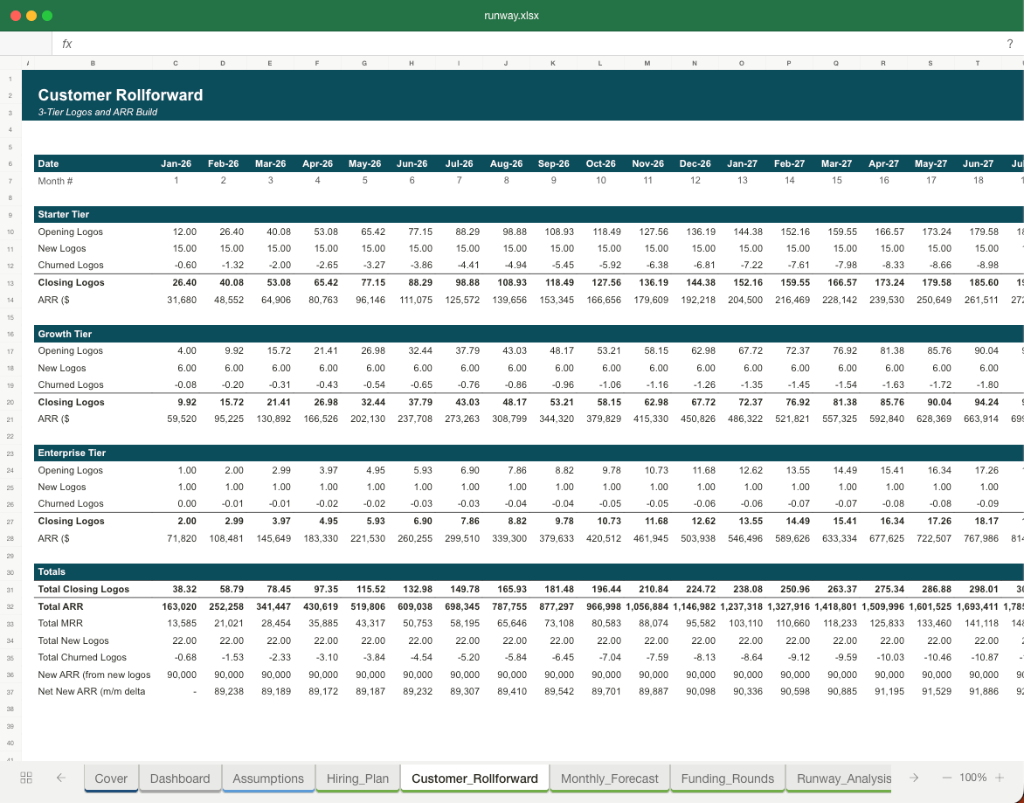
The model forecasts design wins, unit shipments, ASP, wafer and test cost, manufacturing yield, and customer concentration. It includes qualification and R&D spending, supply-chain commitments, inventory, working capital, gross margin, operating cash flow, funding needs, and runway.
A turnkey financial model
Live formulas, no hardcoded values
Outputs are driven by live formulas, so the workbook updates from its assumptions instead of relying on hardcoded results.
All assumptions in one tab
Inputs are clearly marked in the Assumptions tab and separated from calculations, making it clear what to change and what to leave intact.
Statements always balancing
For integrated-statement models, the balance sheet, cash flow, and supporting schedules tie through properly.
Distinct schedules for clarity
Debt, working capital, taxes, and cash flow can get messy quickly. We group calculations in clear schedules, not across disconnected tabs.
No hidden macros or external links
There are no unexplained external workbook links or macros to undermine auditability or portability.
Changes flow through the model
Update a key driver and see the impact carry through the forecast, financing, and return outputs. We never use hardcoded numbers in formulas.
About Menlo Micro
menlomicro.com
How to build a detailed financial model for Menlo Micro
A complete walkthrough of the business, drivers, and assumptions behind the downloadable Menlo Micro model - distilled from its pitch deck and publicly available information.
Product & value proposition
- Core product: The Ideal Switch - a MEMS switch fabricated on 8-inch glass wafers using a proprietary metal alloy beam and Through-Glass-Via (TGV) packaging.
- Tagline / thesis: "Milliwatts-to-kilowatts, DC-to-light" - a single platform spanning RF switching and AC/DC power switching.
- Key performance claims vs. electromechanical relays (EMR): 100x less power (<1mW vs >100mW), 100x higher linearity (>85dBm vs 60dBm), 1000x faster switching (<10µs vs 10ms), 1000x longer life (>3B vs <3M cycles), >99% size reduction (0.006–0.6 cm³ vs 1–71 cm³).
- Key performance claims vs. solid-state (SS): 100x better linearity, >0.5dB lower insertion loss (0.2dB vs 0.7dB), 10x less power, 85% less on-resistance (>30mΩ vs 200mΩ), no heatsinks needed.
- Product configurations: Core switch, switch with integrated controls, multi-die switch matrix, RF System-on-Glass. Unit cell: 50µm × 50µm.
- Spin-out origin: GE Global Research began MEMS circuit-breaker program in 2004; Menlo Micro spun out in 2016 to commercialize IP beyond GE verticals.
Market
- SAM target: $20B+ by 2023, spanning RF relay, RF solid-state, GP relay, GP solid-state, and Power relay segments across 6 end markets.
- End-market SAM breakdown (read from stacked bar chart, approximate):
- Medical: ~$150M
- Aero & Defense: ~$200M
- Test & Measurement: ~$600M
- Consumer: ~$750M
- Telecom: ~$1,500M
- Power IoT: ~$20B+ (dominant, future product; shown as a single gold bar at full scale)
- Today (2020) addressable: RF and general purpose switching. Power IoT/AC/DC is the future expansion.
- Source: Frost & Sullivan market reports + internal Menlo estimates.
Revenue model
- Unit sales of switch ICs to OEM customers. B2B direct sales model implied (no mention of distribution channels or marketplaces).
- Go-to-market today: Qualified GE supplier; first design win is GE Healthcare MRI machines (each MRI replaces >100 PIN diodes with Ideal Switch units).
- Expanding to: Defense, Communications, Test & Measurement via follow-on contracts.
- Revenue recognition: Per-unit shipments (standard semiconductor component model).
- COGS levers: 8-inch wafer fab (4x die/wafer vs 4-inch), volume pricing at commercial fab, scalable test infrastructure.
Traction & metrics
- Units shipped: >100K Ideal Switches shipped to GE Healthcare (Fortune 100 first customer).
- Customers: At least one confirmed production customer (GE Healthcare). Defense, Comms, T&M described as contract-stage.
- Fab capacity 2017: 180 wafers/year (8-inch equivalent); 100K units/year test capacity.
- Fab capacity today (Oct 2020): 6K wafers/year (Menlo allotment); >10M units/year test capacity; 4x die/wafer improvement from 8-inch switch.
- Capital raised: >$77M since 2016 founding.
- Investors: Paladin Capital Group, GE Ventures, Corning, Microsemi.
- Certifications: ISO 9001:2015 certified; qualified GE supplier.
Unit economics
Design-level structural notes only:
- COGS is wafer-based: cost per die × dies/wafer, scaled by wafer volume. 8-inch fab materially reduces COGS vs prior 4-inch setup.
- Test cost is a significant COGS component (>10M units/year infrastructure now in place).
- Heatsink elimination and size reduction generate OEM-level BOM savings; value-based pricing opportunity.
Competition / moat
- Direct competition: Electromechanical relays (Omron, TE Connectivity, Panasonic) and solid-state switches (PIN diodes, GaN, CMOS).
- Moat: Proprietary metal alloy beam science licensed from GE (>100 years of high-voltage metallurgy); Corning glass substrate and TGV partnership; unique combination of conductor-grade ON performance with semiconductor-scale size/cost.
- IP: GE-originated core IP acquired at spin-out; ongoing internal development.
- Barriers: MEMS at scale is notoriously hard; the fab transition from 4-inch R&D to 8-inch commercial is itself a multi-year moat.
- No named direct competitors to the Ideal Switch platform are cited. Deck positions it as a category creation.
Team & funding ask / use of funds
- CEO: Russ Garcia - prior CEO WiSpry, CEO uNav; EVP Microsemi; TI, Silicon Systems, Hughes.
- Co-Founder / CTO: Chris Keimel - former Senior Research Scientist, GE Global Research Center.
- Co-Founder / SVP Marketing: Chris Giovanniello - VP GE Ventures, Teradyne.
- CFO: Mark Czepiel - prior CFO WiSpry (RF MEMS semiconductor).
- SVP Manufacturing: Jeff Baloun - GM Deca Technologies, CEO Imbera, GM Unisem.
- SVP Sales: Lew Boore - VP Silanna, Cavendish Kinetics, WiSpry, Agilent, M/A-COM.
- Board: Russ Garcia (CEO); Paul Conley PhD (Paladin Capital); Marianne Wu (40 North Ventures); John Major (former Broadcom Chairman); Jim Cable (former pSemi Chairman & CTO).
- Advisors include: Rich Simoncic (SVP Analog, Microchip Technology); Kari-Pekka Wilska (former Nokia Americas President); Michael Idelchik (former VP Advanced Technology, GE Global Research).
Recommended financial model
- Archetype + why: Semiconductor component manufacturer revenue model - unit shipments × ASP by product family, with wafer-based COGS and standard fab-scale operating leverage. This is a deep-tech hardware company with discrete unit economics (wafers → die → tested units → packaged switches → customer shipments). A 3-statement model is appropriate, but the primary analytical engine is a bottoms-up unit/volume/revenue build by end market, paired with a wafer-economics COGS model. Not SaaS, not marketplace, not subscription.
- Forecast horizon & granularity: 5 years (2021–2025), quarterly for years 1–2, annual for years 3–5. Deck references a "5-year plan" explicitly.
- Key drivers & assumptions:
*Revenue side:*
- Units shipped by end market (Medical, Aero & Defense, T&M, Telecom/Comms, Consumer, Power IoT): ramp from >100K in 2020 base; scale trajectory - production capacity of >10M units/year is the near-term ceiling
- ASP per unit by product family: - RF switch ICs typically $2–$10 ASP at this performance tier; power switches could be $5–$25. Must be confirmed; no ASP in deck
- Revenue mix shift: RF/GP switching today → Power IoT future; higher ASP likely for power products
- Design win conversion rate and ramp timeline per customer: - typical semiconductor design-win-to-revenue cycle is 12–24 months
*COGS / manufacturing:*
- Wafers/year: 6K (current allotment); scales with revenue ramp via fab capacity negotiation
- Die per wafer: 8-inch wafer = 4x die vs 4-inch; further improvements from design shrink
- Yield rate: - start at 80%, improve to 90%+ as process matures; standard for MEMS at commercial fab
- Test cost per unit: - infrastructure now in place for >10M units/year; costs per unit decline with volume
- Gross margin: - target 50–60% at scale, typical for specialty semiconductor ICs; early ramp likely 20–35%
*Opex:*
- R&D: significant - new product configurations (matrix, RF SoG, Power IoT) require continued investment; ~30–40% of revenue in early years
- Sales & Marketing: B2B enterprise sales motion; small field team; ~10–15% of revenue
- G&A: ~8–12% of revenue
- Headcount: - lean team implied by executive bios; add engineering and sales headcount per revenue tier
*Balance sheet / cash:*
- $77M+ raised to date; runway position and burn rate not disclosed
- CapEx: - fab allotment model (no wafer fab ownership); primary CapEx is test equipment; relatively asset-light vs. owning a fab
- Working capital: - semiconductor B2B typical 60–90 day receivables, 30–60 day payables
- Scenarios (Base / Bull / Bear):
- *Bear:* Power IoT product delayed 2+ years; design-win ramp slower than expected; ASP compression from competition; gross margin stays below 35% through 2025
- *Base:* GE Healthcare volumes grow, 2–3 new defense/comms design wins by 2022, Power IoT products enter sampling 2023, gross margin reaches 45–50% by 2024
- *Bull:* 5G infrastructure cycle drives large Telecom win; Power IoT qualifies at a major industrial OEM; fab capacity expanded to 20K+ wafers/year; gross margin >55% by 2024
Flex variables: unit ramp by end market, ASP by product family, yield, wafer allotment, and Power IoT launch timing.
- Required sheets / outputs:
- Assumptions dashboard (all drivers in one place, tagged DECK vs ASSUMED)
- Unit volume build by end market (annual, then quarterly for near-term)
- Revenue by product family (RF switch, GP switch, Power switch)
- Wafer economics / COGS model (wafers → die → yield → tested units → packaged; cost/wafer, cost/die, cost/unit, blended gross margin)
- Operating expense model (R&D, S&M, G&A, headcount)
- Income statement (3-statement)
- Balance sheet (3-statement)
- Cash flow statement (3-statement) with cash runway
- Scenario toggle (Bear / Base / Bull) on key drivers
- SAM penetration tracker (units shipped vs. market size by vertical) - ties to slide 20 market data
Frequently asked
Is the Menlo Micro financial model free?+
Yes. The Menlo Micro model is a free Excel (.xlsx) download with live formulas. Sign up with your email and the workbook is yours to keep, review, and edit.
What's included in the model?+
A 5-year monthly forecast with P&L, cash flow and runway, valuation (exit multiple plus a DCF cross-check), MOIC/IRR returns, and unit economics, with live formulas throughout.
How was this model built?+
It was built from Menlo Micro's pitch deck and publicly available information, then structured to investment-banking standards as a fully editable Excel model.
Can I change the assumptions?+
Yes. You can change assumptions and the live formulas will recalculate in the downloadable Excel model.
Have more financial modelling questions? Contact us

Created by ex-finance professionals
Hey, I’m Alex and I created Finamodel.
Over my years in the finance industry I kept building the same models over and over again. Same structure, same assumptions, different logo. So I started building frameworks to turn them into clean, reusable templates.
Every model here is one I’d actually use for a client, and I personally vet each one before it goes up.
I’m not an expert in every industry, but I’ve built enough models to know what belongs in one. And when something is completely foreign to me, I reach out to my network for experts to work on our models with us.
Having a template library on hand cuts a first build from hours to minutes.
Need help finding your model? You’ll find me in the Finamodel app!
Other Health-tech Startup Financial Models
Browse another startup in the same category.
98point6
B2B SaaS platform licensing an AI-powered virtual care technology stack to health systems, pivoted from running a direct-to-employer virtual clinic.
A-Champs
IoT-powered gamified training device (ROXs PRO) for sports/health professionals, evolving into a B2C smart coach app for families.

AccuRx
Patient-centred communication platform connecting everyone involved in a patient's care, starting with near-universal penetration in UK GP practices.

Aeris
Swiss-made premium air purifiers sold through DTC, retail, and dealer channels, with a recurring filter consumable attached to a connected mobile app.

Akido Labs
Akido Labs is a data-driven prevention platform that integrates siloed healthcare, municipal, and non-profit data to enable proactive outreach and case management for vulnerable populations (homeless, chronically ill, etc.).

Alloy
Telehealth + DTC subscription platform delivering menopause hormonal treatment (MHT) and holistic care to U.S. women 40+.

Astek Diagnostics
Point-of-care diagnostic device (Jiddu system) that confirms bacterial infections and antibiotic sensitivity in ~1 hour across four body fluid types (urine, CSF, effluent, blood).

Atom Limbs
Atom Limbs is building the first AI-powered, neural-controlled prosthetic arm sold direct-to-consumer on a subscription model.