MOMoonshot Financial Model
Enterprise/Security Startup Financials (Free Excel Download)
Moonshot combines specialist counter-terrorism expertise with proprietary data technology to find, understand, and intervene against online extremism - selling data licenses to governments and tech platforms.



professionals from Deloitte
Used by professionals from






About this model
Moonshot combines counter-terrorism expertise with proprietary data technology to identify, understand, and intervene against online extremism. Its work is aimed at the complex information and risk environments faced by governments and large technology platforms.
The company monetises through data licences sold to public-sector agencies and technology organisations. This creates a national-security SaaS and intelligence-services profile, with a small number of high-value, relationship-driven contracts rather than consumer-scale distribution.
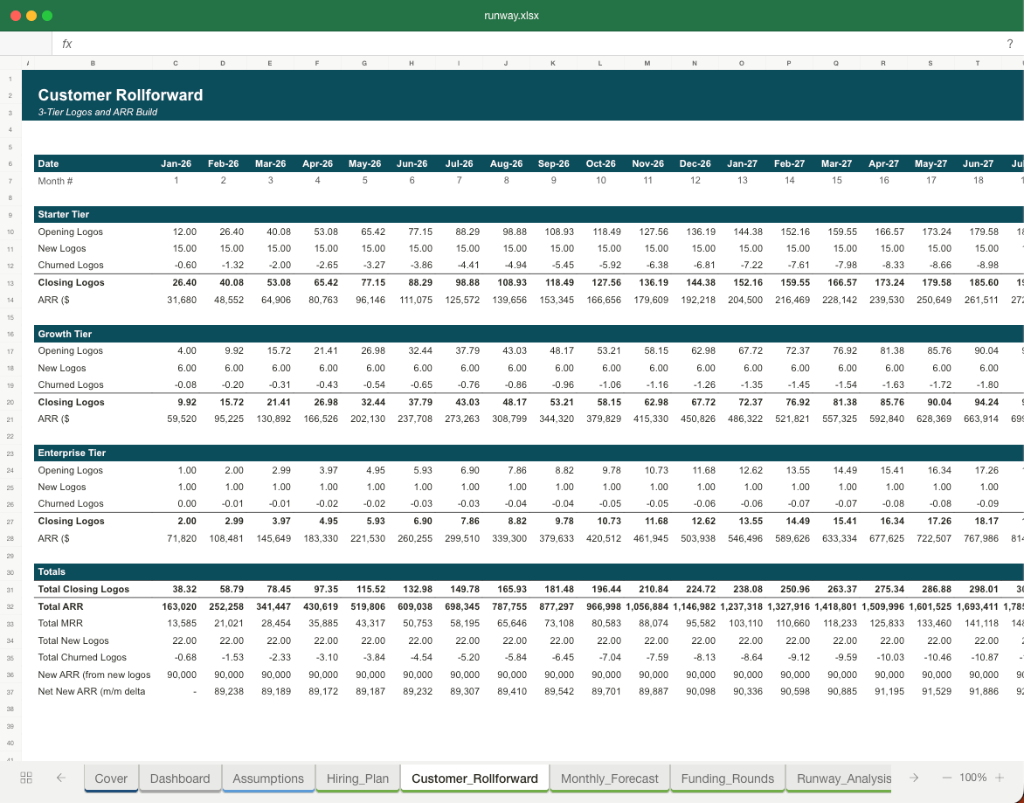
The model uses a contract-led revenue build, tracking new government and platform licences, contract value, renewal, expansion, and delivery cost. It also reflects long procurement cycles, specialist headcount, gross margin, data operations, and cash needs across base and downside cases.
A turnkey financial model
Live formulas, no hardcoded values
Outputs are driven by live formulas, so the workbook updates from its assumptions instead of relying on hardcoded results.
All assumptions in one tab
Inputs are clearly marked in the Assumptions tab and separated from calculations, making it clear what to change and what to leave intact.
Statements always balancing
For integrated-statement models, the balance sheet, cash flow, and supporting schedules tie through properly.
Distinct schedules for clarity
Debt, working capital, taxes, and cash flow can get messy quickly. We group calculations in clear schedules, not across disconnected tabs.
No hidden macros or external links
There are no unexplained external workbook links or macros to undermine auditability or portability.
Changes flow through the model
Update a key driver and see the impact carry through the forecast, financing, and return outputs. We never use hardcoded numbers in formulas.
About Moonshot
moonshot.io
How to build a detailed financial model for Moonshot
A complete walkthrough of the business, drivers, and assumptions behind the downloadable Moonshot model - distilled from its pitch deck and publicly available information.
Product & value proposition
Three-stage pipeline:
- Find: Identify individuals and communities at-risk of radicalisation/terrorism online using proprietary data harvesting from dark/fringe internet sources.
- Understand: Analyse and process behavioural insights on these audiences.
- Intervene: Deliver services to disrupt groups and redirect individuals.
Technology layer: Centralised data processing and analysis engine ingesting hidden dark-web data, producing analytics dashboards and insights sold as licenses to multiple client categories (4 license tracks visible in diagram).
Differentiation: First company to combine specialist subject-matter expertise (counter-terrorism professionals) with custom-built technology.
Market
Deck uses the term "accessible market" (ethics-screened, not total addressable market):
| Vertical | Accessible Market |
|---|---|
| Private Security Services | £34.5Bn |
| Counter-Terrorism | £17.2Bn |
| Organised Crime | £3.7Bn |
| Disinformation | £?Bn - "new and emerging market" |
No SAM/SOM breakdown, no growth rates, no TAM vs. accessible market split provided. Disinformation market size explicitly undisclosed.
Revenue model
- Primary model: Data/analytics platform licenses.
- Licensing structure: Multiple license tiers implied (4 output tracks in the data-flow diagram).
- Channels: Direct sales to governments and large tech platforms.
- Future expansion: Licensing model to be scaled via technology investment; same platform extended into Organised Crime, Disinformation, Private Security verticals.
Traction & metrics
No revenue figures, ARR, growth rates, or contract values disclosed.
Client logos confirmed:
- Tech: Facebook, Google, Jigsaw (Google subsidiary)
- UK Government: Ministry of Defence, Foreign & Commonwealth Office, Home Office
- International governments: US State Department, German Auswärtiges Amt, Australian Dept. of Home Affairs, Australian Dept. of Foreign Affairs and Trade, Victoria State Government
- Multilateral: United Nations, Global Coalition
- Canada: Public Safety Canada
No customer count, contract values, or revenue figures stated.
Competition / moat
No explicit competitive landscape slide. Implied moat:
- "First company of its kind" combining specialist expertise + custom technology.
- Founder relationships with CIA, White House, FBI, DoD, EU Commissioner - effectively a regulatory and institutional access moat.
- Values-driven client selection as differentiation (ethical screen on customers).
Team & funding ask / use of funds
Founders:
- Vidhya Ramalingam - leading global terrorism expert; advises FBI, DoD; testified to US Congress; led EU counter-far-right terrorism programme; Fellow at Oxford; Obama Leader.
- Ross Frenett - digital counter-terrorism innovator; advises CIA, White House, UN; created first open-source counter-terrorism methodology; established Google-financed global network of former terrorists; ex-Irish Defence Forces; ex-Deloitte Technology Consulting.
Funding ask: Not quantified (£ amount not stated).
Use of funds:
- Enhance technology to scale licensing model.
- Accelerate transition to new markets (Organised Crime, Disinformation, Private Security).
Recommended financial model
- Archetype + why: Government/Enterprise SaaS - ARR licensing model with segment expansion. Revenue is recurring data licenses sold to a small number of high-ACV government and enterprise clients. New market verticals (Organised Crime, Disinformation) are expansion levers, not new business models - same platform, new buyers. A 3-statement model underpinning an ARR bridge is appropriate.
- Forecast horizon & granularity: 5 years (Y1–Y5), monthly in Years 1–2, annual in Years 3–5. Given government procurement cycles (6–18 months), monthly is necessary to model cash timing.
- Key drivers & assumptions:
- Starting ARR: £0 modelled as near-zero base (no deck revenue disclosed); seed the model at £0 and build from known clients - rationale: deck is fundraising, implies early/pre-scale.
- Number of active licenses - split by segment (Counter-Terrorism, Private Security, Organised Crime, Disinformation): begin with Counter-Terrorism only (proven client base per slide 10); add segments from Y2 per roadmap.
- Average contract value (ACV) per license: £500K–£2M per annum for government clients; £250K–£750K for tech platforms - rationale: GovTech intelligence contracts typically 6–7 figures; no deck data.
- License count growth: 2–4 new logos per year in Year 1–2, accelerating post-investment.
- Gross margin: 65–75% - rationale: SaaS/data platform with high personnel cost (expert analysts); lower than pure software due to specialist labour content.
- Headcount: primarily technical and analytical staff; model headcount-driven opex growth.
- CAC: high (government sales cycles are long); model as 12–18 months sales cycle, senior BD/Government Affairs headcount.
- Churn: low - government contracts typically multi-year; model 5–10% annual logo churn.
- Expansion revenue: net revenue retention >110% once new verticals activate (same clients buy additional modules).
- FX: primary currency £GBP; US/AU government contracts likely USD/AUD - model at spot with sensitivity.
- Scenarios (Base / Bull / Bear - which variables flex):
- Base: 3 new CT licenses/year; ACV £750K; 2-year expansion into Organised Crime; 70% gross margin.
- Bull: 5 new CT licenses/year + faster vertical expansion (Y2 Disinfo wins); ACV £1.2M; 75% GM.
- Bear: 1–2 licenses/year; government budget freezes; ACV £400K; expansion delayed to Y4; 60% GM.
- Flex variables: new logo count, ACV, time-to-vertical expansion, gross margin (expert headcount cost).
- Required sheets / outputs:
- ARR Bridge - new ARR, expansion ARR, churned ARR by segment per period.
- Income Statement - revenue (licensing), COGS (analyst/expert labour, data infrastructure), gross profit, S&M, R&D, G&A, EBITDA.
- Cash Flow Statement - operating CF, capex (tech build), net burn / runway.
- Balance Sheet - minimal (services business; focus on cash and deferred revenue).
- Headcount Plan - by function (Engineering, Analysts/Experts, BD/Sales, G&A).
- Scenario Toggle - Base / Bull / Bear switcher feeding IS and ARR bridge.
- Runway Model - months of runway from raise vs. burn rate.
Frequently asked
Is the Moonshot financial model free?+
Yes. The Moonshot model is a free Excel (.xlsx) download with live formulas. Sign up with your email and the workbook is yours to keep, review, and edit.
What's included in the model?+
A 5-year monthly forecast with P&L, cash flow and runway, valuation (exit multiple plus a DCF cross-check), MOIC/IRR returns, and unit economics, with live formulas throughout.
How was this model built?+
It was built from Moonshot's pitch deck and publicly available information, then structured to investment-banking standards as a fully editable Excel model.
Can I change the assumptions?+
Yes. You can change assumptions and the live formulas will recalculate in the downloadable Excel model.
Have more financial modelling questions? Contact us

Created by ex-finance professionals
Hey, I’m Alex and I created Finamodel.
Over my years in the finance industry I kept building the same models over and over again. Same structure, same assumptions, different logo. So I started building frameworks to turn them into clean, reusable templates.
Every model here is one I’d actually use for a client, and I personally vet each one before it goes up.
I’m not an expert in every industry, but I’ve built enough models to know what belongs in one. And when something is completely foreign to me, I reach out to my network for experts to work on our models with us.
Having a template library on hand cuts a first build from hours to minutes.
Need help finding your model? You’ll find me in the Finamodel app!
Other Enterprise/Security Startup Financial Models
Browse another startup in the same category.
AgBiome
AgBiome is a microbial-platform agtech company that discovers, develops, and commercialises biological crop protection products (and licences the platform across adjacent markets).

Alation
Enterprise data intelligence platform - data catalog, governance, and metadata management for large organisations.

Archer SPAC
Archera
Cloud resource automation platform that continuously optimizes AWS commitment purchases, de-risks overcommitment, and automates FinOps workflows.

Ardoq
Cloud-native Enterprise Architecture (EA) SaaS platform that helps large enterprises navigate digital transformation through automated data collection, graph-based architecture modelling, and change impact analysis.

Ascend
Ascend.io is an enterprise big data automation platform ("Enterprise Intelligence Platform") that abstracts away the complexity of big data engineering so non-experts can build and run data pipelines.

Athennian
Cloud-based legal entity management system (EMS) uniting entity data with workflow and document automation.

Auditboard
Cloud-based integrated risk management platform connecting audit, risk, compliance, and ESG teams across the enterprise.