 Navina Financial Model
Health-tech Startup Financials (Free Excel Download)
AI-powered "Patient Portrait" platform that synthesises EHR data to surface missed diagnoses, HCC coding gaps, and quality metrics for primary care physicians at the point of care.



professionals from Deloitte
Used by professionals from






About this model
Navina synthesises EHR data into a Patient Portrait that surfaces diagnoses, HCC coding gaps, and quality metrics for primary-care clinicians. It gives care teams a unified view of patient information, supporting documentation and value-based-care decision-making within existing clinical workflows.
It sells to practices, groups, and ACOs with ROI linked to coding and value-based-care uplift. Customer value depends on clinician adoption, deployment across providers, measurable coding improvement, and expansion from an initial group into broader primary-care networks.
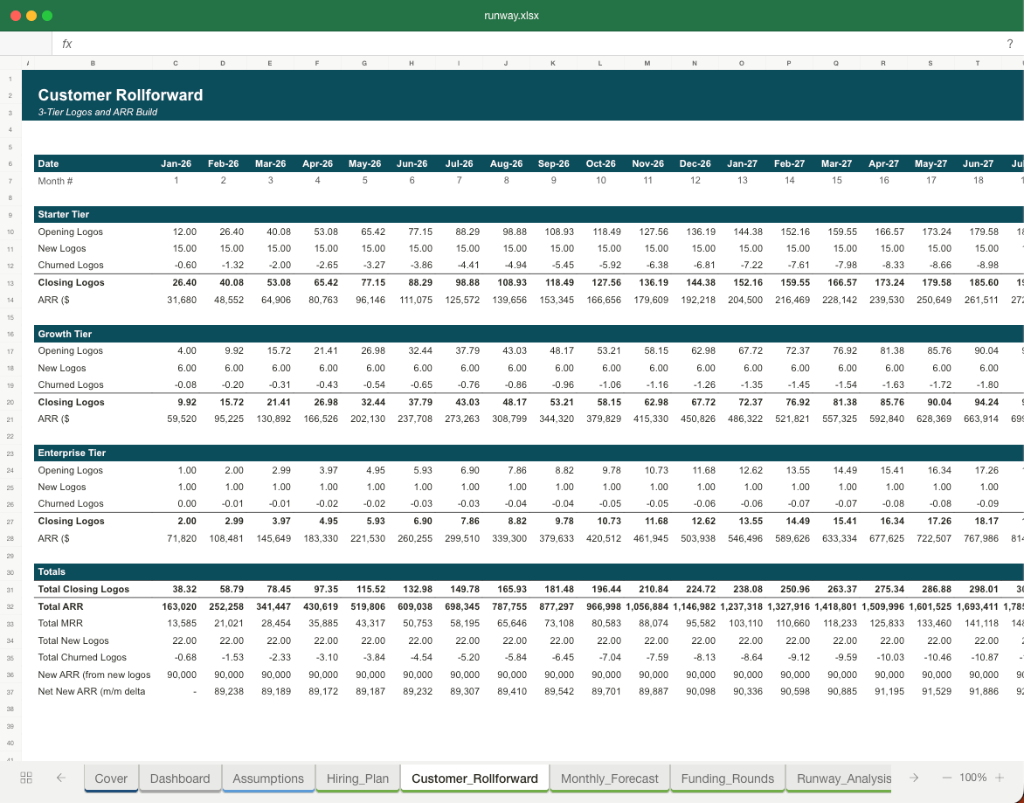
The model forecasts provider organisations, clinician seats, subscription ARPU, deployment, HCC uplift evidence, expansion, and churn. It includes integration and cloud costs, enterprise sales, customer success, product investment, gross margin, cash burn, and runway.
A turnkey financial model
Live formulas, no hardcoded values
Outputs are driven by live formulas, so the workbook updates from its assumptions instead of relying on hardcoded results.
All assumptions in one tab
Inputs are clearly marked in the Assumptions tab and separated from calculations, making it clear what to change and what to leave intact.
Statements always balancing
For integrated-statement models, the balance sheet, cash flow, and supporting schedules tie through properly.
Distinct schedules for clarity
Debt, working capital, taxes, and cash flow can get messy quickly. We group calculations in clear schedules, not across disconnected tabs.
No hidden macros or external links
There are no unexplained external workbook links or macros to undermine auditability or portability.
Changes flow through the model
Update a key driver and see the impact carry through the forecast, financing, and return outputs. We never use hardcoded numbers in formulas.
About Navina
navina.ai
How to build a detailed financial model for Navina
A complete walkthrough of the business, drivers, and assumptions behind the downloadable Navina model - distilled from its pitch deck and publicly available information.
Product & value proposition
- Product: "Patient Portrait" - an AI/ML layer on top of existing EHRs that aggregates and prioritises a patient's entire history, maps clinical relationships (problems ↔ labs ↔ medications ↔ consult notes), and flags missing diagnoses, HCC coding gaps, and RAF score opportunities at the point of care.
- Core value props:
- Reduces chart-review time (33% of physician EHR time is chart review - the single largest time sink).
- Cuts missed clinical elements: 53 out of 100 visits have at least one missed important clinical element (Navina's own research/pilots).
- Revenue recovery: 20% hidden revenues, $30B total potential loss in the primary care market.
- HCC coding uplift → higher RAF scores → multi-million-dollar annual income increase for practices on VBC plans.
- Partners cited: NOMS (HIMSS Davies ambulatory award winner), American Academy of Family Physicians (AAFP).
Market
- $30B total potential revenue loss in primary care from missed HCC/RAF coding.
- No explicit TAM/SAM/SOM breakdown or market CAGR cited.
- Qualitative tailwinds: post-COVID surge in primary care visits, growing VBC/value-based plan adoption, telemedicine driving demand for better data access.
- 33% of physician EHR time spent on chart review (Annals of Internal Medicine, Adler-Milstein 2020).
- 78% of physicians burned out (Physicians Foundation / Merritt Hawkins 2018 survey).
Revenue model
- Sold B2B to primary care practices, multi-specialty groups, and ACOs.
- Economic pitch is tied to RAF/HCC uplift: higher RAF scores → increased capitated payments → "multi-million dollars in annual income for practice groups."
- No explicit pricing model, per-seat fee, or revenue-share structure stated in the deck.
- Implied SaaS or subscription per-provider or per-practice, given the clinical workflow integration angle.
- Channel: direct enterprise sales + channel partnerships (NOMS, AAFP).
Traction & metrics
- Pilots referenced but not quantified in terms of customer count, ARR, or growth rate.
- "Significant reduction in missed clinical data and reduced physician burnout" stated qualitatively.
- No revenue figures, customer count, retention rate, or growth metrics disclosed.
Competition / moat
- Moat stated as:
- Team: founders are ex-IDF Unit 8200 with AI/ML track record; 11th joint project; won national security award for AI breakthrough.
- Clinical depth: diagnostically-linked AI mapping using ICD-10 / HCC coding frameworks.
- Partnerships: AAFP and NOMS give distribution and credibility.
- No competitive landscape slide or named competitors. Deck states "no sufficient technology is available to address this pain" and chart review has "the fewest tools available."
Team & funding ask / use of funds
- CEO: Ronen Lavi - retired Lt. Colonel, IDF Unit 8200, 24 years; established IDF's AI lab for frontline decision support.
- CTO: Shay Perera - retired Major, Elite Intelligence unit, 10 years; M.Sc. EE / Deep Learning & Computer Vision.
- CSIO: Kfir Oved, PhD - co-founder & CTO at MeMed Dx; top 25 in Precision Medicine (BIS Research).
- VP Business: Maor Adlin - 10+ years US healthcare sales/BD.
- VP Medical: Yair Lewis, MD, PhD - board-certified Internal Medicine, Hebrew University + Technion.
- VP Product: Rotem Ben David - 10+ years healthcare product management, ML/signal processing.
Recommended financial model
- Archetype + why: B2B SaaS ARR model with a VBC revenue-uplift ROI layer. The business is subscription-based (per provider or per practice seat), sold to healthcare organisations on VBC contracts. The economic hook is HCC/RAF score uplift - a quantifiable financial return that justifies the price and drives sales cycles. The model should capture both the SaaS P&L and an ROI calculator showing the RAF revenue uplift per practice (to support sales/pricing).
- Forecast horizon & granularity: 5-year annual (Year 1–5) + monthly for Year 1 to model ramp. Early pilot → commercialisation phase.
- Key drivers & assumptions:
| Driver | Value / Source |
|---|---|
| Addressable primary care physicians in US | ~210,000 |
| % on VBC/ACO plans (SAM filter) | ~30% → ~63,000 target physicians |
| Initial target: practice groups & ACOs | Accounts with 5–50 physicians |
| Average practice size (physicians/account) | 10 physicians per account |
| Annual contract value (ACV) per physician | $3,000–$6,000/yr |
| ACV per account | $30,000–$60,000 |
| New accounts / year (Year 1) | 5 |
| New accounts / year (Year 2–5) | 15 / 40 / 80 / 130 |
| Gross revenue retention | 85% |
| Net revenue retention (expansion) | 100–110% |
| Gross margin | 70–75% |
| Sales cycle | 3–6 months |
| CAC (per account) | $15,000–$30,000 |
| RAF revenue uplift per physician (ROI calc) | $50,000–$200,000/yr additional practice income from HCC uplift |
| Missed visit rate (market-sizing hook) | 53 out of 100 visits have ≥1 missed clinical element |
| Physician burnout rate | 78% |
| Hidden revenue opportunity | 20% of potential revenues hidden; $30B total market loss |
| Chart-review share of EHR time | 33% |
- Scenarios (Base / Bull / Bear - which variables flex):
- Bear: slower VBC adoption, longer sales cycles, lower ACV ($3,000/physician), 10 new accounts by Year 3.
- Base: ACV $4,500/physician, 40 accounts by Year 3, 85% GRR.
- Bull: AAFP partnership drives channel volume, ACV $6,000, 80 accounts by Year 3, NRR 115%.
- Key flex variables: ACV, account ramp rate, NRR, and pace of VBC market adoption.
- Required sheets / outputs:
- Assumptions dashboard (all drivers, scenario toggle)
- ARR bridge (new ARR, expansion, churn, net new ARR by year)
- Customer / physician count build (accounts × avg physicians)
- P&L (revenue, COGS → gross profit, S&M, R&D, G&A, EBITDA)
- Headcount plan (sales reps, engineers, clinical/medical staff)
- Cash flow & runway (burn rate, months to cash-out)
- ROI calculator tab (RAF uplift per physician → practice ROI → payback on Navina subscription) - this is a sales support output, not just financial
- KPI summary (ARR, accounts, physicians on platform, gross margin %, NRR, CAC, LTV, LTV/CAC)
Frequently asked
Is the Navina financial model free?+
Yes. The Navina model is a free Excel (.xlsx) download with live formulas. Sign up with your email and the workbook is yours to keep, review, and edit.
What's included in the model?+
A 5-year monthly forecast with P&L, cash flow and runway, valuation (exit multiple plus a DCF cross-check), MOIC/IRR returns, and unit economics, with live formulas throughout.
How was this model built?+
It was built from Navina's pitch deck and publicly available information, then structured to investment-banking standards as a fully editable Excel model.
Can I change the assumptions?+
Yes. You can change assumptions and the live formulas will recalculate in the downloadable Excel model.
Have more financial modelling questions? Contact us

Created by ex-finance professionals
Hey, I’m Alex and I created Finamodel.
Over my years in the finance industry I kept building the same models over and over again. Same structure, same assumptions, different logo. So I started building frameworks to turn them into clean, reusable templates.
Every model here is one I’d actually use for a client, and I personally vet each one before it goes up.
I’m not an expert in every industry, but I’ve built enough models to know what belongs in one. And when something is completely foreign to me, I reach out to my network for experts to work on our models with us.
Having a template library on hand cuts a first build from hours to minutes.
Need help finding your model? You’ll find me in the Finamodel app!
Other Health-tech Startup Financial Models
Browse another startup in the same category.
98point6
B2B SaaS platform licensing an AI-powered virtual care technology stack to health systems, pivoted from running a direct-to-employer virtual clinic.
A-Champs
IoT-powered gamified training device (ROXs PRO) for sports/health professionals, evolving into a B2C smart coach app for families.

AccuRx
Patient-centred communication platform connecting everyone involved in a patient's care, starting with near-universal penetration in UK GP practices.

Aeris
Swiss-made premium air purifiers sold through DTC, retail, and dealer channels, with a recurring filter consumable attached to a connected mobile app.

Akido Labs
Akido Labs is a data-driven prevention platform that integrates siloed healthcare, municipal, and non-profit data to enable proactive outreach and case management for vulnerable populations (homeless, chronically ill, etc.).

Alloy
Telehealth + DTC subscription platform delivering menopause hormonal treatment (MHT) and holistic care to U.S. women 40+.

Astek Diagnostics
Point-of-care diagnostic device (Jiddu system) that confirms bacterial infections and antibiotic sensitivity in ~1 hour across four body fluid types (urine, CSF, effluent, blood).

Atom Limbs
Atom Limbs is building the first AI-powered, neural-controlled prosthetic arm sold direct-to-consumer on a subscription model.