 Nui Cookies Financial Model
Health-tech Startup Financials (Free Excel Download)
Nui makes low-sugar, low-carb indulgent cookies (keto/gluten-free) targeting health-conscious snackers.



professionals from Deloitte
Used by professionals from






About this model
Nui makes low-sugar, low-carb keto and gluten-free cookies for health-conscious consumers. The brand sells an indulgence-style packaged food proposition tailored to buyers seeking alternatives that fit specific dietary preferences without abandoning familiar snack occasions.
It sells DTC and has potential retail expansion, making channel mix important to the economics. Customer value depends on repeat purchase, price, product range, retail velocity, and efficient co-manufacturing and fulfilment as the brand shifts from online acquisition toward wholesale distribution.
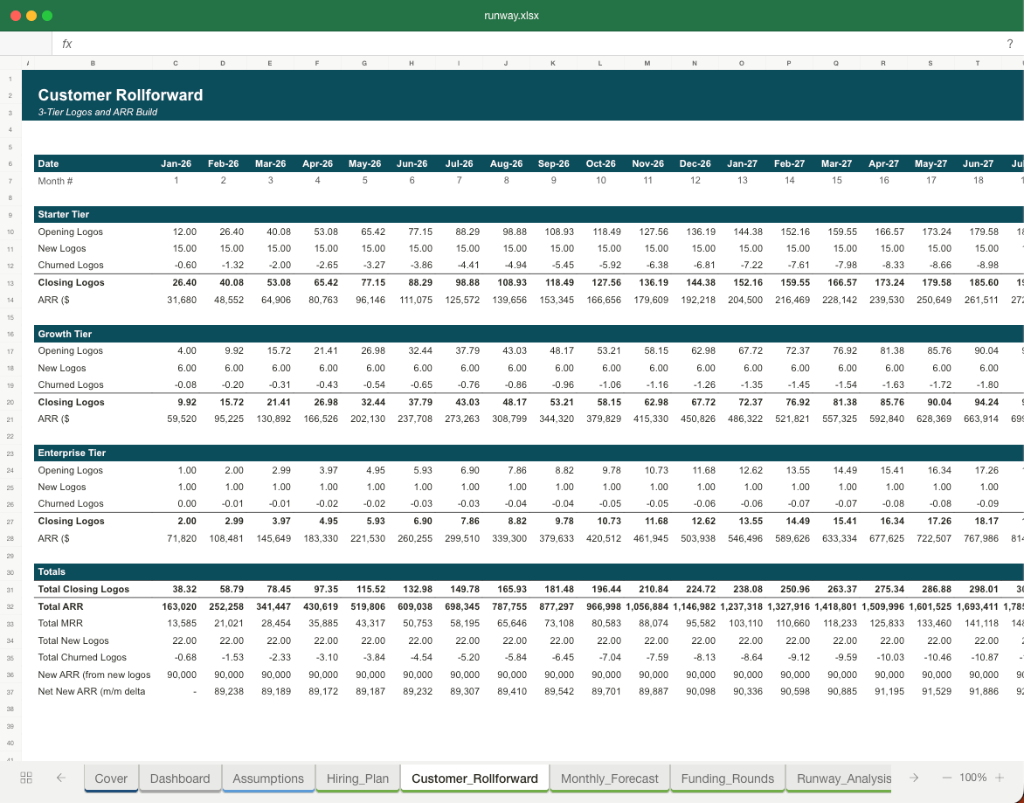
The model forecasts packs sold, price, repeat rate, DTC versus retail mix, ingredient and co-manufacturing cost, and CAC. It includes wholesale margins, inventory, trade spend, fulfilment, marketing, working capital, gross margin, cash burn, and runway.
A turnkey financial model
Live formulas, no hardcoded values
Outputs are driven by live formulas, so the workbook updates from its assumptions instead of relying on hardcoded results.
All assumptions in one tab
Inputs are clearly marked in the Assumptions tab and separated from calculations, making it clear what to change and what to leave intact.
Statements always balancing
For integrated-statement models, the balance sheet, cash flow, and supporting schedules tie through properly.
Distinct schedules for clarity
Debt, working capital, taxes, and cash flow can get messy quickly. We group calculations in clear schedules, not across disconnected tabs.
No hidden macros or external links
There are no unexplained external workbook links or macros to undermine auditability or portability.
Changes flow through the model
Update a key driver and see the impact carry through the forecast, financing, and return outputs. We never use hardcoded numbers in formulas.
About Nui Cookies
eatnui.com
How to build a detailed financial model for Nui Cookies
A complete walkthrough of the business, drivers, and assumptions behind the downloadable Nui Cookies model - distilled from its pitch deck and publicly available information.
Product & value proposition
- Core SKUs (8 slides confirm 6 flavors):
- Chocolate Chip Cookie - 1g sugar, 3g net carbs, 56g / 2 cookies
- Double Chocolate Cookie - 1g sugar, 3g net carbs, 56g / 2 cookies
- Peanut Butter Cookie - 2g sugar, 4g net carbs, 56g / 2 cookies
- Snickerdoodle Cookie - 1g sugar, 2g net carbs
- Birthday Cake Cookie - 1g sugar, 2g net carbs
- Ginger [flavour] Cookie - 1g sugar, 2g net carbs
- Key attributes: Non-GMO, gluten-free, keto-friendly, almond flour base, monk fruit sweetener, grass-fed butter, MCT oil, coconut flour
- Pack format: 2-cookie grab-and-go pack, 56g net weight
- Positioning: "The Nabisco for low sugar, low carb INDULGENT snacks"
- Press: SHAPE Magazine, Elite Daily
Market
Context only (not from deck): operates in better-for-you/keto snack segment, riding US obesity/diabetes narrative stated in problem slide.
Revenue model
- Channels: DTC via eatnui.com (confirmed by URL in Instagram bio); retail channel implied by "Nabisco" ambition but no specific retail partners named.
- Unit format: 2-cookie pack, 56g. Price per pack not stated in deck.
- No subscription, wholesale pricing, or margin data disclosed.
Traction & metrics
- Instagram followers: 99.3K
- Instagram posts: 665
- Instagram following: 555
- Featured on Shark Tank
- Press placements: SHAPE Magazine, Elite Daily
- No revenue, units sold, AOV, repeat purchase rate, or retail door count disclosed.
Competition / moat
- No explicit competitive analysis slide.
- Implied moat: taste ("indulgent" positioning distinguishing from protein bars / sugar-laden "better-for-you" snacks), community/brand (99.3K Instagram followers, Shark Tank exposure), clean ingredient formulation (monk fruit, almond flour, non-GMO).
- Aspirational competitive frame: "Nabisco for low sugar, low carb indulgent snacks".
Team & funding ask / use of funds
Team:
- Kristoffer Quiaoit, CEO - Founder of Bright Brain Learning LLC; business development, sales strategy, management.
- Victor Macias, President - Founder of Male Standard; digital media, content marketing, SEO; brand collaborations with GMC, Unilever, Gillette.
- Valerie Bui, Marketing & Brand Partnerships - Registered Dietitian Nutritionist (MBA); digital marketing, agency management, market research (Dine Brands, Kellogg's).
Recommended financial model
- Archetype + why: DTC + Retail CPG P&L model. Revenue is unit-volume driven (SKU × pack price × volume); margin story turns on COGS (ingredients, co-manufacturing, packaging) and channel mix (DTC carries higher gross margin vs. wholesale/retail). This is a product company, not SaaS or marketplace - a 3-statement operating model with channel-split revenue build is most appropriate.
- Forecast horizon & granularity: 3 years monthly (Year 1–2) then quarterly (Year 3). Monthly granularity needed to model inventory build, seasonal demand spikes (holiday), and DTC ad-spend cadence.
- Key drivers & assumptions:
| Driver | Value / Source |
|---|---|
| SKUs in market | 6 cookie variants |
| Pack size / format | 56g, 2-cookie pack |
| DTC average order value | ~$30–35 (typical keto DTC multi-pack bundle); needs validation |
| DTC order frequency (repeats/yr) | 4–6x/yr for loyal keto consumer; no data in deck |
| DTC channel gross margin | ~55–65%; almond flour / monk fruit ingredients are premium cost inputs |
| Retail gross margin | ~35–45% after trade spend and wholesale discount |
| Channel mix (DTC vs retail) | ~70/30 at current stage, shifting toward 50/50 as retail scales |
| Instagram follower base | 99.3K - used as seed for DTC traffic/conversion modelling |
| Instagram → DTC conversion | 1–3% of followers convert in Year 1; sensitivity driver |
| COGS % of revenue | ~38–45%; premium ingredients + co-man overhead |
| Customer acquisition cost (DTC) | $15–25 via paid social; no data in deck |
| Retail door count ramp | not modelled at launch; scale assumption to be added once retail partners confirmed |
| Headcount / opex | lean 3-person founding team; minimal fixed opex in early years |
- Scenarios (Base / Bull / Bear):
- Base: DTC grows via community + paid social; modest retail entry by Year 2; gross margin ~55% DTC blended.
- Bull: Shark Tank-driven traffic spike converts to sustained DTC volume; retail at 500+ doors by Year 2; AOV lifts on bundle offers.
- Bear: High CAC erodes DTC margin; retail channel slow to open; ingredient cost inflation compresses gross margin to <40%.
- Flex variables: DTC conversion rate, CAC, retail door count, ingredient cost, AOV.
- Required sheets / outputs:
- Assumptions dashboard (all drivers centralized)
- Revenue build - DTC (traffic × conversion × AOV × repeat rate) and Retail (doors × velocity × wholesale price)
- COGS build - ingredient cost per unit, co-manufacturing fee, packaging
- P&L (Gross Profit → EBITDA)
- Marketing & headcount opex schedule
- Cash flow / runway (given early-stage burn)
- Scenario toggle (Base / Bull / Bear on key drivers)
Frequently asked
Is the Nui Cookies financial model free?+
Yes. The Nui Cookies model is a free Excel (.xlsx) download with live formulas. Sign up with your email and the workbook is yours to keep, review, and edit.
What's included in the model?+
A 5-year monthly forecast with P&L, cash flow and runway, valuation (exit multiple plus a DCF cross-check), MOIC/IRR returns, and unit economics, with live formulas throughout.
How was this model built?+
It was built from Nui Cookies's pitch deck and publicly available information, then structured to investment-banking standards as a fully editable Excel model.
Can I change the assumptions?+
Yes. You can change assumptions and the live formulas will recalculate in the downloadable Excel model.
Have more financial modelling questions? Contact us

Created by ex-finance professionals
Hey, I’m Alex and I created Finamodel.
Over my years in the finance industry I kept building the same models over and over again. Same structure, same assumptions, different logo. So I started building frameworks to turn them into clean, reusable templates.
Every model here is one I’d actually use for a client, and I personally vet each one before it goes up.
I’m not an expert in every industry, but I’ve built enough models to know what belongs in one. And when something is completely foreign to me, I reach out to my network for experts to work on our models with us.
Having a template library on hand cuts a first build from hours to minutes.
Need help finding your model? You’ll find me in the Finamodel app!
Other Health-tech Startup Financial Models
Browse another startup in the same category.
98point6
B2B SaaS platform licensing an AI-powered virtual care technology stack to health systems, pivoted from running a direct-to-employer virtual clinic.
A-Champs
IoT-powered gamified training device (ROXs PRO) for sports/health professionals, evolving into a B2C smart coach app for families.

AccuRx
Patient-centred communication platform connecting everyone involved in a patient's care, starting with near-universal penetration in UK GP practices.

Aeris
Swiss-made premium air purifiers sold through DTC, retail, and dealer channels, with a recurring filter consumable attached to a connected mobile app.

Akido Labs
Akido Labs is a data-driven prevention platform that integrates siloed healthcare, municipal, and non-profit data to enable proactive outreach and case management for vulnerable populations (homeless, chronically ill, etc.).

Alloy
Telehealth + DTC subscription platform delivering menopause hormonal treatment (MHT) and holistic care to U.S. women 40+.

Astek Diagnostics
Point-of-care diagnostic device (Jiddu system) that confirms bacterial infections and antibiotic sensitivity in ~1 hour across four body fluid types (urine, CSF, effluent, blood).

Atom Limbs
Atom Limbs is building the first AI-powered, neural-controlled prosthetic arm sold direct-to-consumer on a subscription model.