 OpenTest (Loom) Financial Model
Enterprise/Security Startup Financials (Free Excel Download)
Async video communication platform for business teams (internal knowledge-sharing + external customer feedback)



professionals from Deloitte
Used by professionals from






About this model
OpenTest, later associated with Loom, is an asynchronous video-communication platform for business teams. It supports internal knowledge sharing and external customer feedback by making recorded video a lightweight alternative to meetings and long written updates.
The product uses a freemium, seat-based B2B model, with a $10 per-seat monthly paid anchor cited in the materials. Free users help spread adoption within teams, while enterprise collaboration needs create a route to larger paid deployments.
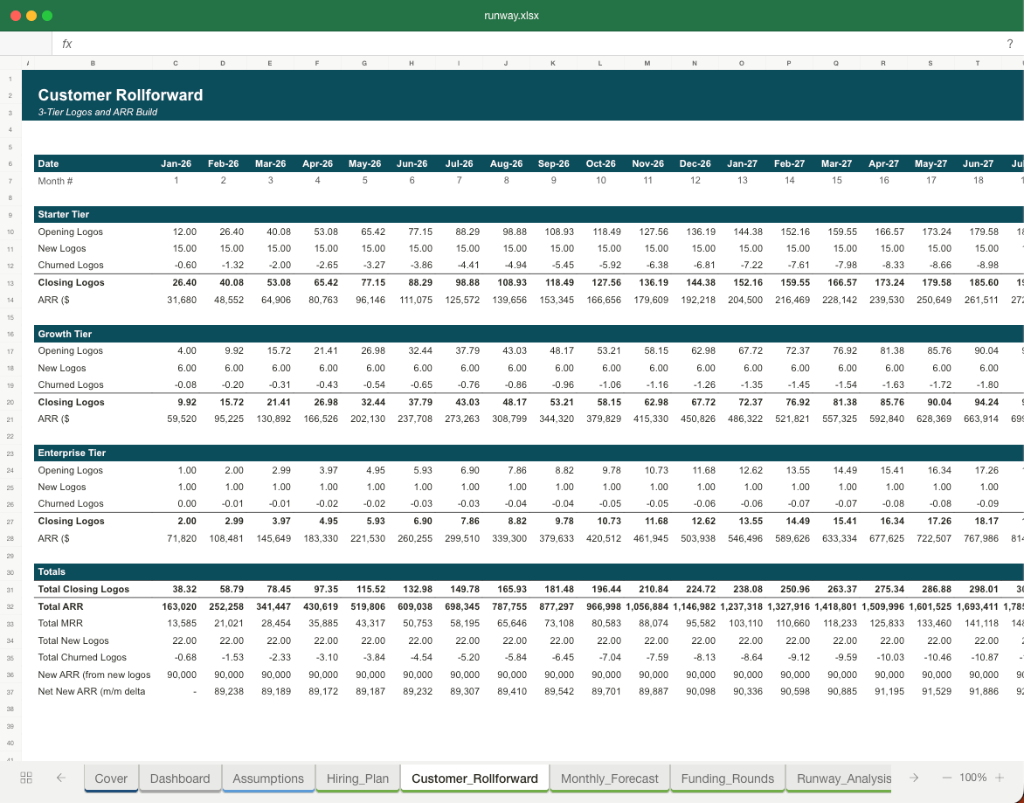
The model follows free users through activation, conversion, paid seats, expansion, and churn. It includes video-hosting costs, gross margin, viral acquisition, conversion efficiency, sales assistance, customer support, product hiring, and the resulting ARR and cash runway.
A turnkey financial model
Live formulas, no hardcoded values
Outputs are driven by live formulas, so the workbook updates from its assumptions instead of relying on hardcoded results.
All assumptions in one tab
Inputs are clearly marked in the Assumptions tab and separated from calculations, making it clear what to change and what to leave intact.
Statements always balancing
For integrated-statement models, the balance sheet, cash flow, and supporting schedules tie through properly.
Distinct schedules for clarity
Debt, working capital, taxes, and cash flow can get messy quickly. We group calculations in clear schedules, not across disconnected tabs.
No hidden macros or external links
There are no unexplained external workbook links or macros to undermine auditability or portability.
Changes flow through the model
Update a key driver and see the impact carry through the forecast, financing, and return outputs. We never use hardcoded numbers in formulas.
About OpenTest (Loom)
loom.com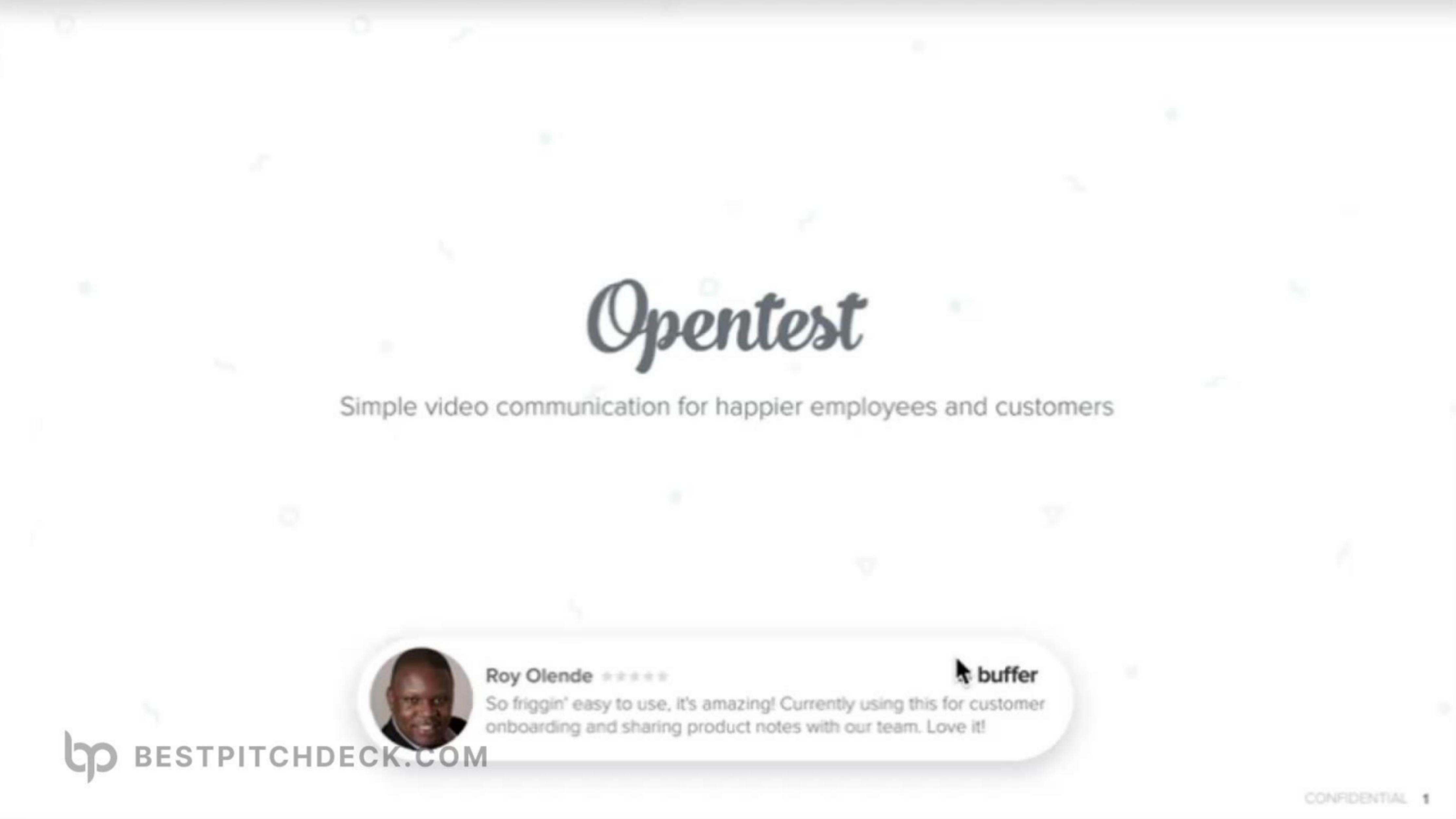
How to build a detailed financial model for OpenTest (Loom)
A complete walkthrough of the business, drivers, and assumptions behind the downloadable OpenTest (Loom) model - distilled from its pitch deck and publicly available information.
Product & value proposition
- Chrome-based screen + webcam recorder; instant shareable link
- Three-phase roadmap: (1) internal team knowledge-sharing video → (2) customer video feedback loop → (3) AI/ML insights from video metadata (sentiment analysis, audio search, eye tracking, behavioral analysis)
- Positioned as a "video CMS" bridging employee↔employee and employee↔customer async communication
- Consumer tier is a referral funnel to drive enterprise/team sign-ups
- White-label integration roadmap with chat/email providers (Intercom, Front)
Market
- TAM: $106B SaaS software market
- SAM: $21B Enterprise Video Market
- SAM growth: Enterprise video workplace market $20.9B (2016) → $36.8B (2020), implying ~15% CAGR
- Video usage within orgs growing 50–200% annually
- 90% of surveyed respondents agree video in org tools improves knowledge sharing
Revenue model
- Freemium: Consumer tier $0/user - unlimited recording, unlimited storage, limited features; acts as top-of-funnel
- Paid: Enterprise tier $10/seat/month - full feature set (collaboration, video CRM, integrations, analytics)
- Expansion revenue: a la carte add-ons planned (transcription, editing, sentiment analysis, video bookmarks)
- Channel: PLG (product-led growth) - free users generate organic team spread; referral gate on desktop recording upgrade
- White-label licensing to chat/email platforms: future revenue stream, not yet active
Traction & metrics
- Launched 3 months before deck date
- 14,550+ total employees (users) across customer orgs
- 1,210+ hours of recording time logged; avg video length 1m 40s
- 57% of users returned to record 2 or more videos (repeat usage / activation proxy)
- Organic team spread: Vidyard 40 members, Uber 14 members, Zuora 13 members, Salesforce 7 members
- Notable customer logos: Uber, Salesforce, Mixpanel, Zendesk, Airbnb, Zuora, Yelp, Houzz, Intercom, HubSpot, Campaign Monitor, Disney
Unit economics
- Note: Deck implies PLG / viral loop reduces paid CAC (referral gate drives organic team expansion) but no data provided
Competition / moat
- Competitive positioning: 2x2 matrix - ease-of-use (x-axis) vs. consumer↔enterprise (y-axis)
- Opentest positioned as: high ease-of-use + enterprise-grade (upper-right quadrant)
- Named competitors: Kaltura, CloudApp, HYFY, Screencastify, Jing, Quicktime, Screencast-O-Matic, Recordit, Crankwheel
- Moat levers stated: (1) referral/viral distribution, (2) proprietary video metadata dataset → ML insights, (3) integrations with existing communication platforms
Team & funding ask / use of funds
- Joe Thomas (CEO & Head of Product): Founded Redesign Agency ($0→$200k Y1); Director of Ops MediaPass (650% impression/profit growth); Director of Product MyLife ($27M raised, $0→$600k MRR)
- Shahed Khan (Head of Design & Sales): Bootstrapped TaskRabbit-like startup at 16 (0→12k Chicago users in 10 weeks); Product Designer Weebly (employee #49); Analyst Upfront Ventures
- Vinay Hiremath (Head of Technology): Intern Facebook (1.5% mobile web engagement lift); Engineer Backplane; Engineer Lead Upthere ($77M raised, video storage/streaming infra)
Recommended financial model
- Archetype + why: B2B SaaS seat-based ARR model with freemium funnel. Seat-based pricing at $10/seat/month is a classic bottom-up SaaS motion; the free consumer tier drives team-level viral spread, so the model needs a free→paid conversion layer on top of a seat expansion model. Not a marketplace or transactional model.
- Forecast horizon & granularity: 3 years (2016–2018), monthly for Year 1 (given early stage and rapid growth), quarterly for Years 2–3.
- Key drivers & assumptions:
| Driver | Value / Assumption |
|---|---|
| Launch date | ~mid-2016 |
| Total free users at deck date | 14,550 |
| Average video length | 1m 40s |
| Repeat usage rate (activated users) | 57% |
| Enterprise price per seat/month | $10 |
| Monthly free user growth rate (Y1) | 30% MoM |
| Monthly free user growth rate (Y2–3) | 10–15% MoM tapering to 5% |
| Free-to-paid seat conversion rate | 5% of free users convert to paid seats |
| Avg seats per paying team | 10 seats |
| Monthly churn (paid seats) | 2% |
| Gross margin | 70% |
| S&M as % of revenue | 30% |
| R&D as % of revenue | 35% |
| G&A as % of revenue | 15% |
| A la carte add-on ARPU uplift | 0% in model base (toggle on in Bull) |
- Scenarios (Base / Bull / Bear - which variables flex):
- Base: 30% MoM free user growth tapering; 5% paid conversion; $10 ARPU; 2% churn
- Bull: Faster viral loop (40% MoM Y1); 8% paid conversion; white-label/integration revenue activates in Year 2; add-on ARPU +$3/seat
- Bear: Slower organic growth (15% MoM); 3% conversion; 3.5% monthly churn (enterprise harder to land than expected); monetization delayed 2 quarters
- Required sheets / outputs:
- Assumptions - all drivers, clearly labeled vs
- Free User Funnel - total registered users, MoM growth, activated users (57% cohort)
- Paid Seats model - free→paid conversion, avg team size, seat expansion, churn waterfall
- Revenue - MRR and ARR build (seat revenue + add-on toggle)
- P&L - Gross profit, S&M, R&D, G&A, EBITDA, net loss
- Cash / Runway - burn rate, implied months of runway (funding raise assumed as input)
- KPI Summary - MRR, ARR, total users, paid seats, MoM growth, net churn, LTV/CAC (once CAC data available)
- Scenario toggle - Base / Bull / Bear switchable via dropdown
Frequently asked
Is the OpenTest (Loom) financial model free?+
Yes. The OpenTest (Loom) model is a free Excel (.xlsx) download with live formulas. Sign up with your email and the workbook is yours to keep, review, and edit.
What's included in the model?+
A 5-year monthly forecast with P&L, cash flow and runway, valuation (exit multiple plus a DCF cross-check), MOIC/IRR returns, and unit economics, with live formulas throughout.
How was this model built?+
It was built from OpenTest (Loom)'s pitch deck and publicly available information, then structured to investment-banking standards as a fully editable Excel model.
Can I change the assumptions?+
Yes. You can change assumptions and the live formulas will recalculate in the downloadable Excel model.
Have more financial modelling questions? Contact us

Created by ex-finance professionals
Hey, I’m Alex and I created Finamodel.
Over my years in the finance industry I kept building the same models over and over again. Same structure, same assumptions, different logo. So I started building frameworks to turn them into clean, reusable templates.
Every model here is one I’d actually use for a client, and I personally vet each one before it goes up.
I’m not an expert in every industry, but I’ve built enough models to know what belongs in one. And when something is completely foreign to me, I reach out to my network for experts to work on our models with us.
Having a template library on hand cuts a first build from hours to minutes.
Need help finding your model? You’ll find me in the Finamodel app!
Other Enterprise/Security Startup Financial Models
Browse another startup in the same category.
AgBiome
AgBiome is a microbial-platform agtech company that discovers, develops, and commercialises biological crop protection products (and licences the platform across adjacent markets).

Alation
Enterprise data intelligence platform - data catalog, governance, and metadata management for large organisations.

Archer SPAC
Archera
Cloud resource automation platform that continuously optimizes AWS commitment purchases, de-risks overcommitment, and automates FinOps workflows.

Ardoq
Cloud-native Enterprise Architecture (EA) SaaS platform that helps large enterprises navigate digital transformation through automated data collection, graph-based architecture modelling, and change impact analysis.

Ascend
Ascend.io is an enterprise big data automation platform ("Enterprise Intelligence Platform") that abstracts away the complexity of big data engineering so non-experts can build and run data pipelines.

Athennian
Cloud-based legal entity management system (EMS) uniting entity data with workflow and document automation.

Auditboard
Cloud-based integrated risk management platform connecting audit, risk, compliance, and ESG teams across the enterprise.