OVOsso VR Financial Model
Health-tech Startup Financials (Free Excel Download)
VR-based surgical training and objective assessment platform for surgeons and medical device companies.



professionals from Deloitte
Used by professionals from






About this model
Osso VR provides virtual-reality surgical training and objective assessment for surgeons and medical-device companies. Its platform gives clinicians immersive practice and performance feedback, while device companies can use specialised content to support training around their products and procedures.
Medical-device firms and hospital or residency programmes create separate enterprise customer segments. Revenue can expand through content modules, trainees, procedure libraries, and deployments across institutions, while implementation and training adoption influence renewal and customer success.
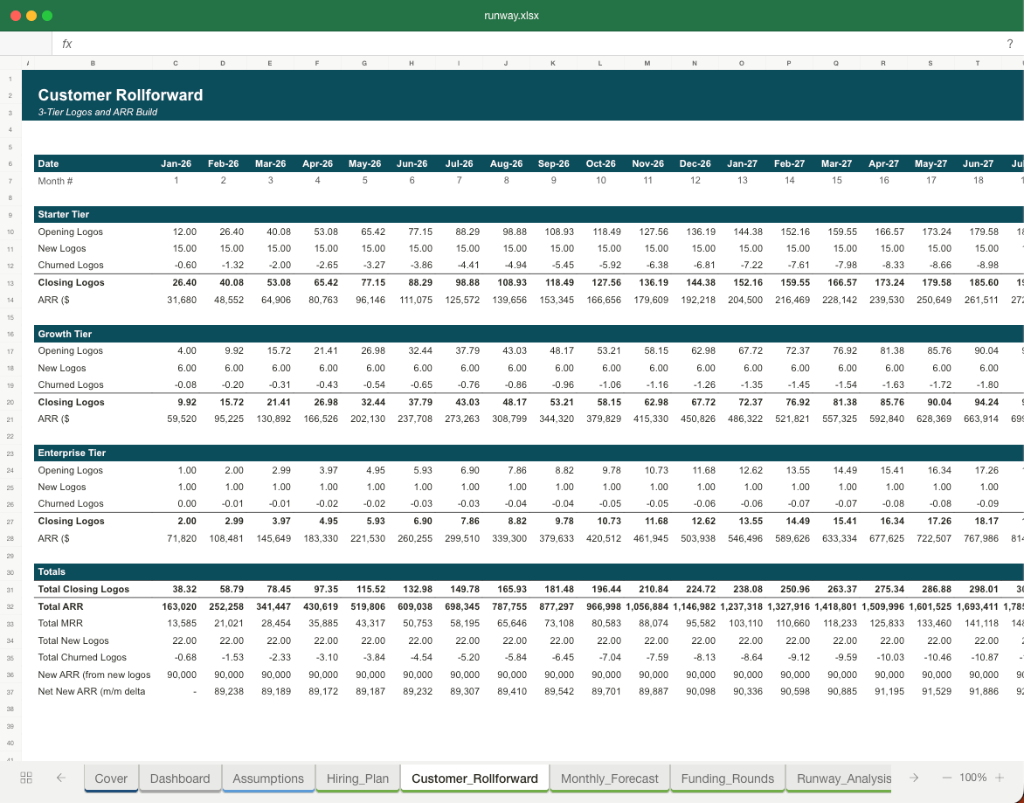
The model forecasts OEM contracts, institutional licences, content modules, trainees, implementation, renewal, and platform-delivery cost. It includes content production, hardware or VR support, enterprise sales, customer success, gross margin, product investment, cash burn, and runway.
A turnkey financial model
Live formulas, no hardcoded values
Outputs are driven by live formulas, so the workbook updates from its assumptions instead of relying on hardcoded results.
All assumptions in one tab
Inputs are clearly marked in the Assumptions tab and separated from calculations, making it clear what to change and what to leave intact.
Statements always balancing
For integrated-statement models, the balance sheet, cash flow, and supporting schedules tie through properly.
Distinct schedules for clarity
Debt, working capital, taxes, and cash flow can get messy quickly. We group calculations in clear schedules, not across disconnected tabs.
No hidden macros or external links
There are no unexplained external workbook links or macros to undermine auditability or portability.
Changes flow through the model
Update a key driver and see the impact carry through the forecast, financing, and return outputs. We never use hardcoded numbers in formulas.
About Osso VR
How to build a detailed financial model for Osso VR
A complete walkthrough of the business, drivers, and assumptions behind the downloadable Osso VR model - distilled from its pitch deck and publicly available information.
Product & value proposition
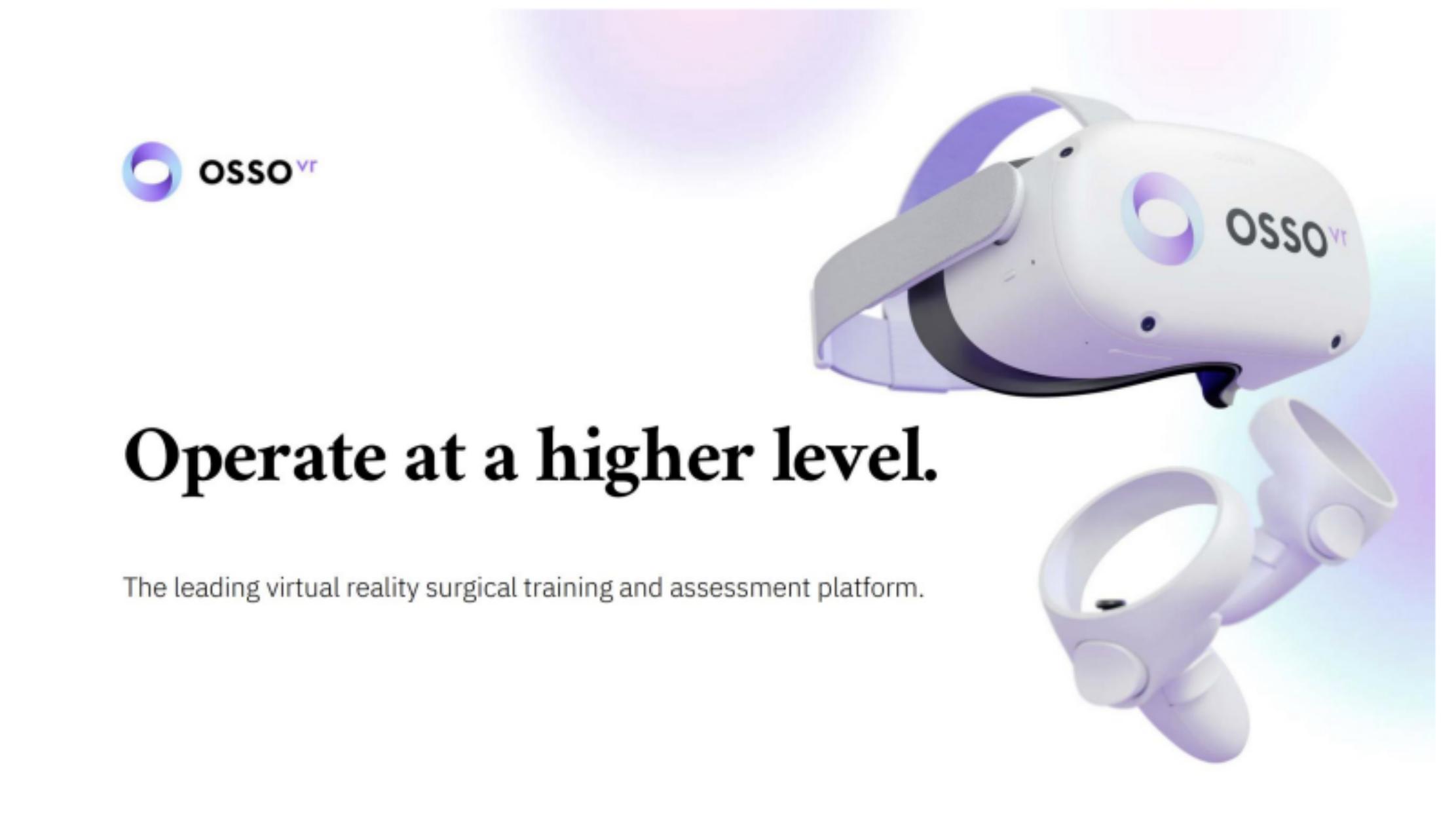
- VR headset-based surgical training platform (appears to use Oculus/Meta Quest hardware, branded as Osso VR).
- Three core differentiators: hands-on simulation, collaborative multi-user training, and objective performance assessment via scored proficiency ratings.
- Replaces or augments traditional education journey (product demo → cadaver lab → first case) with pre-training, qualification, refresher training, and team training touchpoints using VR.
- Medical device company use case: VR-enabled sales training - surgeons pre-trained on a device before cadaver lab, improving adoption and shortening the sales cycle.
Market
- 1.1 million surgeons globally.
- 310 million major surgeries per year.
- $8.3 trillion global cost of healthcare - used as a broad context stat, not a directly addressable market figure.
Revenue model
- Revenue streams implied but not explicitly priced in the deck:
- Medical device company channel: device companies pay for VR training content/platform to train surgeons on their products (sales enablement + adoption use case).
- Hospital/residency program channel: institutions pay for surgical training access.
- Hardware (headset) economics: not addressed - unclear if hardware is sold, leased, or provided by customers.
Traction & metrics
- 20+ hospital & residency programs.
- 12+ medical device companies.
- Named medical device partners: Smith & Nephew, Stryker, Medtronic, Johnson & Johnson, Endologix, Zimmer Biomet.
- Named hospital/academic partners: Rush University Medical Center, Johns Hopkins University, Hospital for Special Surgery.
- Clinical evidence:
- Tibial shaft fixation RCT (N=20): Osso VR training 230% better performance scores vs. standard training; VR group 78% procedural completion vs. PDF group 25% (300% improvement) - published in *Journal of Surgical Education* Feb 2020 and *Clin Orthop Relat Res* (2020) 478:1-8.
- Unicondylar knee arthroplasty (N=20): Osso VR total score 33 vs. PDF 27 (max 36); procedure time 26.73 min vs. 35.45 min; redirects 3 vs. 9; training time 38.82 min vs. 50 min.
Competition / moat
- No explicit competitive slide.
- Implied moat: peer-reviewed clinical evidence of efficacy (published RCTs); existing relationships with top-6 medical device OEMs and elite hospital/academic programs; objective assessment data layer (proficiency scoring) is defensible as a proprietary dataset over time.
- Traditional training methods (cadaver labs, PDF/didactic instruction) are the de facto alternative - no named VR competitors called out.
Team & funding ask / use of funds
Recommended financial model
- Archetype + why: Dual-revenue B2B SaaS / platform model.
- Revenue stream 1: Medical device company subscriptions/contracts (platform access + content modules per procedure/device). This is likely the primary and higher-value stream - OEMs are well-funded and have strong ROI incentive (faster surgeon adoption = more implant revenue).
- Revenue stream 2: Hospital/residency program subscriptions (seat-based or institution-based). Lower ACV but demonstrates clinical validation and drives surgeon familiarity.
- Model type: ARR-build with two cohorted customer segments, not a usage-based or transactional model given the B2B institutional nature.
- Forecast horizon & granularity: 5-year annual model (Years 1–5), with Year 1 broken into quarterly detail. Given early commercial stage implied by the partner count (12+ OEMs, 20+ hospitals), monthly granularity for Year 1 is useful for cash planning.
- Key drivers & assumptions:
- Medical device company customers:
- Starting customers: 12
- New logos per year: 4–8/year; rationale: early land-and-expand with top-6 majors already signed, mid-tier OEMs are the next wave
- ACV per OEM: $150K–$500K/year; rationale: OEM training budgets are large; comparable medtech SaaS platforms price in this range
- Expansion/upsell rate: 20% NRR uplift as OEMs add procedure modules; rationale: multi-procedure expansion is the natural motion once platform is deployed
- Gross churn: 5–10% annually; rationale: sticky once integrated into sales training workflow
- Hospital/residency program customers:
- Starting customers: 20
- New logos per year: 10–20/year; rationale: large addressable base, but longer sales cycles and smaller budgets
- ACV per institution: $20K–$75K/year; rationale: hospital tech budgets are constrained; per-seat pricing typical
- Gross churn: 10–15%; rationale: budget sensitivity in hospital systems
- Gross margin: 70–80%; rationale: software-heavy with content creation costs; hardware is customer-owned (Oculus Quest)
- Content development cost: $50K–$150K per procedure module; rationale: medical-grade VR content is expensive to build and validate
- S&M as % of revenue: 30–40% in early years declining to 20–25%; rationale: B2B enterprise sales motion with specialist reps
- R&D as % of revenue: 20–30%; rationale: ongoing platform and content investment
- G&A: 10–15% of revenue
- Scenarios (Base / Bull / Bear - which variables flex):
- Base: OEM adds 6/year, hospital adds 12/year, OEM ACV $250K, hospital ACV $40K, 75% gross margin
- Bull: OEM adds 10/year (international expansion, smaller OEMs), upsell kicks in faster (30% NRR), ACV rises as platform matures
- Bear: OEM sales cycle lengthens (regulatory/procurement), hospital budgets cut, content development costs exceed plan, hardware dependency on Meta creates distribution risk
- Required sheets / outputs:
- Assumptions dashboard (all drivers in one place, scenario toggle)
- Revenue build - OEM segment (logos × ACV × expansion)
- Revenue build - Hospital segment (logos × ACV)
- P&L (Revenue, COGS, Gross Profit, S&M, R&D, G&A, EBITDA)
- Headcount plan (sales reps, content/R&D, G&A)
- Cash / runway (if funding ask is added)
- KPI summary (ARR, logo count by segment, NRR, CAC, LTV, LTV:CAC)
Frequently asked
Is the Osso VR financial model free?+
Yes. The Osso VR model is a free Excel (.xlsx) download with live formulas. Sign up with your email and the workbook is yours to keep, review, and edit.
What's included in the model?+
A 5-year monthly forecast with P&L, cash flow and runway, valuation (exit multiple plus a DCF cross-check), MOIC/IRR returns, and unit economics, with live formulas throughout.
How was this model built?+
It was built from Osso VR's pitch deck and publicly available information, then structured to investment-banking standards as a fully editable Excel model.
Can I change the assumptions?+
Yes. You can change assumptions and the live formulas will recalculate in the downloadable Excel model.
Have more financial modelling questions? Contact us

Created by ex-finance professionals
Hey, I’m Alex and I created Finamodel.
Over my years in the finance industry I kept building the same models over and over again. Same structure, same assumptions, different logo. So I started building frameworks to turn them into clean, reusable templates.
Every model here is one I’d actually use for a client, and I personally vet each one before it goes up.
I’m not an expert in every industry, but I’ve built enough models to know what belongs in one. And when something is completely foreign to me, I reach out to my network for experts to work on our models with us.
Having a template library on hand cuts a first build from hours to minutes.
Need help finding your model? You’ll find me in the Finamodel app!
Other Health-tech Startup Financial Models
Browse another startup in the same category.
98point6
B2B SaaS platform licensing an AI-powered virtual care technology stack to health systems, pivoted from running a direct-to-employer virtual clinic.
A-Champs
IoT-powered gamified training device (ROXs PRO) for sports/health professionals, evolving into a B2C smart coach app for families.

AccuRx
Patient-centred communication platform connecting everyone involved in a patient's care, starting with near-universal penetration in UK GP practices.

Aeris
Swiss-made premium air purifiers sold through DTC, retail, and dealer channels, with a recurring filter consumable attached to a connected mobile app.

Akido Labs
Akido Labs is a data-driven prevention platform that integrates siloed healthcare, municipal, and non-profit data to enable proactive outreach and case management for vulnerable populations (homeless, chronically ill, etc.).

Alloy
Telehealth + DTC subscription platform delivering menopause hormonal treatment (MHT) and holistic care to U.S. women 40+.

Astek Diagnostics
Point-of-care diagnostic device (Jiddu system) that confirms bacterial infections and antibiotic sensitivity in ~1 hour across four body fluid types (urine, CSF, effluent, blood).

Atom Limbs
Atom Limbs is building the first AI-powered, neural-controlled prosthetic arm sold direct-to-consumer on a subscription model.