 Pathrise Financial Model
Health-tech Startup Financials (Free Excel Download)
Online job-search coaching program for early-career candidates, paid via income share after placement



professionals from Deloitte
Used by professionals from






About this model
Pathrise is online job-search coaching for early-career candidates, paid through an income-share agreement after placement. It offers coaching and support to candidates seeking employment, making revenue contingent on a cohort's ability to obtain qualifying jobs rather than upfront tuition.
Its documented economics are 9% of first-year income, about $9,000 per fellow, with payment triggered only after employment. The business therefore depends on applicant quality, enrolment, coaching capacity, placement rate, salary outcomes, collection timing, and repayment risk.
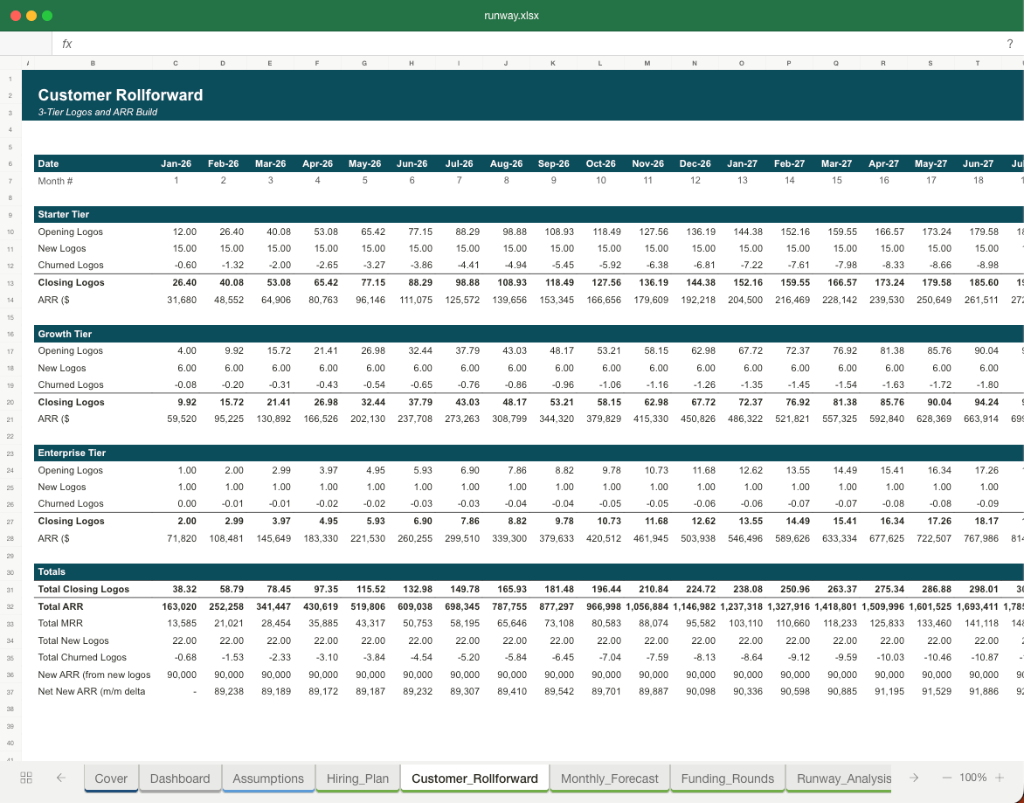
The model tracks applicant cohorts, enrolment, placement rate, salary, ISA collections, repayment timing, coaching cost, and defaults. It includes marketing acquisition, staff capacity, cash-flow lag, gross margin, financing needs, operating burn, and runway.
A turnkey financial model
Live formulas, no hardcoded values
Outputs are driven by live formulas, so the workbook updates from its assumptions instead of relying on hardcoded results.
All assumptions in one tab
Inputs are clearly marked in the Assumptions tab and separated from calculations, making it clear what to change and what to leave intact.
Statements always balancing
For integrated-statement models, the balance sheet, cash flow, and supporting schedules tie through properly.
Distinct schedules for clarity
Debt, working capital, taxes, and cash flow can get messy quickly. We group calculations in clear schedules, not across disconnected tabs.
No hidden macros or external links
There are no unexplained external workbook links or macros to undermine auditability or portability.
Changes flow through the model
Update a key driver and see the impact carry through the forecast, financing, and return outputs. We never use hardcoded numbers in formulas.
About Pathrise
pathrise.com
How to build a detailed financial model for Pathrise
A complete walkthrough of the business, drivers, and assumptions behind the downloadable Pathrise model - distilled from its pitch deck and publicly available information.
Product & value proposition
Online coaching program ("fellows" / "risers") lasting 3–4 months on average:
- Weekly live video sessions with advisors
- Focused on optimising the job search process (resume, networking, interview), not technical upskilling
- $0 upfront cost; fellows pay only after getting hired
- Network effect moat: each placed fellow builds P2P community, provides proprietary hiring-process data, drives referral acquisition, and can return as future hiring manager or advisor
- Placement outcomes at Facebook, Google, Amazon, Microsoft, Uber, Salesforce, Atlassian, etc.
Market
Bottom-up TAM calculation:
- 3.2M new graduates (annual)
- 1.4M white-collar workers in early 20s looking to switch jobs
- TAM assumes $50k salary × 9% ISA = $4,500 revenue per person at market floor
- Note: deck states current average placed salary is 2× $50k = ~$100k → implies actual revenue per placed fellow of ~$9,000 (confirmed in slide 5)
- Stated TAM: $20.7B
Revenue model
- Model: Income Share Agreement (ISA)
- Rate: 9% of first year's income
- Trigger: Paid only after placement; $0 upfront
- Revenue per fellow: $9,000 - implies average placed salary of ~$100k
- Placement rate: 94% hired within 9 months
- Program length: 3–4 months on average
- Revenue is recognised when the fellow starts employment and begins paying; typical ISA structures spread payments over 12 months (exact collection schedule not in deck)
- Acquisition channels: organic/brand, referrals from placed alumni, waitlist (1,000+ prospects)
Traction & metrics
- 421 fellows placed (cumulative to ~Jan 2019)
- $9,000 revenue per placed fellow
- 94% placement rate within 9 months
- 1,000+ fellows enrolled (cumulative)
- 10%+ MoM enrollment growth rate
- Waitlist of 1,000+ prospects
- Revenue per month chart: consistent upward trend May 2018 → Jan 2019; Jan 2019 bar is clearly the highest - exact $ values per bar not labelled on chart axes
- Enrollment per month chart: Jan 2018 → Jan 2019 upward trend; June, July, December enrollment paused
Unit economics
- Revenue per fellow placed: $9,000
Competition / moat
- Proprietary data on employer hiring processes
- P2P alumni community
- Brand and referral flywheel
- Alumni become hiring managers who hire current fellows
- Alumni return as advisors
Team & funding ask / use of funds
- CEO: Kevin Wu (prior: Yelp)
- CTO: Derrick Mar (prior: Facebook)
- Ask: $3M
- Use of funds:
- Fill unmet demand by hiring advisors faster
- Further develop software and data advantage
Recommended financial model
Archetype + why: ISA / cohort-based revenue model (variant of deferred-revenue EdTech). Revenue is not SaaS-recurring; it is cohort-driven - fellows enroll, complete 3–4 months of program, get placed, then pay over ~12 months. The right model tracks cohorts through enrollment → active → placed → revenue-collecting stages. Closest archetype is a cohort P&L with a deferred ISA receivable waterfall.
Forecast horizon & granularity: Monthly, Jan 2019 – Dec 2021 (3 years). Year 1 anchored to deck projections; years 2–3 scenario-driven.
Key drivers & assumptions:
| Driver | Value | Source |
|---|---|---|
| Monthly new enrollments (Jan 2019) | ~150–200/month (read from chart shape) | - |
| MoM enrollment growth rate | 10% | ; Base case uses 5% (half-rate per deck's own projection) |
| Program duration (enrollment → placement) | 3–4 months | ; use 3.5-month average |
| Placement rate | 94% | - |
| Average placed salary | ~$100k (2× $50k floor) | - |
| ISA rate | 9% | - |
| Revenue per placed fellow | $9,000 | - |
| ISA collection period | 12 months post-hire | standard ISA structure; not stated in deck |
| Advisor headcount cost | primary opex driver; $80k–$120k/year per advisor; 1 advisor per 20–30 active fellows | rationale: use of funds says "hire advisors faster" |
| Advisor:fellow ratio | 1:25 | industry proxy |
| Tech & overhead | $500k/year fixed, scaling 15% annually | two-person team currently; $3M raise funds this |
| CAC (marketing cost per enrolled fellow) | $200–$500 | organic/referral heavy at this stage, low CAC likely |
| Churn / dropout before placement | 6% (= 1 − 94%) | - |
Scenarios (Base / Bull / Bear - which variables flex):
- Base: 5% MoM enrollment growth (half of current rate per deck's own projection), $9k rev/fellow, 94% placement
- Bull: 10% MoM enrollment growth maintained, salary uptick to $110k avg → $9,900/fellow
- Bear: Growth slows to 3% MoM, placement rate dips to 85%, collection defaults/deferred 15% of receivables
Required sheets / outputs:
- Assumptions - all drivers in one place, colour-coded
- Cohort engine - monthly new enrollments → placement lag → placed fellows per month → ISA receivable schedule
- Revenue schedule - monthly ISA collections (12-month amortisation of each placed cohort's $9k)
- P&L - Revenue, advisor costs, tech/overhead, EBITDA
- Headcount plan - advisor hiring linked to active fellow count
- Cash flow - key given ISA receivable timing vs. operating costs; runway against $3M raise
- Market penetration - enrolled/placed as % of TAM, to sense-check scale
- Dashboard - KPIs: monthly enrollments, cumulative placed, monthly revenue, cash runway
Frequently asked
Is the Pathrise financial model free?+
Yes. The Pathrise model is a free Excel (.xlsx) download with live formulas. Sign up with your email and the workbook is yours to keep, review, and edit.
What's included in the model?+
A 5-year monthly forecast with P&L, cash flow and runway, valuation (exit multiple plus a DCF cross-check), MOIC/IRR returns, and unit economics, with live formulas throughout.
How was this model built?+
It was built from Pathrise's pitch deck and publicly available information, then structured to investment-banking standards as a fully editable Excel model.
Can I change the assumptions?+
Yes. You can change assumptions and the live formulas will recalculate in the downloadable Excel model.
Have more financial modelling questions? Contact us

Created by ex-finance professionals
Hey, I’m Alex and I created Finamodel.
Over my years in the finance industry I kept building the same models over and over again. Same structure, same assumptions, different logo. So I started building frameworks to turn them into clean, reusable templates.
Every model here is one I’d actually use for a client, and I personally vet each one before it goes up.
I’m not an expert in every industry, but I’ve built enough models to know what belongs in one. And when something is completely foreign to me, I reach out to my network for experts to work on our models with us.
Having a template library on hand cuts a first build from hours to minutes.
Need help finding your model? You’ll find me in the Finamodel app!
Other Health-tech Startup Financial Models
Browse another startup in the same category.
98point6
B2B SaaS platform licensing an AI-powered virtual care technology stack to health systems, pivoted from running a direct-to-employer virtual clinic.
A-Champs
IoT-powered gamified training device (ROXs PRO) for sports/health professionals, evolving into a B2C smart coach app for families.

AccuRx
Patient-centred communication platform connecting everyone involved in a patient's care, starting with near-universal penetration in UK GP practices.

Aeris
Swiss-made premium air purifiers sold through DTC, retail, and dealer channels, with a recurring filter consumable attached to a connected mobile app.

Akido Labs
Akido Labs is a data-driven prevention platform that integrates siloed healthcare, municipal, and non-profit data to enable proactive outreach and case management for vulnerable populations (homeless, chronically ill, etc.).

Alloy
Telehealth + DTC subscription platform delivering menopause hormonal treatment (MHT) and holistic care to U.S. women 40+.

Astek Diagnostics
Point-of-care diagnostic device (Jiddu system) that confirms bacterial infections and antibiotic sensitivity in ~1 hour across four body fluid types (urine, CSF, effluent, blood).

Atom Limbs
Atom Limbs is building the first AI-powered, neural-controlled prosthetic arm sold direct-to-consumer on a subscription model.