PLPlayPlay Financial Model
Enterprise/Security Startup Financials (Free Excel Download)
Enterprise video creation platform that lets internal teams produce agency-quality videos without outsourcing.



professionals from Deloitte
Used by professionals from






About this model
PlayPlay is an enterprise video-creation platform that enables internal teams to produce agency-quality videos without outsourcing. It gives communications and marketing teams a faster, more repeatable way to create video content.
The company sells recurring software to enterprise and mid-market customers, where account value can grow with workspaces, creators, and departments using the product. The commercial proposition is lower production friction and reduced agency dependence.
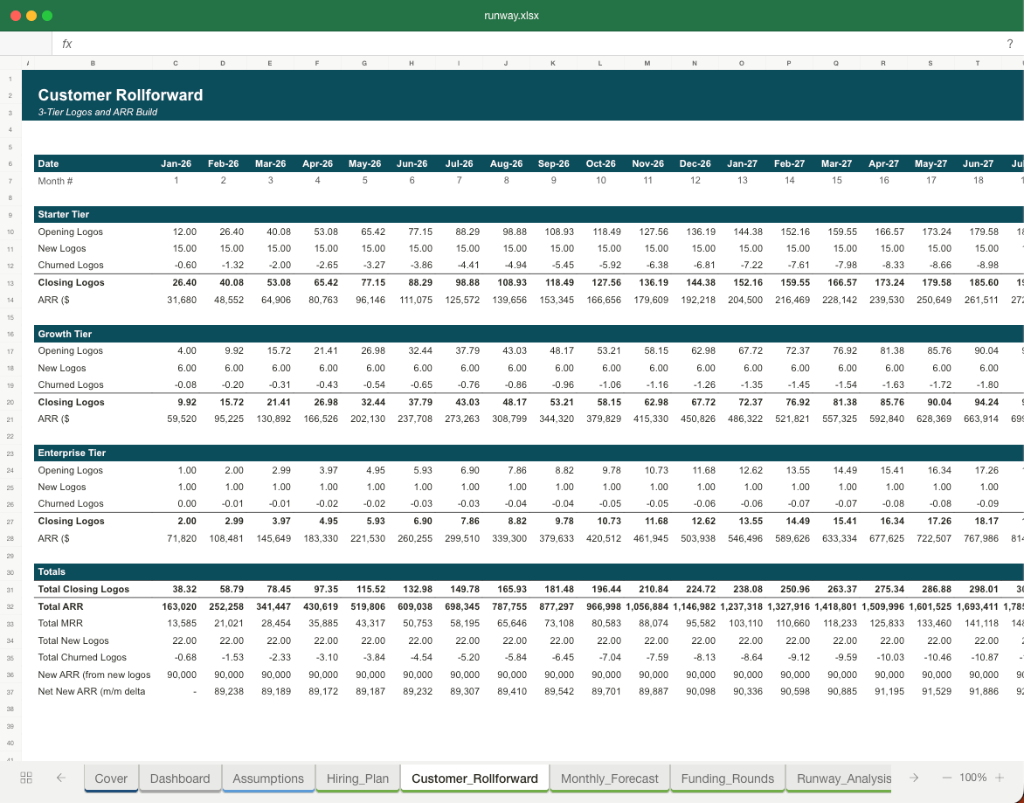
The model uses new logos, seats or workspaces, ACV, expansion, and churn to build ARR. Customer onboarding, video delivery costs, sales capacity, retention, gross margin, product investment, and operating expenses determine the path to scale.
A turnkey financial model
Live formulas, no hardcoded values
Outputs are driven by live formulas, so the workbook updates from its assumptions instead of relying on hardcoded results.
All assumptions in one tab
Inputs are clearly marked in the Assumptions tab and separated from calculations, making it clear what to change and what to leave intact.
Statements always balancing
For integrated-statement models, the balance sheet, cash flow, and supporting schedules tie through properly.
Distinct schedules for clarity
Debt, working capital, taxes, and cash flow can get messy quickly. We group calculations in clear schedules, not across disconnected tabs.
No hidden macros or external links
There are no unexplained external workbook links or macros to undermine auditability or portability.
Changes flow through the model
Update a key driver and see the impact carry through the forecast, financing, and return outputs. We never use hardcoded numbers in formulas.
About PlayPlay
playplay.com
How to build a detailed financial model for PlayPlay
A complete walkthrough of the business, drivers, and assumptions behind the downloadable PlayPlay model - distilled from its pitch deck and publicly available information.
Product & value proposition
PlayPlay is a self-serve, template-driven video creation platform targeting every department inside a company (Social Media, Marketing, Corporate Comms, Internal Comms, HR, Support).
Key differentiators vs. the two bad alternatives stated in the deck:
- vs. agencies: cheaper, faster, more autonomous.
- vs. prosumer DIY tools (implicitly Canva, Adobe Express, etc.): enterprise branding controls, team collaboration, role-based permissions (Owner / Admin / Member), B2B templates, dedicated support.
Product pillars (from slides 6–8):
- Simple: template-based editor, "start from scratch" or branded template library, one-click download/share.
- Highest quality: agency-grade motion design across 9+ format types (News, Tutorials, Case Studies, Events, Interviews, Ads, Social Clips, Podcasts, Reporting).
- Enterprise-ready: team workspaces with folder hierarchy by department, in-app collaboration/commenting, brand asset library, format variants (Square, Horizontal, Vertical, Story).
Named clients visible in deck: USC, Booking.com, AXA.
Market
Context only: slide 2 notes video is ubiquitous across B2C platforms (TikTok, Instagram, Twitter, LinkedIn) and B2B tools (Zoom, Loom, Hopin, Slack) as a "why now" framing, but no addressable market numbers are given.
Revenue model
- SaaS subscription, sold per seat or per workspace/team. Rationale: enterprise B2B video SaaS standard; role-based permissions (Owner/Admin/Member) implies seat or team-tier pricing.
- Annual contracts likely for enterprise; monthly available for SMB. Rationale: AXA-scale clients typically require annual MSAs.
- No pricing tiers, ACV, or pricing page shown in deck.
Traction & metrics
The only quasi-metric visible is a testimonial quote: "I can't do my job without PlayPlay anymore. If I ask our studio to do a video, I would wait for 3 days and pay 10K!" - this implies a competitive displacement value but is not a company metric.
Competition / moat
Slide 2 implicitly maps the competitive landscape:
- B2C incumbents: TikTok, Instagram, Twitter, LinkedIn (not direct competitors - consumer-grade).
- B2B video communication: Zoom, Loom, Hopin, Slack, Signal, WhatsApp, Discord, Messenger (communication tools, not creation).
- Slide 4 identifies indirect competition as agencies and prosumer DIY tools (unnamed).
Stated moats:
- Simplicity / speed-to-publish.
- Agency-quality motion design templates.
- Enterprise controls (branding lock, permissions, team folders, collaboration workflow).
Team & funding ask / use of funds
Recommended financial model
- Archetype + why: B2B SaaS ARR model. PlayPlay sells recurring software subscriptions to enterprises on a seat or workspace basis. Standard SaaS drivers (new logos, seats per account, ACV, churn, expansion) are the right frame.
- Forecast horizon & granularity: 3 years monthly (Year 1–2 monthly detail, Year 3 annual summary). Monthly granularity needed to track new logo cohorts, seat expansion, and NRR.
- Key drivers & assumptions (tag or):
| Driver | Value / Range | Source |
|---|---|---|
| Starting ARR | Unknown | placeholder; flag as open question |
| New logos per month | Unknown | start with 5–15/month; scale with sales headcount |
| Average ACV | Unknown | €15k–€50k/year for enterprise accounts; mid-market lower |
| Seats per account | Unknown | 5–20 seats; expansion driver |
| Seat price / year | Unknown | €500–€1,500/seat |
| Logo churn (annual) | Unknown | 5–10% for enterprise SaaS |
| Net Revenue Retention | Unknown | 105–120%; expansion via seat adds and new departments |
| Gross margin | Unknown | 70–80%; typical for cloud-hosted B2B SaaS |
| S&M % of revenue | Unknown | 30–50% in growth phase |
| R&D % of revenue | Unknown | 20–30% |
| G&A % of revenue | Unknown | 10–15% |
| CAC payback period | Unknown | 12–18 months |
- Scenarios (Base / Bull / Bear - which variables flex):
- Base: moderate new logo adds, NRR ~110%, churn ~8%.
- Bull: faster new logo ramp (enterprise sales team scales), NRR ~120% (cross-department expansion), churn ~5%.
- Bear: slow sales motion, NRR ~100%, elevated churn ~12%, longer CAC payback.
- Required sheets / outputs:
- Assumptions - all drivers in one editable table.
- ARR Bridge - new ARR, expansion ARR, churned ARR, ending ARR by month.
- Cohort table - logo cohorts, seat ramp, and retention by vintage.
- P&L - Revenue, COGS, Gross Profit, S&M, R&D, G&A, EBITDA.
- Headcount - Sales, CS, R&D, G&A headcount driving opex.
- Cash Flow / Runway - burn rate, cash balance, runway to next round.
- KPI Summary - ARR, MRR, NRR, logo count, CAC, LTV, LTV/CAC, gross margin.
- Scenario toggle - Base / Bull / Bear switcher.
Frequently asked
Is the PlayPlay financial model free?+
Yes. The PlayPlay model is a free Excel (.xlsx) download with live formulas. Sign up with your email and the workbook is yours to keep, review, and edit.
What's included in the model?+
A 5-year monthly forecast with P&L, cash flow and runway, valuation (exit multiple plus a DCF cross-check), MOIC/IRR returns, and unit economics, with live formulas throughout.
How was this model built?+
It was built from PlayPlay's pitch deck and publicly available information, then structured to investment-banking standards as a fully editable Excel model.
Can I change the assumptions?+
Yes. You can change assumptions and the live formulas will recalculate in the downloadable Excel model.
Have more financial modelling questions? Contact us

Created by ex-finance professionals
Hey, I’m Alex and I created Finamodel.
Over my years in the finance industry I kept building the same models over and over again. Same structure, same assumptions, different logo. So I started building frameworks to turn them into clean, reusable templates.
Every model here is one I’d actually use for a client, and I personally vet each one before it goes up.
I’m not an expert in every industry, but I’ve built enough models to know what belongs in one. And when something is completely foreign to me, I reach out to my network for experts to work on our models with us.
Having a template library on hand cuts a first build from hours to minutes.
Need help finding your model? You’ll find me in the Finamodel app!
Other Enterprise/Security Startup Financial Models
Browse another startup in the same category.
AgBiome
AgBiome is a microbial-platform agtech company that discovers, develops, and commercialises biological crop protection products (and licences the platform across adjacent markets).

Alation
Enterprise data intelligence platform - data catalog, governance, and metadata management for large organisations.

Archer SPAC
Archera
Cloud resource automation platform that continuously optimizes AWS commitment purchases, de-risks overcommitment, and automates FinOps workflows.

Ardoq
Cloud-native Enterprise Architecture (EA) SaaS platform that helps large enterprises navigate digital transformation through automated data collection, graph-based architecture modelling, and change impact analysis.

Ascend
Ascend.io is an enterprise big data automation platform ("Enterprise Intelligence Platform") that abstracts away the complexity of big data engineering so non-experts can build and run data pipelines.

Athennian
Cloud-based legal entity management system (EMS) uniting entity data with workflow and document automation.

Auditboard
Cloud-based integrated risk management platform connecting audit, risk, compliance, and ESG teams across the enterprise.