 Scalestack Financial Model
Enterprise/Security Startup Financials (Free Excel Download)
AI-powered Sales Ops platform that unifies GTM data, prioritizes accounts/leads, and enables reps to execute sales plays with AI-generated context.



professionals from Deloitte
Used by professionals from






About this model
Scalestack is an AI-powered Sales Ops platform that unifies go-to-market data, prioritises accounts and leads, and gives representatives AI-generated context for executing sales plays.
The company sells subscription software to revenue organisations that need better data coordination and more actionable account prioritisation. Customer value can deepen as more GTM systems, users, and workflows are connected to the platform.
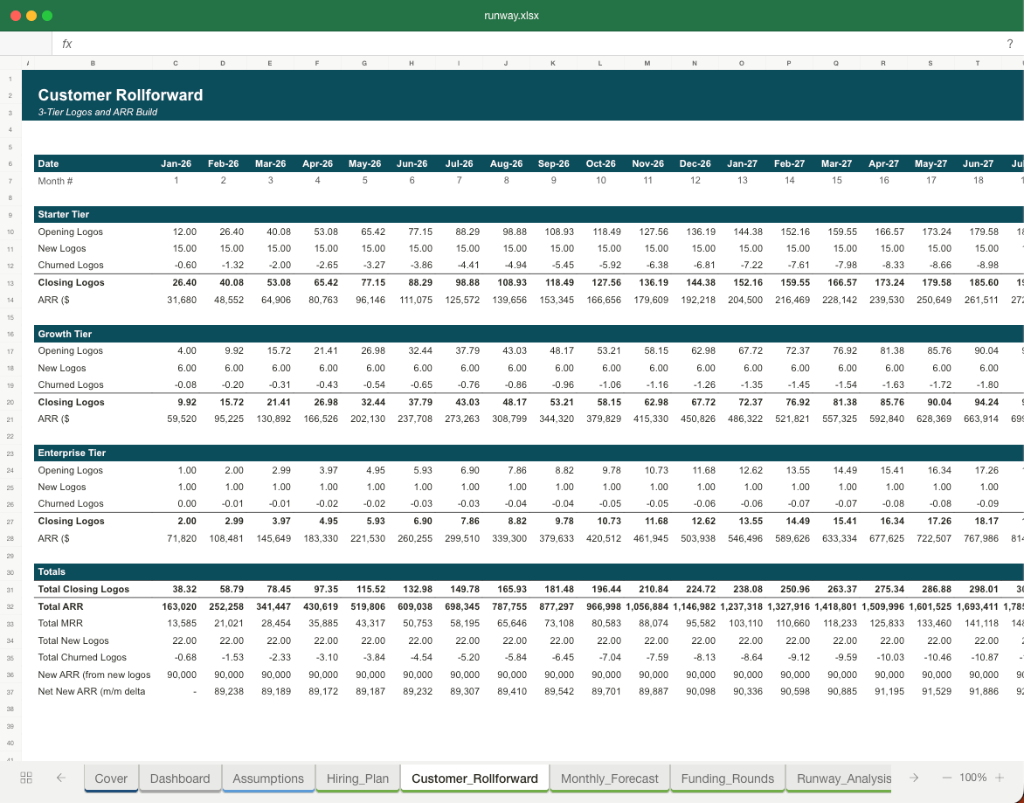
The model uses enterprise ARR drivers: new logos, ACV, seats or workspaces, expansion, and churn. It links integration and data-delivery costs, sales capacity, customer success, gross margin, product investment, and operating expense to the cash plan.
A turnkey financial model
Live formulas, no hardcoded values
Outputs are driven by live formulas, so the workbook updates from its assumptions instead of relying on hardcoded results.
All assumptions in one tab
Inputs are clearly marked in the Assumptions tab and separated from calculations, making it clear what to change and what to leave intact.
Statements always balancing
For integrated-statement models, the balance sheet, cash flow, and supporting schedules tie through properly.
Distinct schedules for clarity
Debt, working capital, taxes, and cash flow can get messy quickly. We group calculations in clear schedules, not across disconnected tabs.
No hidden macros or external links
There are no unexplained external workbook links or macros to undermine auditability or portability.
Changes flow through the model
Update a key driver and see the impact carry through the forecast, financing, and return outputs. We never use hardcoded numbers in formulas.
About Scalestack
scalestack.ai
How to build a detailed financial model for Scalestack
A complete walkthrough of the business, drivers, and assumptions behind the downloadable Scalestack model - distilled from its pitch deck and publicly available information.
Product & value proposition
Three-layer platform:
- Universal API / data orchestration - aggregates internal CRM data + third-party sources (ZoomInfo, Apollo, Lemlist, HubSpot, Crunchbase, LinkedIn, job postings) into a unified, ICP-contextualised dataset.
- AI enrichment & prioritisation - ranks accounts and leads by fit, surfaces actionable signals (job postings, funding events, LinkedIn activity), and synthesises data in context of the customer's ICP.
- GenAI copilot for reps - conversational interface that answers prospect questions, drafts outreach, suggests next steps, and retrieves contact info in real time.
Positioning: "middleware for sales ops" - sits between foundation models / data sources and the rep's workflow. Targets Stage 1 ("Target") of the sales funnel, which the deck argues is the most underserved segment of the sales-tech stack.
Market
Deck presents a bottom-up, time-phased TAM scoped to the "targeting" stage only:
| Horizon | Segment | Companies | ACV | Implied ARR opportunity |
|---|---|---|---|---|
| Today | B2B enterprise-tech, 300–5,000 employees | 13K | $200K+ | $2.6B |
| 2–3 years | B2B, 100–300 employees, Series B+, sales team 20+ | 156K | $100K | $15.6B |
| 3–5 years | B2B, 20–50 employees, CRM-adopted | 755K | $50K | $37.8B |
| Total | - | - | - | $56B+ |
No SAM/SOM breakdown provided. No third-party market-size citation for the overall sales intelligence / sales ops software market (Gartner, IDC, etc.). Market-size figures are company-constructed bottom-up estimates.
Revenue model
- Model: Annual SaaS subscription (ARR-based).
- Pricing: ACV tiers implied by the market-sizing slide - $200K+ for enterprise (500+ employee companies), $100K for mid-market, $50K for SMB. No explicit per-seat or per-usage pricing shown.
- Channel: Direct sales (founders-led given stage); inbound via brand/case studies (MongoDB, Typeform).
- Expansion: MongoDB renewed, suggesting land-and-expand is part of the motion.
- No mention of usage-based / consumption pricing, professional services revenue, or marketplace fees.
Traction & metrics
- ~$XXXK in SaaS revenues in 2022 - number redacted in deck.
- ~$XXXK in ARR as of Jul 2023 - number redacted in deck.
- Customer count: ">XK of reps across X customers" daily - both numbers redacted.
- Named customers: MongoDB (renewed), Typeform (recently signed), Nflux, Instal, Rentroom, Trgt.
- MongoDB ROI: "accounts closed resulted in over $XXM in revenues" - number redacted.
- Strong pipeline referenced, with expansion and new logos; no pipeline dollar figure given.
Competition / moat
Competitive framing:
- CRMs (Salesforce, HubSpot): Data graveyard - no enrichment or prioritisation intelligence. Scalestack connects and cleans data atop CRMs.
- Sales engagement (Outreach, Salesloft): Bottom-of-funnel; assume data quality already exists. Scalestack targets top-of-funnel (Stage 1: Target).
- Data/intelligence vendors (ZoomInfo, Apollo): Generic, horizontal datasets; require engineering to integrate; same data for everyone. Scalestack's API is ICP-contextualised and multi-source.
Moat claims: ICP-contextualised data orchestration; AI layer that synthesises across sources; workflow embedding in existing CRM/engagement tools via integrations. No proprietary data assets or network effect explicitly claimed.
Team & funding ask / use of funds
Team:
- Elio Narciso - CEO; 4x founder, 2 exits; ex-AWS (built global GTM program for startups incl. Notion, Webflow, Zapier); MIT graduate.
- Alex Prioni - COO; 2x founder; co-founded a SaaS design biz that reached PMF and $1M ARR in <2 years; prior product leadership at two startups.
Backed by Forum Ventures (mentioned in product demo screenshot context).
Recommended financial model
- Archetype + why: SaaS ARR model - pure annual subscription business with a clear land-and-expand motion, tiered ACV by company size, and enterprise-led GTM. A 3-statement isn't warranted at this stage given the limited disclosed financials; a top-down ARR/waterfall model is the right frame.
- Forecast horizon & granularity: 5 years (FY2023–FY2027); monthly for Year 1–2, annual thereafter. As of the deck (Jul 2023), the company is generating early ARR with a handful of enterprise logos.
- Key drivers & assumptions:
- New logos won per quarter: start at 1–2/quarter (consistent with 6 named customers, early-stage direct sales); grow to 4–6/quarter by Year 3 as GTM scales.
- ACV - enterprise (500+ employees): $200K; used as anchor.
- ACV - mid-market (100–300 employees): $100K.
- ACV - SMB (20–50 employees): $50K; not actively sold yet - introduce Year 3+.
- Customer mix: 100% enterprise in Year 1–2; shift to 70/30 enterprise/mid-market by Year 3 as segment expansion executes.
- Net Revenue Retention (NRR): 110% - MongoDB renewal and "expansion and new" pipeline language suggests expansion; enterprise SaaS comps typically 110–130%.
- Logo churn: 10% annual; no churn data in deck, early-stage assumption.
- Gross margin: 70%; typical for early B2B SaaS with significant third-party data API costs (ZoomInfo, Apollo, etc.) compressing margins below pure-software benchmarks.
- Sales cycle: 3–6 months; enterprise SaaS sales intelligence typical.
- Headcount / opex ramp: - seed-to-Series A team of ~10–15 FTE; model HR costs as % of ARR declining from ~150% in Year 1 to ~60% by Year 4.
- 2022 SaaS revenue: Redacted ($XXXK) - open question; recommend confirming with company.
- Jul 2023 ARR: Redacted ($XXXK) - open question.
- Scenarios (Base / Bull / Bear - which variables flex):
- Base: 2 new logos/quarter enterprise; NRR 110%; gross margin 70%.
- Bull: 4 new logos/quarter with mid-market acceleration Year 2; NRR 120%; faster ACV expansion as platform value proven.
- Bear: 1 new logo/quarter; NRR 100% (flat retention); ACV discounting to $120K enterprise to win deals; gross margin 65% due to data API cost pressure.
- Required sheets / outputs:
- Assumptions - all drivers in one place with toggles for scenario.
- ARR Waterfall - beginning ARR + new ARR + expansion ARR − churned ARR = ending ARR; monthly detail.
- Revenue & Gross Profit - ARR to recognised revenue (assume annual contracts = revenue = ARR for simplicity); gross margin bridge.
- Headcount & Opex - S&M, R&D, G&A; burn rate.
- P&L Summary - gross profit → EBITDA → net income.
- Cash / Runway - starting cash (unknown; open question), monthly burn, months of runway; flag fundraise need.
- Market Penetration - logo count vs. TAM by segment (13K/156K/755K companies) to show penetration story.
- Dashboard - KPI cards: ARR, logo count, NRR, gross margin %, burn rate, runway.
Frequently asked
Is the Scalestack financial model free?+
Yes. The Scalestack model is a free Excel (.xlsx) download with live formulas. Sign up with your email and the workbook is yours to keep, review, and edit.
What's included in the model?+
A 5-year monthly forecast with P&L, cash flow and runway, valuation (exit multiple plus a DCF cross-check), MOIC/IRR returns, and unit economics, with live formulas throughout.
How was this model built?+
It was built from Scalestack's pitch deck and publicly available information, then structured to investment-banking standards as a fully editable Excel model.
Can I change the assumptions?+
Yes. You can change assumptions and the live formulas will recalculate in the downloadable Excel model.
Have more financial modelling questions? Contact us

Created by ex-finance professionals
Hey, I’m Alex and I created Finamodel.
Over my years in the finance industry I kept building the same models over and over again. Same structure, same assumptions, different logo. So I started building frameworks to turn them into clean, reusable templates.
Every model here is one I’d actually use for a client, and I personally vet each one before it goes up.
I’m not an expert in every industry, but I’ve built enough models to know what belongs in one. And when something is completely foreign to me, I reach out to my network for experts to work on our models with us.
Having a template library on hand cuts a first build from hours to minutes.
Need help finding your model? You’ll find me in the Finamodel app!
Other Enterprise/Security Startup Financial Models
Browse another startup in the same category.
AgBiome
AgBiome is a microbial-platform agtech company that discovers, develops, and commercialises biological crop protection products (and licences the platform across adjacent markets).

Alation
Enterprise data intelligence platform - data catalog, governance, and metadata management for large organisations.

Archer SPAC
Archera
Cloud resource automation platform that continuously optimizes AWS commitment purchases, de-risks overcommitment, and automates FinOps workflows.

Ardoq
Cloud-native Enterprise Architecture (EA) SaaS platform that helps large enterprises navigate digital transformation through automated data collection, graph-based architecture modelling, and change impact analysis.

Ascend
Ascend.io is an enterprise big data automation platform ("Enterprise Intelligence Platform") that abstracts away the complexity of big data engineering so non-experts can build and run data pipelines.

Athennian
Cloud-based legal entity management system (EMS) uniting entity data with workflow and document automation.

Auditboard
Cloud-based integrated risk management platform connecting audit, risk, compliance, and ESG teams across the enterprise.