 Seyna Financial Model
InsurTech Startup Financials (Free Excel Download)
Insurance infrastructure platform - risk carrier + SaaS - enabling brokers and retailers to build, distribute, and manage insurance products.



professionals from Deloitte
Used by professionals from






About this model
Seyna combines a licensed insurance carrier with SaaS infrastructure for brokers and retailers. Its platform supports white-label products, distribution, policy administration, claims, compliance, data processing, and reporting.
Revenue comes from insurance premiums because Seyna carries risk, alongside SaaS fees paid by distribution partners for its operating platform. Reinsurance partners transfer a portion of underwriting exposure while brokers and retailers bring the customer flow.
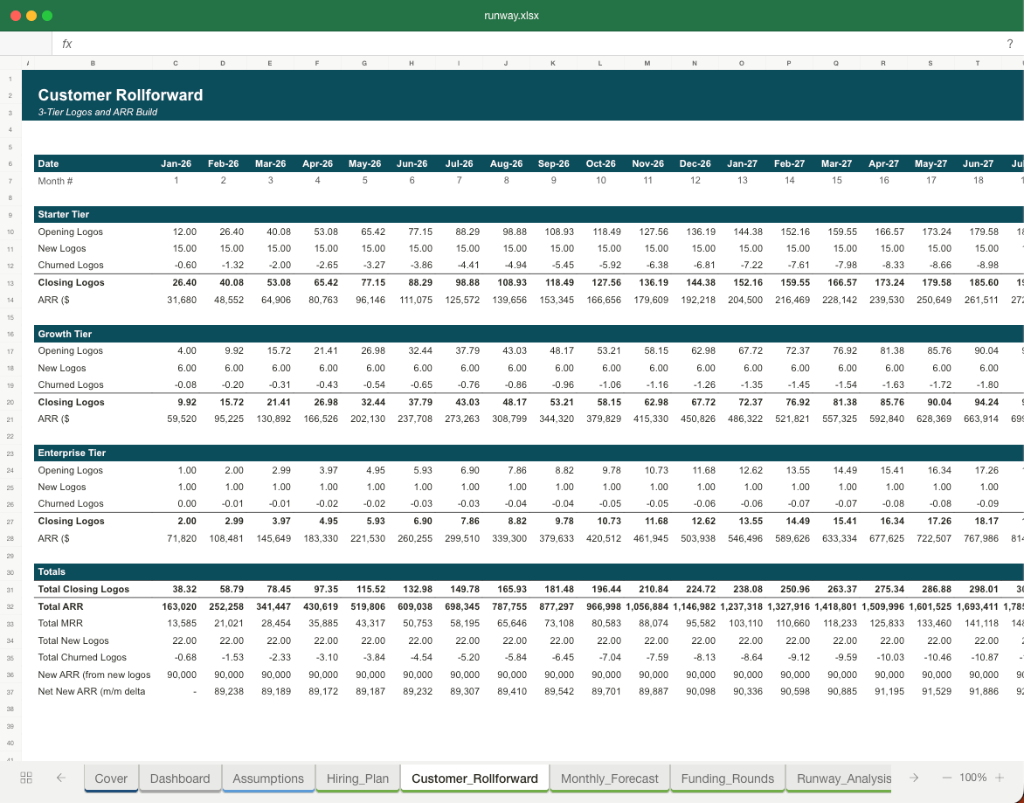
The model separates carrier GWP from platform ARR. Partners, policies, premium, loss ratio, reinsurance, software fees, expansion, and churn determine revenue. Underwriting performance, broker adoption, capital, and claims operations drive profit.
A turnkey financial model
Live formulas, no hardcoded values
Outputs are driven by live formulas, so the workbook updates from its assumptions instead of relying on hardcoded results.
All assumptions in one tab
Inputs are clearly marked in the Assumptions tab and separated from calculations, making it clear what to change and what to leave intact.
Statements always balancing
For integrated-statement models, the balance sheet, cash flow, and supporting schedules tie through properly.
Distinct schedules for clarity
Debt, working capital, taxes, and cash flow can get messy quickly. We group calculations in clear schedules, not across disconnected tabs.
No hidden macros or external links
There are no unexplained external workbook links or macros to undermine auditability or portability.
Changes flow through the model
Update a key driver and see the impact carry through the forecast, financing, and return outputs. We never use hardcoded numbers in formulas.
About Seyna
seyna.com
How to build a detailed financial model for Seyna
A complete walkthrough of the business, drivers, and assumptions behind the downloadable Seyna model - distilled from its pitch deck and publicly available information.
Product & value proposition
- Seyna acts as a licensed risk carrier + software platform - the Shopify analogy for insurance.
- Four product pillars:
- White-label insurance products (online catalog, dynamic pricing, self-service).
- SaaS to run business: API data processing, BI/reporting, market data, compliance automation.
- SaaS for distribution: plug-and-play distribution software (physical and digital), contract management.
- SaaS for policies & claims: end-to-end policy/claims management, cash transactions, fraud/AML integrations.
- Key claimed efficiency: 36x faster product creation/updates vs. incumbents.
- Brokers benefit: more innovation, more sales growth, increased margins (lower tech spend, fewer errors).
Market
- TAM: €565bn - P&C and Life insurance excluding savings & pensions.
- France: €85bn.
- Europe ex-France: €480bn.
- Sub-split: P&C €416bn, Health €149bn.
- Market growth: CAGR 4% (2015–2019). Sources cited: FFA & EIF.
Revenue model
- Dual revenue stream:
- Insurance premium revenue (GWP): Seyna is the risk carrier; earns insurance premiums from policyholders via broker/retailer distribution channel. Reinsurance partnerships (Swiss Re, Munich Re, Hannover Re, Scor) transfer risk.
- SaaS fees: Brokers/retailers pay for the platform (distribution, policy management, claims, BI tools). Metric used in deck: ARR per broker.
- Channel: B2B2C - brokers and retailers as distribution partners, who sell embedded or D2C insurance to end customers.
- Verticals at Seed stage (France): Unpaid rent & surety, cancellation, embedded motor, pet insurance, breakdown/breakage/theft.
Traction & metrics
- Named broker clients (migrating to Seyna):
- Verspieren - embedded on Electrodepot (retailer), vertical: Breakage. ARR:.
- Garantme - D2C + distributors/agencies, product: Rental insurance. ARR:.
- Phenomen - FNAC Billeterie (online and offline), vertical: Ticket Cancellation. ARR:.
- Additional traction bullets on slide 7 are redacted (two bullet points blacked out).
- Reinsurance partnerships established: Swiss Re, Munich Re, Hannover Re, Scor.
- Existing investors: GFC, Allianz, Financière Saint James (family office).
- All quantitative traction metrics (total ARR, GWP, policy count, NPS, retention) are absent or redacted.
Competition / moat
- Moat claims:
- Licensed risk carrier capacity (regulatory barrier to entry - ACPR-approved, FoS filed for EU).
- Reinsurance marketplace already operational (connecting policy holders to balance sheets at scale).
- Data-sharing model: Seyna shares data openly with all market players - competing on service quality, not data lock-in.
- 36x speed advantage in product creation vs. incumbents.
- Competitive set: Not named. Deck positions incumbents as slow/fragmented (multitude of independent systems).
Team & funding ask / use of funds
- Investors to date: GFC, Allianz, Financière Saint James.
- Funding ask / round size: Redacted on slide 6 (Series A column blacked out).
- Use of funds: Not explicitly stated, but roadmap implies: +3 new verticals (Event Cancellation, Health, Protection) + 1 new country launch at Series A.
Recommended financial model
- Archetype + why: Insurance GWP + SaaS ARR hybrid model. Seyna operates as a licensed risk carrier (generating GWP, subject to loss ratios and combined ratios) while also charging SaaS subscription/ARR fees from broker/distributor clients. Neither a pure SaaS nor a pure insurance model - needs both P&L structures. Closest archetype: InsurTech platform with separate GWP P&L and SaaS ARR schedule, feeding into a 3-statement model.
- Forecast horizon & granularity: 5 years (Year 1–2 monthly, Year 3–5 annual). Seed/Series A stage warrants monthly granularity early given high burn sensitivity.
- Key drivers & assumptions:
- Number of broker/distributor clients: 3 named at Seed; ramp ~5–8 in Y1, ~15–25 by Y3 (early-stage InsurTech ramp typical)
- ARR per broker client: disclosed but redacted; €50k–€200k ARR/client range typical for B2B insurance SaaS at this stage - needs client confirmation
- GWP per vertical/client: varies widely by vertical (rental insurance vs. motor vs. breakage); model should parametrize GWP per client by vertical
- Loss ratio by vertical: 55–70% for P&C lines (industry benchmark); Seyna reinsures bulk - model net retention ratio assumption needed
- Reinsurance cession rate: 70–85% of GWP ceded to reinsurers (Swiss Re, Munich Re etc.), leaving net earned premium on balance sheet - confirm with company
- Net earned premium margin (after cessions): 15–30% of GWP retained
- SaaS gross margin: 70–80% (software-only component; industry standard B2B SaaS)
- New vertical launches: +3 verticals at Series A; 6-month ramp per new vertical
- Geographic expansion: 1 new country at Series A; 12-month ramp, revenue = 20% of France run-rate in Y1 of new market
- Headcount growth: engineering-heavy team; 20–35 FTEs at Series A raise, scaling to 60–80 by Y3
- Burn / opex: €300k–€500k/month at Series A stage (tech + compliance + insurance ops)
- ACPR compliance / regulatory costs: material fixed cost line (~€200–400k/year); model separately
- Scenarios (Base / Bull / Bear - which variables flex):
- Base: 15 broker clients by Y3, 60% GWP cession rate, 3 verticals France + 1 country
- Bull: 25 clients by Y3, faster vertical ramp, higher ARR/client (€200k+), 2 new countries
- Bear: Client acquisition slower (8 clients Y3), loss ratio spikes (cat event in a vertical), 1-country-only
- Required sheets / outputs:
- Assumptions (all inputs, scenario toggle)
- Broker/Client Roll (new clients added per period, ARR per client, churn)
- GWP Schedule (gross written premium by vertical, by client, net of cessions → net earned premium)
- SaaS P&L (ARR, MRR, gross margin)
- Insurance P&L (net earned premium, loss ratio, expense ratio, combined ratio, underwriting profit)
- Consolidated P&L (SaaS + Insurance P&L merged)
- Balance Sheet (insurer-specific: technical reserves, reinsurance receivables, equity)
- Cash Flow Statement
- Runway / Funding bridge (burn vs. cash, months of runway, next raise trigger)
- Dashboard (KPI summary: ARR, GWP, combined ratio, clients, burn, runway)
Frequently asked
Is the Seyna financial model free?+
Yes. The Seyna model is a free Excel (.xlsx) download with live formulas. Sign up with your email and the workbook is yours to keep, review, and edit.
What's included in the model?+
A 5-year monthly forecast with P&L, cash flow and runway, valuation (exit multiple plus a DCF cross-check), MOIC/IRR returns, and unit economics, with live formulas throughout.
How was this model built?+
It was built from Seyna's pitch deck and publicly available information, then structured to investment-banking standards as a fully editable Excel model.
Can I change the assumptions?+
Yes. You can change assumptions and the live formulas will recalculate in the downloadable Excel model.
Have more financial modelling questions? Contact us

Created by ex-finance professionals
Hey, I’m Alex and I created Finamodel.
Over my years in the finance industry I kept building the same models over and over again. Same structure, same assumptions, different logo. So I started building frameworks to turn them into clean, reusable templates.
Every model here is one I’d actually use for a client, and I personally vet each one before it goes up.
I’m not an expert in every industry, but I’ve built enough models to know what belongs in one. And when something is completely foreign to me, I reach out to my network for experts to work on our models with us.
Having a template library on hand cuts a first build from hours to minutes.
Need help finding your model? You’ll find me in the Finamodel app!
Other InsurTech Startup Financial Models
Browse another startup in the same category.
Ark Kapital
AI-powered precision lending platform for European tech startups, providing non-dilutive growth loans using real-time raw data analytics.

Battleface
Tech-enabled travel insurance platform covering high-risk and non-standard destinations globally, sold direct and via B2B2C partners.
Beam
Digital-first dental insurance company selling group dental (and ancillary) benefits to employers via brokers

Branch
Tech-enabled home & auto insurance company operating as a reciprocal exchange, selling bundled policies via embedded, direct, and agency channels.
Cachet
B2B2C insurtech marketplace offering flexible, usage-based insurance products to gig/platform economy workers via partnerships with ride-hailing, delivery, and gig platforms.

Caura
Mobile app that aggregates all car-related payments (parking, congestion/ULEZ, tolls, tax, insurance) into a single platform, with insurance comparison as a key monetisation layer.

Clark
Digital insurance broker (Makler) providing a robo-advisor + human expert hybrid platform to manage and purchase all insurance lines via mobile app

Counterpart
Digital MGA (managing general agent) selling D&O and management liability insurance to US SMEs via a tech-enabled underwriting platform.