SAStrive Asset Management Financial Model
Enterprise/Security Startup Financials (Free Excel Download)
Anti-ESG asset manager offering ETFs and shareholder-activism proxy services under a shareholder-primacy mandate.



professionals from Deloitte
Used by professionals from






About this model
Strive Asset Management is an ETF issuer and proxy-advisory business operating under a shareholder-primacy mandate. It is not a SaaS company: its principal products are US-listed ETFs, alongside services related to shareholder activism and proxy advice.
Revenue is driven primarily by management fees on assets under management, with proxy-advisory fees as a separate line. AUM changes with net investor flows, product launches, distribution reach, and market performance, while the business was launched with its first product in August 2022.
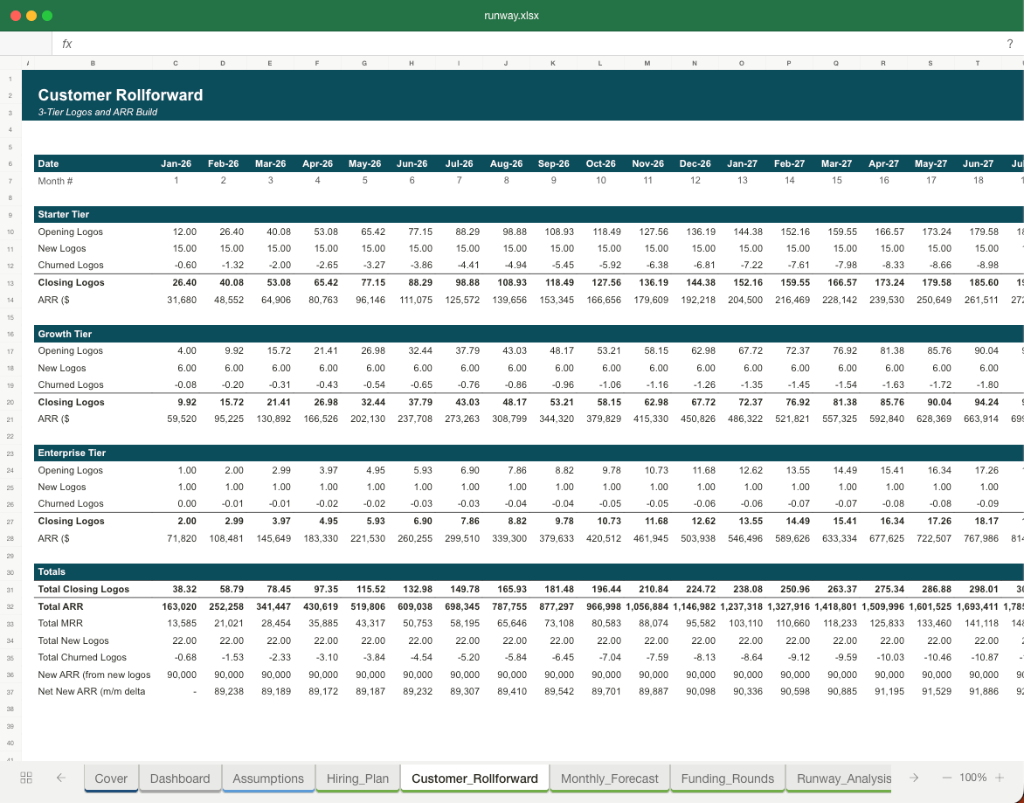
The model forecasts ETF AUM by product, net flows, market returns, and blended expense ratios. It separately models advisory revenue, fund and distribution costs, operating overhead, and cash flow, with scenarios for launch cadence and flow capture.
A turnkey financial model
Live formulas, no hardcoded values
Outputs are driven by live formulas, so the workbook updates from its assumptions instead of relying on hardcoded results.
All assumptions in one tab
Inputs are clearly marked in the Assumptions tab and separated from calculations, making it clear what to change and what to leave intact.
Statements always balancing
For integrated-statement models, the balance sheet, cash flow, and supporting schedules tie through properly.
Distinct schedules for clarity
Debt, working capital, taxes, and cash flow can get messy quickly. We group calculations in clear schedules, not across disconnected tabs.
No hidden macros or external links
There are no unexplained external workbook links or macros to undermine auditability or portability.
Changes flow through the model
Update a key driver and see the impact carry through the forecast, financing, and return outputs. We never use hardcoded numbers in formulas.
About Strive Asset Management
strive.com
How to build a detailed financial model for Strive Asset Management
A complete walkthrough of the business, drivers, and assumptions behind the downloadable Strive Asset Management model - distilled from its pitch deck and publicly available information.
Product & value proposition
- Core thesis: "Shareholder capitalism" (Milton Friedman) vs. "stakeholder capitalism" (WEF/Business Roundtable/ESG). Strive argues the Big 3 (BlackRock, State Street, Vanguard) are in fiduciary breach by voting ESG agendas.
- Products: 10 ETFs (+ 2 in registration as of deck date), model portfolios, proxy advisory services, 401k solution (coming soon), target date funds (coming soon).
- First ETF: DRLL (US energy sector, listed NYSE Aug 10, 2022).
- Engagement strategy: Sends activist letters to portfolio companies (e.g. Exxon, Chevron) demanding they drop ESG commitments and focus on shareholder returns.
- Distribution: Available on 50+ platforms; now on select defined contribution record keepers.
Market
- The Big 3 asset managers collectively control >$20 trillion and own >20% of S&P 500. - cited as the addressable influence market Strive targets.
- No explicit TAM/SAM/SOM slide or figures for addressable ETF/AUM market.
- Proxy supporting data: ESG "for" votes peaked at ~32% in 2021 and fell to ~22% by May 2023 - used to show tailwind for Strive's positioning.
- US outperforms Europe on GDP growth, per capita income, employment rates, innovation - supporting narrative, not market sizing.
Revenue model
- Primary revenue: Management fees on ETF AUM (expense ratios). Specific basis-point fees not stated in deck.
- Secondary revenue: Proxy advisory services (fee structure not disclosed).
- Pipeline products: 401k solutions, target date funds - fee structures not disclosed.
- Distribution channels: Retail brokerage platforms (50+), defined contribution record keepers, institutional clients.
- No revenue figures, fee schedules, or AUM-to-revenue conversion rate disclosed.
Traction & metrics
- AUM: >$950 million
- First product launch: Aug 10, 2022 (DRLL energy ETF)
- Team: 40+ members
- ETF count: 10 available + 2 in registration
- Platforms: 50+
- Corporate engagement wins: Exxon added Larry Kellner and John Harris to board; Chevron shareholders rejected scope 3 climate proposals
- ESG proxy vote trend: "for" votes on ESG proposals fell from ~32% peak (2021) to ~22% (May 2023)
- No revenue, net flows, fee income, or growth rate figures disclosed.
Competition / moat
- Direct competitors cited: BlackRock, State Street, Vanguard (the "Big 3") - framed as adversaries, not just competitors.
- Moat claims:
- First-mover in "anti-ESG" / shareholder-primacy ETF space.
- Brand identity reinforced by high-profile founders (Vivek Ramaswamy as co-founder/face, Anson Frericks as co-founder/former Bud Light exec) and celebrity investors.
- Activist engagement as differentiator - sends proxy letters, claims policy impact.
- Political/regulatory tailwind: States (Texas, etc.) restricting pension investment in ESG-aligned managers.
- Competitor capitulation cited as validation: BlackRock scrubbed "ESG" from 2023 proxy guidelines; State Street CIO distanced from stakeholder capitalism; Vanguard exited NZAM.
Team & funding ask / use of funds
- Co-founders: Vivek Ramaswamy (mentioned Enercom 2022 presenter), Anson Frericks (Enercom 2023 presenter, former Bud Light exec)
- Team size: 40+
- HQ: Columbus, Ohio
- Known investors: Flex Capital, Founders Fund, Narya, Peter Thiel, Howard Lutnick, Bill Ackman
Recommended financial model
- Archetype + why: AUM-based asset management revenue model. Revenue = AUM × blended expense ratio. This is the standard archetype for ETF issuers. AUM is driven by net flows (new product launches × distribution reach) and market returns. Proxy advisory services are a secondary fee line. Not an M&A, SPAC, or SaaS deck.
- Forecast horizon & granularity: 5-year annual model (2023–2027), with monthly granularity for Year 1 to capture ramp dynamics of new ETF launches and DC record-keeper onboarding.
- Key drivers & assumptions:
- AUM at model start: $950M; treat as of Aug/Sep 2023 deck date
- Number of ETFs: 10 live + 2 in registration; 2 new ETF launches/year beyond current pipeline
- Blended expense ratio: ~0.40% (typical for thematic/active-tilt ETFs; DRLL charges 0.41% per public filings)
- Net flow rate (% of starting AUM): 30–50% in Year 1, decelerating to 15–20% by Year 3 as base grows
- Market return assumption on AUM: 8% annual (passive equity benchmark)
- Proxy advisory services revenue: minor line, ~$0.5–1M initially, scaling with institutional client count
- Headcount: 40+; ~5–8 hires/year to support product expansion
- Compensation: blended $150K fully loaded cost/head
- Platform/distribution fees (sub-TA, record-keeper fees): 10–15 bps of AUM on DC/platform assets
- Marketing & advocacy spend: elevated relative to peers given brand-building phase (15–20% of revenue)
- Scenarios (Base / Bull / Bear - which variables flex):
- Bull: ESG regulatory/political backlash accelerates, large DC mandates secured quickly; AUM hits $3–4B by Year 3; 3 new ETF launches/year
- Base: Steady organic growth, 2 new ETFs/year, AUM hits $2B by Year 3
- Bear: ESG headwinds fade, political cycle shifts, net flows stall; AUM growth driven mainly by market returns; revenue barely covers costs
- Required sheets / outputs:
- Assumptions - all drivers, toggled by scenario
- AUM Build - opening AUM + net new flows + market return = closing AUM (monthly Y1, annual Y2–Y5)
- Revenue - management fee revenue by ETF strategy, proxy advisory fees
- Headcount & OpEx - compensation, G&A, compliance, marketing, technology
- P&L - revenue minus OpEx; EBITDA margin by year
- Cash Flow / Runway - burn in early years; breakeven AUM calculation
- Sensitivity - AUM level vs. blended fee rate; net flow rate vs. headcount growth
- Dashboard - AUM, revenue, EBITDA margin, breakeven, key ratios
Frequently asked
Is the Strive Asset Management financial model free?+
Yes. The Strive Asset Management model is a free Excel (.xlsx) download with live formulas. Sign up with your email and the workbook is yours to keep, review, and edit.
What's included in the model?+
A 5-year monthly forecast with P&L, cash flow and runway, valuation (exit multiple plus a DCF cross-check), MOIC/IRR returns, and unit economics, with live formulas throughout.
How was this model built?+
It was built from Strive Asset Management's pitch deck and publicly available information, then structured to investment-banking standards as a fully editable Excel model.
Can I change the assumptions?+
Yes. You can change assumptions and the live formulas will recalculate in the downloadable Excel model.
Have more financial modelling questions? Contact us

Created by ex-finance professionals
Hey, I’m Alex and I created Finamodel.
Over my years in the finance industry I kept building the same models over and over again. Same structure, same assumptions, different logo. So I started building frameworks to turn them into clean, reusable templates.
Every model here is one I’d actually use for a client, and I personally vet each one before it goes up.
I’m not an expert in every industry, but I’ve built enough models to know what belongs in one. And when something is completely foreign to me, I reach out to my network for experts to work on our models with us.
Having a template library on hand cuts a first build from hours to minutes.
Need help finding your model? You’ll find me in the Finamodel app!
Other Enterprise/Security Startup Financial Models
Browse another startup in the same category.
AgBiome
AgBiome is a microbial-platform agtech company that discovers, develops, and commercialises biological crop protection products (and licences the platform across adjacent markets).

Alation
Enterprise data intelligence platform - data catalog, governance, and metadata management for large organisations.

Archer SPAC
Archera
Cloud resource automation platform that continuously optimizes AWS commitment purchases, de-risks overcommitment, and automates FinOps workflows.

Ardoq
Cloud-native Enterprise Architecture (EA) SaaS platform that helps large enterprises navigate digital transformation through automated data collection, graph-based architecture modelling, and change impact analysis.

Ascend
Ascend.io is an enterprise big data automation platform ("Enterprise Intelligence Platform") that abstracts away the complexity of big data engineering so non-experts can build and run data pipelines.

Athennian
Cloud-based legal entity management system (EMS) uniting entity data with workflow and document automation.

Auditboard
Cloud-based integrated risk management platform connecting audit, risk, compliance, and ESG teams across the enterprise.