 Supliful Financial Model
Health-tech Startup Financials (Free Excel Download)
B2B SaaS + print-on-demand platform that lets content creators launch private-label supplement/wellness brands with zero inventory investment.



professionals from Deloitte
Used by professionals from






About this model
Supliful lets creators launch private-label supplement and wellness brands with no inventory investment. The B2B platform combines software, print-on-demand fulfilment, and creator commerce, allowing users to build products and sell them without managing traditional manufacturing or warehousing.
Growth depends on active creators, brands launched, product orders, and creator retention. Revenue can include software fees and fulfilment margin, while product economics depend on order volume, supplier costs, support, and the ability of creators to acquire and retain end customers.
The model forecasts active creators, brands launched, product orders, SaaS fees, fulfilment margin, creator retention, and support cost. It includes supplier payments, shipping, platform costs, creator acquisition, gross margin, working capital, cash burn, and runway.
A turnkey financial model
Live formulas, no hardcoded values
Outputs are driven by live formulas, so the workbook updates from its assumptions instead of relying on hardcoded results.
All assumptions in one tab
Inputs are clearly marked in the Assumptions tab and separated from calculations, making it clear what to change and what to leave intact.
Statements always balancing
For integrated-statement models, the balance sheet, cash flow, and supporting schedules tie through properly.
Distinct schedules for clarity
Debt, working capital, taxes, and cash flow can get messy quickly. We group calculations in clear schedules, not across disconnected tabs.
No hidden macros or external links
There are no unexplained external workbook links or macros to undermine auditability or portability.
Changes flow through the model
Update a key driver and see the impact carry through the forecast, financing, and return outputs. We never use hardcoded numbers in formulas.
About Supliful
supliful.com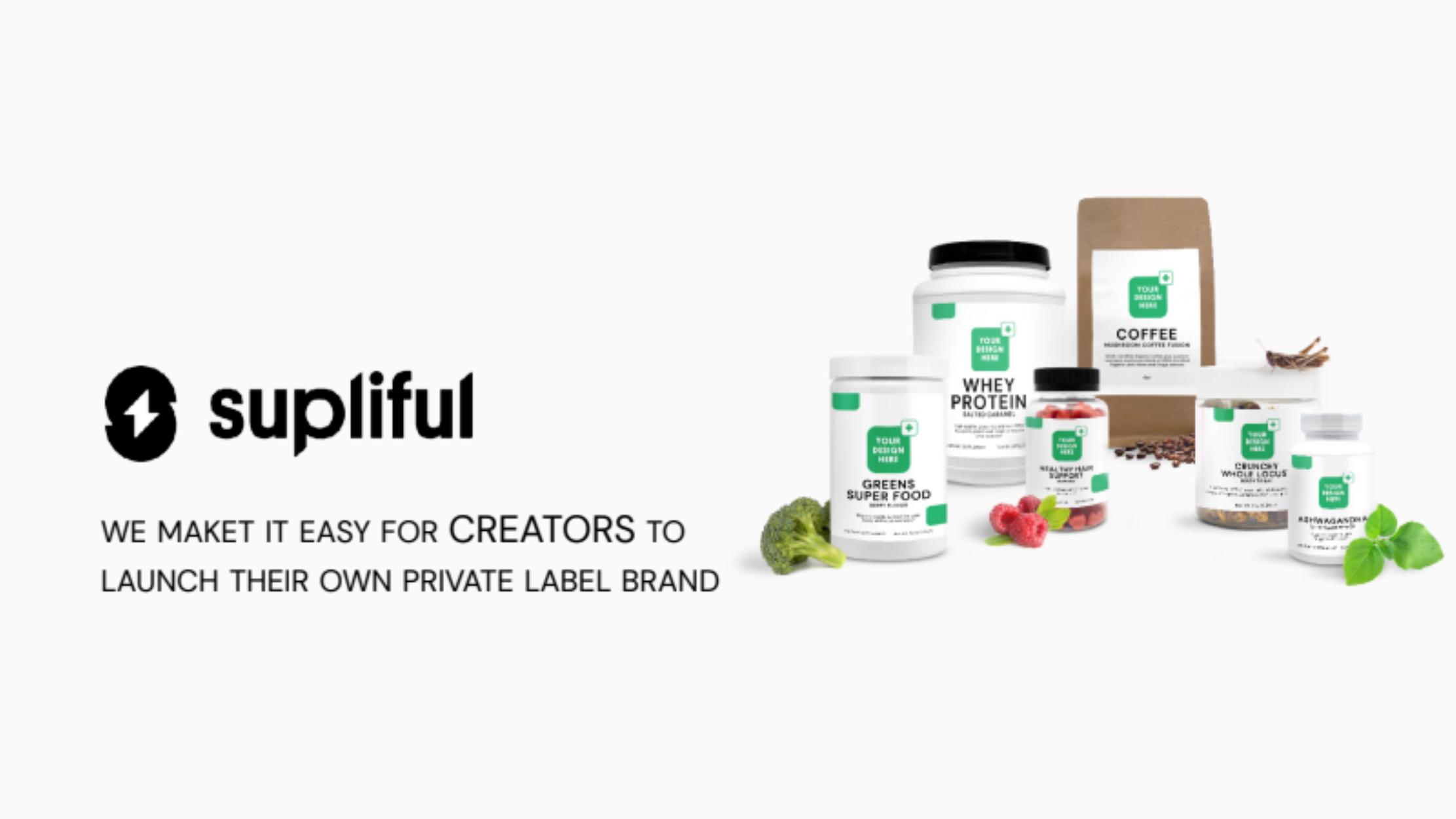
How to build a detailed financial model for Supliful
A complete walkthrough of the business, drivers, and assumptions behind the downloadable Supliful model - distilled from its pitch deck and publicly available information.
Product & value proposition
- Platform with 100+ private-label products across sports nutrition, coffee, superfoods, and other wellness categories.
- Creators browse catalog, apply their branding, publish to a Shopify store; orders fulfilled automatically (print-on-demand drop-ship model).
- Zero upfront inventory cost for creators - they sell before paying COGS.
- Automated store setup, product engagement tools, and hosted Supliful storefronts.
- Targeting "long-tail" creators who cannot afford the traditional minimum order quantities, negotiations, and $25K+ inventory risk.
Market
- TAM: $7.9T - global creator economy monetization opportunity (Linktree Creator Report cited).
- SAM: $2.6T - 120M creators globally who need Supliful's service (60% of 200M total creators).
- SOM: $1.2B - 200K creators in initial fitness vertical; basis: avg $550/month revenue per creator on platform.
- 33% of SAM assumed to be US-based = 40M US creators.
- Note: TAM/SAM figures are very large and appear to reflect total creator economy spend broadly, not private-label supplement market size specifically. The $1.2B SOM is the only number grounded in Supliful's own data.
Revenue model
Three streams:
- Product markup: 33% average markup on all products sold through creator stores (i.e., Supliful charges creators a wholesale price above their supplier cost).
- SaaS subscription: $39/month (basic) or $349/month (premium) plans paid by creators.
- Storefront commission: 5% commission on GMV transacted through Supliful-hosted storefronts.
Target: $4M GMV in 18 months post-seed close.
Traction & metrics
All figures as of approximately May 2022 (8 months after beta launch):
- +$540K total GMV generated by creators using the platform.
- +$270K in revenue recognized by Supliful (i.e., Supliful's take from the $540K GMV).
- +370 activated creators.
- +800 linked Shopify stores.
- 70+ five-star Shopify app reviews.
- Case study - creator Mason (@masonkuhr, 121K TikTok followers): $170K GMV in 6 months post-launch.
- Monthly revenue (Mason's store): Nov $24,354 → Dec $37,288 → Jan $27,904 → Feb $19,019 → Mar $19,194 → Apr $22,998 → May $43,797.
- Avg COGS ~43–55% of revenue visible in chart; gross profit ranged $6,949–$20,799/month.
Unit economics
All figures from slide 9:
- CAC (signup): $10/signup via paid social (Google, FB, IG, TikTok).
- Signup-to-subscriber conversion rate: 20% (benchmarked from Printify ~70K paying subscribers data).
- Effective CAC per paying subscriber: $50 ($10 / 20% conv.).
- LTV per subscriber: $156 (based on $39/month × 4 months avg. customer life).
- LTV – CAC spread: +$106 per subscriber to sustain operations.
- LTV:CAC ratio: ~3.1x (subscriber-level); payback period ~1.3 months.
- Note: LTV uses only subscription revenue; does not include markup or commission upside from active sellers - understates true LTV for high-performing creators.
Competition / moat
- No direct competitor occupies the "private-label on-demand for creators" niche.
- Closest analogues: Printful ($1B+ valuation, 400K creators, print-on-demand apparel) and Printify ($300M valuation, 500K creators) - both print-only, no supplements.
- Other players: large supplement brands (Myprotein, Herbalife) require large MOQs and retail distribution; supplement manufacturers (Rocktomic, NutraScience, Vox Nutrition) lack creator-facing automation.
- Moat claims: product and packaging variety, own-hosted storefronts, easy branding, branded customer support.
- Team has prior exit: built and sold Grafomap.com in 5 years without external financing.
Team & funding ask / use of funds
Team:
- Martins Lasmanis - Business operations / CEO.
- Rihards Piks - Digital marketing.
- Rudolfs Janitis - Full-stack developer.
- Alina Ignatovica - Product manager.
- Dmitry Jemeljanov - Full-stack developer (8+ years).
- Jason Lorberbaum - Fulfillment manager (10+ years).
- 5+ additional (merchandising, customer support, design).
Investors:
- Bolt (Jevgeni Kabanov, CPO).
- Startup Wise Guys (Herty Tarmo, co-founder).
- Diaspora Ventures (Marvin Liao, SF).
- +$900K committed from early investors.
Ask: $2M Seed round.
Use of funds:
- $700K - creator acquisition (target 4,000+ active creators).
- $600K - automation tools, Supliful storefronts, gamification.
- $400K - product expansion: 15+ food suppliers, lab tests, prediction algorithms.
- $300K - Creators Academy (education/coaching).
Recommended financial model
Archetype + why: DTC/marketplace GMV model with SaaS subscription layer. Supliful's economics are driven by (a) number of active creator-sellers on the platform, (b) GMV each creator generates, and (c) Supliful's blended take-rate across three revenue streams. This is closest to a marketplace P&L (think Printify/Etsy), not a pure SaaS model, because most revenue comes from transaction-based product markup and commission rather than subscriptions alone.
Forecast horizon & granularity: Monthly for 24 months (covers $4M GMV target at month 18 and path to Q4 2024 break-even); annual summary through 2025 ($100M gross revenue target).
Key drivers & assumptions:
*Creator funnel:*
- Monthly new signups (free tier) starting ~500/month growing with paid marketing spend.
- CAC per signup: $10.
- Signup → paid subscriber conversion: 20%.
- Active creator base (paid subs) at month 18: 4,000.
- Monthly churn rate on subscribers: ~25%/month (implied by 4-month avg. life from LTV calc).
*Subscription revenue:*
- Subscription plan mix - $39/month vs. $349/month; mix 85% basic / 15% premium based on typical SaaS freemium patterns.
- Blended ARPU: ~$86/month (85% × $39 + 15% × $349).
*GMV & transaction revenue:*
- Avg GMV per active creator per month: ~$550/month (stated as basis for SOM calc, slide 5). Note: Mason case study shows $28K/month avg - that is a high-performer outlier.
- Product markup take-rate: 33% of GMV (i.e., Supliful's wholesale margin on product cost passed through to creators).
- Storefront commission: 5% of GMV on Supliful-hosted stores; 40% of creators use Supliful storefronts vs. own Shopify.
- Blended net revenue rate from GMV: ~35–36% (33% markup + 5% commission on ~40% of volume).
*Cost structure:*
- COGS: supplier cost embedded in markup; gross margin on product revenue ~33% (pass-through markup IS the gross margin on this stream).
- Platform/hosting, payment processing: ~3–5% of GMV.
- Sales & marketing: primarily paid social (Google, FB, IG, TikTok); budget driven by $10 CAC target and desired creator acquisition pace.
- R&D/engineering and G&A: based on team headcount growth; 8-person core team at raise.
- Break-even: Q4 2024.
*Financial targets:*
- $4M GMV at 18 months post-seed.
- $100M gross revenue in 2025.
- Net profit positive Q4 2024.
Scenarios (Base / Bull / Bear - which variables flex):
- Base: $550 GMV/creator/month, 20% signup-to-sub conversion, 4,000 active creators at month 18.
- Bull: Higher creator activation (6,000+ at month 18), GMV/creator ramps as Academy drives performance, premium plan mix increases.
- Bear: Slower creator activation, higher churn (6-month avg. life), lower GMV/creator ($300/month), supplement category saturation slows supplier expansion.
Required sheets / outputs:
- Assumptions - all drivers above with toggle for Base/Bull/Bear.
- Creator Funnel - monthly: signups, conversions, active subs, churn, net adds, cumulative active creators.
- GMV Build - monthly: active creators × avg GMV/creator = total platform GMV.
- Revenue Build - three streams: (a) subscription MRR (plan mix × active subs), (b) product markup revenue (33% × GMV), (c) storefront commission (5% × hosted GMV). Total net revenue.
- P&L - gross profit, S&M (creator acquisition spend), R&D, G&A, EBITDA, net income.
- Unit Economics - CAC, LTV, LTV:CAC, payback by cohort month.
- Cash & Runway - starting from $2M raise + $900K existing; monthly burn to break-even.
- Summary / Dashboard - KPIs: active creators, GMV, net revenue, gross margin %, burn rate, runway.
Frequently asked
Is the Supliful financial model free?+
Yes. The Supliful model is a free Excel (.xlsx) download with live formulas. Sign up with your email and the workbook is yours to keep, review, and edit.
What's included in the model?+
A 5-year monthly forecast with P&L, cash flow and runway, valuation (exit multiple plus a DCF cross-check), MOIC/IRR returns, and unit economics, with live formulas throughout.
How was this model built?+
It was built from Supliful's pitch deck and publicly available information, then structured to investment-banking standards as a fully editable Excel model.
Can I change the assumptions?+
Yes. You can change assumptions and the live formulas will recalculate in the downloadable Excel model.
Have more financial modelling questions? Contact us

Created by ex-finance professionals
Hey, I’m Alex and I created Finamodel.
Over my years in the finance industry I kept building the same models over and over again. Same structure, same assumptions, different logo. So I started building frameworks to turn them into clean, reusable templates.
Every model here is one I’d actually use for a client, and I personally vet each one before it goes up.
I’m not an expert in every industry, but I’ve built enough models to know what belongs in one. And when something is completely foreign to me, I reach out to my network for experts to work on our models with us.
Having a template library on hand cuts a first build from hours to minutes.
Need help finding your model? You’ll find me in the Finamodel app!
Other Health-tech Startup Financial Models
Browse another startup in the same category.
98point6
B2B SaaS platform licensing an AI-powered virtual care technology stack to health systems, pivoted from running a direct-to-employer virtual clinic.
A-Champs
IoT-powered gamified training device (ROXs PRO) for sports/health professionals, evolving into a B2C smart coach app for families.

AccuRx
Patient-centred communication platform connecting everyone involved in a patient's care, starting with near-universal penetration in UK GP practices.

Aeris
Swiss-made premium air purifiers sold through DTC, retail, and dealer channels, with a recurring filter consumable attached to a connected mobile app.

Akido Labs
Akido Labs is a data-driven prevention platform that integrates siloed healthcare, municipal, and non-profit data to enable proactive outreach and case management for vulnerable populations (homeless, chronically ill, etc.).

Alloy
Telehealth + DTC subscription platform delivering menopause hormonal treatment (MHT) and holistic care to U.S. women 40+.

Astek Diagnostics
Point-of-care diagnostic device (Jiddu system) that confirms bacterial infections and antibiotic sensitivity in ~1 hour across four body fluid types (urine, CSF, effluent, blood).

Atom Limbs
Atom Limbs is building the first AI-powered, neural-controlled prosthetic arm sold direct-to-consumer on a subscription model.


