 Unmind Financial Model
Health-tech Startup Financials (Free Excel Download)
B2B SaaS platform providing workplace mental health tools to employees via enterprise employer contracts.



professionals from Deloitte
Used by professionals from






About this model
Unmind provides workplace mental-health tools through B2B enterprise contracts. Employers give employees access to digital resources and broader wellbeing support, positioning the product as a scalable benefit that can complement more intensive clinical care and employee-assistance programmes.
Commercial performance depends on employer clients, covered employees, PEPM revenue, engagement, content usage, expansion, and renewal. The platform must demonstrate employee value and organisational relevance while managing content, care, and support costs that may vary with adoption.
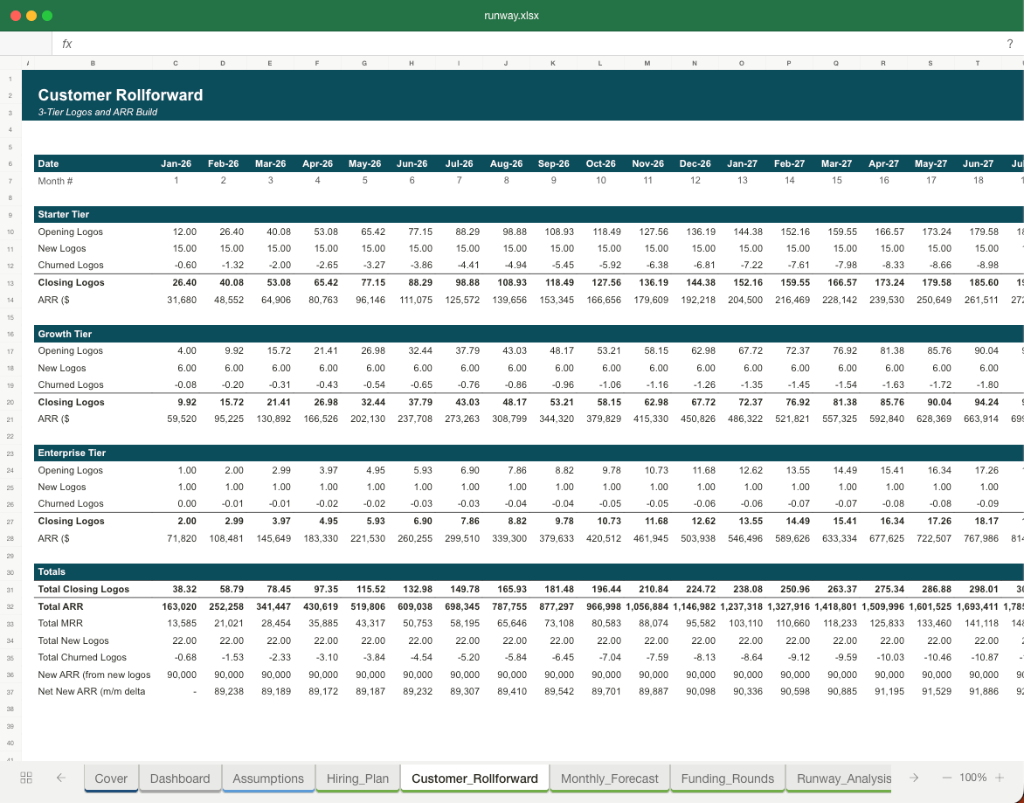
The model forecasts employer clients, covered employees, PEPM revenue, engagement, content and care costs, expansion, and churn. It includes enterprise sales, customer success, product investment, gross margin, operating cash flow, cash burn, and runway.
A turnkey financial model
Live formulas, no hardcoded values
Outputs are driven by live formulas, so the workbook updates from its assumptions instead of relying on hardcoded results.
All assumptions in one tab
Inputs are clearly marked in the Assumptions tab and separated from calculations, making it clear what to change and what to leave intact.
Statements always balancing
For integrated-statement models, the balance sheet, cash flow, and supporting schedules tie through properly.
Distinct schedules for clarity
Debt, working capital, taxes, and cash flow can get messy quickly. We group calculations in clear schedules, not across disconnected tabs.
No hidden macros or external links
There are no unexplained external workbook links or macros to undermine auditability or portability.
Changes flow through the model
Update a key driver and see the impact carry through the forecast, financing, and return outputs. We never use hardcoded numbers in formulas.
About Unmind
unmind.com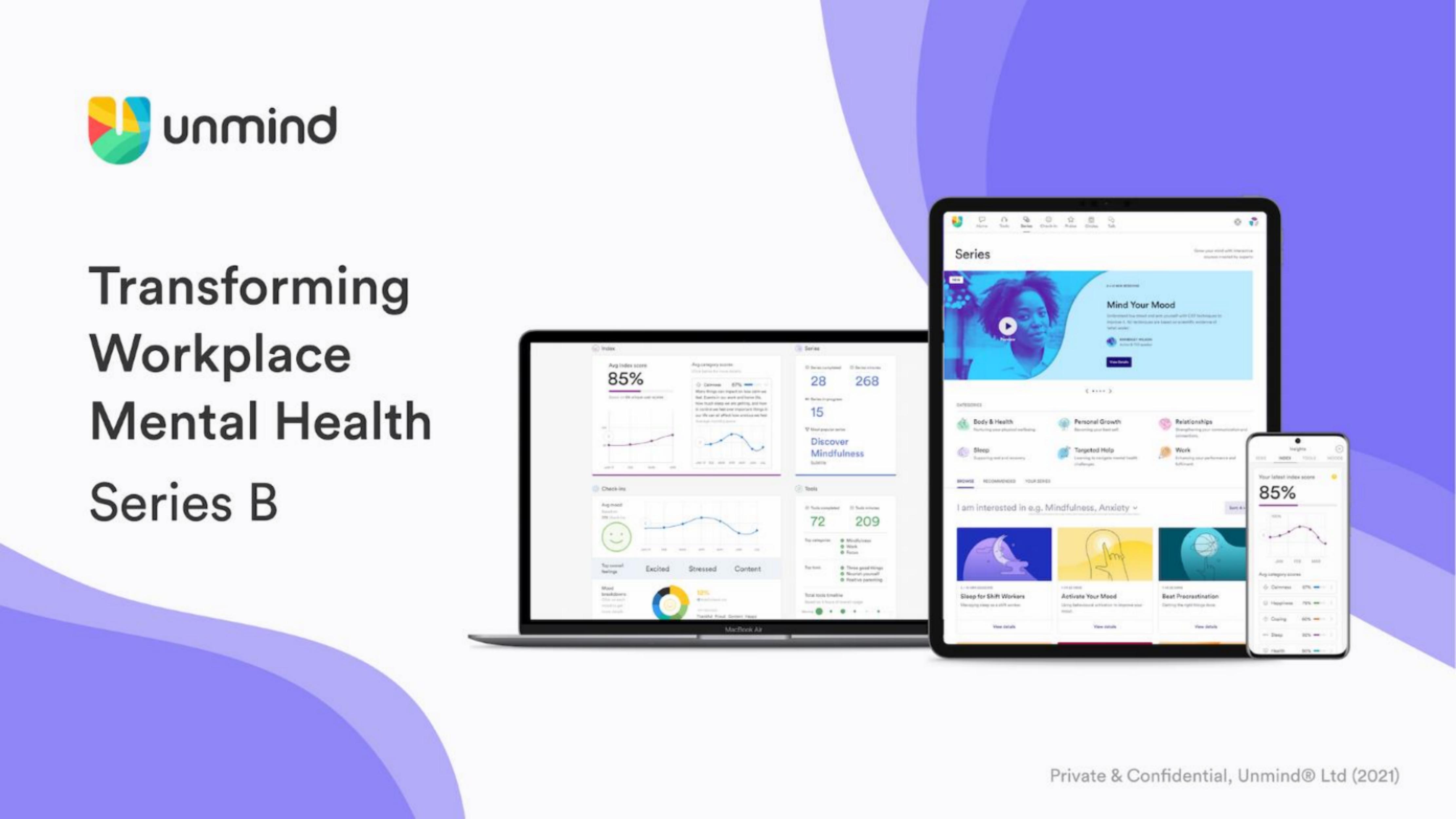
How to build a detailed financial model for Unmind
A complete walkthrough of the business, drivers, and assumptions behind the downloadable Unmind model - distilled from its pitch deck and publicly available information.
Product & value proposition
Unmind delivers a digital mental health platform with three layers:
- Employee-facing app: clinically-backed assessments, self-guided programs (Series), daily mood diary, in-the-moment exercises, supportive signposting, gratitude tools.
- Employer-facing analytics dashboard: aggregated wellbeing index scores (e.g. 85% Unmind Index), engagement stats (28 programs, 268 tools, 15 check-ins shown as sample metrics), HR insights.
- Client Success / adoption layer: campaigns portal, awareness calendar, communication assets to drive uptake.
Positioning: prevention-first, not reactive EAP - explicitly contrasts with costly/reactive traditional approaches.
Market
- Annual cost to US employers of mental ill-health (pre-COVID): $80–100bn
- 1 in 5 employees will experience a mental health issue this year
- 1/3 of US adults reported anxiety/depression symptoms in May 2020
- 85% of organisations predict COVID-19 will negatively impact employee mental health
- 87% of managers report increased mental health conversations due to COVID
- 88% of large employers expected to provide online mental health support in 2021
- 91% of employees believe their employer should care about their mental health
- No explicit TAM/SAM/SOM breakdown, no addressable market dollar figure for the SaaS segment provided in deck.
Revenue model
- B2B enterprise SaaS: employers (HR buyers) purchase access for their workforce.
- Metric tracked: ARR (Annual Recurring Revenue) and client count.
- No per-seat price, contract size, or ARPU figures disclosed in deck.
- Sales motion: direct enterprise sales with a Client Success team managing adoption and renewal.
- No mention of usage-based pricing, professional services fees, or marketplace revenue.
Traction & metrics
- ARR: consistent growth from Q1 2019 to Q4 2020 shown on combo chart; no Y-axis values are labelled - absolute ARR figure not readable from image.
- Client count: growing in parallel with ARR over same period; no absolute number labelled.
- Users in 115 countries
- 2 new offices opened in 2020
- Buyer NPS: 78
- 88% of users experience improvement in mental wellbeing, work, or relationships
- 92% of users report higher confidence, awareness, and understanding of mental health
- Named clients include: NHS, TSB, Virgin Media, Standard Chartered, Just Eat, M&S, Uber, Gymshark, Woolworths, Samsung, British Airways
Competition / moat
- Moat framed around: whole-person/whole-organisation approach (vs. point solutions), clinically-backed content, high-touch Client Success team, proprietary Unmind Index benchmark.
- No direct competitor named or comparison table shown.
- Implicit positioning vs. traditional EAP (reactive, high-cost, low-reach).
Team & funding ask / use of funds
- No team slide present in deck.
- No explicit funding ask amount or use-of-funds breakdown disclosed.
- Round identified as Series B; 2021 global expansion is the stated growth initiative.
Recommended financial model
- Archetype + why: B2B SaaS ARR model. Revenue is subscription-based (ARR), sold to enterprises; the growth chart tracks ARR and client count quarterly. Standard SaaS waterfall (new ARR, expansion ARR, churned ARR) is the right structure.
- Forecast horizon & granularity: 3 years (2021–2023), quarterly for Year 1, annual for Years 2–3. Matches the quarterly cadence of the traction data shown.
- Key drivers & assumptions:
- Starting ARR (Q4 2020): ~£3–5M estimated from growth curve shape and Series B timing; mark as placeholder - no axis value in deck. Replace with actual figure when available.
- Starting client count: ~50–100 enterprise clients, estimated from chart trajectory. Replace with actual.
- Average contract value (ACV) per client: £50–100k based on enterprise HR SaaS comps (NHS, British Airways scale implies large seat counts).
- New client additions per quarter: 5–15, accelerating into 2021 given new US/AU offices.
- Net Revenue Retention (NRR): 110–120% - high NPS (78) and outcome metrics suggest strong retention with upsell potential.
- Gross margin: 70–75% - digital SaaS with content/clinical costs and Client Success headcount; no infrastructure-heavy COGS.
- S&M as % of revenue: 40–50% at Series B stage (enterprise sales motion, international expansion).
- R&D as % of revenue: 20–25%.
- G&A as % of revenue: 10–15%.
- Headcount growth: proportional to new offices (US, AU); country manager hiring signalled.
- Scenarios (Base / Bull / Bear - which variables flex):
- Base: NRR 115%, 10 new clients/quarter, ACV steady.
- Bull: COVID tailwind sustains; NRR 125%, 15 new clients/quarter, ACV expansion as enterprise seat counts grow.
- Bear: Market normalises post-COVID; NRR 105%, 5–7 new clients/quarter, longer sales cycles.
- Required sheets / outputs:
- Assumptions - all drivers with Base/Bull/Bear toggles
- ARR Waterfall - beginning ARR, new, expansion, churn, ending ARR by quarter
- Client Count - new clients, churned clients, total
- P&L - revenue, gross profit, S&M, R&D, G&A, EBITDA
- Headcount Plan - by department
- Cash & Runway - if raise size becomes known
- Dashboard - ARR, client count, NRR, burn, key KPIs
Frequently asked
Is the Unmind financial model free?+
Yes. The Unmind model is a free Excel (.xlsx) download with live formulas. Sign up with your email and the workbook is yours to keep, review, and edit.
What's included in the model?+
A 5-year monthly forecast with P&L, cash flow and runway, valuation (exit multiple plus a DCF cross-check), MOIC/IRR returns, and unit economics, with live formulas throughout.
How was this model built?+
It was built from Unmind's pitch deck and publicly available information, then structured to investment-banking standards as a fully editable Excel model.
Can I change the assumptions?+
Yes. You can change assumptions and the live formulas will recalculate in the downloadable Excel model.
Have more financial modelling questions? Contact us

Created by ex-finance professionals
Hey, I’m Alex and I created Finamodel.
Over my years in the finance industry I kept building the same models over and over again. Same structure, same assumptions, different logo. So I started building frameworks to turn them into clean, reusable templates.
Every model here is one I’d actually use for a client, and I personally vet each one before it goes up.
I’m not an expert in every industry, but I’ve built enough models to know what belongs in one. And when something is completely foreign to me, I reach out to my network for experts to work on our models with us.
Having a template library on hand cuts a first build from hours to minutes.
Need help finding your model? You’ll find me in the Finamodel app!
Other Health-tech Startup Financial Models
Browse another startup in the same category.
98point6
B2B SaaS platform licensing an AI-powered virtual care technology stack to health systems, pivoted from running a direct-to-employer virtual clinic.
A-Champs
IoT-powered gamified training device (ROXs PRO) for sports/health professionals, evolving into a B2C smart coach app for families.

AccuRx
Patient-centred communication platform connecting everyone involved in a patient's care, starting with near-universal penetration in UK GP practices.

Aeris
Swiss-made premium air purifiers sold through DTC, retail, and dealer channels, with a recurring filter consumable attached to a connected mobile app.

Akido Labs
Akido Labs is a data-driven prevention platform that integrates siloed healthcare, municipal, and non-profit data to enable proactive outreach and case management for vulnerable populations (homeless, chronically ill, etc.).

Alloy
Telehealth + DTC subscription platform delivering menopause hormonal treatment (MHT) and holistic care to U.S. women 40+.

Astek Diagnostics
Point-of-care diagnostic device (Jiddu system) that confirms bacterial infections and antibiotic sensitivity in ~1 hour across four body fluid types (urine, CSF, effluent, blood).

Atom Limbs
Atom Limbs is building the first AI-powered, neural-controlled prosthetic arm sold direct-to-consumer on a subscription model.