 WorkLife 1 Financial Model
Enterprise/Security Startup Financials (Free Excel Download)
Work Life is a micro venture fund investing in future-of-work / bottom-up SaaS companies at Seed and Series A.



professionals from Deloitte
Used by professionals from






About this model
WorkLife 1 is a micro venture fund investing in future-of-work and bottom-up SaaS businesses at Seed and Series A. It is a GP fundraising presentation, not an operating startup plan.
The fund's value proposition rests on specialist sourcing and support for companies shaping how teams work. Management fees support the GP, while carry and LP outcomes depend on portfolio appreciation and exits.
The model builds a venture-fund J-curve from commitments, calls, investments, reserves, fees, exits, and carry. It reports DPI, TVPI, RVPI, gross and net IRR, with sensitivities for ownership and exit timing.
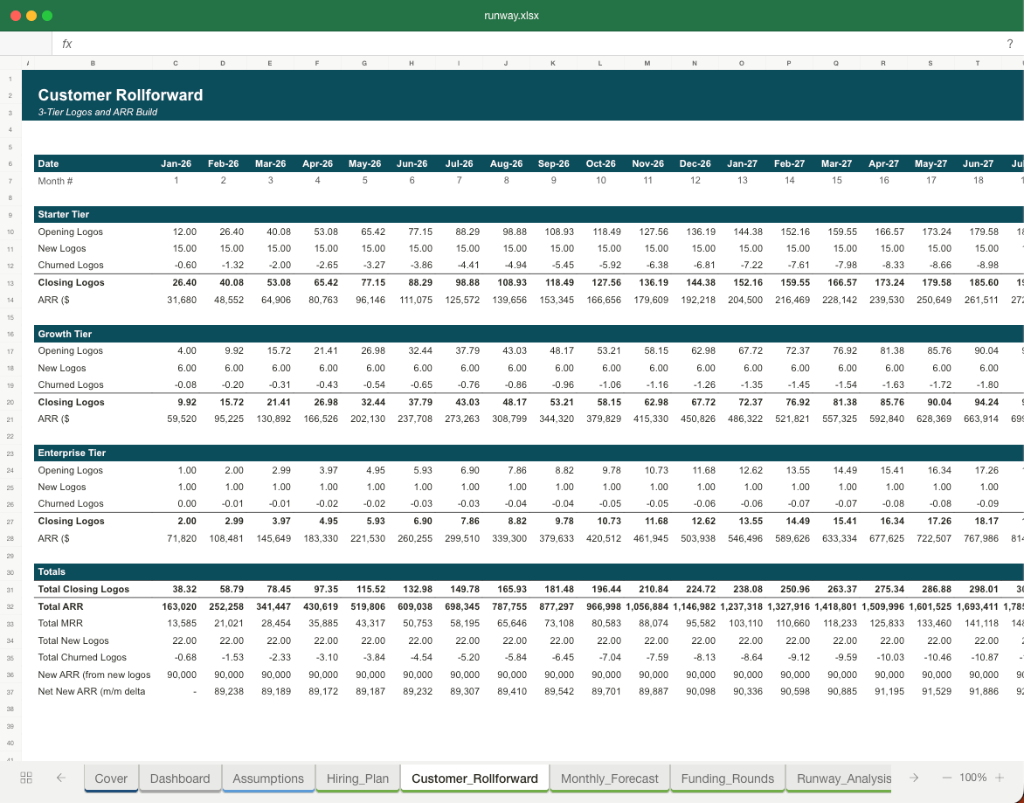
A turnkey financial model
Live formulas, no hardcoded values
Outputs are driven by live formulas, so the workbook updates from its assumptions instead of relying on hardcoded results.
All assumptions in one tab
Inputs are clearly marked in the Assumptions tab and separated from calculations, making it clear what to change and what to leave intact.
Statements always balancing
For integrated-statement models, the balance sheet, cash flow, and supporting schedules tie through properly.
Distinct schedules for clarity
Debt, working capital, taxes, and cash flow can get messy quickly. We group calculations in clear schedules, not across disconnected tabs.
No hidden macros or external links
There are no unexplained external workbook links or macros to undermine auditability or portability.
Changes flow through the model
Update a key driver and see the impact carry through the forecast, financing, and return outputs. We never use hardcoded numbers in formulas.
About WorkLife 1
worklife.vc
How to build a detailed financial model for WorkLife 1
A complete walkthrough of the business, drivers, and assumptions behind the downloadable WorkLife 1 model - distilled from its pitch deck and publicly available information.
Product & value proposition
GP thesis: "consumerization of the enterprise" / bottom-up SaaS (BYOT - Bring Your Own Tool). Three investment themes:
- Workplace software adopted bottom-up by individuals → teams (e.g. Webflow, Voiceflow)
- Reimagined work opportunities - talent networks and creator tools (e.g. Substack, Cameo, Anchor)
- Brand/community-driven software where social signals drive enterprise purchasing (e.g. Superhuman, Figma)
Differentiation: GP has a proprietary deal-flow funnel via SaaS School (invite-only accelerator, 200+ applicants/batch, 40 companies accepted) and a personal brand with 20K+ Twitter followers, 3M monthly impressions.
Market
- Bottom-up SaaS market validation cited: Zoom IPO opened 81% higher; Slack IPO valued at $24B+
- No numeric market-size figures stated.
Revenue model
VC fund economics:
- Management fee: 2% per annum on committed capital
- Carried interest: 20% of profits above hurdle
- LPs receive co-investment rights in follow-on opportunities
- ~40% of deal flow sourced from SaaS School pipeline
Traction & metrics
- Fund I oversubscribed at $5M cap
- 30 investments planned over 24 months
- SaaS School: 200+ applications per batch, 40 accepted per cohort
- Twitter: 20K+ followers, 3M monthly impressions
- Prior angel portfolio: 10 companies shown (Voiceflow, Webflow, Work OS, Forethought, Lunchclub, Girlboss, Voyage, Dev.to, Relationship Hero, AirGarage) co-invested alongside a16z, Accel, True Ventures, Lightspeed, Floodgate, Founders Fund, YC
- Dev.to traction cited: 2M unique visitors/month
- Notable SaaS School alumni: Loom (Series A, Kleiner Perkins), Webflow (Series A, Accel), Superhuman (Series A → Series B, a16z)
Unit economics
- Check size: $50K–$150K per deal
- At $3M fund target, 30 investments → avg $100K/deal (mid-range of stated check size)
- Management fee: 2% × $3M–$5M = $60K–$100K p.a.
- No portfolio IRR, TVPI, DPI, or loss-ratio data shown.
Competition / moat
Moat framing (GP's stated advantages):
- Curated deal flow via SaaS School network
- First-to-market positioning as a micro-fund specifically focused on next-gen workplace SaaS
- Portfolio network effects: shared learnings, partner integrations, co-selling
- Named as a top angel investor by Business Insider alongside Ellen Pao and Cyan Banister
- No direct competitive funds named.
Team & funding ask / use of funds
- GP / sole operator: Brianne Kimmel (ex-Zendesk GTM, Village Global Network Leader, angel investor)
- Fund size: $3M target, $5M hard cap
- Investment period: 18–24 months
- LP roster (slide 2): Marc Andreessen, Chris Dixon, Garry Tan, Zoom CEO Eric Yuan, InVision CEO Clark Valberg, executives from Dropbox and Slack
- Use of funds: deploy $50–150K per deal into ~30 Seed/Series A future-of-work companies
- No explicit management fee budget breakdown or fund expenses shown.
Recommended financial model
- Archetype + why: VC Fund Economics model. This is not an operating company - it is a GP raising a blind-pool fund. The appropriate model is a venture fund J-curve / cash-flow model covering capital deployment, management fee income, portfolio construction, and carried interest waterfall. A 3-statement operating model is not applicable.
- Forecast horizon & granularity: 10-year fund life (standard VC); quarterly granularity for deployment and distributions, annual for summary P&L and LP returns.
- Key drivers & assumptions:
- Fund size: $3M target / $5M cap; model at $3M base, $5M bull
- Number of investments: 30
- Check size range: $50K–$150K, average ~$100K; model average = $100K
- Investment period: 18–24 months
- Management fee: 2% p.a. on committed capital
- Carried interest: 20% above hurdle; hurdle rate = 8% (standard US VC)
- Reserve ratio (follow-on vs. initial): 0% - deck implies no reserve allocation given small fund size; flag as open question
- SaaS School sourced deals: ~40% of portfolio
- Vintage: 2019 based on deck references
- Fund life: 10 years (standard); 2-year extension option
- Deployment pace: ratable over 18–24 months, then harvest
- Portfolio construction: 30 companies; no SAFE/note vs. equity split stated
- Gross MOIC by scenario - :
- Bear: 1.5× (majority markdowns, 1–2 breakouts)
- Base: 2.5× (3–4 breakouts at 20–50× on small checks)
- Bull: 4.0× (1 unicorn exit + several 10× names given deal quality signals)
- Loss rate: ~40% of portfolio written to zero (early-stage norm)
- Time to liquidity: avg 6–8 years from first investment; distributions from year 5+
- GP commit: 1% of fund (standard); not stated in deck
- Scenarios (Base / Bull / Bear - which variables flex):
- Flex: fund size ($3M / $4M / $5M), gross MOIC (1.5× / 2.5× / 4.0×), number of winning exits (1 / 3 / 5), average exit multiple on winners
- Fixed: fee structure (2/20), check size, investment period
- Required sheets / outputs:
- Assumptions - fund size, check size, # investments, fees, hurdle, MOIC by scenario
- Deployment Schedule - quarterly capital calls, investment pace, cumulative deployed
- Portfolio Construction - company-level table (30 rows): initial check, reserve (if any), entry stage, expected exit stage, assumed multiple
- Management Fee P&L - annual fee income vs. fund expenses (GP salary, legal, admin); net GP economics
- J-Curve / Cash Flow - LP capital calls (negative), distributions (positive), net cash flow by year
- Carried Interest Waterfall - return of capital → hurdle → catch-up → 80/20 split; by scenario
- LP Returns Summary - gross MOIC, net MOIC, gross IRR, net IRR by scenario
- Dashboard - KPI cards: fund size, # investments, avg check, projected net MOIC, net IRR; J-curve chart; portfolio construction pie
Frequently asked
Is the WorkLife 1 financial model free?+
Yes. The WorkLife 1 model is a free Excel (.xlsx) download with live formulas. Sign up with your email and the workbook is yours to keep, review, and edit.
What's included in the model?+
A 5-year monthly forecast with P&L, cash flow and runway, valuation (exit multiple plus a DCF cross-check), MOIC/IRR returns, and unit economics, with live formulas throughout.
How was this model built?+
It was built from WorkLife 1's pitch deck and publicly available information, then structured to investment-banking standards as a fully editable Excel model.
Can I change the assumptions?+
Yes. You can change assumptions and the live formulas will recalculate in the downloadable Excel model.
Have more financial modelling questions? Contact us

Created by ex-finance professionals
Hey, I’m Alex and I created Finamodel.
Over my years in the finance industry I kept building the same models over and over again. Same structure, same assumptions, different logo. So I started building frameworks to turn them into clean, reusable templates.
Every model here is one I’d actually use for a client, and I personally vet each one before it goes up.
I’m not an expert in every industry, but I’ve built enough models to know what belongs in one. And when something is completely foreign to me, I reach out to my network for experts to work on our models with us.
Having a template library on hand cuts a first build from hours to minutes.
Need help finding your model? You’ll find me in the Finamodel app!
Other Enterprise/Security Startup Financial Models
Browse another startup in the same category.
AgBiome
AgBiome is a microbial-platform agtech company that discovers, develops, and commercialises biological crop protection products (and licences the platform across adjacent markets).

Alation
Enterprise data intelligence platform - data catalog, governance, and metadata management for large organisations.

Archer SPAC
Archera
Cloud resource automation platform that continuously optimizes AWS commitment purchases, de-risks overcommitment, and automates FinOps workflows.

Ardoq
Cloud-native Enterprise Architecture (EA) SaaS platform that helps large enterprises navigate digital transformation through automated data collection, graph-based architecture modelling, and change impact analysis.

Ascend
Ascend.io is an enterprise big data automation platform ("Enterprise Intelligence Platform") that abstracts away the complexity of big data engineering so non-experts can build and run data pipelines.

Athennian
Cloud-based legal entity management system (EMS) uniting entity data with workflow and document automation.

Auditboard
Cloud-based integrated risk management platform connecting audit, risk, compliance, and ESG teams across the enterprise.