 Yac Financial Model
Enterprise/Security Startup Financials (Free Excel Download)
Async voice messaging tool that eliminates unnecessary meetings for remote and distributed teams.



professionals from Deloitte
Used by professionals from






About this model
Yac is an asynchronous voice-messaging product for remote and distributed teams. It helps colleagues replace unnecessary meetings with short recorded messages and a more flexible communication workflow.
The company uses a freemium product-led model with a paid Teams tier. Individual adoption can spread within a workspace, creating the central commercial path from free usage to paid seats and account expansion.
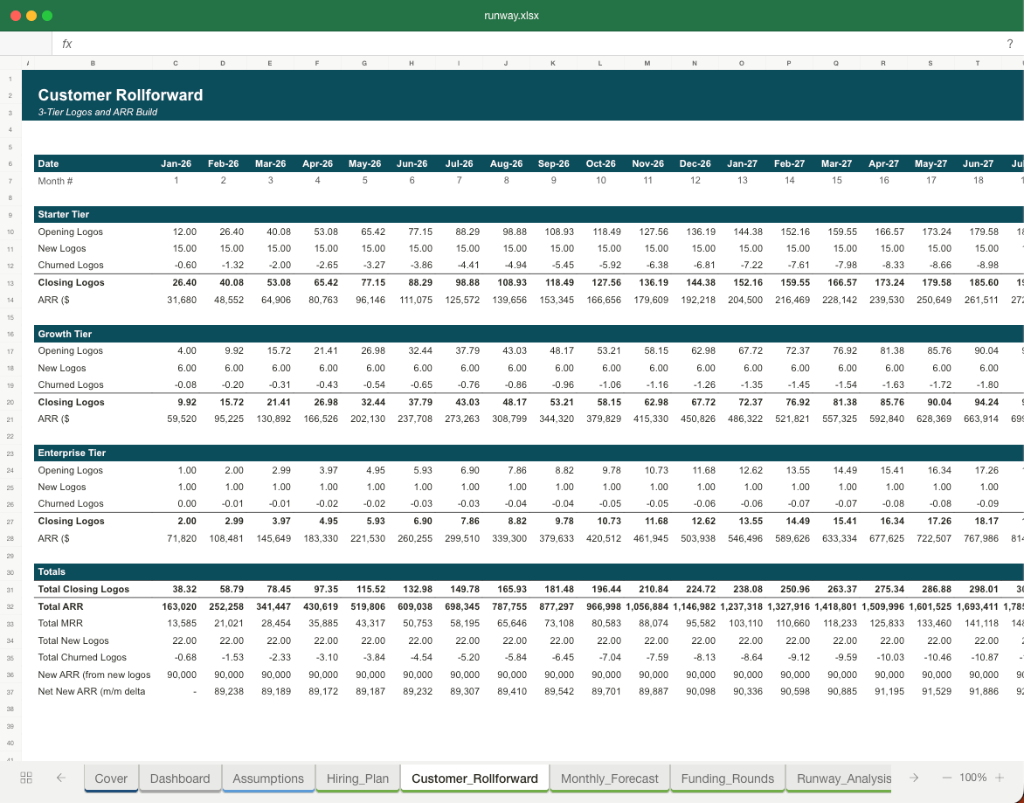
The model follows free users through activation, paid conversion, team seats, expansion, and churn. Audio delivery, PLG acquisition, gross margin, customer support, product investment, and sales assistance determine ARR and cash runway.
A turnkey financial model
Live formulas, no hardcoded values
Outputs are driven by live formulas, so the workbook updates from its assumptions instead of relying on hardcoded results.
All assumptions in one tab
Inputs are clearly marked in the Assumptions tab and separated from calculations, making it clear what to change and what to leave intact.
Statements always balancing
For integrated-statement models, the balance sheet, cash flow, and supporting schedules tie through properly.
Distinct schedules for clarity
Debt, working capital, taxes, and cash flow can get messy quickly. We group calculations in clear schedules, not across disconnected tabs.
No hidden macros or external links
There are no unexplained external workbook links or macros to undermine auditability or portability.
Changes flow through the model
Update a key driver and see the impact carry through the forecast, financing, and return outputs. We never use hardcoded numbers in formulas.
About Yac
yac.com
How to build a detailed financial model for Yac
A complete walkthrough of the business, drivers, and assumptions behind the downloadable Yac model - distilled from its pitch deck and publicly available information.
Product & value proposition
- Podcast-like voice messages sent asynchronously - no scheduling, no calls, no overhead.
- Features: unlimited voice messages, transcription & full-text search, screen & cam recording, playback speed controls (1x/2x), heard-status, Slack-like channels, group messaging, selfie/rear-facing cam, photo/video attachments, unread inbox.
- Deep Slack integration: replaces Slack call button, messages play natively in Slack - one of very few companies with this permission.
- Miro co-branding partnership for async workshops in progress.
- BackTrack companion app: #9 for Utilities on Mac App Store.
- Value claim: teams save avg. $35,000+/year/employee in meeting time; avg. 10 meetings/week saved; users feel 2–3x more connected.
Market
- No explicit TAM/SAM/SOM figures in deck.
- Problem framing (proxy for market size): employees spend 31 hours/month in unproductive meetings; businesses spend 68 hours/month clarifying prior communication.
- Competitive positioning: quadrant map places Yac in the shortform + async quadrant - distinct from Zoom/Teams (sync/longform), Slack (shortform/sync), Loom/email (async/longform). Direct async voice competitors shown: Echo, Voxer.
Revenue model
- Freemium SaaS, per-seat subscription:
- Free tier - $0: unlimited voice messages, native mobile apps, public sharing links, Yac.com profile, unlimited friends, transcription & search.
- Teams tier - $5/seat/month (or $3/seat/month billed annually): adds screen & cam recording, team management, desktop app, transcription & search, Slack integration, group messaging.
- Distribution: self-serve / product-led growth via app stores (Mac, mobile), Product Hunt, Slack App Directory, partner integrations.
- No enterprise tier, usage-based pricing, or professional services mentioned in deck.
Traction & metrics
- Beta testers & users include: Bose, Mailchimp, Buffer, Google, HubSpot, Zapier, Upwork, Spotify.
- Investment from Slack (strategic).
- 2x Golden Kitty Winners; #1 Product Hunt Remote Winner.
- Top 10 Mac App Store; BackTrack #9 Utilities on Mac App Store.
- Voted Best Remote Tool - Hacker Noon, Fast Company, CB Insights.
- Press: WSJ, TechCrunch, Fast Company.
- Advisor: Darren Murph, Head of Remote at GitLab.
- Workfrom AMA: 35,000-person remote work community.
- No ARR, MRR, DAU/MAU, paying seat counts, churn, or growth rates disclosed.
Unit economics
- Implied blended ARPU: $5/seat/month (monthly) or $3/seat/month (annual). No average team size or seats-per-account stated.
Competition / moat
- Quadrant positioning: async + shortform voice = differentiated from Zoom (sync/longform), Teams (sync), Slack (sync/shortform text), Loom/email/Threads (async/longform).
- "Goldilocks Zone" framing: goal-based, voice-first, semi-synchronous, historical context, time-zone independent - vs. Slack (chat, no context) and Zoom (synchronous, disruptive).
- Direct async voice competitors: Echo, Voxer.
- Moat claims: exclusive Slack call-button replacement permission; native Slack playback (very few companies); Miro co-brand partnership; strategic Slack investment.
Team & funding ask / use of funds
- Founding team:
- Justin Mitchell - Vision & Technical
- Hunter McKinley - Growth & Marketing
- Jordan Walker - Operations & Finance
- Advisor: Darren Murph (Head of Remote, GitLab).
- Ask: $7.5M raise.
- Prior funding: Strategic investment from Slack (amount not disclosed).
Recommended financial model
- Archetype + why: SaaS freemium ARR model. Revenue is per-seat subscription; growth driven by PLG (free-to-paid conversion) and team expansion within existing accounts. No transactional or usage-based revenue.
- Forecast horizon & granularity: 3 years monthly (M1–M36), with annual summary. Monthly needed to model free-to-paid conversion funnel and cohort expansion.
- Key drivers & assumptions:
| Driver | Seed value |
|---|---|
| Teams tier price (monthly) | $5/seat/month |
| Teams tier price (annual) | $3/seat/month |
| Annual billed mix (% of paid seats on annual plan) | 40% |
| New free signups per month (M1) | 500 |
| Free signup monthly growth rate | 15% |
| Free-to-paid conversion rate | 5% |
| Avg. team size on paid plan (seats/account) | 8 |
| Monthly churn (paid seats) | 2.5% |
| Gross margin | 75% |
| Sales & marketing as % of revenue | 40% |
| R&D as % of revenue | 30% |
| G&A as % of revenue | 15% |
| Headcount (M1 employees) | 10 |
| Avg. fully-loaded salary | $120K |
| $7.5M raise deployed over | 24 months |
- Scenarios (Base / Bull / Bear - which variables flex):
- Bear: free signup growth 8%, conversion 3%, churn 4% - capital-constrained, slower PLG
- Base: free signup growth 15%, conversion 5%, churn 2.5%
- Bull: free signup growth 25%, conversion 8%, churn 1.5% - Slack integration drives viral loop
- Required sheets / outputs:
- Assumptions (all toggleable drivers above)
- Funnel (free signups → free users → paid conversions → paid seats, monthly cohorts)
- Revenue (MRR/ARR bridge: new, expansion, churn, net new)
- P&L (revenue → gross profit → EBITDA, monthly)
- Headcount plan (by function, linked to opex)
- Cash & runway (opening cash, monthly burn, ending cash, months runway)
- KPI dashboard (ARR, MRR growth %, net revenue retention, LTV/CAC, months runway)
Frequently asked
Is the Yac financial model free?+
Yes. The Yac model is a free Excel (.xlsx) download with live formulas. Sign up with your email and the workbook is yours to keep, review, and edit.
What's included in the model?+
A 5-year monthly forecast with P&L, cash flow and runway, valuation (exit multiple plus a DCF cross-check), MOIC/IRR returns, and unit economics, with live formulas throughout.
How was this model built?+
It was built from Yac's pitch deck and publicly available information, then structured to investment-banking standards as a fully editable Excel model.
Can I change the assumptions?+
Yes. You can change assumptions and the live formulas will recalculate in the downloadable Excel model.
Have more financial modelling questions? Contact us

Created by ex-finance professionals
Hey, I’m Alex and I created Finamodel.
Over my years in the finance industry I kept building the same models over and over again. Same structure, same assumptions, different logo. So I started building frameworks to turn them into clean, reusable templates.
Every model here is one I’d actually use for a client, and I personally vet each one before it goes up.
I’m not an expert in every industry, but I’ve built enough models to know what belongs in one. And when something is completely foreign to me, I reach out to my network for experts to work on our models with us.
Having a template library on hand cuts a first build from hours to minutes.
Need help finding your model? You’ll find me in the Finamodel app!
Other Enterprise/Security Startup Financial Models
Browse another startup in the same category.
AgBiome
AgBiome is a microbial-platform agtech company that discovers, develops, and commercialises biological crop protection products (and licences the platform across adjacent markets).

Alation
Enterprise data intelligence platform - data catalog, governance, and metadata management for large organisations.

Archer SPAC
Archera
Cloud resource automation platform that continuously optimizes AWS commitment purchases, de-risks overcommitment, and automates FinOps workflows.

Ardoq
Cloud-native Enterprise Architecture (EA) SaaS platform that helps large enterprises navigate digital transformation through automated data collection, graph-based architecture modelling, and change impact analysis.

Ascend
Ascend.io is an enterprise big data automation platform ("Enterprise Intelligence Platform") that abstracts away the complexity of big data engineering so non-experts can build and run data pipelines.

Athennian
Cloud-based legal entity management system (EMS) uniting entity data with workflow and document automation.

Auditboard
Cloud-based integrated risk management platform connecting audit, risk, compliance, and ESG teams across the enterprise.